zenpundit.com » insight

Archive for the ‘insight’ Category

Creativity and the laughable

Monday, May 16th, 2011

[ by Charles Cameron — creativity, Taliban, Leonardo, pareidolia, Virgin Mary, Kwan-yin ]
*

.
Sharing, as I do with Zen, a keen interest in the creative process, I am used to the idea that an idea that seems trivial at first, the very expression of which risks making oneself a laughing-stock, may well carry the seed of success.

Whitehead is quoted as saying, “Every really new idea looks crazy at first.” Einstein, “If at first the idea is not absurd, then there is no hope for it.” Nils Bohr, “Your theory is crazy, but it’s not crazy enough to be true.” The idea is not even confined to physicists and mathematicians. Mark Twain observed, “The man with a new idea is a crank – until the idea succeeds.” And Winston Churchill, “No idea is so outlandish that it should not be considered with a searching but at the same time steady eye.”

I was therefore intrigued to read this account of the origins of the Taliban’s recent Kandahar prison break:

One of the surprising mujahideen squad in the city of Kandahar, who by his connections gained full knowledge of the inside and outside of the prison, pondered one day whether it could be possible to dig a tunnel from the inside of a house on the other side of the street to the prison as a means to releasing the prisoners. This fantasy and imagination seemed laughable at first even to its owner; he dared not share his opinion with others. But, after more time and continued thinking, he reached a conclusion. On one of these days, while he was riding a motorcycle with two of his comrades, he shared that view with them. They thought it impossible initially and deemed it a fruitless, dangerous attempt. Finally, they placed their trust on God and shared their opinion with the mujahideen high command in Kandahar. With guidelines from the command, the aforementioned four revealed [to] their trusted comrades their decision to implement this plan regardless of its risks and even if it looked impossible.

The sentence that really got my attention was this one:

This fantasy and imagination seemed laughable at first even to its owner; he dared not share his opinion with others.

*

Leonardo da Vinci once wrote of having “a new and speculative idea, which although it may seem trivial and almost laughable, is none the less of great value in quickening the spirit of the invention.”

His “trivial and almost laughable” idea?

It is this: that you should look at certain walls stained with damp or at stones of uneven colour. If you have to invent some setting you will be able to see in these the likeness of divine landscapes, adorned with mountains, ruins, rocks, woods, great plains, hills and valleys in great variety; and then again you will see there battles and strange figures in violent action, expressions of faces and clothes and an infinity of things which you will be able to reduce to their complete and proper forms. In such walls the same thing happens as in the sound of bells, in whose strokes you may find every word which you can imagine.

Essentially, Leonardo is suggesting that we use what’s effectively the Rorschach technique to induce pareidolia (I think that’s the state) and elicit mental contents – images triggered by the mind’s eagerness to sense meaning – thus imitating the universe itself in bringing something out of nothing, out of the potent void.

*

This is, however, the same psychological mechanism that brought us the sale of a grilled cheese sandwich for $28,000 on eBay – because it “looked like” the Virgin Mary

That’s not a note I’d like to end on, however — so I’ll just remind myself that we don’t “know” what the Virgin Mary looks like, and pass on to the rather charming story of a similar pareidolic image, this one possessing the almost miraculous property of looking simultaneously like the Blessed Virgin and the bodhisattva of compassion, Kuan-Yin:

Situated in the East Bay area, near the lovely city of San Francisco, the Purple Lotus School is witnessing yet another miracle. … In April 1996, when the great “Merit Wall” on campus had just been constructed, a mysterious face appeared on the wall immediately after the cement dried. … Buddhists who have witnessed this phenomenon believe this to be the face of the compassionate Bodhisattva Kuan-Yin. … Others have believed this image to be that of the Virgin Mary. Magia and Junia Chou, the daughters of the Purple Lotus Society’s Master Samantha Chou, attend a Catholic elementary school. Upon seeing the image, both called out earnestly and delightedly, “Look! It’s the Virgin Mary!” … With the essence of Enlightenment and universal wisdom in mind, perhaps one can argue that a distinction between the two is not important after all.

*

It’s laughable, I know — but I must confess I like the “meaning” I can draw from that…

An end-timely reminder

Saturday, May 14th, 2011

[ by Charles Cameron ]

.

I spend a fair amount of effort as you know, trying to monitor the various forms of end-times religion manifesting in the Abrahamic faiths, so it came as a shock to me to find a seam of material on Sunni Mahdism that I hadn’t previously run across, now a year old, from over on my old side of the pond of all places…

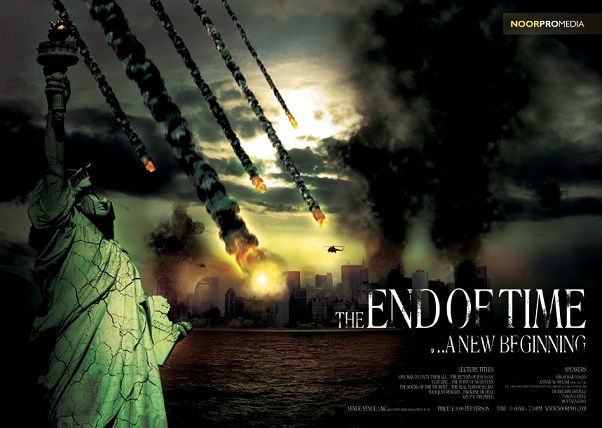
Look what happens to London:

london.jpg

And if that isn’t graphic enough for you — and it really isn’t very graphic — look at what happens to New York

nyc.jpg

The End of Time… A New Beginning…

*

The first image comes from a poster for a tour of Ireland in October of last year — though why the good people of Ireland should be so worried if London is consumed in sulphurous fog and flame is a little hard for me to understand — while the second graphic advertises a conference in London — though why the good people of London should be so concerned if the city of New York… no, I won’t go there, there’s the Special Relationship, isn’t there?  Is there?

I missed both events, alas, living quietly here in the United States, or I might have heard, in Ireland:

a clear description about life in the grave, the trials of the last day, the major and minor signs leading to the last hour and the day of resurrection including Imam Mahdi, The Dajjal and many more.

I could have taken notes, and published them here on Zenpundit. After all, as the advertisements advertised:

On the Day of Judgment those who pass the test will be rewarded with Paradise.

Cliff’s Notes for Judgement Day — a sure best seller!

*

Not to worry, I can still study up on the January 2009 London conference, at which Anwar al-Awlaki reportedly hosted a live video question-and-answer session, presumably beaming in from Yemen — even though tickets are no longer available

If I can just get hold of the DVDs…

end-of-time-awlaki-dvds.jpg\

Sadly, though, they’re out of stock

*

Okay seriously now — three points:

This is associated with al-Awlaki.  This has slick PR, intercontinental video feeds, and DVDs.  And this is Sunni Mahdism.

Check?

Two horrors, one suggestion, and a very great poem

Thursday, May 5th, 2011

[ by Charles Cameron ]
*
.
I like the idea of seven generations as a timeline to work with: it’s mid-range, and it confers a sort of limited immortality on the world around me, without being too bothered about me and my personal survival. On the other hand, it’s an “over the horizon” kind of thinking, and I once heard the suggestion that when in a four-and-a-half tatami room, I should confine myself to four-and-a-half tatami thinking.

So.

An alternative approach is to leave everything else out of a given picture, and concentrate on what happens to children.

I’m not suggesting “seven generation”, “four-and-a-half tatami”, or “children only” thinking should be the only approaches we take, just that they may add valuable insight…

*

In which spirit: Forget, for a moment, enmity: here are two horrors…

quo-child-impact.jpg

*

These two things have struck me as particularly horrible in my browsing over the last few days. The first – assuming the Guardian is quoting the Pakistani intelligence official correctly, and that the official knows what he’s talking about – is the sort of thing we might not, as the saying goes, “wish on our worst enemy” – but it happened to our enemy’s child, a girl, twelve years old:

Osama bin Laden’s 12-year-old daughter watched as her father was shot dead by American special forces, a senior Pakistani intelligence official has told the Guardian.

The girl, who was found at the scene of the raid by Pakistani security services, is being cared for at a military hospital having been wounded in the attack. She has been questioned about the sequence of events during the raid on Sunday night.

No blame, as the saying goes – but for that child, it’s a double tragedy.

And the second?

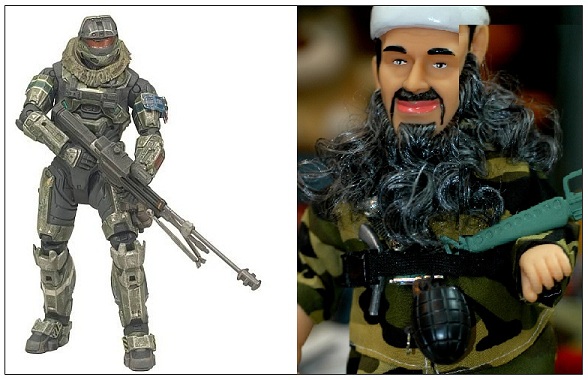
I know how excited my own sons get when a new action-figure toy from the Halo line arrives in the household – so I dread to think how a toy like this might turn younger minds, as yet perhaps innocent of violence and hatred, towards the “heroism” of jihad…

halo-ubl.jpg

[ Jun Noble 3 action figure from Amazon – OBL action figure from Foreign Policy slideshow ]

*

It is childhood I am grieving:

Leaves, like the things of man, you
With your fresh thoughts care for, can you?
Ah! as the heart grows older
It will come to such sights colder
By & by, nor spare a sigh…

Gerard Manley Hopkins SJ, from his poem Spring and Fall, to a young child

Towards a Pattern Language for CT?

Tuesday, May 3rd, 2011

[ by Charles Cameron ]

.

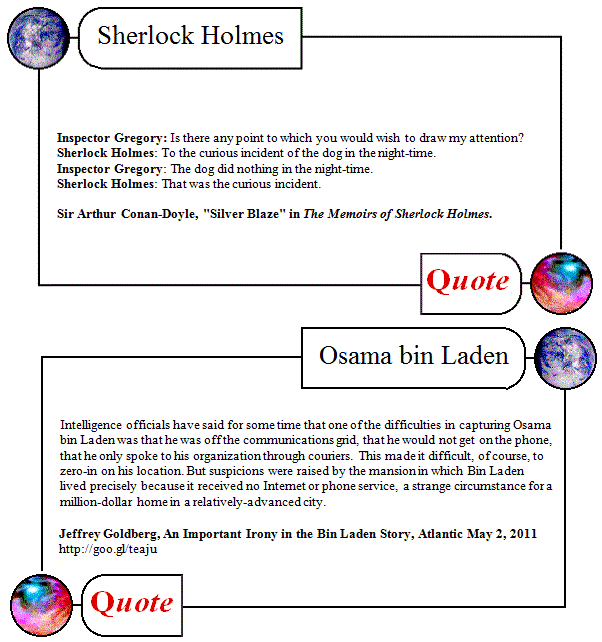
Okay, someone wasn’t reading his Sherlock Holmes

quo-obl-and-holmes.gif

Consider this a very minor contribution to the ongoing discussion of the benefits of a liberal arts education in connecting analytic dots (or avoiding those who connect them).

*

Refs:

Wikipedia, Pattern Language (background), and Christopher Alexander, A Pattern Language (one of the very great books).

The DARPA arts

Friday, April 29th, 2011

[ by Charles Cameron ]

.

Blog-friend Cameron Schaefer has a piece up at Small Wars Journal today in which he quotes Boyd (writing that his approach “incorporated science, but more closely approximated the often chaotic, creative impulses of art”) and Mahan (“art, out of materials which it finds about, creates new forms in endless variety”), and concludes:

Approaching strategy in an indirect fashion, as more of an art than science may make some uneasy, specifically those who find safe haven in the concreteness of checklists and formulas. Yet, the nature of strategy reflects the nature of the world. It is infinitely complex, it is always changing and it is filled with humans that often do irrational things. Literature (see Charles Hill) and psychology have as much of a place at the strategy table as military history… as do mathematics, physics, political science and technology. So, when asking, “what must one study to be a great strategist?” the answer seems to be, “everything else.”

Okay, so that (and Hill‘s work, which Zen reviewed recently) gives us the significance of the arts in strategic thinking which, one hopes, is practiced before going in to battle, and may indeed give one second thoughts about it…

*

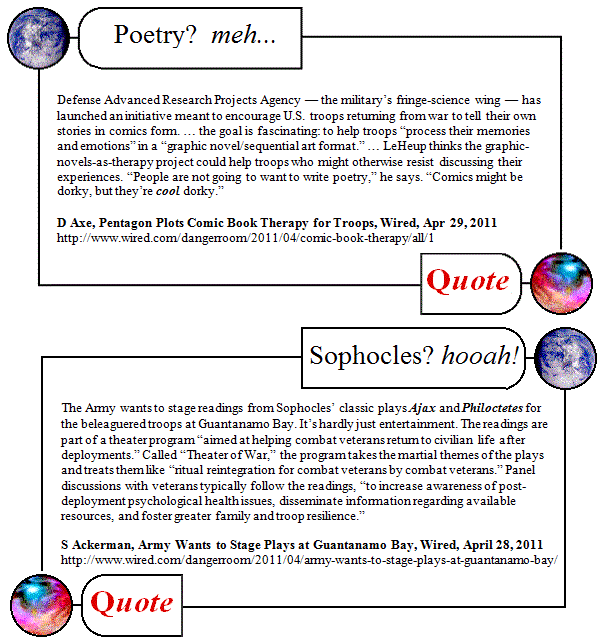
Literature and the arts are also important after battle, though – and the US Military and DARPA have clearly been thinking about that side of things:

quodarpa-arts1.gif

Sources: ComicsPlays

Poetry? meh… Sophocles? Chlanna nan con thigibh a so’s gheibh sibh feoil!

*

Lionel Tiger and Robin Fox in The Imperial Animal characterize modern health care as the “bureaucratization of mercy” and propose that for comparison, we set it beside:

the Greek ideal of the hospital as the place with the best food, the finest furnishings and paintings, and the most skilled musicians and comedians.

The greatest healing center in ancient Greece was the Asclepion at Epidavros / Epidaurus, which housed an amphitheater that could seat more than ten thousand people for dramatic and musical performances without amplification.

At Epidavros, patients would be healed by watching those same dramas of Sophocles to which the US Army is now turning for therapeutic relief in Guantanamo — for as Tiger and Fox (what a pair of names) go on to argue:

It is not the healthy, but the sick who most vitally needed such agreeable and re-creative stimuli; and the resources the community had were most beneficially and sanely used in helping them ease their personal disarray and feel encouraged by this display of their community’s careful concern.

*

It’s also interesting to note that the graphic novel Silver Shields mentioned in Axe‘s piece as a precursor to DARPA’s “Online Graphic Novel/Sequential Art Authoring Tools for Therapeutic Storytelling” project is “set during the ancient Greek invasion of Afghanistan more than two millenniums ago” as a metaphor for America’s current situation…


Switch to our mobile site