zenpundit.com » IC

Archive for the ‘IC’ Category

Reforming Intelligence vs.Intelligent Reforms

Wednesday, December 5th, 2012
The intense behind the scenes lobbying on behalf of prospective candidates to replace General David Petraeus as Director of the CIA and the ongoing furor over Ambassador Rice’s “talking points” on Benghazi, have spilled over into op-eds quietly urging that the vacancy be used as an opportunity for reforms of the IC and CIA. This is not unexpected – the churn of ” IC reform” tends to be cyclical, free of institutional or historical memory and useful for distracting the media from genuine problems – but it is also true that the situation could bear improvement.

One of the smarter observations was by former star analyst Nada Bakos in Foreign Policy:

…..In light of this, what should the DNI’s role be in the intelligence community, if not disseminating a coordinated intelligence product? The CEO of a company is typically the one planning strategy, interfacing with board members, stockholders, and consumers. A CEO doesn’t typically write the chief financial officer’s year-end summary or the marketing director’s strategy — instead, he views both products from 25,000 feet to ensure the company is on steady footing. The DNI should have a similar role: rather than replicating work, it should focus on reviewing the source material from the various agencies and collaborating to ensure all of the information has been reviewed. In the case of the Benghazi talking points, the intelligence community all had a role in editing the talking points once passed from the CIA. Other points of view make sense, but in the immediate aftermath of something like Benghazi, the arrival of new (and possibly conflicting information) is likely to confuse, not improve, the product. It is best to leave the dissemination, in the immediate aftermath, in the hands of the agency that owns the source of the information and is in the business of disseminating intel products — in this case the CIA.

As with the recent and somewhat ironic leaking that the Pentagon is going to overrun the Earth with hordes of DIA covert agents [i.e. 90% of new money and personnel will probably feed the CONUS based DIA bureaucracy as a budget protection strategy] when an agency or entity can get political authorities to grant them incursions into another bureaucracy’s turf, it is because that bureaucracy has ceased doing it’s job so long ago everyone has just accepted that it will never change.

The Bakos piece contrasts well with the politicized bullshittery being offered in The New York Times. Here are some of my favorite bits of harmful nonsense:

….The United States has over 280 diplomatic posts worldwide. They are working on drug interdiction, arms control negotiations, border security, counterterrorism, access to energy and trade, implementing sanctions, fair trade and the like. Intelligence helps diplomats recognize everything from cheating on agreements to social unrest and surprise attack. And it helps them make decisions that lower the risks and consequences of war.

The new director should rededicate the C.I.A. to supporting these diplomatic operations.

Right. Each ambassador should get to play amateur Station Chief and fritter away extremely scarce intel resources on pet projects because, you know, the State Department has done such an awesome job on it’s own core missions the past decade or so, and….uh…wait….

….The best way to ensure the intelligence process can both produce the best analysis possible, free from political and policy influence, and that covert operations are smart and legal is to ensure the director is an independent actor not subject to political pressure. Making the job a 10-year appointment, which will cross the lines of elections, offers a way to reduce the risk of politicization.

Shorter Bruce Reidel: The DCIA should be able to delay or refuse the President’s order to do covert ops so the US will do far fewer of them and in maximum risk-averse fashion.

No.

You de-politicize the DCIA by not having new presidents fire old DCIAs because they were appointed by an administration from the other party, a practice begun not by Ronald Reagan as Bruce Reidel mistakenly believes, but by his predecessor, Jimmy Carter. The idea that the DCIA who is expected to oversee the most sensitive covert missions (i.e. those intended to have strategic or political effects) should be “independent” of the President is some form of really poor Constitutional theorizing. What happens when an “independent” DCIA launches covert ops *against* the wishes of a President?

Here are a few ideas that would be useful to keep in mind, if “reform” of the IC and CIA is actually desired and isn’t merely a stalking horse for smuggling in a different set of  foreign policy preferences unsupported by the wider American public (which I suspect much of the recent noise is):

It isn’t a choice between a “Militarized” CIA and a CIA that does HUMINT collection:

The CIA is supposed to do both covert action and intel collection and always did. Period. The true anomaly is the comatose period after the Church-Pike Hearings bloodied the CIA on Capitol Hill and created a deeply risk-averse generation of CIA managers, who, it must be said, did not exactly bend over backwards in the 1990’s to unleash a legion of deep cover operatives and agents of influence. The “militarized CIA” meme is utter B.S. from folks who dislike armed drones and kinetic tactics and lost that policy argument two years ago.

Drones and nefarious celebrity generals are not what prevents the CIA from more robust intel collection effort – only CIA management prevents better HUMINT collection by not prioritizing it and increasing the number of CIA personnel in overseas postings.

The Director of the CIA, alone or in combination with the DNI, is not the solution:

What is required is an engaged and active Chief Executive willing to spend time and political capital making the IC work for his administration the way it should and the way he needs. This may mean firing the recalcitrant, the resistant and the risk-averse and taking heat from The Washington Post and The New York Times when their favorite “senior official” sources start screaming bloody murder on background to undermine their DCIA and DNI.

Top talent in the DCIA chair, one with real gravitas on the Hill if possible, will be important but that person will still need the full backing of the President and key members of Congress or nothing will change.

“Clandestinity” and Strategic intel are more important than “Reportage”:

Senior officials in any administration like to get IC  briefs that edge out the media on breaking events and bring them details they can’t find in their own, usually very extensive, personal networks or from the bureaucracies and agency experts they themselves oversee.  The CIA in particular has catered to this demand as, it must be said, they are obligated to do.

The problem is that in economic terms, the marginal value of “secret” information over what information is available in the open media in an emerging crisis is not going to be very great unless the CIA has made substantial investments in clandestine networks in the crisis area over a period of years or decades to acquire “strategic” intel, or at least a formidable position to uncover some.

Pouring ever greater resources into near real time “reportage” and being a slightly spooky version of CNN makes such long-term, clandestine investments by the CIA less likely, less deep and less influential in shaping emerging events. Much like having a .357 magnum when someone is crawling through your bedroom window at 3 am, when a crisis erupts overseas, America either has a robust clandestine network on location or it does not.

Congress has a key role and usually abdicates it in favor of grandstanding or rearranging deck chairs:

The IC will work better with consistently active oversight done with a minimum of partisan rancor and an avoidance of any new legislation that features a new (and usually more complex) org chart. It’s important -sometimes delicate operations and lives depend on our politicians behaving and speaking with discretion. If there are important objectives for national security for the IC to accomplish, nothing sends that message better than the administration and key members of the intelligence committees acting in concert to make a policy succeed.

I’m not holding my breath on that last one.
On the HipBone and Sembl games: update

Thursday, November 29th, 2012

[ brief intro by Charles Cameron, then shorter version of Dr. Cath Styles‘ presentation of Sembl at the National Digital Forum in New Zealand, 20 November 2012 ]
.

Charles writes:

I’ve been working for almost twenty years on the development of a playable variant on Hermann Hesse‘s concept of the Glass Bead Game.

It’s an astonishing idea, the GBG — that one could build an architecture of the greatest human ideas across all disciplinary boundaries and media — music, religion, mathematics, the sciences, anthropology, art, psychology, film, theater, literature, history all included — and it has engaged thinkers as subtle as Christopher Alexander, the author of A Pattern Language [See here, p. 74]. Manfred Eigen, Nobel laureate in Chemistry and author of Laws of the Game [see here], and John Holland, the father of genetic algorithms [see here].

Here’s Hesse’s own description of the game as a virtual music of ideas:

All the insights, noble thoughts, and works of art that the human race has produced in its creative eras, all that subsequent periods of scholarly study have reduced to concepts and converted into intellectual values the Glass Bead Game player plays like the organist on an organ. And this organ has attained an almost unimaginable perfection; its manuals and pedals range over the entire intellectual cosmos; its stops are almost beyond number.

My own HipBone Games were an attempt to make a variant of the game that would be simple enough that you could play it on a napkin in a cafe, and has in fact been played online — and more recently, my friend Cath Styles has adapted it for museum play, and introduced the basic concept and our future hopes in a presentation at the National Digital Forum 2012, New Zealand — which you can see very nicely recorded in Mediasite format.

Do take a look — Cath makes a first-rate presentation, and I love the Mediasite tech used to capture it.

Since the slides are shown in a small window concurrently with Cath’s presentation, I’ve edited her presentation for Zenpundit readers, and reproduced many of her slides full-size with some of her commentary below.

**

Sembl, the game of resemblance

Cath speaking:

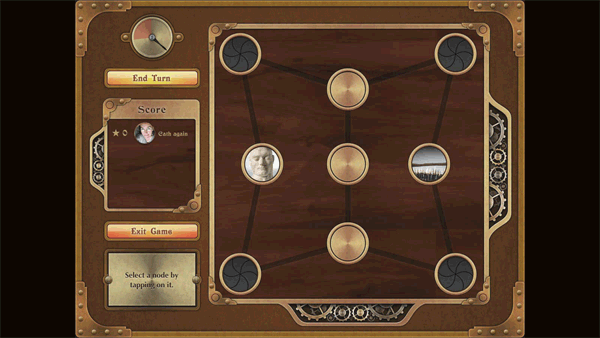
In its first form, Sembl is an iPad game, called The Museum Game, at the National Museum of Australia. We’ve just released it in beta as a program for visiting groups.

Cath then talks about feedback from children and adults about their experience of playing the game. Some kids homed in on the principle of resemblance, others emphasised the social side of the game. She talks, too, about their teacher, and her observations about the ways the game engaged her kids.

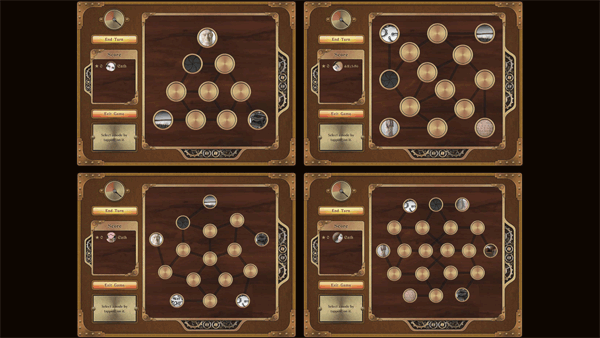
She then shows us various Sembl gameboards for iPad:

Sembl Museum gameboard for four teams of younger players

Four different Sembl Museum gameboards

Cath speaks:

But The Museum Game is just one form of Sembl. The Museum Game is played in real time, on site, and players take photos of physical objects to create nodes on the board.

The next step is to make a web-based form, that you could play at your own pace, and from your own place. Then, Sembl becomes a game-based social learning network, which amplifies the personal value of the game – it becomes social networking with cognitive benefits.

But it’s the bigger picture – of humans as a community – that I most want to explore: Sembl as an engine of networked ideas, or linked data.

Charles notes: I’m skipping the educational part — and the bit about my own role in the game’s development, to get to the core of her presentation as I see it: the cognitive facilitation it provides

Cath again:

Another way of saying this is that the Game provides a structure and impetus for dialogue, between the museum and visitors, between visitors and things, among visitors and between things. And this is not dialogue in the sense of an everyday conversation. It’s deeper than that. It’s a mutual experience of looking both ways, simultaneously.

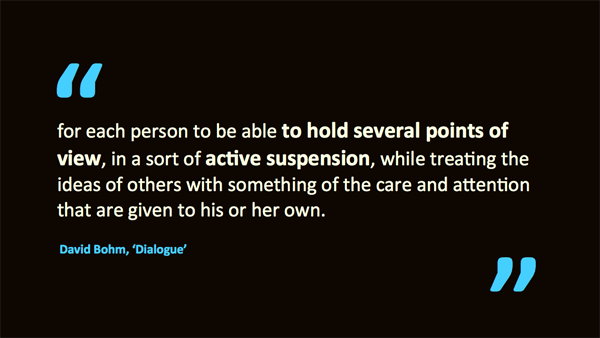
Cath next quotes David Bohm, the eminent quantum physicist:

to hold several points of view in active suspension – quotation of David Bohm

Cath speaks:

For Bohm, dialogue means holding several points of view in active suspension. He regarded this kind of dialogue as critical in order to investigate the crises facing society. He saw it as a way to liberate creativity to find solutions.

Cath then drops in an important topic header:

Toward a game-based social learning network

Cath:

The concept of Sembl, in its deepest sense, is social learning – game-based social learning. In its first instantiation, it is game-based social learning in a museum and – if things turn out as I hope they will – from next year it will be playable at any other exhibiting venue that has the infrastructure and the will to host games – galleries, libraries, botanic gardens, zoos and so on.

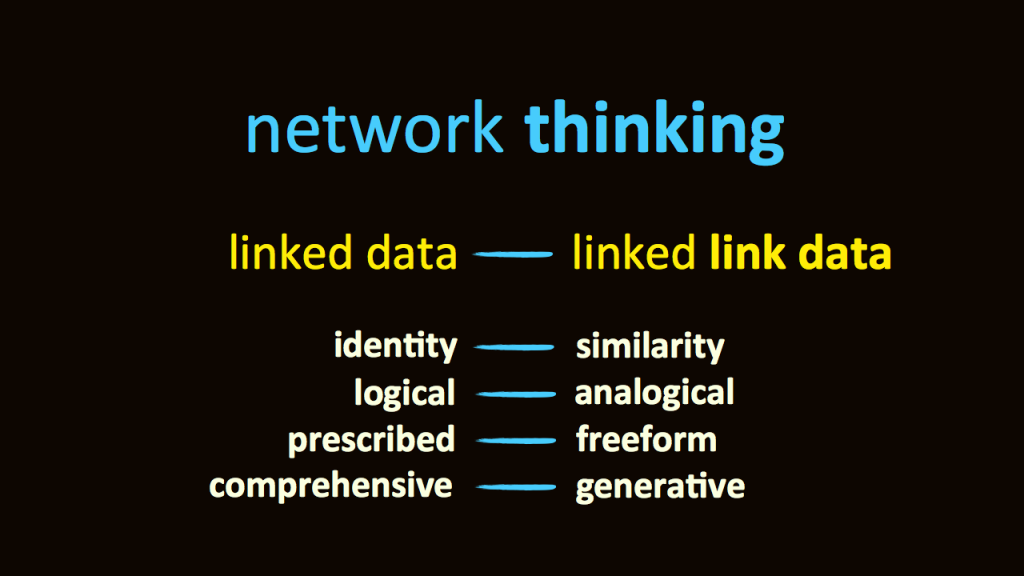
network thinking – how Sembl network links differ from traditional linked data links

A web-based form of Sembl can generate linked data with a difference. It’s linked link data, and quite different to normal linked data.

  • Instead of connections based on what a thing is – sculpture, or wooden, or red – Sembl generates connections based on a mutual resemblance between two things. Which, amazingly enough, is a great way of gaining a sense of what each thing is. And if your interest is to enable joyful journeying through cultural ideas, or serendipitous discovery, this approach just wins…
  • Instead of compiling logical links, Sembl cultivates the analogical.
  • Instead of building and deploying a structured, consistent set of relationships, Sembl revels in personal, imprecise, one-of-a-kind, free association, however crazy.
  • Instead of attempting to create a comprehensive and stable map of language and culture, Sembl links are perpetually generative, celebrating the organic, dynamic quirks of cognitive and natural processes.

But the most important way that Sembl is distinct from other systems of network links is that those who generate the links learn network thinking. Which is a critical faculty in this complex time between times, as many smart people will tell you.

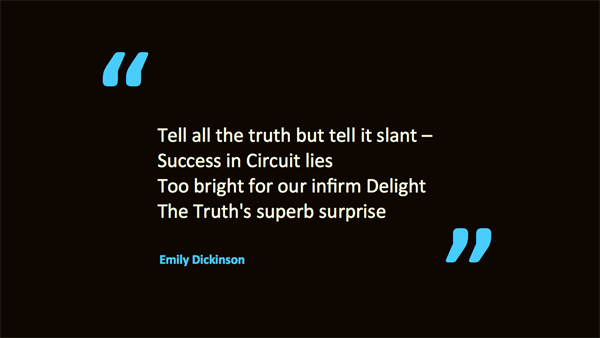
Poets have always known the virtues of analogy as a path to the truth.

Tell all the truth but tell it slant – poem by Emily Dickinson

Sembl promotes dialogic, non-linear thinking, and new forms of coherence.

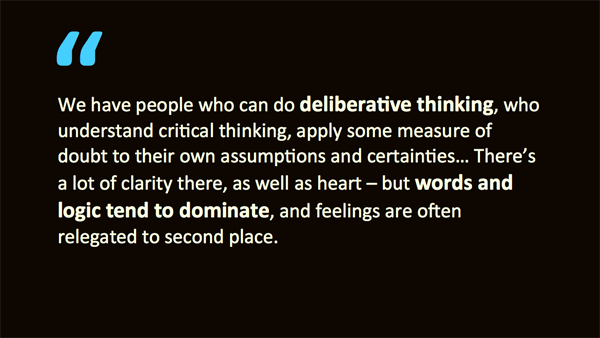
deliberative thinkers – quotation of Charles Cameron

It’s distinct from deliberative thinking, which is rational and causal and logical and linear.

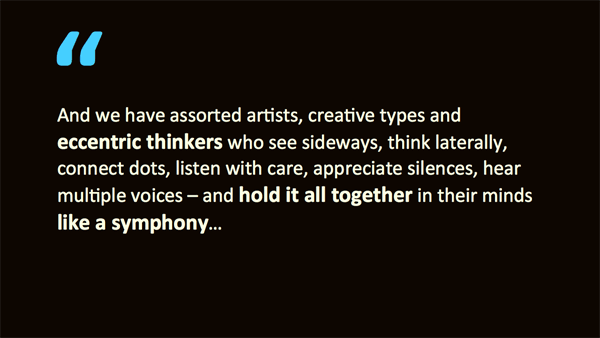
eccentric thinkers – quotation of Charles Cameron

It’s another kind of thinking, which might be informed by rational thought, but its purpose is not singular.

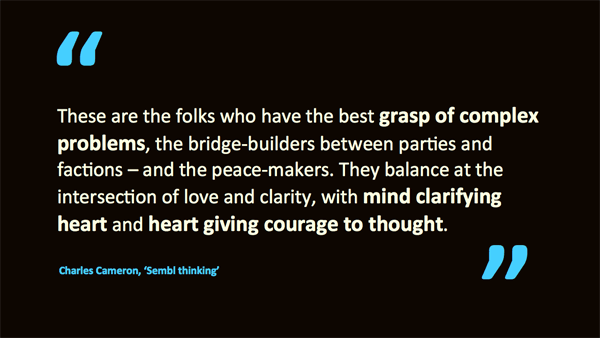
bridge-builders – quotation of Charles Cameron

You might say its purpose is to create – and cohabit – a state of grace, from which ideas simply emerge.

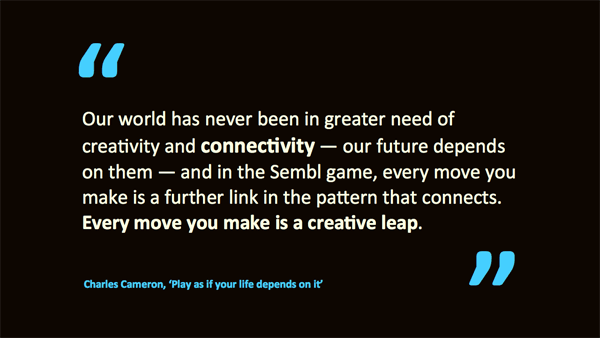
every move you make is a creative leap

If playing Sembl gives us practice in polyphonic thinking, if it helps cultivate connectivity and our capacity to find solutions to local and global problems, it is good value. As Charles says, every move is a creative leap.

Cath concludes:

If you’re interested in working with us to supply content, develop strategy or raise capital, we’re keen to talk.

And I can’t tell you how much I’m anticipating being able to invite everyone to play.

thanks

**

Cath can be reached via Twitter at @cathstyles, and I’m at @hipbonegamer. The Sembl site is at Sembl.net.

Next up: what Sembl has to offer the IC.

Wei Wu Wei, or the inactionable option

Tuesday, November 13th, 2012

[ by Charles Cameron — the excellence of today’s piece by Joshua Foust and the importance of intelligence that is not actionable, with illustrations from Zenpundit, Dickens and Shakespeare ]
.

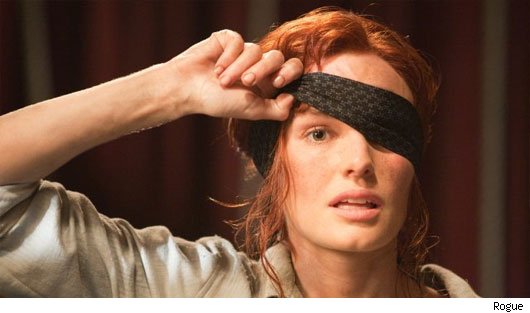
Kate Bosworth peers out from under a blindfold in the 2010 movie, Warrior's Way

**

Josh Foust just posted an important piece in his Atlantic column and on his American Security Project blog titled Myopia: How Counter-Terrorism Has Blinded Our Intelligence Community, with the subtitle:

The United States’ overriding interest in “actionable” information on terrorists has produced a dangerous form of tunnel vision.

Bingo.

This is important, and I’ll circle back to it. But first, please follow the full arc of the circle…

**

I post little headers at the top of all my Zenpundit posts these days, to let people know where on the irrelevance scale my latest offering should be placed — I guess the idea came from the 19th century practice of offering “synoptic chapter headings” to titillate the reader of novels, as when Mr Dickens titles one chapter of The Pickwick Papers:

Chapter XVIII. Briefly illustrative of two points; first, the power of hysterics, and, secondly, the force of circumstances

I digress.

Some while back, I posted a piece called The Haqqani come to high Dunsinane here on Zenpundit, and gave it the header:

why is non-actionable (useless) intelligence sometimes the most intelligent (useful)? – importance of multiple frames for complex vision

The piece was about the Haqqani network, but obliquely so — I was leaping from an image in a video where a cluster of Haqqani-guys in training were running around dressed as trees, to a similar image in Shakespeare‘s Macbeth:

Macbeth shall never vanquish’d be until
Great Birnam wood to high Dunsinane hill
Shall come against him.

Well, that was the prophecy, and Macbeth took it to mean he’d never be defeated in battle:

That will never be.
Who can impress the forest, bid the tree
Unfix his earthbound root? Sweet bodements! Good!

Prophecies and portents are notorious for their double meanings, however, and this one’s fulfillment comes when Malcolm gives the order to his men:

Let every soldier hew him down a bough
And bear’t before him. Thereby shall we shadow
The numbers of our host and make discovery
Err in report of us.

Heh — “discovery” here means what today we’d call “intelligence” — and notice the importance here of reading multiple meanings out of a single sign.

A while later, a messenger arrives, and declaims:

As I did stand my watch upon the hill,
I look’d toward Birnam, and anon, methought,
The wood began to move.

This turns out to be true enough, for in the next scene Malcolm, now before Dunsinane, gives the order:

Now near enough: your leafy screens throw down.
And show like those you are.

and:

Make all our trumpets speak; give them all breath,
Those clamorous harbingers of blood and death.

And so it goes.

**

Let me emphasize, this is not, definitively not, actionable intelligence that I am in any way attempting to offer as such to anyone engaging in close-quarters combat with the Haqqanis.

Our arc is almost complete at this point, so let’s take a closer look at Josh Foust’s piece:

Large areas of the IC have move away from their traditional role of analyzing a broad range of current events for policymakers and toward supporting the global counterterrorism mission. News stories about this shift suggest the counterterrorism mission has become the overarching concern of the national security staff.

This shift in focus can create blind spots that pose unique challenges for the president. If branch chiefs and the policymakers they support value “exploitable” information over deep understanding, they might be ignoring potentially vital information that doesn’t seem immediately of interest.

Imagine an analyst finding reports of a growing discontent in a Middle Eastern country’s politics; if that does not provide immediate benefit for a decision-making process for targeting suspected terrorists, it can easily be ignored in the avalanche of targeting information.

Blind spots, eh?

Those would be “the dots” in the “larger picture” that you can’t “connect” until it’s too late. And where are they found? In “information that doesn’t seem immediately of interest” — intelligence that’s not “actionable” in other words.

Or to put that another way, what Josh calls “tunnel vision” comes from staring at what’s “actionable” — whereas vision that’s “out of the tunnel” comes from noticing what’s in peripheral vision.

**

Wei wu wei? It’s a Taoist motto: literally, it means “action without action” though it can also be translated “effortless action”.

I know, I know, this is a useless post. But you know what Hui Tzu said to Chuang Tzu?

I have a big tree of the kind men call shu. Its trunk is too gnarled and bumpy to apply a measuring line to, its branches too bent and twisty to match up to a compass or square. You could stand it by the road and no carpenter would look at it twice. Your words, too, are big and useless, and so everyone alike spurns them!

And you know what Chuang Tzu said in response?

A Tale of Two Victories and Two Falls

Sunday, November 11th, 2012

My co-blogger Charles Cameron is fond of his “DoubleQuotes” postings that feature frequently uncomfortable juxtapositions designed to prod thinking. Here’s a wordier one from me:

….Planning for a second term has been under way for months, with Lew and Pete Rouse, the counselor to the president and Obama’s internal management guru, preparing lists of possible promotions and nominations. The staff process has been gossiped about by the staff, but details have been kept secret, even from insiders.

“They haven’t even made calls. People haven’t been asked,” said a Democrat familiar with the situation. “They’re more targets than they are potential nominees.”

Now, officials will start to cement their departure dates, and aides will sound out colleagues about possible new roles. Among the top current officials expected to go: Treasury Secretary Timothy Geithner, Secretary of State Hillary Clinton, Defense Secretary Leon Panetta, Energy Secretary Steven Chu, Interior Secretary Ken Salazar and Lisa Jackson, administrator of the Environmental Protection Agency.

Attorney General Eric Holder and Transportation Secretary Ray LaHood might not be far behind — or may even beat them out the door.

There’s also a growing list of people the administration is looking to find spots for: Massachusetts Gov. Deval Patrick most of all, as well as former Michigan Gov. Jennifer Granholm and outgoing North Dakota Sen. Kent Conrad.

Obama has overseen one of the most stable cabinets in history — the only departures have been Defense Secretary Robert Gates, and Gary Locke and John Bryson from Commerce. But what’s about to happen amounts to an almost full-scale second transition: 


….At eleven o’clock in the morning, Nixon met with his staff in the Roosevelt Room. To many in the room he seemed oddly cool and quietly angry as he thanked them all for their loyalty and said something few of them understood. He said that he had been reading Robert Blake’s Disraeli and was struck by his description a century ago of William Gladstone’s ministers as “exhausted volcanoes” – and then mumbled something about embers that once shot sparks into the sky.

“I believe men exhaust themselves in government without realizing it” the president said “You are my first team, but today we start fresh for the next four years. We need new blood, fresh ideas. Change is important…..Bob, you take over.”

Nixon left then, turning the meeting over to Haldeman. The men and women of the White House stood to applaud his exit, then sat down. The chief explained what Nixon’s words meant: a reorganization of the administration. He told them that they were expected to deliver letters of resignation before the end of the day, then passed out photocopied forms requiring them to list all official documents in their possession. “These must be in by November 10,” he said. “This should accompany your pro forma letter of resignation to be effective at the pleasure of the President”. They were stunned. Speechless. Were they being fired? Haldeman said they would know within a month whether or not they could remain. At noon, the same drama was played out with the entire Cabinet, with Haldeman again passing out the forms.

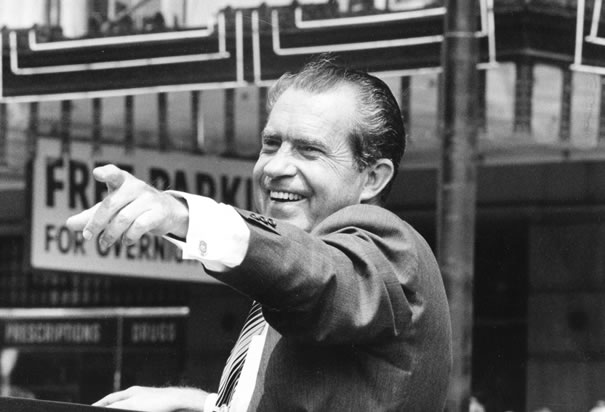
Ironically, one of the many Cabinet secretaries Nixon ignominiously fired in his bid to centralize power in his White House staff was his former 1968 primary rival, HUD Secretary George Romney, father of 2012 Republican nominee, Governor Mitt Romney.  A blow from which George Romney’s political career never recovered. Nixon’s relationship with Romney had been an acrimonious one, formally polite on the surface with public shows of confidence by Nixon and machiavellian intrigues behind the scenes to undermine Romney and reverse the policies he had been advancing in Nixon’s name.

This latest Cabinet reshuffle to build a “Team without Rivals”, comes in the context of an explosive story, the abrupt resignation Friday of CIA Director General David Petraeus, citing an extramarital affair and accepting responsibility for “extremely poor judgment” and “unacceptable conduct”. The affair, allegedly conducted with his official biographer, came to light during a still not fully explained FBI investigation into unauthorized accessing of Petraeus’ private email account. The resignation of the highly regarded General Petraeus comes just before he was expected to testify before Congress regarding discrepancies and questions in the administrations handling of the terrorist attack in Benghazi that killed Ambassador Chris Stevens and other Americans. It also coincides with the Secretary of State Hillary Clinton, declining to testify.

It is difficult to say if General Petraeus public career will survive this scandal that he has brought upon himself, an action which stands in jarring contrast to his sterling, some might say superhuman, record of service to America, or if he will, like George Romney, fade away. Certainly, the CIA badly needed to stop the revolving door on the Director’s office and have a strong, visionary, hands-on leader who could reform and invigorate the Agency not merely in terms of covert action but in terms of rebuilding of capacity in deep cover clandestinity and the acquisition of strategic intel. I do not often find myself in agreement with Senator Feinstein but she is correct, this resignation hurts because it is also a significant institutional opportunity cost for the IC. I too wish it had not been accepted  – at one time it wouldn’t have been – but that is the President’s prerogative.

What however are the real issues? What should we be looking for?

Two things: As with Richard Nixon’s second term machinations, with such sweeping changes personnel changes in the offing for the Obama administration, ask yourself as events unfold: “Where is power flowing? And Why?”

If you do you will be in a better position to game out the direction of the next four years, especially in foreign policy and national security.

The White House has attempted to sell a story that the FBI doing a low-level harassment investigation  stumbled upon a security breach and – on their own authority, mind you – tapped the email account of the Director of the CIA and kept him under surveillance and investigated his mistress and, oh, yeah, the President was only informed of this business after the election on Thursday. Wait! And the DNI ( a three star general whose career was primarily intel administration) on his own initiative called the CIA Director ( a four star general and former theater and combatant commander) in on the carpet and fired him told him to resign. Right.

No, what most likely happened was that the minute the special agents realized who was involved in their investigation and the magnitude of the implications, they stopped and informed their superiors and the matter went up the chain to the FBI Director’s desk. The FBI Director, a former prosecutor with a political antennae circumspect enough to be appointed by George W. Bush and have his term be extended by Barack Obama, would have duly informed the Attorney-General of the United States before proceeding further and – I expect – the National Security Adviser, White House Chief of Staff and the DNI. Worst case scenario thinking in terms of national security would have been one driver. Another would be the fear of an all too juicy story leaking and the media catching an unbriefed POTUS unaware on the campaign trail with a blockbuster scandal before the election. How would that have gone over?

I would further expect that we will in the next few days and weeks hear the most salacious contents of the emails between Petraeus and his biographer, leaked by anonymous officials, timed to coincide with difficult days of testimony regarding Benghazi or new appointments to the administration that could, on a slow media day, prove controversial.

Instead of being distracted by prurient nonsense unrelated to the stewardship of the Republic, time would be better spent scrutinizing the host of nominations to come, not as individuals but as “teams” for particular areas of national security and foreign affairs cutting across bureaucracies – ex. arms control, Russian relations, Mideast etc. What commonalities or congruencies emerge?

I suggest this because back when the Obama administration decided on their “pivot” to Asia, the people they selected for second to third tier workday management related to the Asia-Pacific region were all accomplished, decent, honorable public servants, but their greatest common characteristic was a lack of any professional expertise with China. We saw the same personnel gambit with the Bush administration in the run-up to the war with Iraq where the greatest disqualifier for a job with the CPA was familiarity with the Arab world, Islam or Iraq. When you want careful stratagems, you solicit the advice of experts; when you want grand and revolutionary gestures, the wheels of policy are better greased with bold ignorance. There’s a reason Nixon appointed William Rogers Secretary of State – he knew the State Department bureaucracy would largely oppose his foreign policy initiatives and he wanted someone ill-suited and uninformed in charge there who he could more easily manipulate and keep in the dark.

The sixties radicals used to assert “the personal is the political”; in the eighties, Ronald Reagan in staffing his first administration understood that “the personnel are the political” and picked people culled from Heritage and Cato. My intuition is that in the second decade of the 21st century, the inside circle of the Obama administration have discovered that ” the political are the patterns”.

The story unfolding is no longer the “smoking gun” or the compromising jigsaw piece but the entirety of the puzzle.

Søren Kierkegaard on espionage & Kenneth Burke on strategy

Thursday, October 25th, 2012

[ by Charles Cameron — a meditation on theological espionage, literary strategy, a Sufi tale from Jalaluddin Rumi, and why the arts and humanities offer excellent preparation for analytic work ]
.

Kit Marlowe's portrait, Corpus Christi College, Cambridge, Kierkegaard sketch, Niels Christian Kierkegaard

.

It may seem somewhat strange, at least on the surface, for a poet to be interested in strategy and a theologian in the world of intelligence analysis.

We poets. however, have been termed “the unacknowledged legislators of the world” by Mr. Shelley, one of our own number, and we theologians long considered our study the Queen of the Sciences – so here we have the roots of attitudes that may flower into this strange hybrid being that is myself.

**

It’s not easy to list significant writers who were also in the intelligence business, in part because both “writing” and “intelligence” are subject to varied definitions — so my own list here will lean heavily British, and have the patina of old age rather than the glamor of the freshly minted. Let’s just say that Christopher Marlowe, who wrote the great play Doctor Faustus, was apparently sent on extended errands while up at Cambridge on “matters touching the benefit of his country”.

More recently Rudyard Kipling, John Buchan, Somerset Maugham, Graham Greene, even JRR Tolkien apparently, Ian Fleming, John le Carré, and Anthony Burgess have been among British writers who were also spies, and Peter Matthiessen can serve as a distinguished recent American example.

Which brings me to the OSS, and this quote from a 2003 piece on Boston.com:

Yale’s literature specialists played a key role in shaping the agency’s thinking. Mole-hunter James Jesus Angleton, the most controversial figure in CIA history, began his career as an apprentice of the New Critics on Yale’s English faculty, and his literary training in “close reading” may have shaped his hyper-skeptical (some would say paranoid) approach to counterintelligence.

**

Why do fine writers make decent intelligence analysts?

John le Carré, who has been both, has this to say:

Artists, in my experience, have very little centre. They fake. They are not the real thing. They are spies. I am no exception.

I’d like to take that a little further. I’d like to say that to be a keen observer of human behavior, you must be a keen observer of your own – only one who has taken the beam out of his own eye can see clearly the mote that is in another’s. That brings you, I believe that chameleon-like condition of receptivity and observation that Keats termed “negative capability” in his letter to Richard Woodhouse of October 27, 1818.

More on that in the Sufi story below. Now, onward to the two quotes that anchor this piece.

**

Here’s Kenneth Burke on “strategy” in the arts, in his Literature as Equipment for Living [link is to .pdf]:

For surely, the most highly alembicated and sophisticated work of art, arising in complex civilizations, could be considered as designed to organize and command the army of one’s thoughts and images, and to so organize them that one “imposes upon the enemy the time and place and conditions for fighting preferred by oneself.” One seeks to “direct the larger movements and operations” in one’s campaign of living. One “maneuvers,” and the maneuvering is an “art.”

Are not the final results one’s “strategy”?

And Kierkegaard on “spying” as a theologian, in the chapter, Governance’s Part in My Authorship from his The Point of View:

l am like a spy in a higher service, the service of the idea. l have nothing new to proclaim, I am without authority; myself hidden in a deception. l do not proceed directly but indirectly — cunningly; I am no saint — in short, l am like a spy who in spying, in being informed about malpractices and illusions and suspicious matters, in exercising surveillance, is himself under the strictest surveillance. See, the police also use such people. For that purpose they do not choose only people whose lives have always been most upright; what is wanted is only experienced, scheming, sagacious people who can sniff out everything, above all pick up the trail and expose. Thus the police have nothing against having such a person under their thumb by means of his vita ante acta [earlier life] in order precisely thereby to be able to force him unconditionally to put up with everything, to obey, and to make no fuss on his own behalf. It is the same with Governance, but there is this infinite difference between Governance and the municipal police — that Governance, who is compassionate love, precisely out of love uses such a person, rescues and brings him up, while he uses all his sagacity, which in this way is sanctified and consecrated. But in need of upbringing himself, he realizes that he is duty-bound in the most unconditional obedience.

**

To return, then, to the issue of those who spy upon themselves…

Jalaluddin Rumi has a story in his Masnavi, one of the many facets of which, I suspect, can illuminate this point, albeit a bit obliquely.

He describes a contest that a sultan once held between the Chinese and Greek schools of artists, to determine which had the greater ability in art. Each school was given one half of a room, and a great curtain fixed between them. The Chinese, with a vivid appreciation of nature’s moods and humanity’s place between skies and mountains, painted their half of the room with exquisite care and subtlety. The Greeks took quite an other approach, covering the walls on their side with silver plate, then buffing and burnishing it to a brilliant reflective sheen.

When the work was done and the curtain drawn back, the beauty of the Chinese room was stunning – but the loveliness of the Greek room, in which the Chinese room was reflected to dazzling effect, was even more so:

The image of those pictures and those works
was mirrored on those walls with clarity.
And all he’d seen in there was finer here –
his eyes were stolen from their very sockets.

Rumi explains that the Chinese in his fable are like those who see the outer world only, while the Greeks are those who “stripped their hearts and purified them” – and that “the mirror’s purity is like the heart’s”…

Those who examine their own hearts — Ursula le Guin nicely calls them “withinners” since their voyages, adventures, discoveries and treasures are found primary within themselves — may make reluctant spies, for they do not easily see one side of a dispute as entirely right and the other side utterly wrong: but their nuance places them among the finest of analysts.

**

Oh, but let’s be sensible and worldly: most of us like to balance our mundane lives with the more exciting possibilities that are their opposites, and espionage – the derring-do more than the analysis, to be sure – is a wonderful foil for scholars’ fantasies, just as being swept off one’s feet by a prince and loved tempestuously between the pages of a book is a sweet shift from the menial paper trails of office life, and space opera a fine venture for those beset by gravity and white lab coats.

And whether Jason Bourne, Jack Bauer, James Bond or just a little J&B‘s your tipple, you may find espionage, dealing as it does with secrets, is a natural launching pad for fantasy…

**

More sseriously, for the analysts and educators among our ZP readership — let me just suggest that the literary and humane arts will deepen analytic understanding as surely as big data will extend its technical reach.

And when you come right down to it — your human mind is still the best and subtlest software engine in the room…


Switch to our mobile site