zenpundit.com » IC

Archive for the ‘IC’ Category

Form is Insight: the project

Monday, October 22nd, 2012

[ by Charles Cameron — about the (not yet titled) book (or post-book project) i seem to be writing, which offers a grand slam intro to an array of box-free contemplative and artistic approaches to creative thinking, and hence opens fresh angles on intelligence ]
.

One thing I can promise: whatever this project turns out to be, it won’t be predictable.

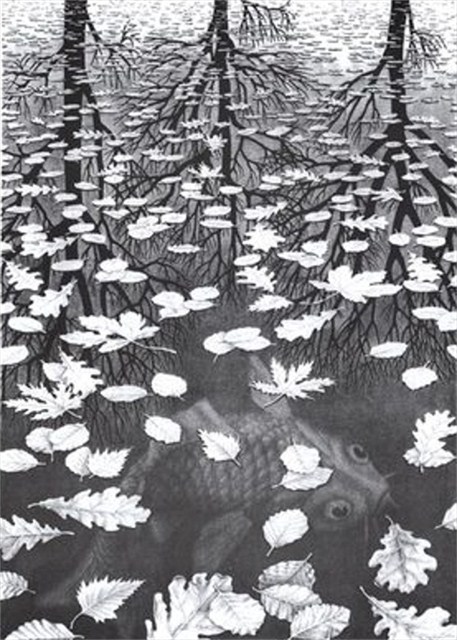
credit for this incredible image: Roger Dean

.

This project won’t take you over familiar territory, congratulating you on holding the same opinions as the author and adding in enough choice details to keep you interested. I’m not aiming to teach you the same thing you already know, only better, more interestingly, more precisely, or in greater detail. I’m aiming to question you, challenge you, and give you a whole new range of optics through which to view the world.

**

So, here we go.

I think I am finally at the point where the book (or whatever it is) I’ve been gathering inside me all these years is ready to be written. Some of it has already emerged in earlier posts here on Zenpundit — you don’t known and couldn’t count how many thanks, Mark — and this is certainly where I’ve been developing the style of integrated visuals and verbals that gives the project its flavor — so I’d also like to use my posts here to discuss the thing with you as I go along.

The project is about intelligence in the widest sense, including heart and mind, and with particular focus on creativity. I’m addressing this from two standpoints that mesh together well, and I’m addressing it to two audiences that I believe also mesh together well.

The standpoints are (i) meditation and (ii) the arts, and the audiences are (i) the “intelligence community” and (ii) bright people in general.

I believe that meditation cultivates a spacious mind-set in which we can hold multiple concerns in mind at the same time – the opposing needs of different people, stakeholders, sections of society, the environment, etc – thus seeing things from multiple angles and in balancing & thus balanced ways. And I think the arts serve as the primary means for expressing these balances with all their nuances and shadings, and that techniques from within the arts such as polyphony, chiaroscuro, formal constraint and pattern can teach us to shape multi-faceted insights like these into rich and complex understandings – complex patterns that respond to complex situations. I’ll go into all this in detail as we move along, with examples.

I also believe that this kind of creatively patterned insight — embodying artistic methodology in the context of complex problems with a “fresh” and open mind – will be of interest beyond the intelligence agencies and policy-makers, to business people, artists, and also — importantly — the bright general public, which I take to be a far larger subset of the population than we commonly think, and always eager for reading that doesn’t talk down to them but appreciates their own intelligence and good will.

For now let me just say that I’m very excited, because this seems (at last) to be a project that ties together my game-work with Sembl, the think-tank side of me which has been monitoring religious violence, jihad and terror and working towards nuance, understanding and peace these last dozen years — and my sense of creativity as a writer and poet.

Ripeness is all: I suspect the time for this venture has arrived.

**

Here’s the single page overview I’ve written, with a working title:

Intelligence is Zen: understanding our complex world with koans in mind

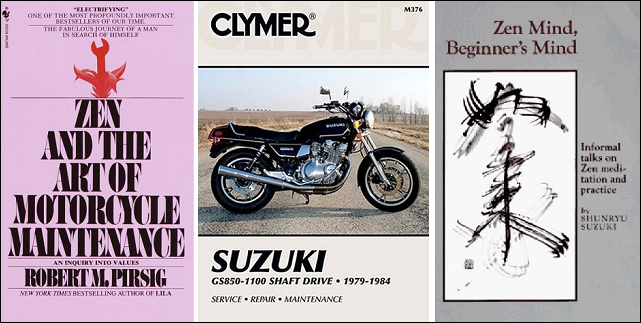
Just a few days ago, the Director of National Intelligence, James Clapper, referenced Pirsig‘s book, Zen and the Art of Motorcycle Maintenance, as key to the Intelligence Community’s work in understanding and adapting to the many, varied, intersecting problems we face in the world today. As I noted, Clapper was focused a bit more on the biker wisdom than the Zen to be found in Pirsig’s book, but he does raise a question I’ve been addressing for some years now:

What does the contemplative mind have to offer in terms of understanding a complex world?

To my mind, the creativity which is all the buzz of the business world, aimed at solving what are called “wicked problems” — problems that feature multiple stakeholders with multiple aims and objectives, aims and objectives which themselves shift over time so the problems are “never the same river twice” – requires a major mental and emotional shift. Reverie and meditation free us up to make the shift: the shift itself is poorly understood.

Our present, mostly linear way of thinking favors either/or side-taking, dubious cause-and-effect expectations which fail to take complex feedback loops into account, followed all too often by a rush to judgment. We need a whole new – old, even ancient – way of thinking.

Our problems are complex because they overlap, they ripple through one another. In Buddhist terms, they are “interdependently arising.” Not surprisingly, the way of thinking that is required to gain a deeper insight into “interdependently arising” problems can be found in explicit form in such contemplative traditions as Madhyamika & Zen, Taoism, Sufism, and their Abrahamic contemplative analogs. At the heart of these systems is fresh thinking – thought refreshed by quiet.

Furthermore, the shaping of insights in an open field of thought is something the world’s artistic traditions have long dealt with, and there are schools of insight not just available but recorded in exquisite detail in the world’s traditions of poetry, music, painting, theater, film… in patterns that are found in nature, in culture, and in the very turbulence we now must learn to flow with.

The project therefore takes a meditation-influenced approach to intelligence, both in the sense in which Clapper would use the word, relating to the intelligence analysis which develops and influences our decision-makers’ understanding of what’s needed, and in the more general sense of those capable folk with bright minds, keen insights, sharp instincts, warm hearts.

I’ll propose a series of ways of looking differently – with application for anyone, whether artist, intel analyst, businessman, policy-maker, or lover – that cut to the essence of creativity: lateral, analogical, holistic thinking, witnessing pattern beneath the surface of things. My examples will be mainly drawn from terrorism, which I have been monitoring for a dozen years: my style is that of a poet and an eccentric Englishman.

My subtext, my subliminal message, will be contemplation and artistry as profound common sense.
One hand Clapping: or is the DNI a Zen Pundit?

Monday, October 15th, 2012

[ by Charles Cameron — silos, motorcycles, zen and the DNI ]
.


.

Pam Benson writing at the CNN Security blog may or may not have had anything to do with the title of her post, Spy chief gets Zen, but she’s presumably responsible for her first paragraph:

You usually don’t associate spying with being Zen, but that’s exactly what the nation’s chief intelligence officer did this week at an intelligence gathering in Orlando, Florida.

Here at Zenpundit we’re naturally prone to both Zen and Punditry, so we like that — but to be honest it’s a little over the top. I’m dropping his entire keynote in at the bottom of this post, but for now let’s just say instead that DNI James R Clapper gets bikers.

Okay, maybe we can go a little further, and say he gets Zen and the Art of Motorcycle Maintenance. That’s not quite Zen, but it’s getting closer. Kristin Quinn‘s piece at Trajectory magazine is titled GEOINT 2012: Zen and the Art of Intelligence, which at least pays hommage to Pirsig’s book, and focuses on Pirsig-zen as it applies to Intelligence…

And that’s a direction we can applaud.

Two questions, then: what is zen, and what is intelligence?

**

Zen is, strictly speaking:

A direct transmission outside the Scriptures,
Not dependent on words and letters,
Directly pointing to one’s own mind
Seeing into one’s own nature.

Those words, however, are something of a scripture, so the transmission isn’t in them — it’s one of those things like ceaseless change, always there, never the same, flexible beyond the capacity of words to capture it — as Laozi remarked at the start of the Dao De Jing, in scribbled response to a border guard who demanded that his scriptures be verbal — “dao ke dao, fei chang dao” — two Chinese phrases English can barely translate.

Where do we go from here, then, if we’re accustomed to think in words?

The zen master Shunryu Suzuki Roshi has one answer in the title of his book Zen Mind, Beginner’s Mind.

Zen takes you back to where your mind is fresh and playful, before it got narrow-minded, siloed and rutted. Zen means wide-angle alertness, from a point prior to preference, assumption and prejudice.

Zen takes your thoughts and emotions to the laundry, while you take a shower. They come back lighter and cleaner, and you’re freshened up and ready to go.

**

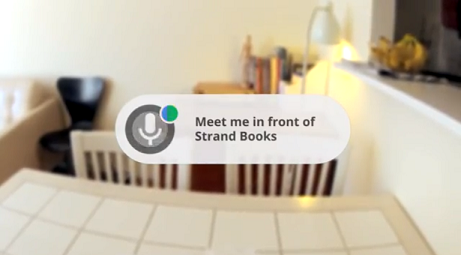
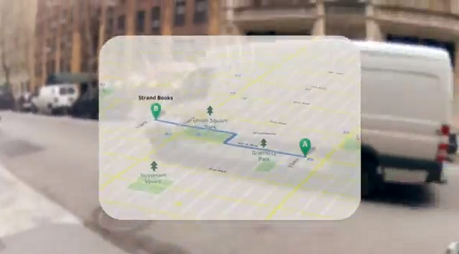
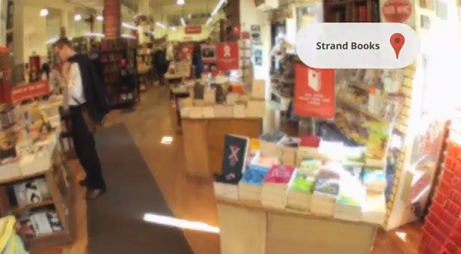
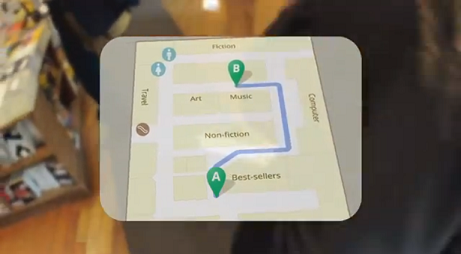
Let me put that another way, using the analogy of Google glasses. Zen takes you behind words: you can still see them, you can see through them. Very quickly, then, since 5 images are worth 5,000 words and take a lot less time to ingest:

Wearing some futuristic Google Glasses, you would be able to…

Let your glasses know you want to go to the Strand Bookstore (great idea, btw!):

Get yourself a quick map from there to here, visible but superposed on your natural ability to see the street:

Know when you’ve arrived at the bookstore (a) because you can see the books and (b) because your glasses tell you so.

Use a map to navigate to the Music section:

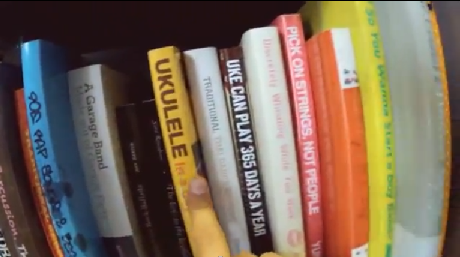
And locate the Ukulele shelf:

When IMO you’d be better off reading about Johann Sebastian Bach — though that’s a matter of personal taste.

With zen, your thoughts and emotions are like head- and heart-mounted displays — you can see them, they can inform your understanding, but you can also see through them, they’re transparent. You can see the world.

**

I’m going to suggest my own definition of intelligence: it’s the ability, given some data point or points, to recognize a variety of salient patterns into which it or they fit, and to create a synthetic understanding of how to move, given that all those salient pattern-fields are in play.

It is seeing in depth, past the surface, where the surface is your assumptions and expectations, and depth is the currents and undercurrents of nuance that your expectations hide.

Let me say that another way: assumptions and preferences — taking sides, being on a team — deprive you of depth. And another: the opposite of surface / superficial thinking is depthful thinking / pattern-recognition.

That, in a nutshell, is why I feel intelligence and zen “go together” even more seamlessly than zen and bikers.

**

Here’s Clapper’s speech:

**

In a future post, I hope to tackle the question of koans — those strange zen riddles, of which the best known may be…

What is the sound of one hand clapping?

Form is insight: the funnel, part 1

Thursday, October 11th, 2012

[ by Charles Cameron — a post in my importance of form in intelligence series — Afghanistan, the complexity — also a Blackfoot Tale from Grinnell ]
.

Funnel image credit: Oxsite

.

One of my favorite tales of all time is the Blackfoot legend of The Bull Band, which begins thus in Grinnell‘s telling:

The people had built a great pis’kun, very high and strong, so that no buffalo could escape; but somehow the buffalo would not jump over the cliff. When driven toward it, they would run nearly to the edge, and then, swerving to the right or left, they would go down the sloping hills and cross the valley in safety. So the people were hungry, and began to starve.

Somehow I’d come by a sense that the pis’kun was a sort of funnel – perhaps from Joseph Campbell, whom I once heard tell this tale in his own words – and today I looked around my foolscap-sized screen and discovered that John Canfield Ewers reports what he calls a “buffalo fall” pretty much how I’d imagined the thing, in his Indian Life on the Upper Missouri:

The Piegan band called Never Laughs was camped on the Teton River a few miles north of the present town of Choteau. Their chief announced, “Now we are going to make a buffalo fall.” They built a corral below the cliff and piled rocks in a great V-shape on the slope above the fall. Then they chose a man to lead the buffalo to the fall. But each time he lured them in between the lines of rocks they broke away before they reached the cliff edge. After this had happened three times, young Many Tail Feathers became angry…

So that’s the shape I’m thinking of here: “a great V shape” – let’s call it a funnel.

**

I want to use the funnel to illustrate a movement in time, an imperative in intelligence, and a loss in nuance.

First, some background.

**

We are in a tricky situation here, because our minds would like to grasp a problematic reality (which resembles a landscape) by means of a thought (which resembles a road sign).

What’s up in Afghanistan?

Drought, and a huge humanitarian catastrophe, say those whose eyes are focused on human beings as fellow creatures in need of food, water and shelter. Preparations for getting the oil in Khazakstan to market, say those who focus on geology, resources, economics. The start of a strategic corridor that also includes Tibet and Kashmir, contested by India and Pakistan, the nuclear locals, and Russia and China, the nuclear regionals, in a four-sided tug of war. Islam itself, the religion of God, or a perverse and puritanical variant thereof. Or one man, Osama bin Laden.

Clearly a complex landscape – and we would like, depending which road sign we follow, to bomb the shit out of them, bring in truckloads of food and medicines, establish a stable government with which to ink a pipeline deal, export their Wahabi brand of Islam to the world — or discreetly support the US in its mission to extirpate the terrorists of Al-Qaida without rousing the more fundamentalist and simplistic of our citizens to topple the government and institute a radical Islamist state.

So much depends on whether we are in Peshawar or the Pentagon, in poverty or power. So much depends on our perspective, and the parallax it brings with it.

Because no matter what point of view we choose to consider the landscape from, some parts of the terrain will seem so close together as to be indistinguishable which we can understand to be worlds apart if we can only view them from another angle, in a different perspective.

I am not arguing for moral relativism. I am arguing for a recognition of complexity, and for an admission that sound bites and white papers cannot handle this style of problem. I have painted a highly impressionistic portrait of the complexities at work here, where China touches the tip of the eastwards panhandle of Afghanistan, where Kandahar can stand proxy for Jerusalem, where the national sport is a sort of polo with a goat’s head for a ball, and the tea served in thin, curved glasses is green and sweet.

**

I have checked Google and Dogpile, and as far as I can tell from poor memory, my sense of my own style, and the absence of the same text in the search engines, the above is my own work — the text of the bulk of which I found somewhat haphazardly on my hard drive while working on Part 2 of this post. If anyone else claims copyright, count me an admirer and let me know. I believe it’s “mine” for whatever that concept may be worth, I’m skeptical about solo creativity in any case, myself.

In part 2 of this post, which is definitely almost all borrowed from bright other beings, I’ll try to illustrate the funnel as it applies to America, Afghanistan, Obama and Osama, in a series of “zeroing in” quotes illustrating the complexity of the situation and analysis as contrasted with the “yes” of a kill-decision…

Of the importance of form in intelligence: I

Wednesday, October 3rd, 2012

[ by Charles Cameron — form as pattern recognition, the form of suicide / martyrdom ops, a format for analysts, first in a series on form in intelligence, and maybe the beginnings of an eccentric thinking manual for analysts ]
.

Bear with me for a paragraph or two, while I try to sort something out.

Form is to content as algebra is to arithmetic: does that work for you? Form is one degree more abstract than content: how about that? I don’t think either of these expressions quite captures what I want to say about form and content, but they may help us think about form. Here’s a form:

It’s pretty clearly a diagram of connections of some sort, but exactly what those connections are is unclear as long as the various boxes in the diagram remain empty.

I could fill it with the names of members of a hippie commune that practiced a flexxible approach to free love over a decade or two, from when the founder bought the farm (in the literal sense of real estate) to the point where the last surviving member bought the farm (metaphorically speaking — the farm in the sky).

Or with the names of elements in the human digestive and energetic system…

I mention the latter, because I came across this particular (empty) diagram on a blog post by a certain Jacques Chester about how people get fat, where it was preceded by the words:

A better diagram for bodyweight control will resemble a great big mess

I won’t tell you where I got the other idea from, if you want to know you’ll just have to fantasize, as I did.

**

At least in this case, form means pattern. The diagram above is a pattern, fill it with appropriate verbal or other content and you’ll give it meaning — which can then be disputed or accepted. But the form, the patterning, is somehow antecedent to any particular content.

Take the last words of each line of Shakespeare‘s Sonnet XCVII and you’ll get:

been, year, seen, everywhere, time, increase, prime, decease, me, fruit, thee, mute, cheer, near.

The rhyme scheme is pretty clear: ABAB CDCD EFEF GG.

That’s a form, and all of Shakespeare’s sonnets follow it. Petrarch‘s sonnets by contrast follow the rhyme scheme ABBA ABBA CDECDE.

**

In my practice of thinking, as a poet and as a practitioner of the open source analysis of scriptural sanctions for religious violence, I find the recognition of forms — pattern recognition — to be my central process.

I think what first really brought this home to me was the similarity of form between two reports of terrorist training activities — each in its own way illustrating the idea that the activity to be performed will begin quite naturally on earth, where training is required, but end quite supernaturally in paradise, where it isn’t:

That one’s pretty obvious, right? I mean, if you’ve seen the first instance you would be pretty likely to remember it if you ran across the second…

And what the form means is pretty clear too — martyrdom ops, suicide ops.

But what if you had a note-pad on your desk — or better, a game format on your computer — that gave you those two boxes, free of specific data, and any time you found a weird or anomalous data-point or image you could scribble it or drag-n-drop it into that form, give it a name for easy retrieval, and keep your eyes peeled for parallels, opposites, similars?

I call that format SPECS, by the way, because it allows you to see two similar ideas stereoscopically, so to speak, and thus gain an extra dimension — neat trick, eh?

What if collecting SPECS was part of your training as an analyst, and you practiced the form a few hundred times and kept 150 mind-blowing examples — as Shakespeare did with his ABAB CDCD EFEF GG sonnets?

**

Why, you’d be training yourself in pattern recognition — formal thinking — horizontal thinking — lateral thinking — analogy — thinking by leaps and bounds.

Inteligence happens in the Intelligence Community, and in the human population as well. I can’t speak to the ways in which animal and plant mimicry, or the artistry of birdsong, correspond to pattern recognition, although that would be a fascinating topic for another post.

What I can say is that analogical, horizontal, cross-disciplinary thinking is in its own away more powerful than logical, rational, vertical, silo-bound thinking.

**

In terms of Intelligence and intelligence, the strategies of linear / vertical thinking are like your fingers: it’s your skill at lateral / horizontal thinking that gives your mind an opposable thumb.

Games of telephone and counter-telephone?

Wednesday, October 3rd, 2012

[ by Charles Cameron — embassy or consulate — a minor detail for an editor, perhaps, but all the difference in the world for Ambassador J Christopher Stevens ]
.

Here’s a screen grab of a piece posted on the Atlantic site today:


.

The article itself is worth your time, and I’ll get back to the screen grab later. Here’s the text para that interests me:

In the famous “Bin Ladin Determined to Strike in US” Presidential Daily Brief of August 6, 2001, one of the major analytic points was that “Al-Qa’ida members — including some who are US citizens — have resided in or traveled to the US for years, and the group apparently maintains a support structure that could aid attacks” (emphasis added). Notice that this analysis uses two hedges in a single sentence. Given the lack of certainty on the issue, such linguistic dodging made sense — as it does in report after report where individuals are discussing information below the level of actionable intelligence.

Leah Farrall has been tweeting about the way this characteristically cautious phrasing used by analysts gets lost as “the higher up the food chain an analytical report goes the greater the tendency for bosses in [the] food chain to add their two cents worth” — so that by the time it reaches the politicians, “there is absolutely WMD.”

The shift from “apparently” to “absolutely” is an interesting one.

**

The 2007 National Intelligence Estimate featured a section on the nomenclature of such distinctions, which I trust and imagine was directed more at its readers than towards the analysts who produced it:

What We Mean When We Say: An Explanation of Estimative Language

When we use words such as “we judge” or “we assess”—terms we use synonymously — as well as “we estimate,” “likely” or “indicate,” we are trying to convey an analytical assessment or judgment. These assessments, which are based on incomplete or at times fragmentary information are not a fact, proof, or knowledge. Some analytical judgments are based directly on collected information; others rest on previous judgments, which serve as building blocks. In either type of judgment, we do not have “evidence” that shows something to be a fact or that definitively links two items or issues.

Intelligence judgments pertaining to likelihood are intended to reflect the Community’s sense of the probability of a development or event. Assigning precise numerical ratings to such judgments would imply more rigor than we intend. The chart below provides a rough idea of the relationship of terms to each other.

We do not intend the term “unlikely” to imply an event will not happen. We use “probably” and “likely” to indicate there is a greater than even chance. We use words such as “we cannot dismiss,” “we cannot rule out,” and “we cannot discount” to reflect an unlikely—or even remote—event whose consequences are such it warrants mentioning. Words such as “may be” and “suggest” are used to reflect situations in which we are unable to assess the likelihood generally because relevant information is nonexistent, sketchy, or fragmented.

In addition to using words within a judgment to convey degrees of likelihood, we also ascribe “high,” “moderate,” or “low” confidence levels based on the scope and quality of information supporting our judgments.

• “High confidence” generally indicates our judgments are based on high-quality information and/or the nature of the issue makes it possible to render a solid judgment.
• “Moderate confidence” generally means the information is interpreted in various ways, we have alternative views, or the information is credible and plausible but not corroborated sufficiently to warrant a higher level of confidence.
• “Low confidence” generally means the information is scant, questionable, or very fragmented and it is difficult to make solid analytic inferences, or we have significant concerns or problems with the sources.

**

You could think of these as counter-telephone measures — attempts to avoid the distortions and corruptions that tend to arise when a message is passed from one person to another, And that’s important a fortiori when an ascending food-chain of transmitters may wish (or be persuaded) to formulate a message that will assure them the favorable attention of their superiors — but also because the higher the report goes, the closer it gets to decision-time..

As the Atlantic article says, this kind of “linguistic dodging” (aka attention to nuance) makes sense “in report after report where individuals are discussing information below the level of actionable intelligence.”

Inevitably there’s a shift in tempo between contemplation and action.

**

Anyway, messages tend to get distorted as they’re passed along.

Consider, for instance, the caption to the photograph that graces the Atlantic piece at the top of this post:

The U.S Embassy in Benghazi burns following an attack in September. (Reuters)

There’s only one problem there. The US didn’t have an Embassy in Benghazi — they had a Consulate — and that’s not a distinction that lacks a consequence. Whatever else may be the case, Ambassador Stevens would certainly have been better guarded had he been back in Tripoli in his embassy.

Whoever wrote that caption wasn’t as deeply immersed in the situation as the former CIA analyst who write the article. And when you’re not deeply immersed, it is perilously easy to get minor but important details wrong.


Switch to our mobile site