zenpundit.com » cognition

Archive for the ‘cognition’ Category

Frederick the Great, Baron Von Steuben, and the Value of Practice, Practice, Practice

Tuesday, April 3rd, 2012
[by J. Scott Shipman]
Frederick the Great

.

During a recent trip to London, I took along John McAuley Palmer’s Washington – Lincoln – Wilson Three War Statesmen. Previously I reviewed Palmer’s excellent and informative America in Arms, so I’ve been looking forward to this follow-up. While I’m not finished with Washington (on about page 90), this one is a much tougher read than the first, but I’m going to press on as I can make the time among competing work and books.

What I wanted to share with you was an excerpt from Palmer’s remarks on Baron Von Steuben’s Prussian military background.

Friedrich Wilhelm August Heinrich Ferdinand von Steuben

.

Von Steuben, in many respects was Washington’s ace at organizing, equipping, and training the army—a job for which Von Steuben was eminently qualified. His was the latest training in the methods of Frederick the Great and his vaunted what was to become his Prussian General Staff. (many thanks to Seydlitz for correcting my error)

For training, Frederick used what he called the “applicatory method.” This sounds a lot like Fred Leland’s cutting edge law enforcement training and Don Vandergriff’s work with the US Army. Here are a few quotes:

“He found that military success depends, not upon profound theoretical knowledge, but upon sound judgement and quick resolute decision under stress. Directing a successful attack is therefore not the same thing as writing an essay about it. It is a question of grasping a situation, making a practical decision, and issuing intelligible orders to the several parts of a military command. It is a question of not merely knowing but of doing. (emphasis, Palmer, pages 42-43)

“This led Frederick to form the habit of giving himself tactical problems in his daily walks and rides. Carlyle gives us the following interesting glimpse of the great king after he had become a distinguished and successful general:

For Friedrich is always looking out, were it even form the window of his carriage, and putting military problems to himself in all manner of scenery. What would a man do, in that kind of ground, if attacking, if attacked? With that hill, that brook, that bit of bog? And advises every officer to be continually doing the like. That is the value of picturesque or other scenery to Friedrich. (emphasis mine)

“From making this a method of self-culture to making it a means of instructing others is but a step…It is the continual test of judgement, of decision, and of facility in issuing effective orders.” (Palmer, page 43)

Frederick also used this training method as a “tactical measuring rod” to help determine the competency of his leadership.

Von Steuben proved Frederick’s methods with Washington’s army. But what struck me was the simple power of establishing and maintaining good habits that promote, practice, enable coping with dynamic environments, and the exploitation individual curiosity and action. Frederick institutionalized his “self-culture” into his meta-culture and so did Von Steuben in turn.

This type of practicing; the continual maintenance of good habits will help ensure a competitive posture in just about any field. Further, Frederick practiced ad hoc—wherever he was, he was thinking through the lens of his profession and asking relevant questions of himself and his subordinates—further lessons for today’s leaders, regardless the profession.

Looking, paying attention, and thinking is free—so even in declining budgets we should follow the example set by Frederick and Baron Von Steuben in his turn.

Cross-posted at To Be or To Do.

Of Kony and Constellation

Friday, March 23rd, 2012

[ by Charles Cameron — non-linearity, complexity, “constellational thinking”, a quick spin around the blogosphere, history, Walter Benjamin — following on from Nancy Fouts ]
.


image: Galileo Galilei, Siderius Nuncius (i.e. The Starry Messenger), 1610

.
The novelist Teju Cole has a piece in the Atlantic that’s triggered by the Kony2012 business, and zooms out to touch on much else besides. His piece is titled The White Savior Industrial Complex, and as I was reading it, I came across a phrase that tweaked my keen interest. Cole is talking about Nicholas Kristof, and writes:

His good heart does not always allow him to think constellationally. He does not connect the dots or see the patterns of power behind the isolated “disasters.” All he sees are hungry mouths, and he, in his own advocacy-by-journalism way, is putting food in those mouths as fast as he can. All he sees is need, and he sees no need to reason out the need for the need.

By my lights, “he sees no need to reason out the need for the need” is a powerful tongue-twister, but it’s the phrase “to think constellationally” that interests me here.

Cole returns to a slight variant on the phrase later, this time saying:

Success for Kony 2012 would mean increased militarization of the anti-democratic Yoweri Museveni government, which has been in power in Uganda since 1986 and has played a major role in the world’s deadliest ongoing conflict, the war in the Congo. But those whom privilege allows to deny constellational thinking would enjoy ignoring this fact.

Constellational thinking, then, connects the dots, sees the patterns behind isolated events, sees not just the events themselves but also the circumstances that caused them – and its absence allows us to reduce complexly-interwoven reality to one or more simplistic polarities — better suited to sound bites than to analysis.

*

Cole also points us to Rosebell Kagumire‘s video response to the Kony affair, and she in turn has her own way of addressing the same kind of reduction of complexity to simplicity. She wrote, back on March 8th:

For the last many hours i have followed a campaign by Invisible Children NGO called KONY2012 that has gone viral getting more than 20 million hits on Youtube. I am a story teller and i know the danger of a single story.

So simple, that: I know the danger of a single story.

Remember the Ocean of the Streams of Story diagram in my post almost a week ago, Countering Violent Extremism: variants on a theme? Edward Tufte designed it, to illustrate a paragraph by Salman Rushdie

The truth of a complex situation lives in the interweaving of many stories, not in a single strand, a single view.

*

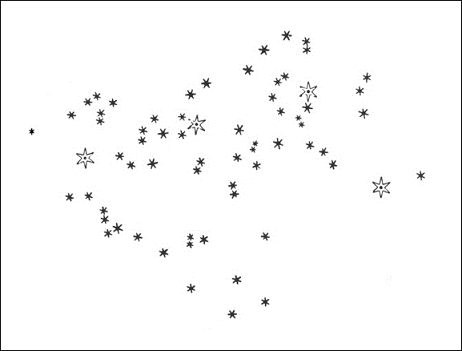
Constellations — of thoughts, of ideas.


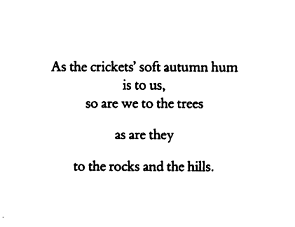
image: Eugen Gomringer, Constellation, ca 1960

I did some digging – I’m not the Oxford English Dictionary, and I can’t say for sure that any particular use of “constellation” marks its first appearance in the sense that interests me here – Eugen Gomringer‘s Constellations (from 1954 onwards, example above) may be relevant in an avant-garde way– but my search brought me to a post by Liz Danzico at Bobulate titled Celestial History, in which Liz wrote:

Teaching constellations is an exercise in storytelling. You see, dots, these anonymous light encrusted patterns, must be memorized and categorized, and it’s only through stories that one can make sense of them. Starting with the north star, and systematically creating relationships in the winter sky among Hercules and Sagittarius, Libra and Polaris, we told tales. We’d trade stories on top of the old stone building in the middle of dark campus until late into the night. Creating these stories, giving Hercules a relationship to Cassiopeia — true or not, good or not, believable or not, it didn’t matter — what mattered were that patterns were found and marked.

Marking patterns and making content accessible through stories is what we do. And often, still, when we begin, we’re in the dark.

*

This post in turn lead Robin Sloan at Snarkmarket to write a quick note of praise, Explosions in the sky, which drew a comment from Tim of Short Schrift that said:

After the Copernican revolution, a constellation isn’t even a constellation. Instead, it’s a two-dimensional flattening of a three-dimensional reality. Actually, we should probably say a FOUR-dimensional reality. The light from stars at varying distances, leaving their sources at various times in the distant past, gets mistaken, from our earthbound point-of-view, as a simultaneous two-dimensional pattern.

BUT! That distortion, that accident, produces something extremely powerful — both imaginatively and practically.

Take “constellational thinking” and apply it to something besides stars in space. Let’s say — history.

Over here, you’ve got the Roman Republic, over there, the French Revolution. Distant in time, distant in geography, no kind of causal proximity let alone a relationship between them.

But bam! Slap them together. View them as a single event, a collapse of time.

Now you begin to see the French Revolution the way part of the Revolution saw itself, as an explosion of the continuum of history.

Now — and sorry if I slow-played this — you’re in Walter Benjamin’s “On the Concept of History.” Now you’re performing a genuinely three-dimensional nonlinear reading of historical time.

Consider that process, spelled out in the phrases “Distant in time, distant in geography, no kind of causal proximity let alone a relationship between them. But bam! Slap them together. View them as a single event, a collapse of time.”

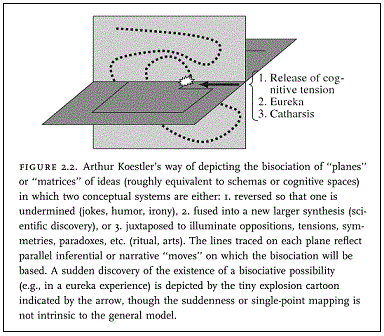
Consider how that “fits” the same Arthur Koestler model of thinking I was on about yesterday in my post Nancy Fouts and the heart of the matter, in which I described:

the “release of cognitive tension” that occurs when some form of analogy, similitude, overlap allows the mind to join conceptual clusters from two fields in a “creative leap”

*

Well, I’m not along in finding this sort of thing useful. Here’s bethr from Mixed Bits writing on tumblr:

Constellational thinking

Omigosh… I’ve been using this phrase in numerous conversations for at least 4 years, usually when attempting to describe how I seem to process information and think, in contrast to the linear thinking which is more prevalent and encouraged in my profession. I’ve never heard anyone else use this phrase…it excites me that others have applied the same phrase and metaphor to the same idea and have articulated it much better than I ever have.

*

And Walter Benjamin:


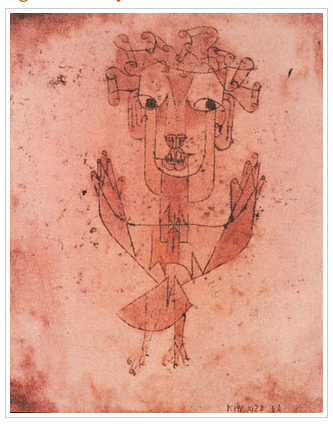
image: Paul Klee, Angelus Novus, 1920

Turning to Walter Benjamin’s On the Concept of History for a moment, we find a remarkable and justly celebrated paragraph about the angel depicted above, a 1920 Paul Klee painted etching which Benjamin himself once owned, now housed in the Israel Museum, Jerusalem:

There is a painting by Klee called Angelus Novus. An angel is depicted there who looks as though he were about to distance himself from something which he is staring at. His eyes are opened wide, his mouth stands open and his wings are outstretched. The Angel of History must look just so. His face is turned towards the past. Where we see the appearance of a chain of events, he sees one single catastrophe, which unceasingly piles rubble on top of rubble and hurls it before his feet. He would like to pause for a moment so fair, to awaken the dead and to piece together what has been smashed. But a storm is blowing from Paradise, it has caught itself up in his wings and is so strong that the Angel can no longer close them. The storm drives him irresistibly into the future, to which his back is turned, while the rubble-heap before him grows sky-high. That which we call progress, is this storm.

*

More prosaically, Benjamin then gives us the twinned realities to which Tim had pointed in his comment at Snarkmarket:

For Robespierre, Roman antiquity was a past charged with the here-and-now, which he exploded out of the continuum of history. The French revolution thought of itself as a latter day Rome. It cited ancient Rome exactly the way fashion cites a past costume. Fashion has an eye for what is up-to-date, wherever it moves in the jungle of what was.

*

Benjamin’s “moment” — his here-and-now — has passed, perhaps. The nuances discoverable through juxtaposition, counterpoint, overlay, constellational thinking, remain.

Nancy Fouts and the heart of the matter

Thursday, March 22nd, 2012

[ by Charles Cameron — Nancy Fouts, sculpture, juxtaposition, essence of creativity, pocket universes, Arthur Koestler, Mark Turner ]
.

Nancy Fouts is an American artist based in London. I ran across her work a while ago thanks to Michael Weaver on Google+, and was immediately struck by the intensity of her images, each one of which seemed like a landmark from a larger geography, more precisely focused and dense with meaning than our own world usually appears to be.

First impression:

.
The first image I saw was of a snail on the straight edge of a razor blade (above, left) — an image out of the script of Apocalypse Now to be sure, but presented by Fouts in sharp detail and unadorned by any other context, visually, direct from eye to mind and heart.

This may be the image many people first see of her work — very, very striking, exquisite, terrifying if you allow it to be so, and yet as clear and simple, almost, as a single drop of water on a leaf.

Singer and song:

.
But it was this next image that conquered me:

The juxtaposition is impeccable: sewing machine, record on turntable – and the overlap between the two, the link, the vesica piscis between them, is the needle.

The music of Bach, Handel, and Vivaldi — particularly on harpsichord — has been disparagingly called “sewing-machine music”. If that phrase gave rise to this marvelous image, perhaps the slight can be forgiven.

The sewing-machine? It’s a Singer. And in what must surely be an ironic, gender-influenced choice coming to us from an artist so assured and exacting — the music that the needle draws from the groove of the record is, as you can tell from the record label, the music of His Master’s Voice.

Philosophical aside:

.
I have pointed before to this diagram from Mark Turner‘s The artful mind: cognitive science and the riddle of human creativity, based on those in Arthur Koestler‘s The Act of Creation (eg those on pp 35 and 37):
koestler-model.gif

It shows the essence of the creative act — the “release of cognitive tension” that occurs when some form of analogy, similitude, overlap allows the mind to join conceptual clusters from two fields in a “creative leap”.

Nancy Fouts’ work doesn’t merely make use of such twinned field overlaps, it makes twinned fields with overlap the defining quality of her works.

She is aiming right at the heart of the creative process. And it shows.

Moving further afield:

.
In that earlier post of mine, I talked about Ada, Countess of Lovelace, and noted that her analogy between Charles Babbage‘s Analytical Engine and Jacquard‘s mechanical loom, famously expressed by her thus:

The Analytical Engine … weaves algebraic patterns, just as the Jacquard-loom weaves flowers and leaves.

was precisely the creative leap that led to the us of punched card systems in computation from Babbage to Watson…

I could give other examples. The Taniyama-Shimura conjecture which formed the basis of Andrew Wiles‘ proof of Fermat‘s Last Theorem, bridges two previously distinct branches of mathematics precisely by showing that for every elliptic curve, there is a related modular form

And no, I don’t understand the mathematics. But I understand the concept of twinned fields, and the power of their overlap.

Some favorite tropes:

.
Back, then, to Nancy Fouts:

One thing that interests me about her work is that she has a few simple “essences” that she returns to time and again: in this case, bees, forms that resemble honeycombs, and by implication, honey.

In my own work, making similar connections between what we might paradoxically call “kindred ideas in unrelated fields” — I might set Nancy’s honeybees across from the verse from the Upanishads [Brihadaranyaka, fifth Brahmana, 14] which says:

This Self is the honey of all beings, and all beings are the honey of this Self.

Another of Nancy’s tropes connects nature and music…

The piercing:

.
And thimbles, those miniature emblems of armor and protection, are another recurring theme:

Let’s take a look at that last image, of the thimble transpierced by a needle.

I believe it has a history — again, accessible via an associative leap. Here are three images of the “wounded healer” motif, two of them specifically images of the Inuit shaman who has harpooned himself — a motif which the anthropologist and zen roshi Joan Halifax writes “captures the essence of the shaman’s submission to a higher order of knowing”:

Armor, the defenses we have in place to protect our selves, and vulnerability, the ability to to allow our selves to be wounded, so that the “self” which is “the honey of all beings” may shine through us. The paradox of Selflessness and Self.

Koan and sacrament:

.
Among wounded healers, we might count the crucified Christ, his side pierced by the spear of a Roman soldier — and here I might suggest that Fouts contrasts (image below, left) the self-sacrifice at the heart of Christianity with the pugilistic approaches of some proponents of his message:

And the image of Christ (right) balancing on a high wire?

Again I’m reminded of the language of shamanism. The anthropologist Barbara Myerhoff studied the religious beliefs and practices of the Huichol or Wixaritari of the Mexican Sierra Madre Occidental, with Ramon Medina Silva, a mara’akame or shaman of the tribe.

In her book, Peyote Hunt: The Sacred Journey of the Huichol Indians, she describes a feat of balance that Ramon performed, which appeared to serve a “sacramental” function for his people – providing them with what Cranmer‘s Book of Common Prayer calls “an outward and visible sign of an inward and spiritual grace”:

One afternoon Ramon led us to a steep barranca, cut by a rapid waterfall cascading perhaps a thousand feet over jagged, slippery rocks. At the edge of the fall Ramon removed his sandals and told us that this was a special place for shamans. We watched in astonishment as he proceeded to leap across the waterfall, from rock to rock, pausing frequently, his body bent forward, his arms spread out, his head thrown back, entirely birdlike, poised motionlessly on one foot. He disappeared, reemerged, leaped about, and finally achieved the other side. We outsiders were terrified and puzzled but none of the Huichols seemed at all worried. The wife of one of the older Huichol men indicated that her husband had started to become a mara’akame but had failed because he lacked balance.

It’s easy to read the description — but by no means as easy to keep one’s balance — something that Fouts’ image perhaps suggests more vividly than words easily can.

Richard de Mille describes the mara’akame‘s function in Huichol society as to “cross the great chasm separating the ordinary world from the otherworld beyond,” and suggests that Medina Silva’s feat of acrobatics on the barranca that day is to be understood as offering “a concrete demonstration in this world standing for spiritual balance in that world.”

Myerhoff herself was never entirely sure whether Medina Silva was “rehearsing his equilibrium,” or giving it “public ceremonial expression” that afternoon: it is clear, however, that for the Huichols, such feats of balance possess a resonance and meaning that extends beyond the “merely” physical.

Bringing the viewer into the picture

.
I may of course be projecting some of my own ideas onto Nancy Fouts’ work — and indeed, perhaps that’s the point.

She has some pretty fierce observations to make concerning matters religious — Christian, Buddhist and other — and I’ll leave those who are interested to make their own discoveries on her website. I don’t doubt there are places where her sympathies and my own overlap, and others where we differ.

Fouts speaks a direct and visceral language of images — and her juxtapositions, carefully chosen and choreographed as they are, provoke us to feel and think.

Thank you, Nancy.

No need to reach for the gun, fellas — but that’s art.

_________________________________________________________________________________________

credits for images of Harpooned Shaman: Charlie Ugyuk (left); David Ruben (right).

The Said Symphony: move 19

Sunday, March 18th, 2012

[ by Charles Cameron – extended analytic game on Israeli-Palestinian conflict — for those who wish to catch up, our game thus far consists of an intro to the game and game board, followed by moves 1-5, 6-9, then moves 10-11 which together constitute a meditation, moves 12, 13-15, 16-17, and most recently before this, move 18 with cadenza ]

Move 19: The view from above

Move content:

Discussing strategy, the very canny LTG (USMC, Ret’d.) Paul Van Riper had this to say:

What we tend to do is look toward the enemy. We’re only looking one way: from us to them. But the good commanders take two other views. They mentally move forward and look back to themselves. They look from the enemy back to the friendly, and they try to imagine how the enemy might attack them. The third is to get a bird’s-eye view, a top-down view, where you take the whole scene in. The amateur looks one way; the professional looks at least three different ways.

A bird’s-eye view, a hawk’s eye view, a top-down view, an overview, a view from 30,000 feet, a God’s eye view, a view from above, a zoom…

If move 18 and its cadenza gave us a view of the depth of vision or insight that is necessary for a full and rich understanding of the world we live in — its qualitative or spiritual scope, if you like — this next move, with its picnic and drone-sight, addresses its breadth in space and time — materially and quantitatively speaking.

The classic expression of the sheer material scope of the universe was put together by Charles and Ray Eames in their justly celebrated film, Powers of Ten, from which the lower of these two images is drawn:

Here are some other relevant scans of the scope of things, in terms of time and space:

The Scale of the Universe 2
A Brief History of The Universe
The Known Universe
A Time-Lapse Map of Every Nuclear Explosion Since 1945

These are impressive videos to be sure, but as an aside I’ll invite you to ask yourselves how well they compare with this zoom in words, a poem by the zennist, ecologist, essayist and poet Gary Snyder, from his book, Axe Handles: Poems:

Such breadth of vision, such craft.

*

If this “material scope of things” too has a cadenza, it would be that all of this is shot through with some primary oppositions, dappled as the poet Gerard Manley Hopkins would have it, with swift, slow; sweet, sour; adazzle, dim — as indicated in the drone-sight and picnic double image at the head of this move.

This dappling, this constant flux of opposites, takes many forms — day and night lead to the more abstract light and dark, which can then be interpreted morally as good and evil, to which we respond with repulsion and attraction as the case may be, building our worldviews from love or fear…

At different scales the opposites that matter most to us may have different names and shadings, but here I’d just like to draw attention to the dappling of our world with:

competition and cooperation
Darwin‘s natural selection and Kropotkin‘s mutual aid
duel and duet (ah! — a favorite phrasing of mine)
war and peace

Provocatively, we find this dappling in scriptures, too, wherein the ripples of such verses as “The LORD is a man of war: the LORD is his name” (Exodus 15.3) dropped like a stone into the pond of the human mind, meet with the ripples of other verses such as “God is love; and he that dwelleth in love dwelleth in God, and God in him” (I John 4.16).

There are times when we take such oppositions literally, perhaps too literally, and times when we begin to see oppositions as abstract and theoretical end-points to what is in fact a yin-yang process continually unfolding…

Which brings me by a commodius vicus of recirculation to this image of the great opposition between war and peace, its dappling, its unfolding:

Links claimed:

To the Lamb, move 18: this move presents the material scope of the universe in counterpoint to its visionary scope as laid out in move 18 with its cadenza.

To Revelation, move 17 — the word revelation means unveiling, as we have seen, and our sciences and technologies, with their spectra of telescopes, microscopes, cameras and zooms, are unveiling and revealing to us much about the physicality of the world we live in — much that was accounted for in other times and places through intuition, vision and poetry.

This scientific and technical revelation of material existence, for many of us moderns, has largely eclipsed the mode of visionary revelation of move 17 — yet it cannot eradicate it. Implicit in this move, then, is the sense that we carry with us both subjective and objective, inner and outer, qualitative and quantitative understandings — though the data that “sight” and “insight” provide us with may be different in kind, and resolving them may be something of a koan to us, the deep problem in consciousness as philosophers of science have named it — and that we can discount neither one if we are to have and maintain a rich sense of our situation.

Comment:

If the two previous moves have shown us the scope of the universe we co-inhabit, perhaps we should now make our own zoom in, much as James Joyce did when he had the schoolboy Stephen inscribe his name and address in his geography book as Stephen Dedalus, Class of Elements, Clongowes Wood College, Sallins, County Kildare, Ireland, Europe, The World, Universe – an address that Stephen then read both forwards and backwards, finding himself in one direction, and finding in the other that he had no means of knowing what might lie beyond the universe…

Imagine then, skipping rapidly from (unimaginable) cosmos via such things as the intriguingly named End of Greatness to galaxy or nebula…

…solar system and planet — whence we can slow down and zero gently in on the Middle (or as my friend Ralph Birnbaum would call it, the Muddle) East, Israel / Palestine, Jerusalem / Al Quds / the Temple Mount / Noble Sanctuary – and to such matters of contemplative vision and tribal passion as the first, second and projected third Temples, the al-Aqsa mosque.

Our increasing focus will bring us, then, to that the rock which Jews believe marks the place where Abraham bound his son Isaac (the Akedah), and which Muslims believe to be the place of ascent of the Prophet to the celestial realms (the Mi’raj) on his Night Journey (Qur’an, Al-Isra).

Here again myth and history collide, and both visionary and material considerations merge in the heart of the what my friend the Israeli journalist Gershom Gorenberg has justly called “the most contested piece of real estate on earth”.

One quick illustrated quote from Secretary Clinton

Wednesday, March 14th, 2012

[ by Charles Cameron — sometimes i post things so obvious they might actually be useful ]
.

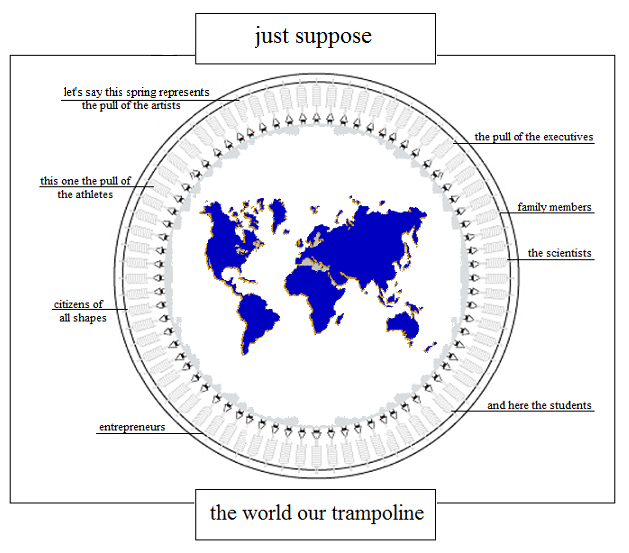
One quick annotated quote from Sec. Clinton‘s speech at the U.S. Institute of Peace China Conference, March 7th:

Now when I say “we,” I do not mean only our governments, as important as they are. Every day, across both of our countries, executives and entrepreneurs, scientists and scholars, artists and athletes, students and teachers, family members and citizens of all kinds shape and pull and add to this relationship. Together, they represent a vast range of priorities, concerns, and points of view. And they are all stakeholders in how we build toward a shared future.

It’s really that list I’m after…

There are seven billion individuals bouncing up and down on our trampoline, some of them holding hands, some of them in gangs that want to trip up rival gangs, or make a clearing for themselves and themselves alone, some too weak to bounce much at all…

and each time each one of us lands, we impact the trampoline from a different angle, stretch it a different way – tugging it to the will of the artist, the entrepreneur, the child, the retiree, the curious, the aggressive, the meek…

As we know, the earth is round, which is to say three-dimensional – but the tugs on it, the tensions, are more complicated than that, in fact they’re complex, n-dimensional – and constantly shifting.

Hilary Clinton wants to wake up in the morning, have coffee – and model that! – along with, and in balance with, her counterpart in another huge mass of population, half a globe and at least six philosophies away…

The coffee’s good, but it’s not enough — what we all could use is a new mode of thinking.

*

Maps courtesy of www.theodora.com/maps used with permission


Switch to our mobile site