zenpundit.com » cognition

Archive for the ‘cognition’ Category

John Robb on the OODA Loop

Thursday, December 1st, 2011

John Robb at Global Guerrillas had a nice primer on John Boyd’s OODA Loop recently and he put on a twist that I thought was very useful:

HOW TO WIN ANY CONFLICT

….I’m Inside Your OODA Loop

How does all of this apply to conflict?  The simple answer is that conflict, in its most basic form, is a contest between decision making loops.  The side with the FASTER and BETTER decision making loop wins any conflict.  Why?  They adapt quicker.   Here’s some more detail:

A FASTER decision making loop means that you accomplish a successful OODA loop quicker than an opponent.  If you can do this, you are inside your opponent’s OODA loop.  This means that by the time your opponent responds to your last actions, you are already onto your next ones.  Get far enough ahead and the opponent’s decision making process will collapse and victory is assured.

A BETTER decision making loop?  That’s question that can lead to endless debates and theory crafting.  My approach to improving a decision making loop?  Connectivity.  The more connected a loop is, the better the decision loop is.  Connectivity falls into three categories:

  1. Mental — improves decisions by connections to a superior mental model of the current situation.  A superior model/strategy is predictive of events. It can tell you what data is important and what isn’t.  Weak strategies/tactics fall apart upon first contact w/enemy.
  2. Physical   — improves observation through connections to better sources of data, cleaner w/less distortion  — improves action by making it possible to actually accomplish the desired decision in the real world
  3. Moral — better orientation due to connections to strong traditions, extensive experience, and collected wisdom.  Training can help here.

The opposite is true also.  Damage an opponents connectivity, and their decision making loops are less effective.

One of the difficulties with discussing OODA is that many people who either oppose the concept or do not know much about it, will explain the OODA Loop only as “getting inside your opponents OODA Loop” in terms of the capacity to “go faster” -i.e cycle through your own OODA Loop faster than your opponent, making more decisions, taking more actions, leaving them in the dust, disoreinted and going into a downward spiral to defeat. Usually, misrepresented like this:

Ok, well going “faster” is a small part of it, but not sequentially and there’s neurological limits on this that arrive pretty quickly in terms of thinking speed in any case. Robb’s use of “BETTER” helps capture more of the critical and subtle qualitative nature of the “Orientation” box:
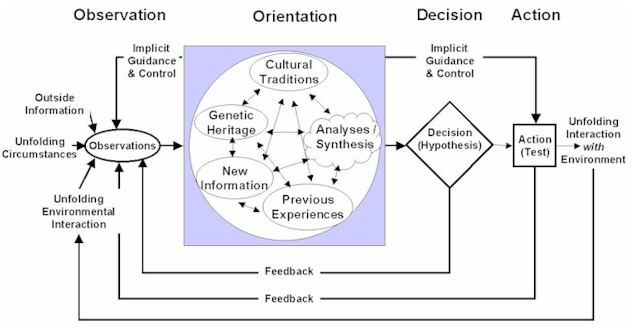
What are some of the possible effects of a “virtuous cycle” of better decisions?

Position yourself with more options
Gain new perspectives (“Observation”, “Orientation”)
Position yourself with the greatest comparative advantage (best option)
Lock in a comparative advantage
Position yourself with the longest potential decision tree (no quick “dead ends” or “cul de sacs”)
Change the tempo of interaction in your favor
Change the rules of interaction in your favor
Prevent a conflict with additional potential oponents
Lower your costs or increase theirs
Assure minimum gains
Arrive first
Increase or decrease the distance between yourself and your opponent
Broaden or narrow the field of conflict
Gain time
Seize or maintain the initiative
Define or redefine “victory”
Foreclose a critical option or set of options to your opponent
Force your opponent to act on your terms (“Check”)
Lower the morale of your opponent

Confuse, mystify or mislead your opponent
Attract allies or supporters
Increase your resources or potential maximum gains
Repair, remediate or replace previous losses

John is correct that “connectivity” helps you gain many of these benefits. 

Remember:

 “Being on the winning side is a lot more fun!”

ADDENDUM (Some interesting commentary on OODA):

Adam Elkus

I’ve Got the OODA Blues

Joseph Fouche:

Libeling Boyd

How Not to be Like Boyd

Who’s Afraid of Genghis John?

TDAXP, PhD

Variations of the OODA Loop 1: Introduction
Variations of the OODA Loop 2: The Naive Boydian Loop
Variations of the OODA Loop 3: The Sophisticated Boydian Loop
Variations of the OODA Loop 4: Pseudo-Boydian Loops
Variations of the OODA Loop 5: Post-Boydian Loops
Variations of the OODA Loop 6: Bibliography


Book

Sunday, November 20th, 2011

Thinking in Time by Richard Neustadt and Ernest May

Picked up this classic work on metacognition, history and strategic decision making for the astronomical price of…..$ 4. Including shipping.

The diminuition of the teaching of history in elite universities after the 1960’s, when the old undergraduate canon was chucked in deference to demands by student and faculty radicals for an a la carte system (to replace the old core with politicized race-gender-crit rubbish), has contributed to the decline in American strategic thinking.

Request for Information from the Readership

Thursday, October 27th, 2011

Need some help with a project at work. 

Looking to assemble a fast-and-dirty reading list for laymen that deals with the following topics:

Social intelligence, Emotional self-regulation, Emotion and learning, De-escalation of conflict, Attention, Self-Efficacy

Interested in both academic (for reference) and middlebrow (for distribution) titles, particularly those that contain interpersonal strategies and organizational culture angles. Links to journal or magazine articles or whatever else you deem useful will also be appreciated.

Fire away, the more the better.

More on Boyd & Beyond II and Boydian Theory

Wednesday, October 19th, 2011

Two posts of note:

USNI Blog (Lucien Gauthier) – Training Sailors to be Autodidactic

….The conference spent a lot of time on the first half of the OODA-Loop, Observing and Orienting.  At some point I became convinced that the type of Sailor we need is one that is a “situational autodidact”.  Major Marcus Mainz, USMC, during his presentation made the brilliant comment that “training is for the known, education is for the unknown” in this sense, the spirit in which we must educate our Sailors must be towards making them capable of educating their self as needed when the unknown presents itself to them.

….For Sailors to take greater advantage of their experiences, they need to actively question their actions.  By this, I mean that a person analyses a question more than they do a statement.  But, it has been my experience that when someone recants an experience they had, it is a rare thing to hear someone say anything in terms of ‘why’ they did something.  Much more often someone only tells the ‘what’ of their actions.  Think of the Socratic Method, where Socrates would answer his students questions with another question.  A Sailor who has internalized such a ‘Socratic process’ would be in a position to provide more cogent feedback as well as learn from their mistakes more often than we do today.

What I am saying is not that the training we offer Sailors falls short of its objectives as they stand today.  But, that the spirit of the training is not where it needs to be-we focus our objectives too much on acting rather than orienting.  The training our Sailors receive are based on concrete and testable objectives that can be measured, quantified and turned into metrics, that fit well into powerpoint.  We do no help Sailors to become autodidactic-we are not training them to become students of their environment, but rather students of their school house.

We start to approach training Sailors to be autodidacts of their environment in the Operational Risk Management training we receive (One thing about ORM:  It is Boyd’s OODA-Loop operationalized.  The Navy has totally ripped off Boyd, and yet we never mention his name outside of the Warfare Universities-shame on us).  We need more and deeper training on ORM and how this method applies to everything we do, whether we consciously realize it or not.  In giving this deeper level or ORM, we should also find Sailors able to be more articulate of the process they’ve gone through.  Thereby becoming able to better train others of their experiences….

Naval affairs is not my bailwick, but my understanding of following online discussions by experts in the field like General Robert Scales, is that Professional Military Education across all the services is a) in need of significant reform and b) is facing a future of restricted budgets and possible deep cuts. My only firsthand knowledge of PME comes from a brief stint in June at The Army War College, courtesy of Dr. Steve Metz. The AWC curriculum was explained to me in detail by Col. Bill Lord, and while they were hitting the right notes in terms of trying to inculcate a strategic epistemology, the time frame allowed for doing so is extremely compressed.

Fast TransientsBoyd’s Conceptual Spiral – New Edition

This is from Dr. Chet Richards as well as Chuck Spinney….

Download Conceptual Spiral (152 KB PDF), Boyd’s take on the origin and importance of novelty:

Novelty is not only produced by the practice of science/engineering and the pursuit of technology, it is also produced by the forces of nature, by our own thinking and doing as well as by others. Furthermore, novelty is produced continuously, if somewhat erratically or haphazardly. Now, in order to thrive and grow in such a world, we must match our thinking and doing, hence our orientation, with that emerging novelty. (28)

Adds the original page numbers, which may seem a little odd because for readability this edition spreads several of Boyd’s originals over two or even three pages.  All of these will have the same number.

We are wired to crave and be attracted to novelty, it sets us thinking and generates insights and stimulates our creativity.

Autonomy, Mastery, Purpose

Tuesday, October 18th, 2011

An research-based look at human motivation by Dan Pink:

Interestingly, the direction of corporate/billionaire driven Education Reform runs counter to most of this, being centered in strongly Taylorist ethos of micromanagement and continuous quantitative measurement, rote and synchronized usage of teaching scripts and routines, with the intention of erasing autonomy of both teachers and students. Standardized competence, set at a level of basic skills, is their systemic learning objective rather than mastery – for which they wish to charge the taxpayers a boatload of money. #EpicFail.


Switch to our mobile site