zenpundit.com » cognition

Archive for the ‘cognition’ Category

An OODA Loop Made of Straw

Saturday, October 8th, 2011

From AFJ:

…This notion that there are specific knowable causes that are linked to corresponding effects dominates military thinking and manifests in our drive to gather as much information as possible before acting. This concept was captured by Air Force Col. John Boyd’s decision loop: observe, orient, decide and act. In this OODA Loop, an endless cycle in which each action restarts the observe phase, it is implied that collecting information would allow you to decide independent of acting. Also implied is the notion that you can determine measures of effectiveness against which to observe each action’s movement toward achievement of your goal so you can reorient. The result of this type of thinking is to spend a lot of time narrowing the focus of what we choose to observe in order to better orient and decide. This drives one to try and reduce the noise associated with understanding the problem. We do this by establishing priority information requests or other methods of focused questions aimed at better understanding the core problem so we can control it.

No.

The OODA Loop is not a linear process, orientation is the key and the OODA Loop does not by default “narrow your focus”. WTF?

Maybe the military or, more likely, some brigade commander, instituted a process like this in Iraq for their information-intel analysis, maybe not, but if they did it was not what Colonel John Boyd argued they ought to do. Nor is it an understanding of what the OODA Loop is or how it works.

Here’s an OODA Loop for Dummies level brief from Dr. Chet Richards intended for businessmen but there are more sophisticated explanations out there by Chet and others. Google is your friend. 🙂

Operating Inside Their OODA Loops

This post might help as well:

Chet on TEMPO….Rao on OODA

The OODA of Fouche

Wednesday, August 17th, 2011

Did not want this fine graphic of Joseph Fouche lost in the dread comment section:

The fog and friction is a nice touch.

One thing leads to an unexpected other

Saturday, August 13th, 2011

[ by Charles Cameron — complex situations, unexpected consequences, analysts’ need for semi-random knowledges ]
.

azelin-tweet.gif

Suppose you’re a Japanese journalist given a news report to write about a tourist who may have contracted an obscure disease on a visit to Zaire. The job seems straightforward enough, you expect your Japanese readers to be sympathetic to the plight of your Japanese tourist subject, you don’t exactly expect your readers to include one Shoko Asahara, guru of Aum Shinrikyo…

But he’s there in the penumbra, reading… as this report from the Center for Counterproliferation Research of the NDU testifies:

In 1992, Aum sent a team of 40 people to Zaire to acquire Ebola. Led by Asahara himself, the team included doctors and nurses. During an outbreak of Ebola in Zaire, a Japanese tourist visiting that country may have contracted the hemorrhagic fever. This report, which received considerable publicity in Japan, apparently inspired Asahara to mount the expedition to Zaire in October 1992. Ostensibly, this trip was intended as a humanitarian mission, called the “African Salvation Tour.” It is not known if Aum actually obtained Ebola cultures. A Japanese magazine quoted a former member of the group, “We were cultivating Ebola, but it needed to be studied more. It can’t be used practically yet.”

One things leads to an unexpected other.

*

Here’s a positive example, one that I heard on the radio yesterday, and nothing to do with terrorism — except perhaps at the cellular level:

You know, the Scottish surgeon George Beatson was walking through the highlands in England, and he heard some shepherds saying, oh, you know, when we remove the ovaries of cows and goats, the pattern — or the breasts of these animals changes; the pattern of milk production changes.

So, Beatson began to wonder, well, what is the — this was a time when no one knew about estrogen. So, Beatson began to wonder, what is the connection between ovaries and breasts? And he said, well, if ovaries are connected to breasts, then maybe they’re connected to breast cancer.

And he took out the ovaries of three or four women with breast cancer and had these spontaneous, had these, not spontaneous, but amazing remissions. And it was — this is the basis for tamoxifen, the drug that actually blocks estrogen, and thereby affects breast cancer.

I mean, who would have thought that walking through and talking to a shepherd in Scotland would affect a billion-dollar drug, which is very, very powerful against breast cancer today?

One thing leads to an unexpected other.  Listen.

*

Back to terror — and what jihadists notice, think about and discuss:

They follow the news.

If the stock-market takes a dive, the folks on the forums know about it — and crow about it.  Because, as bin Laden said, AQ’s policy is one of “bleeding America to the point of bankruptcy, Allah willing, and nothing is too great for Allah.” Inspire magazine calls it “the strategy of a thousand cuts” and claims the “aim is to bleed the enemy to death”.  Daveed Gartenstein-Ross‘ book, Bin Laden’s Legacy, is abundantly clear on that point.

So yes, they follow the news.  So they know about the riots in the UK.

There was an interesting short flurry of tweets on Twitter a couple of days ago, when Will McCants, who monitors such things and runs the Jihadica blog, noted: “Lots of pictures of #londonriots being posted to Ansar jihadi forum” and followed up by quoting a couple of forum comments: “God is burning the ground beneath the feet of the Crusaders” and “We are witnessing this aggressor nation quaking inside and out….collapsing and suffering defeat by the permission of God”.

Jason Burke of the Guardian picked up on McCants’ post and noted, “so now Islamic militants exploiting #londonriots” – and Aaron Zelin of Jihadology chimed in with the tweet I quoted at the top of this post.

The conversation continued for a bit, but it’s Aaron’s comment that I want to focus on, because it makes explicit the kind of seamless weave of knowledge that I’ve been thinking about lately — which makes cross-disciplinary awareness both so necessary and so feasible at this time.  Let’s call it Zelin’s law:

every event and issue will be exploited by every group and ideology on the net.

Here’s my corollary: one thing leads to an unexpected other.

*

So what?

So we need a supersaturated solution of knowledges where decisions are made.

So our analysts need to be speckled specialists — experts with a sufficiently wide and random assortment of additional odd knowledges to be able to frame and reframe and reframe, to shake off any group frame and suggest half a dozen plausible alternatives, to doubt each one of them in turn, to turn to the right people who are themselves specialists in those other framings, to ask, to listen, to hear…

So we also need a supersaturated solution of ignorances — admitted, and inquiring.

*

Here’s Herbert E Meyer on the non-bureaucratic qualities of first-rate analysts:

In normal circumstances people like this would never be willing to take government jobs. Moreover, any agency that hired them would soon be driven nuts by their energy, their drive, their seemingly off-the-wall ideas, their sometimes bizarre work habits, even their tempers.

Sometimes bizarre, eh?  “Embrace the maverick,” Deputy Director for Intelligence Jami Miscik advised.

And by extension, embrace the unexpected — learn to expect it.

Is there a literature of the unexpected? Read it! And I don’t just mean read Nicholas Nassim Taleb‘s Black Swan — I mean, keep tabs on the undertows, read the opposition, read the factional fights within the opposition, read the underclass and upperclass, the radical and the pacific and the merely eccentric and the totally off the wall.  Know that some people believe there is a reptile in Queen Elizabeth II‘s head — and I don’t mean people who hold some variant on Paul MacLean‘s triune brain theory!  Read the ancients as well as the moderns.

Note especially the places where two fields or perspectives or framings overlap — they’re the places where experts can most easily see that each others’ approaches have value.  Cultivate binocular vision — and I mean, vision.

And do all this with a fair amount of randomness, with curiosity.

I happen to study religion, for instance, and splatter myself with other things — epidemiology, for instance, and complexity, and lit crit, and medieval music and plenty more besides — just enough to give a vaguely Jackson Pollock look to my interest in religion.

And Aum Shinrikyo’s attempt to gather samples of the Ebola virus isn’t an epidemiology story, isn’t a new religious movements story — it’s at the intersection, it’s both.

*

How many fields of knowledge can you gossip in for a minute or three? That’s a question with profound implications in terms of networked interactions and collective understanding.

How many languages can you frame your questions in?

Chet on TEMPO….Rao on OODA

Tuesday, July 26th, 2011


At Fabius Maximus, Dr. Chet Richards reviews TEMPO by Dr. Venkat Rao, enjoying the book as much as I did, if not more. Chet has some particularly incisive comments, positive and critical, in his review, which I suggest you read in full:

Book Review: Tempo

…Rao draws on Boyd in several places, as well on sources ranging from the topical, such as Gladwell and Taleb, to the foundational (e.g., Camus and Clausewitz), to the downright obscure – know anything about The Archeology of Garbage? Do the words wabi and sabi ring a bell?

The result is a synthesis, what Boyd called a “snowmobile,” that combines concepts from across a variety of disciplines to produce a cornucopia of new ideas, insights and speculations. You may be confused, challenged, outraged, and puzzled (some of the language can be academic), but you’ll rarely be bored because every chapter, often every page, has something you can add to the parts bin for building your own snowmobiles.

Let me highlight just a couple, of special interest to folks familiar with Boyd’s concepts. Near the end of the book, Rao introduces an expanded version of “legibility”:

A piece of physical reality is legible if it is obviously the product of coherent human agency, a deliberate externalization of a mental model. When human and natural sources of order are harder to tease apart, you get greater illegibility (p. 133 – and I warned you about the academic language).

Then a couple of paragraphs later, he claims that:

Used with adversarial intentions, Boyd’s OODA can be understood as a deliberate use of illegibility to cause failure.

At first, this seems silly. Boyd only considers conflict between groups of human beings (Patterns of Conflict, 10), so all uses of his strategic concepts would seem to be prima facia examples of legible phenomena. On the other hand, and this is an example of what makes Rao’s little book so valuable, some commentators, such as Stalk and Hout in 1990’s Competing Against Time, point out that victims of a Boyd-style attack can rarely identify the cause of their problems – often blaming bad luck or incompetent, self-serving and treacherous idiots in their own organizations. Boyd made this clear in his own work, such as in Patterns of Conflict, 132, when he suggested that his victims would exhibit a variety of traumatic symptoms including confusion, disorder, panic, chaos, paralysis and collapse – indicating unrelenting attack by forces outside the scope of their own mental models…

Chet concludes with a suggestion for Venkat (with which I concur):

…As for where to go from here, Rao might write more about tempo. This will seem strange to him, I’m sure, but pages go by with hardly a mention of the concept. This means that we need another book from him. I’d suggest expanding on some of the concepts that he raises but doesn’t find space to develop. Here are three ideas: […]

But you will have to go over to Fabius Maximus to read the rest. Venkat, in turn responded to Chet over at his blog, Ribbonfarm:

Chet Richards’ Review of Tempo on Fabius Maximus

….Overall, Chet comes to the conclusion that Tempo resonates with the Boydian spirit of decision-making. I don’t entirely get out of jail free though:

Perhaps his unfamiliarity with the original briefings, however, led him to  make one characterization that is incorrect, although widely believed:

The central idea in OODA is a generalization of Butterfly-Bee: to simply operate at a higher tempo than your opponent. (118)

Guilty as charged. I didn’t spend enough time exploring how OODA gets beyond merely “faster tempo” to “inside the adversary’s tempo.” That’s something I hope to explore in a more nuanced way in a future edition. Over the last 6-8 months, I think I’ve come to understand the subtleties a lot better, and the challenge is to now spend more time thinking through clear definitions and examples….

I think everyone who has explored the OODA Loop concept, including John Boyd himself, initially gravitated to the aspect of cycling “faster” than one’s oponent because it is a natural assumption that resonates with our own experiences. We have all seen competitions where one player or athlete was “quicker” in reading situations and arriving at the right intuitive decision – usually most of us have been both the faster as well as the slower and more hesitant person. It’s the first scenario that springs to mind and being “faster” gives an obvious comparative advantages. Obvious does not mean “only” though.

What made the “faster” interpretation of OODA Loop really stick in the culture though, IMHO, was this unfortunate but easily understood graphic:

NOT THE REAL OODA LOOP

As a result, we get critical arguments that the OODA Loop is really something germane only to binary situations similar to the high pressure aerial combat that Boyd experienced in the Korean War or as a tactical fighter pilot instructor (or Musashi’s sword fighting) and not something generally useful in military strategy. An odd argument, given that Clausewitz liked to use binary metaphors to describe the nature of war.

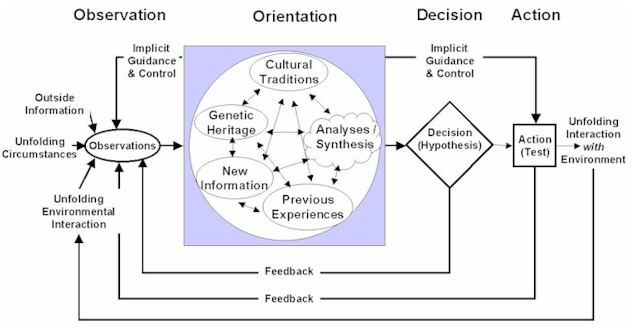
The next graphic, which better illustrates the simultanaeity and dynamic nature of the OODA Loop, with other potential avenues of exploitation than just going “faster” (which will swiftly hit diminishing returns in any event) does not lend itself as easily to nearly instant comprehension:

THE ‘OFFICIAL” OODA LOOP:

With these cognitive relationships operating continuously, mostly subconsciously with automaticity and in an iterative fashion, a different set of meanings to the phrase “inside your oponent’s OODA Loop” than just going “faster”, like a formula one race car zooming around a track.

Sacred Things

Thursday, June 23rd, 2011

[ post  by William Benzon cross-posted from his New Savanna blog with Intro by Charles Cameron — nature, arts, the sacred ]

.

Intro

.

This strange category, the sacred, strikes me as important because it intensifies.

It gives rise to beauty, terror, repulsion, love.  It empowers whatever vision, ideology, mission, crusade, jihad, movement, or tendency it touches.  And our society has in some ways lost touch with it so completely that we think it is found in the outward forms of piety, and miss its secular manifestations, its manifestation in religions other than our own, and most significantly and disastrously the groundswell of feeling it gives rise to in unexpected places.

It is a haven for many in an unlovely or uncertain world, a dwelling-place for saints, idealists, artists and — who knows? — perhaps the mad. And it catches us up when we least expect it — when the lights go down low in a cinema or at the opera, the curtain parts, and we enter another world whose rules are not our own.

We need to understand this.

.

In my post on Sacred space and the imagination, I tried to give a feel for the sacred without focusing on places of official worship, where it may be so expected as to be missed elsewhere, and I headed that post “no mil/intel stuff” because “this blog is dedicated to exploring the intersections of foreign policy, history, military theory, national security,strategic thinking, futurism, cognition and a number of other esoteric pursuits” — and my post clearly fell under the “other esoteric pursuits” part of the rubric.

But pattern pervades all, and the arts are prime sources for an understanding, a grasp, an accurate intuition of patterns in general. So we are not so far from strategy after all…

William Benzon responded to that post of mine, which he’d cross-posted on his own blog, with a post of his own, which I am cross-posting here. By way of introducing Benzon himself, then —

Benzon is a scientist (he led the information systems group at NASA in 1981, developing strategic recommendations about NASA-wide computer use and acquisition, and in conjunction with David G. Hays, published a series of articles in the Journal of Social and Evolutionary Systems covering the development of cognition in the brain from primitive vertebrates through primates and in human culture from the preliterate world through the development of computing) with wide cross-disciplinary interests (he’s played concerts with the likes of Dizzy Gillespie and B.B. King), either the first or one of the very first independent scholars invited by the National Humanities Center to lead off a topic of his choice on their blog, the author of a brilliant book on music and the brain, Beethoven’s Anvil: Music In Mind And Culture, and my friend.

Here, then, is his response to my post. Take it away, Bill…
.

Sacred Things

.

IMGP0005rd

… that still roaring dell, of which I told;
The roaring dell, o’erwooded, narrow, deep,
And only speckled by the mid-day sun;
Where its slim trunk the ash from rock to rock
Flings arching like a bridge;–that branchless ash,
Unsunn’d and damp, whose few poor yellow leaves
Ne’er tremble in the gale, yet tremble still,
Fann’d by the water-fall! and there my friends
Behold the dark green file of long lank weeds,
That all at once (a most fantastic sight!)
Still nod and drip beneath the dripping edge
Of the blue clay-stone.

— Coleridge, This Lime-Tree Bower My Prison

This post began, I suppose, when, upon reading Charles Cameron’s post, Sacred space and the imagination, the “graffiti!” light went off in my brain. Not just any graffiti light, but this one:

westward ho.jpg

Well, not that exact one, but it was a photograph of that same arch, a different photograph. This one shows the graffiti a little more clearly, but it’s not the same graffiti, as graffiti often changes over time, in some places more rapidly than others.

If you look back over Cameron’s images, you’ll see that it’s of a piece with them. And I’ve got dozens of photos of that arch: different times of the day, different seasons, different years, different graffiti, different angles. And that’s not all.

Graffiti and the sacred is a natural, one that hadn’t quite hit me full-on until I’d read Cameron’s post. You see, my first post about graffiti (the images, alas, are gone) was about this piece, which I called the Shrine of the Triceratops:

dino_train_872

It’s not that I believe, mind you, that there’s a triceratops cult in Jersey City and that this is where they meet. Nothing like that. Rather, that that image seemed to embody of the spirit of the place, the Japanese word is kami. (That triceratops is now gone. First, eroded by the weather, then other writers went over it.)

I could go on and on about graffiti, but I won’t, because this post isn’t just about graffiti. But I’ll leave you with one last graffiti thought. Graffiti is often likened to cave art. Well, cave art, some of it, perhaps all of it, is sacred art. Not mere pictures, but spirits bodied forth on walls.

*

And then there’s my current film project, Apocalypse Now. And that is deeply intertwined with the sacred. Not that it presents itself as a sacred story, nothing so straight-forward, but that it deals with ultimate things in a secular way.

Ultimate things in a secular way! – now there’s a fine kettle of fish for you. Just what does that mean? I suppose, for example, that that physicist’s dream, the grand unified theory, is a secular run on ultimate things. But is that secular the same secular as is appropriate to Appocalypse Now? I think not. Are we then confronted with the varieties of secular experience, mingling next to the varieties of religious experience? And where’s the boundary?

But, no, the film doesn’t present itself as religious in the way that Tree of Life presents itself as religious. But the caribao sacrifice at the end, that’s a real sacred ritual, not an enactment. Coppola shot the real thing, not that you’d know that from watching the film, though you could see that the caribao was really hacked to death. And the final third of the film takes place in a liminal no man’s land. It’s sacred territory, for some (nontrivial) meaning of sacred.

Anyhow, it looks like I’m going to argue that Apocalypse Now is an ontological text. That it is about the moral structure of the world rather than conveying this or that moral (or immoral) action. It’s about how things are through the ends of time, not about how this or that person gets from here to there.

*

And that certainly seems to be what’s going on in Malick’s very different The Tree of Life. We have the trials of the O’Brian family, daddy’s something of a dick, though a music-loving dick, mommy’s kind but a flake, and one kid dies – whether by suicide or not, that’s not clear from the film itself (I’ve seen it only once — shouldn’t have to see it more than once on such a plot point). But god’s creation is magnificent. As if that had anything to do with the O’Brian’s afflictions. Well, it does. It doesn’t.

In any event, it seems that this film, that as a film must unfold in time, minute by minute by (often tedious) minute, blasts time to smithereens. It opens with a verse from Job and then a flickering shimmering light that’s supposed to be, I guess, a Supreme Something Or Other in the Universe, but isn’t this dew-flecked dandelion more elegant?

dandilion

And then, I think, some story in the more or less present. Yes, that’s it, she gets the telegram. The news is not good, not good at all. Things fall apart. A plane. At the airport. And somewhere in there not too far into the film we get this sequence in which the world and all the life in it gets created, ending with some dinosaur killing some other dinosaur. Live action and CGI special fx. Wonderful imagery. Wonderful.

And slices of that imagery get cut into the rest of the film as life goes on, backwards and forwards. It’s as though the world didn’t get created by once, but always and ever, created and recreated, recreating.

*

And behind it all there’s Uncle Walt. Uncle Walt’s the first one who gave us a vision of the creation of the world, a cinematic vision that is, one we can see with our own eyes and hear with our own ears. All in less than half an hour. And it’s got dinosaurs!

I’m talking, of course, of “The Rite of Spring” episode in Disney’s Fantasia. He got the science wrong, even then they knew that the T. Rex and the Stegosaurus never co-existed, but he showed us the whole solar system, and seismic activity, and crashing dashing oceans, then life originating in the ocean, coming on land. And dinosaurs!

pterodactyl.jpg

Disney’s the one who had the genius to visualize THE WHOLE THING. We who’ve grown up in the shadow of Disney now take it for granted that such things are seeable, but Disney was there first. If Disney hadn’t done it, Malick would have had to figure it out from scratch. As it is, Disney’s imagery has so permeated the culture than one can do (and see) a film like Tree of Life without once thinking of Fantasia.

In fact, the cultural coding against cartoons is so deep that I hesitate ever so little to put Fantasia in the same paragraph with Tree of Life. How could these films possibly have anything in common much less be the same thing: entertainment. Yikes! I mean, Tree of Life is so freakin’ serious. And Fantasia is so, well, gorgeous, and rather annoyingly cutesy at times.

And it ends in a forest glade:

ave maria

The music is a rather fruity arrangement of Schubert’s Ave Maria. The motion: slow, stately, rigorous, restrained, austere.

— Bill Benzon.


Switch to our mobile site