zenpundit.com » horizontal thinking

Archive for the ‘horizontal thinking’ Category

A Hipbone Approach IV: Polar bears and polar opposites

Friday, November 12th, 2010

by Charles Cameron
pic of polar bear tenuously balanced on tiny iceberg

Norwegian photographer Arne Nævra took second prize in the “Our world” category of the Shell Wildlife Photographer of the Year 2007 competition with this photo

Bruce Sterling‘s State of the World 2010 conversation with my online friend Jon Lebkowsky on the Well’s “Inkwell” forum this year was rich in concept and language as one might expect. This in particular caught my eye:

It’s like looking at your SUV and seeing drowning polar bears. Just a minority viewpoint.

Two concepts, two dots to connect: SUVs and polar bears. Sterling chose those two concepts, no doubt, because the connection between them is non-obvious in the sense that a dictionary definition of SUV won’t contain a reference to polar bears, heck, even an encyclopedia article is unlikely to, and the reverse is also true — and obvious, in the sense that the “minority” in question can easily connect these two otherwise quite distinct and separate dots, the connection being “climate change” aka “global warming” or more specifically an entire complex dynamic systems analysis incorporating the process by which an aggregate of comparatively large and frequently used gasoline-powered internal combustion engines adds incrementally to a trend in the global weather…

Not that any of this should surprise us: Sterling’s readers presumably know that SUVs are a convenient stand-in for “gas guzzlers” and thus for the whole panoply of cars and trucks, and more abstractly for our planetary tendency to technologize our environment into greater convenience and less sustainability — and polar bears, while Sterling may like the look of them in photos, documentaries, zoos or on the occasional visit to the Arctic, serve here as a marker for the entire notion of environmental degradation, a massive die-out of species and such other non-Arctic phenomena as the loss of mountain tops in Appalachia and of rain forests in the Amazon and elsewhere.

So Sterling has played two “concepts” on the board of “connect the dots” and asserted that for some people the connection will be obvious, while for others it will be invisible — which in term of connecting the dots means it might as well not exist.

*

Indeed, some will argue that while both dots — SUVs and polar bears — exist, the connection implied between them does not.

But that’s not the topic of my consideration here.

*

Bruce Sterling’s interview gives me the pair of dots I intend to focus on today – SUVs and polar bears – but there’s another pair of dots that Sterling’s remarks forms part of, a pair in which Sterling stands at one pole (science, fiction) of the debate on climate change, with Rep. John Shimkus, R- IL, at the other (scripture, fact).

Addressing the House Subcommittee on Energy and Environment’s hearing on Preparing for Climate Change on March 15, 2009, Rep. Shimkus made the following now-celebrated remarks:

The right of free speech is a great right that we have in this country. Very few times we use it to espouse our theological religious beliefs, but we do have members of the clergy here as members of the panel. So I want to start with Genesis 8, verses 21 and 22. “Never again will I curse the ground because of man even though every inclination of his heart is evil from childhood, and never again will I destroy all living creatures as I have done. As long as the earth endures, seed time and harvest, cold and heat, summer and winter, day and night will never cease.” I believe that is the infallible word of God, and that is the way it is going to be for his creation.
 
The second verse comes from Matthew 24. “And he will send his angels with a loud trumpet call, and they will gather his elect from the four winds, from one end of the heavens to the other.” The earth will end only when God declares it is time to be over. Man will not destroy this earth. This earth will not be destroyed by a flood.
 
And I appreciate having panelists here who are men of faith, and we can get into the theological discourse of that position. But I do believe God’s word is infallible, unchanging, perfect.

I have characterized Sterling’s stance as “science, fiction” and Rep. Shimkus as “scripture, fact” – but the connection between these two dots is far from clear, and it is at leasdt arguable whether the designations shouldn’t instead be “science, fact” for Sterling, and “scripture, fiction” for Rep. Shimkus.

*

There’s a certain elegance to that – in fact it begs to be made into one of those diagrams that Jung and Levi-Strauss were fond of…
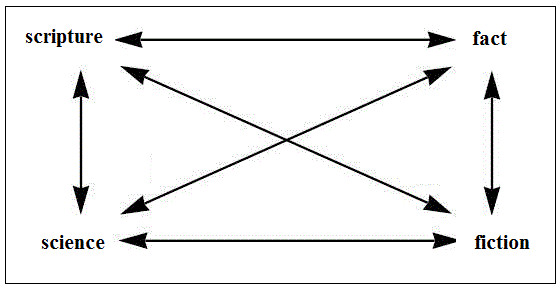
Science fact fiction scripture

Of course, fact and fiction may not be exclusive, opposed categories, and the same is true of scripture and science. Consider, for example, Kathleen Raine’s comment:

myth, when a real event may be the enactment of a myth, is the truth of the fact and not the other way around”

or the similar idea that CS Lewis once wrote to her

What flows into you from the myth is not truth but reality (truth is always about something but reality is about which truth is) and therefore every myth becomes the father of innumerable truths…

*

To return to Sterling… The game of connect the dots that Sterling plays here could be made into a simple systems diagram of the sort that Peter Senge used to illustrate his book, The Fifth Discipline, or the more elaborate form of systems dynamic model that Jay Forrester pioneered at MIT and Donella Meadows so eloquently preached in her essay, Places to Intervene in a System — complete with feedback loops in which shifts in global weather patterns and the exquisitely-patterned trails of SUVs dance the dance of complexity and emergence…

Sterling’s version of the game is verbal, minimalist, and suggestive: two phrases, not often found next to each other, quietly juxtaposed, in such a way that the mind can supply the connection that makes the leap between them. In short: the man can write.

The point I am laboring to make here has to do with communication: with getting an insight across to other people.

Writers do this by dropping verbal markers (“SUVs” and “polar bears”) into sentences. Mostly, they write many such sentences in sequence (a blog post, an article, a book), so the reader skims or skips lightly from one marker to the next, like a stone skipping across a pond in the childhood game. Individual leaps and single connections between pairs of dots are not important here, the reader’s mind half-notes them as it passes to the next dots and the next, and such things as “conclusions” and “actionable items” or in some cases “character” and “plot” far outweigh the largely subliminal links and connections triggered along the way.

From an analytic point of view, however, it is the connections that make the difference — whether those connections are causal, as in the steps of an argument; dynamic, as in the workings of a homeostatic system with feedback loops; emergent, as in the discernment of pattern at the edge of chaos; or associative, as with creative insight, metaphor and analogy.

And in each of these cases, some form of language, diagram or model can spell out the connection, some form of software can embody that language, diagram or model, and some form of human insight can assimilate its meaning and apply it to further tasks of observation, orientation, decision and action…

*

We may connect the dots for pleasure, as in one of those games that chains of restaurants print up to keep children busy while their parents talk over pancakes and bacon, or for benefit: and here the issue is not only to connect “past” dots correctly so as to understand what has already happened and can be viewed with twenty-twenty hindsight, but to make the great conceptual leap from past and present and propose connections with dots that will arise in the “future” (that zone of uncertainty): we write scenarios, we plan, we attempt to intuit an enemy’s next move, to make our own OODA loop tighter and meaner than his.

And while in the short term we may succeed, in the mid and long term we may fail.

At which point, as a depth psychologist might say, our projections tell us more about ourselves than about the reality we are attempting to grasp.

I’d include here those moments when we “see” connections that don’t exist, as well as those in which we miss connections that do: hallucinatory links, and blind spots, both.

*

Bruce Sterling, in the same forward-looking piece that contains that quick verbal aside about polar bears and SUVs, asks himself how anyone can give “a coherent picture of where your future is heading”. Without some such picture, indeed, we are at the mercy of vicious feedback loops and unintended consequences.

Here’s how he thinks about what we might call medium term scenarios:

Let’s imagine you’re three years old again. You want to give your Dad, back in 1974, a coherent picture of what 2010 looks like. You know, something very actionable, lucid and practical, where he can just slap the cash on the counter and everything works out great for the family. Okay: given what you know now about the present, tell me what you oughta tell him about 2010, back in 1974.

Forrester-style modeling won’t carry us forward thirty five years: there are simply too many shades of grey and black swans between “now” and “soon”.

And so task number one is an “ornithological” task — to peer into our own blind-spots, to see the invisible, to have what is called “vision”.

And I don’t mean a gosh-darn brand-new marketing strategy. I mean a sense of the great tides that underlie epochal changes — the kind of vision that William Blake had, which allowed him to rail on about the “satanic mills” long before the word “ecology” was a dim spark in the mind of the fellow who coined the word. The sort that Leonardo da Vinci had.

The sort, in fact, that contemplatives (all those Zen and Tibetan and Benedictine monks) and shamans (Lakota and Huichol and !Kung and all the rest) and artists (in words, in images, in sound, in film, in concept) all know about.

*

Which is to say, the sort Einstein knew about — so that when the mathematician Jacques Hadamard asked him about his thought process, he answered:

The words or the language, as they are written or spoken, do not seem to play any role in my mechanism of thought. The psychical entities which seem to serve as elements in thought are certain signs and more or less clear images which can be “voluntarily” reproduced and combined.
 
There is, of course, a certain connection between those elements and relevant logical concepts. It is also clear that the desire to arrive finally at logically connected concepts is the emotional basis of this rather vague play with the above mentioned elements. But taken from a psychological viewpoint, this combinatory play seems to be the essential feature in productive thought – before there is any connection with logical construction in words or other kinds of sign, which can be communicated to others.
 
The above mentioned elements are, in my case, of visual and some of muscular type. Conventional words or other signs have to be sought for laboriously only in a secondary stage, when the mentioned associative play is sufficiently established and can be reproduced at will.

That’s quite a mouthful, so I’d like to pick out a few points that maybe of relevance here.

Let’s clear the word “muscular” out of the way first. Some of the ideational germs of Einstein’s most brilliant work, he tells us, are “muscular”. Many of us know that visual thinking is an important component of understanding: Einstein adds thinking “of muscular type” into the mix. His body is part of his mind, and he knows it. That’s important: Einstein is, in fact, connecting dots for us here linking mind and body. But he doesn’t just link dots in his response to Hadamard — he actually talks quite a bit about making connections.

*
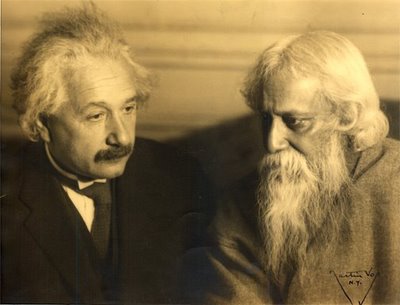
Einstein Tagore

Einstein links to Tagore

Let me rephrase his response to Hadamard the way I see the process he describes unfolding.

He has a strong emotional desire to understand, in the way that “physics” understands — which is to say, “to arrive finally at logically connected concepts” of the nature of nature. He then turns away from logic and concepts, and — still under the sway of that desire — attends to the sensations of his body and to his internal field of vision. In response to that desire and from regions of the body and mind unspecified, certain “psychic elements” of a visual and some of muscular sort arise. These he says can be “combined” — he says also that he can “play” with them — but the play is, at least at first “vague”. Indeed it is precisely this “combinatory play” which appears to Einstein to be “the essential feature in productive thought”. It is only when these elements have been voluntarily played with and satisfactorily combined that Einstein begins, internally, to verbalize and “translate” the combinations he has perceived into some form of “logical construction in words or other kinds of sign, which can be communicated to others”.

So we have three sorts of connection going on here: (i) an associative connectivity between imagistic and muscular “psychic elements” in the mode of play (ii) their “connection with logical construction in words or other kinds of sign” and (iii) the connections he can then present to others in the language of “logically connected concepts” — ie mathematical physics.

*

In all of this, I would like to highlight (i) the (perhaps unexpected) importance of the body’s connection with the mind in human thinking, (ii) the significance of a deep desire for understanding as the attractor for the largely unconscious motions of body and mind, (iii) the role of play as the mode of thinking in which creative linking occurs, (iv) the ubiquity of connectivity as the ruling imperative in all phases from the initiation of play to the communication of theoretical physics.

All four — body-mind, desire, play and connection — are key components in anything worthy of the name of vision.

Guest post: A Hipbone Approach to Analysis II.

Friday, October 29th, 2010

 Charles Cameron is the regular guest-blogger at Zenpundit, and has also posted at Small Wars Journal, All Things Counterterrorism, for the Chicago Boyz Afghanistan 2050 roundtable and elsewhere.  Charles read Theology at Christ Church, Oxford, under AE Harvey, and was at one time a Principal Researcher with Boston University’s Center for Millennial Studies and the Senior Analyst with the Arlington Institute:

A Hipbone Approach to Analysis II.

by Charles Cameron

Let’s call this one Hopscotch across the disciplines.

…our intelligence community failed to connect those dots…
        –  President Obama, Remarks on Security Reviews, Jan 05, 2010

I’ve been giving quite some thought over the past fifteen years to this issue of connecting dots.

My internet handle, hipbone, does double duty for me, since it refers to Ezekiel’s apocalyptic prophecy as featured in the lyric, “hip bone connected to you back bone”, in the old spiritual, Dem Bones, Dem Dry Bones. On the one hand it points to apocalyptic, by which I mean the soon expectation of a sudden and complete transformation in world affairs, very possibly accompanied, triggered or accomplished by extreme violence, with the end result being a highly favored “new heaven and new earth” or “new world order” depending on who is doing the expectation. On the other hand, it points directly to the idea of “connecting the dots” itself, since the entire song is about connections. I have been working on both fronts at least since 1995.

1

Connecting the dots is a matter of thinking, and there are two basic strategies of thought available to the human mind: linear thinking, which proceeds via cause and effect along a single track, and which is the major style of thought used within disciplinary silos, and lateral thinking, which skips sideways across silos and disciplines on wings of metaphor and analogy. Machines can crunch numbers and do some of our linear thinking for us: but it’s up to the analysts to cover the lateral front.

2

Let’s go aphoristic:

Expectation is algorithm: there are no algorithms for the unexpected.

I’d like to connect the dots … to blind spots.

Blinds spots are the spots we can’t, or won’t, and in any case don’t see. They fall into the category of the invisible. Visionaries are those who can see the invisible, who peer into our blind spots, into those places where we can’t see the connections between the dots, and can therefore easily be blind-sided. There’s an almost Borgesian thickness to the way things tie into one another here: the unexpected is by definition what we can’t predict, what blunt force thinking can’t predict — but it’s not invisible to those whose practice is to peer into the invisible, to aficionados of the subtler associative / metaphorical strategy…

3

Let’s go mythic.

There are two major strategies in life, two main ways of tackling problems, just as there are two heroes in the ‘Spider Woman” myth, which Joseph Campbell said was the central myth of the Americas. In Navajo terms, these twin heroes are called Monster Slayer and Child Born of Water, and their names may already give us the sense that one represents a brute force approach while the other is cannier, subtler — and able to achieve things his twin could barely imagine.

The Massive Ordnance Penetrator may be able to penetrate 60 feet of concrete, but the Grand Canyon was created by the natural flow of water — and as Lao Tzu said, “Nothing under Heaven is more soft and yielding than water, yet for eroding the hard and strong, nothing can surpass it.”

You can pitch this one-two punch at a variety of levels. The military can be seen as the nation’s Monster Slayer, its intelligence community as the Child Born of Water. You could see Thomas Barnett’s Leviathan as Monster Slayer, his SysAdmin as Child Born of Water. Or within the IC, you could say that software that can “crunch mega amounts of data” takes the Monster Slayer approach — but it requires cognitive skills and insight of a Child Born of Water sort to know when a student’s slightly eccentric interest represents a threat to the lives of three thousand office workers…

4

Let’s go analogic.

I’m thinking of the flight school students who “focused on learning to control the aircraft in flight, but took no interest in takeoffs or landings” — who asked one instructor where they could take lessons on jets without learning to fly smaller planes first, a request he concluded indicated they were “either joking or dreaming”.

In the not-so-terror-conscious atmosphere pre-9/11, a lack of interest in takeoffs and landings might have seemed quirky — but the “connections” weren’t obvious enough for the info to travel all the way up the FBI food-chain to the very top, as it would today. In post-9/11 retrospect, such things look a bit different – but I presume it still took reasoning by analogy for an instructor in a SE Asian diving school to recognize that a student who appeared less interested in the business of avoiding the bends and surfacing safely than in learning underwater swimming might pose a similar threat.

With 20/20 hindsight, this sort of thing seems glaringly obvious: even Monster Slayer could see it.

5

Let’s think about ignorance for a moment.

There’s Rumsfeld’s famous quip about known unknowns and unknown knowns, there are the genres of black swans and unintended consequences, there is what’s obvious and non-obvious, there are blind spots and hidden assumptions — and it’s the non-obvious that blindsides us, right?

We could rephrase the Spider Woman idea to state that Monster Slayer proceeds in terms of the obvious, while Child Born of Water works with the non-obvious. Jami Miscik, at that time Deputy Director for Intelligence at CIA, once remarked, “To truly nurture creativity, you have to cherish your contrarians and give them opportunities to run free”.

Child Born of Water is the contrarian, the maverick, the one whose oblique angle on things provides insight by… making non-obvious connections between the non-visible dots.

Guest Post: Of Weaponry and Flags II.

Wednesday, October 27th, 2010

Charles Cameron is the regular guest-blogger at Zenpundit, and has also posted at Small Wars Journal, All Things Counterterrorism, for the Chicago Boyz Afghanistan 2050 roundtable and elsewhere.  Charles read Theology at Christ Church, Oxford, under AE Harvey, and was at one time a Principal Researcher with Boston University’s Center for Millennial Studies and the Senior Analyst with the Arlington Institute:

[Originally cross-posted at Chicago Boyz]

Of Weaponry and Flags II.

by Charles Cameron

YT in a comment on Zenpundit just pointed me to a quote from Virilio’s War and Cinema, Scott meanwhile suggested I might be interested in Meaning by Michael Polanyi – and between the two of them, I find myself wanting to make a trilogy of quotes that present the symbolic impact of flags from philosophical, psychological and neurological perspectives, thus (I hope) braiding together from somewhat disparate sources a simple, non-dualistic insight. From Michael Polanyi and Harry Prosch, Meaning, pp. 72-73:

The focal object in symbolization, in contrast to the focal object in identification, is of interest to us only because of its symbolic connection with the subsidiary clues through which it became a focal object. What bears upon the flag, as a word bears upon its meaning, is the integration of our whole existence as lived in our country. But this means that the meaning of the flag (the object of our focal attention) is what it is because we have put our whole existence into it. We have surrendered ourselves to that “piece of cloth” (which would be all the flag could be perceived to be were we to try to view it in the indication way of recognizing meaning). It is only by virtue of our surrender to it that this piece of cloth becomes a flag and therefore becomes a symbol of our country. Some of the subsidiaries, then, that bear upon the flag and give it meaning are our nation’s existence and our diffuse and boundless memories of our life in it. These, however, not only bear upon the flag as other subsidiary clues bear upon their focal objects, but they also, in our surrender to the flag, become embodied in it. The flag thus reflects back upon its subsidiaries, fusing our diffuse memories. We cannot use a straight arrow to express this feature in our diagram, since such an arrow pictures only a straight, one-directional bearing-upon. We must make the arrow loop, in symbolization, in order to express the way our perception of the focal object also carries us back toward (and so provides us with a perceptual embodiment of) those diffuse memories of our own lives (i.e., of ourselves) which bore upon the focal object to begin with. This is how the symbol can be said to “carry us away.” In surrendering ourselves, we, as selves, are picked up into the meaning of the symbol.

From Murray Stein, Jung’s map of the soul: an introduction, p 100:

Life itself may be sacrificed for images such as the flag or the cross and for ideas like nationalism, patriotism, and loyalty to one’s religion or country. Crusades and countless other irrational or impractical endeavors have been engaged in because the participants felt, “This makes my life meaningful! This is the most important thing I’ve ever done.” Images and ideas powerfully motivate the ego and generate values and meanings. Cognitions frequently override and dominate instincts. In contrast to the impact of the instincts on the psyche — when one feels driven by a physical need or y — the influence of archetypes leads to being caught up in big ideas and visions. Both affect the ego in a similar way dynamically, in that the ego is taken over, possessed, and driven.

And from Paul Virilio, War and cinema: the logistics of perception, pp. 5-6:

War can never break free from the magical spectacle because its very purpose is to produce that spectacle: to fell the enemy is not so much to capture as to ‘captivate’ him, to instil the fear of death before he actually dies. From Machiavelli to Vauban, from von Moltke to Churchill, at every decisive episode in the history of war, military theorists have underlined this truth: ‘The force of arms is not brute force but spiritual force.’ There is no war, then, without representation, no sophisticated weaponry without psychological mystification. Weapons are tools not just of destruction but also of perception – that is to say, stimulants that make themselves felt through chemical, neurological processes in the sense organs and central nervous system, affecting human reactions and even the perceptual identification and differentiation of objects

Might one identify the “stimulant” aspect (Virilio) as the one that drives those in the battlefield under fire, and thus also their memories and reflections, while strategists, as thinkers, will be more inclined to see the significance of the “archetypal” aspect (Murray, Jung)? Virilio (like Boyd) is concerned with speed — and it seems plausible to me that we have three “speeds of thought” – instinctive, considered and contemplative – corresponding in rough outline to Maslow’s hierarchy, the instinctive being bodily and immediate, the considered being logical and rapid, and the contemplative being symbolic and gradual. But there’s a curious loop at work here, because the symbolic / archetypal may take its time to work its way into conscious awareness – in some cases we refer to the end result as “maturity” or “wisdom” – but it’s also somehow very close to instinct, as Jung suggests in “On the Nature of the Psyche”, Collected Works VIII, para. 415:

Psychologically … the archetype as an image of instinct is a spiritual goal toward which the whole nature of man strives; it is the sea to which all rivers wend their way, the prize which the hero wrests from the fight with the dragon.

If anyone wants to follow up this particular line of thought, I’d recommend Jolande Jacobi’s Complex / Archetype / Symbol in the psychology of C. G. Jung, and for the interweaving of image, archetype and instinct, Andrew Samuels, Jung and the Post-Jungians Chapter 2, pp. 19 ff.

Guest Post: Connecting the Dots: Light on Light

Monday, October 25th, 2010


 Charles Cameron is the regular guest-blogger at Zenpundit, and has also posted at Small Wars Journal, All Things Counterterrorism, for the Chicago Boyz Afghanistan 2050 roundtable and elsewhere.  Charles read Theology at Christ Church, Oxford, under AE Harvey, and was at one time a Principal Researcher with Boston University’s Center for Millennial Studies and the Senior Analyst with the Arlington Institute:

Connecting the Dots: Light on Light

by Charles Cameron 

In a recent blog-post on MahdiWatch, Timothy Furnish draws our attention to an Islamic think tank named Grande Strategy.

1.

Their page of further readings on a future Islamic state includes works by an eclectic bunch – including Sir Muhammad Iqbal, recognized after his death and the foundation of the State as the national poet of Pakistan; Sheikh Taqiuddin An-Nabhani, the founder of the Hizb-ut-tahrir movement; Ali Shariati, the Marx-influenced Shi’ite radical intellectual viewed by some as the ideological force behind the Iranian revolution; Abul A’ala Maududi, Sunni writer and founder of Jamaat-e-Islam; Harun Yahya, also known as Adnan Oktar, a major Islamic creationist writer who holds that “Alawites, Wahabbites, Jafarites, they are all pure Muslims; harboring enmity against them is by no means acceptable”; Sayyid Qutb, Sunni author and Muslim Brotherhood member; and Ayatollah Ruhollah Khomeini, father of the Iranian Revolution.

Let’s just say that if the books of all these worthies were placed on a single bookshelf and given voices, the ensuing hubbub would resemble the House of Commons at Question Time.

2.

One article on the Grande Strategy site – the one that caught Timothy Furnish’s attention – is titled To the Unknown Mujahid, May We Never Forget You. It is interesting, as Furnish notes, because it is yet another sign of Mahdist thinking in the region of Afghanistan / Pakistan. It describes a man seen teaching in a mosque in the Faisal Masjid (presumably in Islamabad):

I have never seen a human spirit glow in this manner. I did not think this was even possible. I checked myself by discretely asking a few other brothers (perhaps it was some deficiency in me), and they too confirmed. Let me intimately describe you this man, he was tall, bearded wore a military camo jacket and in all his manners was as if he had walked out of the 1st century Hijri. He spoke English well enough that you could tell he was well-educated and belonged to a noble family. He was from Kashmir, in fact an elected member of the local government (back then Musharaf was all about devolution of power to press the national parties). Some close relatives of his were also senior officers in the Pakistan Army. He was obviously a mujahid, although in my opinion one that was fighting against India and in Kashmir and had nothing to do with the Afghanistan war.

The writer recounts his experience of this man because, as he puts it…

Because I believe (and Allah knows best) that if he is not the Mahdi himself or one of his men, at the least he is the precursor to the kind of men that would make up the army of the Mahdi. Or for those who do not believe in the Mahdi, he is the category of men that can save us from our present circumstances. A prototype to our success. And Allah knows best. Disclaimer: I don’t want to claim that he is the Mahdi.

3.

There’s also an article on the site about the Black Banners from Khurasan — another marker for Mahdist expectation — that includes quite a mix of sources and resources: commentary, for instance, on the Scofield Reference Bible (a major source of “dispensationalist” end times beliefs) and the “Project for New American Century”, together with some conspiracism about 9/11 specifically and US policy in general:

The US’s War on Terror is a deceptive game and a mind boggling riddle. The term terrorism is itself vague and un-defined and built on repetitive lies upon lies as evident in the case of 9/11. It is almost always blindly used against Muslims. The unilateral, pre-emptive extra-judicial violence by the western powers is always named as wars of democracy and freedom.

— plus for good measure some information about the Jewish origins of the Pashtun / Pathan peoples, and this intriguing statement:

According to Syed Saleem Shehzad of Asia Times Online, Al Qaeda shares this belief with the Taliban that Afghanistan is the promised land of Bilad-e-Khurasan.

— which would mark both as apocalyptic movements (see here and here).

4

On the other hand, one comment from a Shi’ite reader suggests that President Ahmadinejad will be the one who recognizes the Mahdi and brings the victorious army to meet him:

When Shuayb Ibn Saleh (Pres. Ahmedinejad) learns of Al Mehdi (as) emergence he will head towards Syria under three banners each of which has 4,000-5,000 men. It is these banners that are of gaudiance that Allah’s Messenger (saas) spoke of when he mentioned that ‘ when you see this army coming from Khursan, then go and join that army even if you have to crawl over snow, because in that army is the Caliph Al Mehdi[as]’. This holds true because it is Shuayb Ibn Saleh who will consolidate the government of Al Mehdi (as) in Jerusalem within 6yrs (72months).

and:

The Black Flags Coming from Khurasan is not of the Taliban … These Black Flags Belongs To Only Shuayb Ibn Saleh (Pres. Ahmedinejad)

5

But let’s get back to that business about the “Unknown Mujahid”. According to the report Furnish quotes from:

This particular class was being taught by a man, the like of whom I had never seen before, nor since have ever seen again. When you reach a certain level of spiritual enlightenment… sometimes you can “see” or “feel”… the “noor” or “aura” or “spiritual light” of another… This man did not have a glow – it was like a 1000 watt halogen lamp…

I have to say I find that report particularly interesting because, as Dr. Furnish notes, it offers a Sunni parallel to the self-description given by Iran’s Shi’ite President Ahmadinejad — who claimed on video that he’d been told by someone who was there, “When you began with the words ‘in the name of God,’ I saw that you became surrounded by a light until the end [of the speech]”, and commented, “I felt it myself, too. I felt that all of a sudden the atmosphere changed there, and for 27-28 minutes all the leaders did not blink.”

The thing is, this sort of report can also be found on both sides of the Iranian / Israeli aisle.

Gershon Salomon – who as leader of the Temple Mountain Faithful has the twin goals of “the liberation of the Temple Mount from Arab (Islamic) occupation” and “the building of the Third Temple on the Temple Mount in Jerusalem in our lifetime” – wrote a revealing memoir in which he recounted:

I had the privilege to experience the appearance of the G–d of Israel and His angels in one of the critical battles of Israel when I served in the Israeli Army as a young officer and my small unit was attacked by thousands of Syrian Arab soldiers. … It was night but I could see a light covering me from all sides and lighting the dark night. At the same moment, I could see the Syrian soldiers not shooting me but turning and running very fast back to the mountains. I again lost consciousness. I was told later that the Israeli soldiers looking for me in the darkness were only successful in locating me when they saw the light.

6

For what it’s worth, such stories can also be found about the divine or saintly figures of many religions.

Martin Buber tells a legend of the great Hassidic rabbi the Baal Shem Tov, in which a visiting rabbi saw that “the head of the master stood entirely in the white light … The rabbi saw that the master stood entirely in white light.

The Bhagavad Gita describes a moment when Krishna shows his divine form to Arjuna, who describes it thus: “If a thousand suns were to light up the sky all at once, that radiance would equal the radiance of my Lord.”

In the New Testament, Matthew describes how “Jesus taketh Peter, James, and John his brother, and bringeth them up into an high mountain apart, And was transfigured before them: and his face did shine as the sun, and his raiment was white as the light.” (Matt. 17:1-2).

7

If I have points to make, there are several of them:

  • That religious motivations can be powerful drivers at the level of popular morale.
  • That we frequently overlook religious motivations.
  • That reports of apocalyptic signs and miracles are potent amplifiers of religious motives.
  • That when we study religions, we frequently overlook the miraculous and the apocalyptic.
  • That comparative religious studies give context to events that seem extraordinary and affirming within a single religious tradition.
  • That when we study religions, we frequently overlook its comparative aspects.

Oh – and that depth psychology (Freud, Brown, Jung, Hillman) and cultural anthropology (Bateson, Turner, Lansing) also have much to teach us.

8

Connecting dots is not so hard once you can see them — but how do you connect your blind spots?

Guest Post: Of Weaponry and Flags

Sunday, October 24th, 2010

 Charles Cameron is the regular guest-blogger at Zenpundit, and has also posted at Small Wars Journal, All Things Counterterrorism, for the Chicago Boyz Afghanistan 2050 roundtable and elsewhere.  Charles read Theology at Christ Church, Oxford, under AE Harvey, and was at one time a Principal Researcher with Boston University’s Center for Millennial Studies and the Senior Analyst with the Arlington Institute:

Originally posted at Chicago Boyz.com

Of Weaponry and Flags

by Charles Cameron

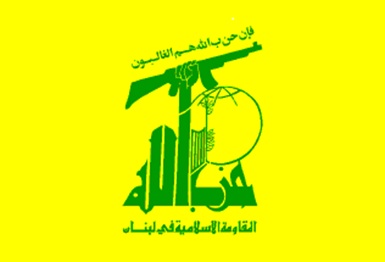
Hezbollah Flag Use

A day or two ago, Abu Muqawama asked whether the Hizballah flag showed an AK-47, and in general what flags carried what weapons as emblems.

As it happens, I’d just been viewing a pro-jihadist United States of Islam video and made the following screen-capture as an illustration of my continuing concern about the “black flags of Khorasan” and the issue of whether AQ and or its franchises and or portions of the Taliban consider themselves to be fighting the apocalyptic war of the end of time.

Black Flag Support out Troops Sm

Note also that the filmmaker’s ironic borrowing of the phrase “Support Our Troops” to urge support of the troops of the Mahdi will not be lost on some viewers.

This screen-capture, from the United States of Islam video, in turn reminded reminded me of the Saudi flag, which likewise carries the shahada or Muslim profession of faith and a weapon – a sword.

Saudi flag

According to a note on an earlier version of the World Flag Database:

The script in the centre of the flag is the Islamic creed, “There is no God but Allah, and Mohammed is the Prophet of Allah”. The flag is therefore considered sacred and special protocol rules apply: the flag does not dip in salute, nor is it ever flown at half-mast. Note that the creed always reads properly from right to left, with the sword hilt to the right, so the reverse of the flag is not a mirror image of the obverse. When making the flag, the creed must be reproduced precisely, including the accent marks. The use of the flag on any commercial item (especially clothing) is not recommended as it might be considered inappropriate, or even insulting.

The Shahada is the central testament of faith of Islam, as is the Shema Yisroel of Judaism and the Credo of Christianity, and I respect it as such – and likewise the Saudi flag., on which it is displayed.

*

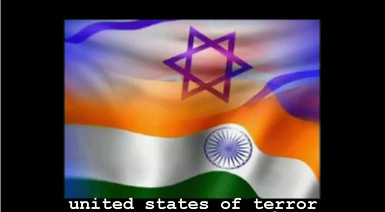
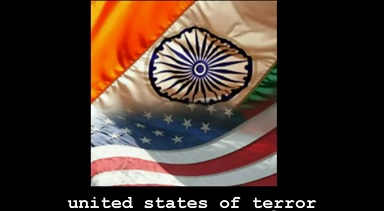
Flags, however, are potent symbols, and the graphical power of the “black flags of Khorasan” motif should not, in my view, be underestimated. The particular video that I took that screen-capture from makes use of “mix” flags of its own devising:

Flag01

– merging the American and Indian flags – or the flags of India and Israel –

Flag02

to create an imagery of the “United States of Terror” to juxtapose against their own black flags as the “United States of Islam” – giving us Huntington’s “Clash of Civilizations” in visceral graphic form.

And that conjunction of India with Israel bears thinking about, too… not only in terms of military aid between the two nations, but also of the symbolic juxtaposition of the Al-Aqsa Mosque and Jerusalem with the Babri Masjid and Ayodhya…

Indeed, the Indian flag itself also deserves consideration in our context.

indian-flag

Originally, Mahatma Gandhi had hoped that it would feature the charka or spinning wheel which he had made famous. As an informative article on the subject from The Hindu puts it:

For Gandhiji, the charka represented not a mere hand-spinning device that could provide employment and income to the poor, but much more. “The message of the spinning-wheel is much wider than its circumference. Its message is one of simplicity, service of mankind, living so as not to hurt others, creating an indissoluble bond between the rich and the poor, capital and labour, the prince and the peasant.” (Young India, September 17, 1925). “Above all, charka is a symbol of non-violence” (Collected Works of Mahatma Gandhi, Vol. 71, first edition, p.234).Gandhiji was, therefore, all the more sad when a correspondent from Hyderabad brought to his notice, on the eve of Independence, K. M. Munshi’s indictment in his broadcast speech that the wheel in the new flag represented the Sudarshana Chakra (discus of Lord Vishnu), a symbol of violence! But Gandhiji consoled himself that “under no circumstances, can the Asoka Chakra become a symbol of violence as Emperor Asoka was a Buddhist and a votary of non-violence” (Harijan Sevak, August 17, 1947).

So there’s another weapon-flag connection – albeit one where non-violence seems to triumph over violence.

*

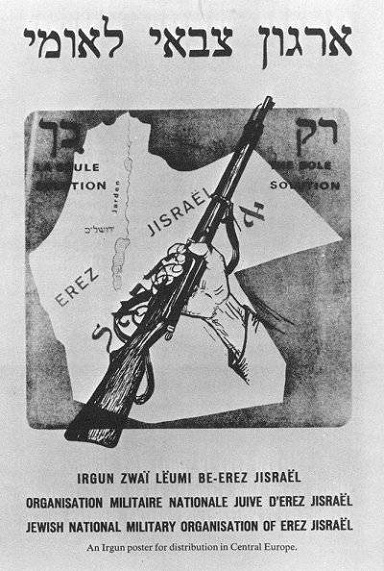
But let me get back to the yellow Hizbollah flag with which we started, and quickly note the resemblance (which I don’t claim to be the first to note, but cannot presently find my source for) between its portrayal of a rifle raised in a victorious fist, and this poster from the Irgun:

Irgun poster

And that’s enough about weaponry and flags for now, I think.

I hope to follow this post up shortly with a more detailed account of the United States of Islam video mentioned above, and its many and curious references and resonances.


Switch to our mobile site