zenpundit.com » freedom

Archive for the ‘freedom’ Category

Jottings 2: Dr Fadl book announcement

Friday, May 3rd, 2013

[ by Charles Cameron — I got the announcement via Cole Bunzel, and Kévin Jackson kindly informed me that Dr Fadl is currently free ]

.

Dr Fadl‘s announcement, in Arabic, is here — I had to use Google Translate, which wouldn’t pass a Turing test. However…

**

A while back, I made a post here titled Will Dr Fadl retract his Retractions? in which I wrote:

Sayyid Imam al-Sharif, popularly known as Dr Fadl, wrote two of the key works of jihadist ideology, The Essential Guide for Preparation and the thousand-page Compendium of the Pursuit of Divine Knowledge, in the late 1980s — thereby providing his friend from student days, Ayman al-Zawahiri, with powerful scholarly backing for the doctrines of militant jihad and takfirism. Lawrence Wright refers to Fadl as an “Al-Qaeda mastermind” in a detailed 2008 New Yorker analysis.

Dr Fadl was imprisoned without trial in the Yemen shortly after 9/11, but it was after he had been transferred to an Egyptian prison in 2004 that he wrote Rationalizing Jihad, the first volume of his “retractions” — a work so powerful in its attack on his own earlier jihadist doctrine that al-Zawahiri felt obliged to respond with a two-hundred page letter of rebuttal. A second volume from Dr. Fadl followed more recently.

If Dr Fadl regains his liberty, the question arises whether he will claim his critiques of jihadist dictrine were obtained by force, and effectively retract his retractions – or whether he will stand by them, as I somehow expect he might — still declaring, this time as a free man, that “There is nothing that invokes the anger of God and His wrath like the unwarranted spilling of blood and wrecking of property,” and “There is nothing in the Sharia about killing Jews and the Nazarenes, referred to by some as the Crusaders. They are the neighbors of the Muslims … and being kind to one’s neighbors is a religious duty.”

**

As late as October 2012, I was noting an Atlantic piece by Daveed Gartenstein-Ross and Aaron Zelin on How the Arab Spring’s Prisoner Releases Have Helped the Jihadi Cause, and asking whether Dr Fadl had been released in my post Quick update / pointer: GR & AZ on prisoner release — but now we know.

In response to an inquiry I tweeted after seeing Bunzel‘s tweet above — asking whether Dr Fadl was still imprisoned, albeit more comfortably than most — Kévin Jackson replied:

I’m no Arabist, but I’d guess we can take it that Sayyed Imam Al-Sharif aka Dr Fadl is talking freely in this book, which he says will cover both his experience of the history of AQ “from the womb (the Afghan jihad against communism) … to the end” in detail, with dates and names, and “all this with the background of the study of Islamic jurisprudence that distinguish between right and wrong, and this is a jurisprudential historical book.”

**

Tricky that, the need to rely on Google Translate. Once again I regret my lack of umpteen languages.

The Boston Bombers and Superempowerment

Wednesday, May 1st, 2013

My friend Dave Schuler who blogs at the excellent The Glittering Eye and on foreign policy at Dr. James Joyner’s Outside the Beltway , queried me as to what I thought of the Boston Bombers in light of the concept of the Superempowered Individual.

For those not familiar with the concept, the term “superempowered individual” originated in phrase coined by Thomas Friedman and quickly gained traction and evolved in the .mil/strategy/defense blogosphere and communities of interest after 9/11 turned everyone’s attention to the potential reach of catastrophic terrorism. Many people, including myself have written on the topic and while no single, agreed upon, definition of SEI exists, there is a consensus around an individual having the capacity to multiply the scale of the harm they can cause by leveraging or disrupting complex systems, be they mechanical, social, cyber or some combination. I defined SEI’s this way:

To qualify as a superempowered individual, the actor must be able to initiate a destructive event, fundamentally with their own resources, that cascades systemically on a national, regional or global scale. They must be able to credibly, “declare war on the world”.  

Using that definition, Dzhokhar and Tamerlan Tsarnaev are far from superempowered individuals. They were not “super” anything and rather than being masters of complexity, they ginned up some primitive IEDs  and blundered miserably after their attack on the Boston Marathon. The younger of the two accidentally ran over his own brother with a car, killing him, which gives some idea of the operational amateurism of these culprits. If Islamist terrorism has a Darwin Award, the Brothers Tsarnaev are contenders

Yet the cost of their attack, the Boston bombing, allegedly tops $330 million dollars? Why?

I would argue that the US is systematically “superdisempowering” itself by VASTLY multiplying the costs of any given act of terrorism with absurd and outrageous levels of costly security theater and glitzy paramilitarization of law enforcement that continue to cascade and accumulate long after sorry nitwits like Richard Reid, Dzhokhar Tsarnaev or the amazingly incompetent Underwear Bomber have become obscure historical footnotes. It is incredibly counterproductive in every sense and has overwhelmingly negative effects that only add significantly to the costs of terrorism

Timothy McVeigh, in a much more heinous act of terrorism, blew up a Federal building and killed 168 people and injured 800 others with a massive truck bomb and America did not feel a need to dress our police officers like extras in Starship Troopers or it’s airport security like customs officials from a minor Fascist puppet regime. This is not a criticism of police officers who do a dangerous job with professionalism and bravery but of a national policy of paternalism and creeping authoritarianism that is slowly morphing them into asphalt soldiers.

The attacks on September 11 were thirty times worse and far more spectacular than McVeigh’s bombing, transfixing the attention of the whole world, but somehow we got along without President Bush declaring martial law and closing New York city and sending troops door to door to roust citizens in their homes without warrants or probable cause.

We need to take a healthy step back and put the brakes on our own policy and security responses to terrorism and dial them down to a rational minimum level required for investigative effectiveness. If not because these policies have become dangerously injurious to liberty and American democracy or because they are mostly wasteful government spending then we should do it because we have become so expert at making the costs of any act of terror extremely expensive by our own reaction that we are providing the enemy and itinerant crazies with a tremendous incentive to attack us more.

Seriously.

The only thing superempowered right now is own own lack of strategic sense.

The Apple II of 3 D Printing?

Thursday, February 28th, 2013

It may be 1977 all over again.

Check out the Form 1 Kickstarter page 

The Formlabs home page and their blog.

I recently reviewed Chris Anderson’s book Makers. What 3 D printing needs is the affordable, user-friendly, versatile device to move 3 D printing from the arcane realm of  techno-hobbyist geeks to the general population’s “early adapters”, which will put the next “consumer model” generation on everyone’s office desk; eventually as ubiquitous as cell phones or microwaves.

Formlabs should send one of these to John Robb and Shloky for a product review.

Hat tip to Feral Jundi


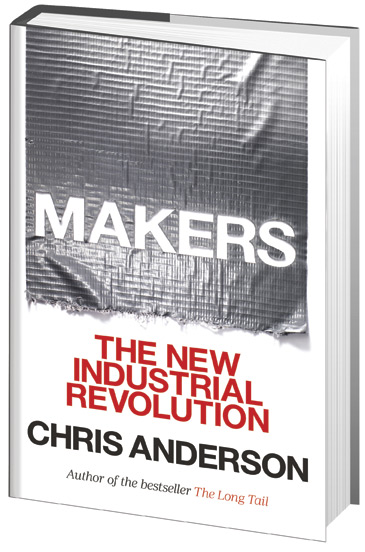
Book Mini-Review: Makers: the New Industrial Revolution by Chris Anderson

Wednesday, February 13th, 2013

Makers: The New Industrial Revolution by Chris Anderson 

This is a fun book  by the former editor-in-chief of WIRED , author of The Long Tail and the co-founder of 3D Robotics, Chris Anderson. Part pop culture, part tech-optimist futurism and all DIY business book, Anderson is preaching a revolution, one brought about by the intersection of 3D printing and open source “Maker movement” culture, that he believes will be bigger and more transformative to society than was the Web. One with the potential to change the “race to the bottom” economic logic of globalization by allowing manufacturing entrepreneurs to be smart, small, nimble and global by sharing bits and selling atoms.

Anderson writes:

Here’s the history of two decades of innovation in two sentences: The past ten years have been about discovering new ways to create, invent, and work together on the Web. The next ten years will be about applying those lessons to the real world.

This book is about the next ten years.

….Why? Because making things has gone digital: physical objects now begin as designs on screens, and those designs can be shared online as files…..once an industry goes digital in changes in profound ways, as we’ve seen in everything from retail to publishing. The biggest transformation, but in who’s doing it. Once things can be done on regular computers, they can be done by anyone. And that’s exactly what we’re seeing happening in manufacturing.

…..In short, the Maker Movement shares three characteristics,  all of which I’d argue are transformative:

1. People using digital desktop tools to create designs for new products and prototype them (“digital DIY”)

2. A cultural norm to share those designs and collaborate with others in online communities.

3. The use of common design file standards that allow anyone, if they desire, to send their designs to commercial manufacturing services to be produced in any number, just as easily as they can fabricate them on their desktop. This radically foreshortens the path from idea to entrepreneurship, just as the Web did in software, information, and content.

Nations whose entire strategy rests upon being the provider of cheapest labor per unit cost on all scales are going to be in jeopardy if local can innovate, customize and manufacture in near-real time response to customer demand. Creativity of designers and stigmergic /stochastic collaboration of communities rise in economic value relative to top-down, hierarchical production systems with long development lags and capital tied up betting on having large production runs.

Interesting, with potentially profound implications.

“Sustaining” your Way to Serfdom as a Grand Strategy

Monday, January 14th, 2013

Friend of the blog, commenter L.C. Rees, likes to point out that one of the most important part of a grand strategy, particularly one that is maintained despite evidence of being a geopolitical failure, are the domestic political effects that work to the advantage of the faction supporting it.  In my view, grand strategy usually has a political or cultural evolutionary component and, human nature being unchanging, Rees’s cynical observation has merit.

Last year, a couple of JCS aides/field grade officers wrote a grossly overpraised paper that was pushed by Anne-Marie Slaughter, Thomas Friedman and assorted worthies, that purported to be about a new grand strategy with which America could navigate the world. Mostly it centered on a preference for an America being run by a vaguely EU-like, technocratic, regime under the rubric of “sustainment”, in which the authors wisely folded in a number of  shibboleths popular with the corporate-liberal upper class who write large donation checks to think tanks or make their living in public policy and academia.

The talk of this nature died down when the election cycle began, but the themes were recently revived by the New America Foundation’s Grand Strategy Project whose director had an op-ed in Foreign Policy to reintroduce this agenda to the chattering classes now that the pesky voters are out of the way until 2014:

A New U.S. Grand Strategy 

….Walkable communities: The first pool of demand is homegrown. American tastes have changed from the splendid isolation of the suburbs to what advocates are calling the “five-minute lifestyle” — work, school, transit, doctors, dining, playgrounds, entertainment all within a five-minute walk of the front door. From 2014 to 2029, baby boomers and their children, the millennial generation, will converge in the housing marketplace — seeking smaller homes in walkable, service-rich, transit-oriented communities. Already, 56 percent of Americans seek this lifestyle in their next housing purchase. That’s roughly three times the demand for such housing after World War II.
If only Bismarck had included some “walkable communities” for Prussia, Europe might have avoided the tragedy of World War I.
.
Incidentally, all of this argument from assertion is unsupported rubbish keyed to a preexisting anti-suburban agenda the Obama administration brought with them into office in 2009. As Joel Kotkin explained:

….Whenever possible, the Clintons expressed empathy with suburban and small-town voters. In contrast, the Obama administration seems almost willfully city-centric. Few top appointees have come from either red states or suburbs; the top echelons of the administration draw almost completely on big city urbanites—most notably from Chicago, New York, Los Angeles, and San Francisco. They sometimes don’t even seem to understand why people move to suburbs.

Many Obama appointees—such as at the Departments of Transportation and of Housing and Urban Development (HUD) and at the Environmental Protection Agency (EPA)—favor a policy agenda that would drive more Americans to live in central cities. And the president himself seems to embrace this approach, declaring in February that “the days of building sprawl” were, in his words, “over.”

Not surprisingly, belief in “smart growth,” a policy that seeks to force densification of communities and returning people to core cities, animates many top administration officials. This includes both HUD Secretary Shaun Donovan and Undersecretary Ron Sims, Transportation undersecretary for policy Roy Kienitz, and the EPA’s John Frece.

Transportation Secretary Ray LaHood revealed the new ideology when he famously declared the administration’s intention to “coerce” Americans out of their cars and into transit. In Congress, the president’s allies, including Minnesota Congressman James Oberstar, have advocated shifting a larger chunk of gas tax funds collected from drivers to rail and other transit.

In addition, the president’s stimulus—with its $8 billion allocation for high-speed rail and proposed giant increases in mass transit—offers little to anyone who lives outside a handful of large metropolitan cores. Economics writer Robert Samuelson, among others, has denounced the high-speed rail idea as “a boondoggle” not well-suited to a huge, multi-centered country like the United States. Green job schemes also seem more suited to boost employment for university researchers and inner-city residents than middle-income suburbanites.

Suburbanites may not yet be conscious of the anti-suburban stance of the Obama team, but perhaps they can read the body language. Administration officials have also started handing out $300 million stimulus-funded grants to cities that follow “smart growth principles.” Grants for cities to adopt “sustainability” oriented development will reward those communities with the proper planning orientation. There is precious little that will benefit suburbanites, such as improved roads or investment in other basic infrastructure.

Kotkin nails it. Mr. Doherty is simply trying to find some national security window dressing for an elite preference that ordinary people will be much easier to manage, monitor and fleece if they are concentrated in high-density urban housing and prevented from voting with their feet by a network of punitive, anti-development, anti-mobility, Federal  regulations. The research paper, if you can call it that, justifying this authoritarian agenda can be found here. Judge for yourself.
.
However, this is no idle pipe dream, it has been done before. The  Japanese pursued a similar national “grand strategy” after WWII with the blessing of Washington to reconstruct defeated Japan: the old, independent,  Japanese business empires called zaibatsu were transformed by SCAP into submissive keiretsu that would take “administrative guidance” from the Ministry of International Trade and Industry and the Ministry of Finance. In return, the keiretsu were heavily subsidized by the government, which kept Japanese “salarymen” to an artificially low “middle-class” standard of living with macroeconomic policies that forced the Japanese to have an extremely high level of savings. A docile work force penned into tiny apartments, governed by a de facto one-party autocracy of the Liberal Democratic Party that kept the rent-farming machinery in place for big business for fifty years. It isn’t a great model, it is not what Walter Lippmann would have called “a good society” but it did work.
.
Mexico under the PRI dictatorship was a more backward version of this paradigm, as was Chicago under Mayor Daley.
.
Now back to our own grand strategy of walkable communitarianism:

…..Every continental-scale economic region must embark on a decisive sustainability strategy without delay. Working within existing norms of the World Trade Organization and the United Nations, America will lead the partnership of major economies to refashion the global economic system around eight or nine economic blocs, each boasting the scale necessary to support mature industrial ecosystems. This will mean promoting and strengthening regional economic blocs such as the Association of Southeast Asian Nations, the Union of South American Nations, the African Union, the Commonwealth of Independent States, and the Organization of Islamic Cooperation.

This part is literally nonsensical.

Say what you want about Osama bin Laden’s powers of rhetoric: he may have failed to convince his fellow Muslims to unite the ummah into a Caliphate but he evidently convinced a lot of people at The New America Foundation that Islam is an economy.

And as aside, why the hell is pushing political unification of South America or Africa under top-heavy, transnational bureaucracies in American interest? It sure isn’t in the interest of poor Africans or campesinos. For that matter, how can Africa unify if a third of their states will be in the OIC? WTF? Does Foreign Policy use editors or is it just a blog?

However, all that was simply geopolitical fantasizing over matters about which the United States has little control and would be unlikely to come off even under the best of circumstances. The next part I suspect is intended much more seriously. It certainly reflects a worldview that is pernicious and apparently more widespread among our elite than we realized, for which they are now testing the waters, to see if their fellow citizens are the herd they imagine us to be and if they can get away with it.

….Just as America would never fight a 21st-century war with Korean War-era weapons, it should not govern today with institutions devised for a bygone era. The Founding Fathers established a constitution that allows for the adaptation of the institutions of government to the knowledge, threats, and opportunities confronting each generation. Americans should make use of that foresight. Under this strategy, the country will adapt the institutions of its federal government to execute this grand strategy and invest in the American people to ensure that they receive the opportunities they need to be informed and engaged citizens. 

This is a tentative call, in milquetoast, coded, language, to find legal stratagems to gut the Bill of Rights and euthanize American democracy, or at least render it comatose, as a mere facade for a new paternalist technocracy that treats citizens as wards or children while we are rent-farmed for the benefit of a small elite. Certainly when we are all marooned in our government-regulated, high-density, housing, disarmed and without private transportation or much disposable income it will be too late for us to raise our voices in protest.  Doherty is correct about one aspect, such a society is probably “sustainable”; feudalism after all lasted more than a thousand years.

In plain English, the strategy of “sustainment” is a long term policy for postmodern serfdom with most of us intended to be walking behind the oxen when we are not wearing the yoke ourselves. Despite the nervous, thin-lipped, smiles and hasty reassurances, these people truly wish us and our children ill.

The good news is that none of this can come to pass without our consent. The U.S. Constitution is both sword and shield, if you are willing to pick it up. Speak, write, organize, litigate and vote out of office would-be authoritarians no matter what party label they wear. The best antidote for our creeping oligarchy is electing and appointing to office a large number of people outside of this exceedingly insular, geographically and intellectually narrow, social circle of graduates of  a handful of universities and last few percentage points of socioeconomic status who have in the last 15 years grabbed control of our government.

Really, we’re Americans – our talent pool is 315 million strong. We can easily do better.


Switch to our mobile site