zenpundit.com » blogosphere

Archive for the ‘blogosphere’ Category

Graphical footnotes, 2: the mourning after

Thursday, November 8th, 2012

[ by Charles Cameron — an example of the “serpent bites own serpent self” paradox from the 2012 election ]
.

This is offered as a footnote to my earlier post on self-referential aka recursive paradoxes. It is the bottom ten percent, at full width, of the mourning band Pamela Geller put on her Atlas Shrugs 2000 site when she learned of President Obama’s victory in the 2012 Presidential election.


.

For the record, I do not endorse Ms Geller’s entirely negative view of Islam — a vast and vastly diverse world religion with a long and storied history — nor for that matter her commentary on the election —

UPDATE: Obama won. And America, land of the free, home of the brave, died tonight.

nor the header for the post that consisted entirely of the graphic above — with the black extending an unremitting nine more times the height shown here:

THE DAY AFTER AMERICA

To be blunt: methinks the lady jumpeth shark.

**

What does interest me more than a little is the self-reflexive paradox with which she phrases her insight that America just killed itself — an example of the kind of paradox I was talking about in my post Numbers by the numbers: one.

Does Culture Trump Strategy?

Thursday, November 1st, 2012

The always interesting John Hagel tweeted a link recently to an old post at  Mill’s-Scofield Innovanomics, a blog run by a business strategist and consultant with a science background, Deb Mills-Scofield.

Summer’s Trump Cards 

….Culture Trumps Strategy: The best made plans are worthless if they’re not aligned with the culture. Sometimes the strategy can help transform the culture (for good or bad), but if the culture doesn’t support it, it won’t happen.  Perhaps that’s why I think CEOs need to be CCS’s – Chief Culture Stewards.

Challenge:  Start to check the health of your culture – really, be brutally honest -before the end of August.

This was interesting to me.

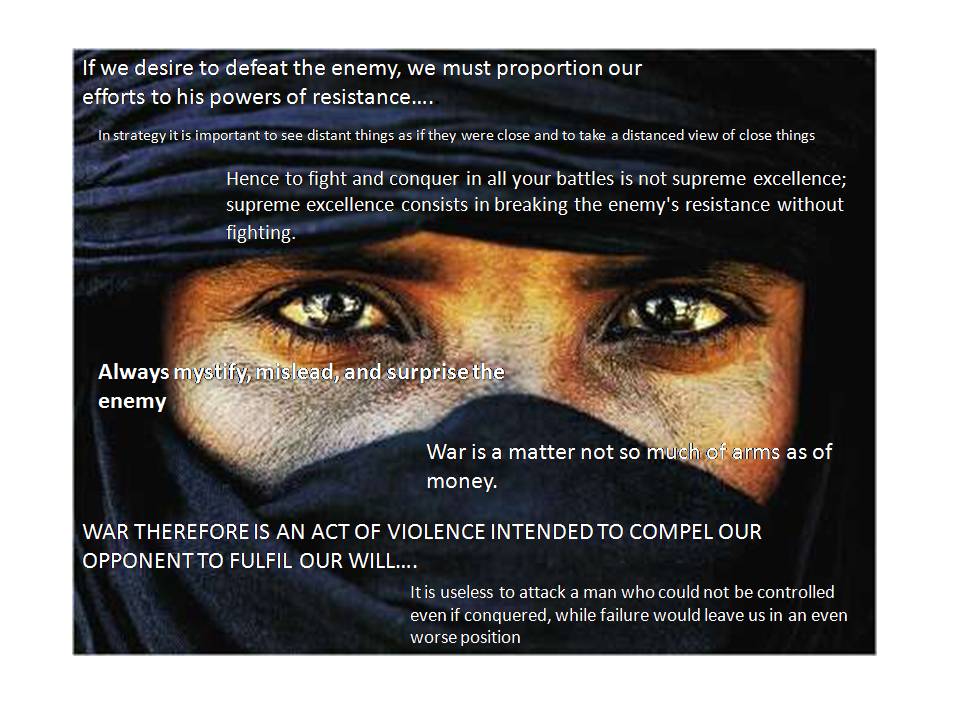
Obviously, Mills-Scofield was concerned here with “business strategy” and organizational theory and not strategy in the classical sense of war and statecraft. As Dr. Chet Richards has pointed out, unlike a military leader in war, businessmen are not trying to destroy their customers, their employees or even their competition, but while not the same kind of “strategy”, the underlying cognitive action, the “strategic thinking”,  is similar. Perhaps the same.

So, shifting the question back to the original context of war and statecraft, does culture trump strategy?

On twitter, I had a brief twitter discussion on this with Marc Danziger who was sympathetic to the proposition of cultural supremacy. I am not so sure, though I think the relationship between culture and strategy is an iterative one, the degree to which culture matters in strategy is highly contextual and is determined by how broadly you define cultural values as being directly operative in driving the scenario. Some disjointed comments:

  • Your own cultural-societal worldview shapes politics, policy and politik. So indirectly, culture will be a determining factor in conceiving “Ends” worth spilling blood and dying for – particularly in wars of choice. When war, especially existential conflict is forced upon a state by an enemy attack, some of the initiative and room for constructing artful or limited “Ends” has been lost and becomes secondary to survival. Even Stalin’s normally overweening and murderous ideological preferences mattered somewhat less in Soviet policy and strategy the day after Operation Barbarossa began than the day before.
  • If the Ends in view imply forcing a political settlement upon the enemy – “compelling him to do our will” – than the enemy’s culture matters a great deal. All the moreso, if the war entails COIN, military governance of an enemy population and reconstructing an enemy state to our liking. The enemy culture is part of the operational environment because our use of military force (destruction) is going hand in glove with substantial political activity (construction) – mere physical control of the population is not enough, though it is a precondition for success. MacArthur’s role as SCAP in post-war Japan demonstrated an exceptionally shrewd blend of coercion and concession to traditional Japanese cultural touchstones.
  • If our Ends are much more limited – degrading enemy operational capacity and/or simple, spasmodic, punitive expeditions to impose costs on an enemy state or entity in retaliation for aggression; or, if we intend to stand off-shore and strike with air and naval superiority – than the enemy culture matters far less. Force is being used to “bargain” at a very primitive level that does not require much cultural nuance to understand and the message of “we will hit back” . Likewise, if the war is an unlimited one of extermination and Carthaginian peace, enemy culture matters far less than your military capacity to execute your strategy.
  • Your cultural worldview shapes your grand strategy or statecraft because great and lesser powers are not coldly playing chess for material interests alone when they engage in geopolitical conflict and warfare but are establishing, evolving and protecting a national identity on the world stage. What Thucydides called “Honor”, the British “Paramountcy”, Richard Nixon “Credibility” and Joseph Nye “Soft Power” may all have been intangible expressions, difficult to quantify, but are very much part of the strategic calculus of war and peace.
  • Finally, it is important to note that strategic employment of brute force has a large role in setting the parameters of where and when cultural nuance and interpretation matter and exercise political leverage during war. Extreme violence disrupts and warps the cultural norms of belligerents, usually for the worse. It was the wars of the French Revolution and Napoleon that awoke the romantic pan-German nationalism of the 19th century that eventually united Germany and transformed it into the terror of the world in the 20th. The First World War ushered in a century of ideological monstrosities and revolutionary state terrorism on an epochal scale of murder unequaled even by the butchery of the Romans or Mongols. War is often the Abyss that looks into you.

Thoughts?

Of hot spots and feedback loops

Friday, October 26th, 2012

[ by Charles Cameron — with a pinch of humility which, if you ask me, burns hotter than any pepper ]
.


.

Micah Zenko at the Council on Foreign Relations‘ Politics, Power, and Preventive Action blog raised a question yesterday that I found irresistible:

Well…

To be more exact, and exercise just a little humility, the question I found so exciting was really the one Crispin Burke posed, in a tweet pointing to Zenko’s piece:

**

So I read Zenko’s post with Burke’s term “hot spot” in the back of my head, and when I responded to Zenko, did so in terms of hot spots. Which because they’re like the celebrated “dots” we’re often told we’ve failed to connect, triggered some thoughts that I think are worth repeating, even if the phrasing is a little off from Zenko’s own.

And the only real benefit I can see from my carrying Burke’s “hot spots” over into Zenko’s post is that it raised the issue of peppers, which adds a little spice to my response, and gave me a great graphic to go at the top of this post.

Okay, here’s the key sentence that frames Zenko’s post:

If you ask ten forecasters to predict the next conflict, you’ll likely get ten very different answers. But, they will agree on one thing: it is impossible to know for sure where and when the next conflict will emerge.

Zenko may not mention hot spots as such, but already two things stand out for me: he uses the words “where and when” and “the next” — so he’s thinking in geographic terms and short timelines. In his title, he asks about 2013, which is almost in the greetings card section of my local Safeway by now. And he sees trouble in terms of places, not systems.

**

Here’s the response I posted at his CFR blog:

A given hot spot may only be hot when coupled with another spot in a feedback loop – and the two spots may be widely separated geographically.

To my way of thinking, an assessment of incipient troubles needs to look for feedback loops, blowback systems, echo chambers – all of them patterned phenomena that are likely to feature both sides of a potential or ongoing conflict from a systems analytic point of view. A microphone isn’t a hot spot, a loudspeaker isn’t a hot spot, but put the two of them in the same acoustic system and you can generate an ear-shattering howl…

I’d look at “strong” versions of Islamophobic rhetoric and “strong” versions of Islamist rhetoric as a single system transglobally, for example, and I’d want to figure out what would cause dampening effects on both sides.

Another tack I’d take is to ask questions like “what’s in our blind spots” and “what’s under the radar” – I vividly recall hearing Ali Allawi tell a session at the Jamestown Foundation that within Iraq, “most of the dissident Shi’a movements not within the ambit of the political process have very strong Madhist tendencies” and that they were “flying under our radar” — despite the fact that US forces had been involved in a major battle with one such group outside Najaf.

I’ll post a more extended response on Zenpundit – but for now, I’d just like to throw in one additional question: is there a Scoville Scale for the “hotness of spots” as there is for peppers? It’s hard to know how to think through potential vulnerabilities without some sense of both intensity and probability of risk…

**

Forget Scoville and his habaneros — let’s get to the meat and potatoes.

I’ll be straightforward about this. I suspect we’re doing our intelligence analysis and decision-making with only one cerebral hemisphere fully functioning — ie with only half a brain — like halfwits one might almost say, but in a strictly metaphorical manner — without benefit of corpus callosum.

We don’t have the leaf > twig > branch > limb > tree > forest > watershed > continent > world zoom down yet.

We don’t think in systems, we think in data points.

Blecch, or d’oh! — your choice.

**

So my questions — and I don’t claim by any means to have an exhaustive list, that’s why we have many and varied bright people instead of just one or two — would be along the lines of:

  • how many kinds of metaphorical dry kindling are there in the world, which could turn into metaphorical wildfires?
  • and what sorts of metaphorical sparks could trigger them?
  • where are the rumblings?
  • what are the undercurrents of strong emotion running in different sociological slices of the world, that can be discerned from open sources such as the comments sections of online news media, conspiracy sites, religious group and subgroup (sect/cult) teachings, eccentric political movements, strands of pop culture — fanfic, comics, graffiti — single issue blocs?
  • where are the feedback loops, the parallelisms and oppositions, the halls of mirrors, the paradoxes, the koans, the antitheses, the conceptual antipodes?
  • where does energy drain from the system, and where does it collect, pool, and stagnate?
  • and perhaps most of all, what do we do, ourselves, wittingly or unwittingly, that tends to irritate others enough that they do unto us?
  • and do we consciously want to keep doing those things, and the blowback be damned?
  • **

    Where do we go from here. I think Zen (the Zen of Zenpundit, not the Zen of Zenko in this case) is right: we need to cross-weave our “vertical thinking” tendencies with “horizontal thinking” — see Zen’s posts on understanding cognition 1 and 2, which I take to be foundational for this blog.

    It’s the horizontal part that I’m trying to develop here, in my series of posts under the rubric of “form is insight” — because I think we have the other half of the equation, or the other cerebral hemisphere if you prefer, fairly well in hand.

    As always, it’s our vulnerabilities, dependencies, deficits and blind-spots we should be paying most attention to.

    A Handy intro to Networks

    Monday, October 22nd, 2012

    Blogfriend Rob Paterson has two concise posts up on understanding networks and network theory. If this is a subject you want to know more about, they are must-reads.

    My Network Revealed – Now what can you learn about yours?


    ….Here is my social network as created by the Mapping tool on Linkedin. It’s not the 100% true picture but it looks like 90% to me. You can use their mapping tool by going here.

    If I am right and we are moving to an economy that depends on our networks, then it is essential that we learn what each of our networks means and what we can do to make them healthier. So, with that in mind, let’s look at mine and I will share some lessons with you.

    Next week, I will post a podcast that I recorded yesterday with the Master of Networks, Valdis Krebs. Anything I know is because of him. He will go much deeper than I – so this is an introduction.

    Diversity – In nature diversity is a good thing – so it is with our social networks. You can see that I am connected to a series of worlds. PEI , Public Media, Network Thinkers, Family and I have 2 outside nets of New Military Thinkers and my legacy Corporate connections.

    I think that this does not look too bad – I have good links into many fields. How does your world look? 

    Our networks are like gardens, we can always make them better. We can always add and remove. We can always pay attention. ….

    Read the rest here.

    Human Networks – A masterclass by the Master Valdis Krebs – Podcast #networks

    This is Valdis Krebs – The Galileo of human Social Networks – ie the person who shows us what they look like, when before they were invisible, and who shows us the simple rules that drive them. 

    The few nations that were early into navigation and exploration in the 16th century, did very well. As we ourselves move into a world where all the advantages will accrue to those that understand Networks, I think it is vital that we understand how to navigate in the Network world. 

    The problem that many of us have is that when we hear the work “Network” we think of TV networks or Telephone networks that are driven by the old rules of engineering. What Valdis talks about mainly are Natural Networks, of which human social networks are a part. These are driven by the rules of Emergence and Nature and NOT by the rules of the CEO.

    The good news is that the Rules of Nature in this regard are simple to understand and to operate. 

    Network copy
    This is the “Map” that we are now going to explore.

    Read the rest here.

    Valdis Krebs is indeed the master of network-mapping and leveraging social networks


    A triptych for Jane McGonigal

    Thursday, October 18th, 2012

    [ by Charles Cameron — on play, games, vertigo and koan — technically this is a ludibrium, a jeu, a jest — a dervish whirl for the mind ]
    .


    .

    I’m joining the conversation Jane McGonigal is leading over on Big Questions Online — our topic is How Might Video Games Be Good for Us? — and she came up with a gem of a quote from Huizinga‘s Homo Ludens which pointed me to two other quotes that are part of the collection I keep in mind, one from Wittgenstein, the other from Roger Caillois.

    **

    I’ve strung them together here because the way the mind hops and skips from one idea to the next in this series enchants me:


    .

    There’s more to those three quotes taken together, along with the leaps between them, than there is in keeping them apart. They have, what was it Wittgenstein said? — a family resemblance. They belong together. You could start with the third quote, in fact, and then hop to the first and second, and the effect would be much the same, you could make a ring of them.

    **

    They spiral so closely in on one another, indeed, as to induce ilynx, vertigo. Let’s keep on spinning.

    To my mind, the master of vertigo in our times is Jorge Luis Borges, who uses the word “vertiginous” at least four times in his fictions — my favorite arriving in his story The Circular Ruins, where he writes:

    He understood that modeling the incoherent and vertiginous matter of which dreams are composed was the most difficult task that a man could undertake, even though he should penetrate all the enigmas of a superior and inferior order; much more difficult than weaving a rope out of sand or coining the faceless wind.

    Blam! — is there anything more vertiginous than paradox, enigma, koan, mystery?

    **

    In perspective, there’s the vanishing point. In service to others, there’s forgetfulness of self.

    **

    While we’re on the subject of play, I have a confession to make. Several times on this blog and elsewhere, I have cited the art historian Edgar Wind as saying that Ficino’s motto was “studiossime ludere” and that he translated it “play most assiduously” — Marsilio Ficino being the intellectual hub of Renaissance Florence under the Medici. When I was putting together my initial post to Jane McGonigal for her Big Questions discussion, I wanted to use that quote, but couldn’t quite find it in the source I thought it came from. Well, I’ve been doing some checking since then, and Wind does quote something very similar in his Pagan Mysteries in the Renaissance — but the phrase is “studiosissime ludere”, and what he writes is this —

    Serio ludere was a Socratic maxim of Cusanus, Ficino, Pico, Calcagnini — not to mention Bocchi, who introduced the very phrase into the title of his Symbolicae quaestiones: ‘quas serio ludebat’.[1]

    which he then footnotes thus (translation coming up shortly):

    [1.] cf. Ficino, In parmeniden (Prooemium), Opera, p. 1137: ‘Pythagorae, Socratisque et Platonis mos erat, ubique divina mysteria figuris involucrisque obtegere, … iocari serio, et studiosissime ludere.’

    Then there’s Ioan Couliano, another great scholar of Renaisssance thought — and a victim of Ceausescu‘s secret police — in Eros and Magic in the Renaissance, translates for us (pp. 37-38):

    Pseudo-Egyptian hieroglyphics, emblems and impresae were wonderfully suited to the playful spirit of Florentine Platonism, to the mysterious and “mystifying” quality Ficino believed it had. “Pythagoras, Socrates, and Plato had the habit of hiding all divine mysteries behind the veil of figurative language to protect their wisdom modestly from the Sophist’s boastfulness, of joking seriously and playing assiduously, iocari serio et studiosissime ludere.” [34] That famous turn of phrase of Ficino’s — translation of a remark by Xenophon concerning the Socratic method — depicts, at bottom, the quintessence of every phantasmic process, whether it be Eros, the Art of Memory, magic, or alchemy — the ludus puerorum, preeminently a game for children. What, indeed, are we doing in any of the above if not playing with phantasms, trying to keep up with their game, which the benevolent unconscious sets up for us? Now, it is not easy to play a game whose rules are not known ahead of time. We must apply ourselves seriously, assiduously, to try and understand and learn them so that the disclosures made to us may not remain unanswered by us.

    Couliano footnotes the quote thus:

    [34.] Proem. in Platonis Parmenidem (Opera, II, p. 1137). This is simply the Latin translation of an expression Xenophon had used to designate the Socratic method (paizein spoude). On the custom of the “serious games” of Ficino and his contemporaries, see Edgar Wind, Pagan Mysteries in the Renaissance 3d ed. (Oxford, 1980), pp. 236-38.

    **

    Okay, I was trying to check a Latin tag that I’d obviously been quoting from memory, and things just kept on spinning — and weaving — together.

    So where are we now? We’re talking of “playing with phantasms, trying to keep up with their game” (Couliano) — and thus back at that Borges quote, too, with its “incoherent and vertiginous matter of which dreams are composed”…

    Which is us.

    I mean, “We are such stuff as dreams are made on, and our little life is rounded with a sleep.”

    **

    Okay. Practical matters. To go along with Witty Wittgenstein and the others on my recommended reading list, here’s an image of McGonigal’s dissertation and book:

    The dissertation is available here as a .pdf: the book is available here on Amazon.


    Switch to our mobile site