zenpundit.com » blogosphere

Archive for the ‘blogosphere’ Category

2083 Graphics — a couple of details

Tuesday, July 26th, 2011

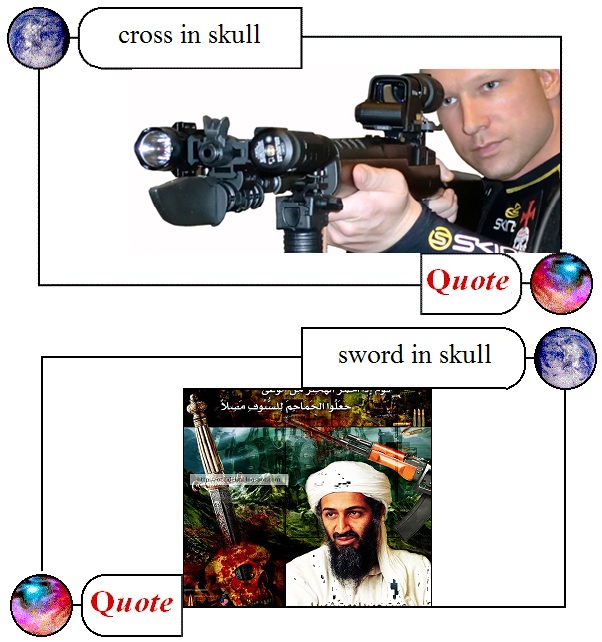
[ by Charles Cameron – graphic from 2038 manifesto compared with UBL martyr graphic & US “hunting permit” ]

.

I should say first off that I am grateful to Chris Anzalone aka Ibn Siqilli for his “In Pictures” series of posts of Islamist and related graphics, and especially his “martyrsseries, all which inspired my own first post on 2038 graphics a couple of days back.

It was his post on “Usama bin Laden, the Martyr, As Seen in Jihadi-Takfiri Artwork” today that gave me the idea for this post, when I noticed something familiar-but-different in one of the bin Laden graphics, and went back to check the portraits of Anders Breivik at the end of the 2083 manifesto.

Let’s call this pair of images Symbolic Analogy:

dq-symbolic-analogy.jpg

Once you start looking at the details, of course, other things pop out…

Like these two Hunting Permits:

dq-hunting-permits.jpg

As they say on this eHow page on How To Identify Military Insignia:

Military insignia make for good collector’s items because there are a variety of patches and badges, many with interesting, funny or bizarre imagery. If you happen to inherit some insignia, or a patch at a flea market or antique store catches your eye, identifying your treasure could take some work. Before you take your insignia for a professional appraisal, see if you can figure out what it is on your own. …

Examine your military insignia and note every detail. Figure out what the imagery is, whether you are looking at a pirate or unicorn, and whether it is a fabric patch or metal badge. Take special notice of any text or numbers on your insignia, even if you can’t understand them.

Carl Prine’s Rebuttal to “Be honest: Who actually read FM 3-24?”

Wednesday, July 13th, 2011

My amigo and SWJ News co-columinst Crispin Burke recently put forth a very interesting and provocative jeremiad “Be honest: Who actually read FM 3-24?” and one of his targets, journalist and Iraq war veteran Carl Prine, has been duly provoked, Prine has responded in great detail yesterday at Line of Departure:

Starbuck is wrong

Starbuck is wrong.

And in his drive to keep getting it wrong, he’s trying to rewrite FM 3-24, the military’s chief doctrinal publication on counterinsurgency.

But that just makes him more wrong.

He’s wrong about me.  He’s wrong about what I believe.  He’s wrong about the literature that informs FM 3-24.  He’s wrong about what the manual says and he’s wrong about what it left out.  He’s wrong about historiography.  He’s wrong about how a caste of top officers and diplomats came to understand “strategy” in the wake of the occupation of Iraq.

Let’s help get him right.  Or, at least, less wrong.  He’s a good man.  We need to turn him and ensure he quits taking shots at me I don’t deserve!

….The problem to anyone who studies Malaya, however, is that since the publication of the memoirs of exiled communist leader Chin Peng a dozen years ago, we now know that the civic, military and political policies under the British “hearts and minds” approach didn’t defeat the revolution.

Instead, the revolt was irreparably broken by brutal operations against the guerrillas, then a most coercive “screwing down the people” phase that dispossessed or killed thousands of Chinese, followed by draconian “population control” measures that, as Peng put it, starved the guerrillas in the bush because they snapped their rat lines and cut off their rice.

The “hearts and minds” initiatives designed to bring medical care, education, social welfare and other aid to the resettled Chinese and woo them to the colonial government’s side from 1952 – 1954 didn’t crack the back of the insurgency, a point now pretty much beyond dispute.

Why?  Because the previous “hearts and minds” claptrap as the cause of pacification in Malaya was contradicted by the Malayan Chinese, most especially those guerrillas who took up arms against the British regime!

You know, the people targeted by a population-centric counterinsurgency.  The people most counter-insurgents in their pop-centric fantasies almost never discuss except as abstractions, the human yarn wefted and warped by their long needles of war.

One finds “Hearts and Minds” prominently mentioned 11 times in Dr John Nagl’s valentine to Templer and colonial Malaya, Eating Soup with a Knife; to Nagl it’s the stuff of police services and economic development and whatnot with the psychology of the people being the center of gravity those reforms are meant to snatch.

And Nagl would like the best burglar of hearts and minds to be a learning, nimble and evolving military-political institution such as the U.S. Army.  It’s no small wonder, then, that Nagl became a dominant voice in FM 3-24 and that many of this thoughts in Eating Soup came to dominate the manual, too.

Or, as the introduction to FM 3-24 echoes soupily, “by focusing on efforts to secure the safety and support of the local populace, and through a concerted effort to truly function as learning organizations, the Army and Marine Corps can defeat their insurgent enemies.”

This is mere euphemism and wasn’t worth the ink that it cost taxpayers to print it.  But it sets the stage for the rest of FM 3-24, which follows a hearts and minds template that Starbuck doesn’t apparently realize is borrowed from mid-century….

Ouch. Note to self: if I ever decide to square off against Carl, I will make sure to do my homework. Read the rest here.

First, I would point out to readers here for whom some of this in both essays is inside baseball, that the tone is less harsh and the substantive distance between Burke and Prine less great in  the comments sections of both blogs than it first appears in reading their posts. It is a healthy, no-holds barred exchange and not a flame war.

Secondly, it is an important exchange, tying together COIN disputes over theory, historiography, empirical evidence, operational and tactical “lessons learned”, strategy, policy (Clausewitzian sense), politics (colloquial sense) and personalities that have raged for five years across military journals, think tanks, the media, the bureaucracy and the blogosphere. In some ways, these essays can serve as a summative of the debate. I say “some ways”, because what is the most important element or effect of America’s romance with COIN will differ markedly depending on whom has the floor. My own beef is not with doing COIN, it is with not doing strategy.

As Crispin and Carl’s vignette about General Creighton Abrams demonstrated, American historians are still having savagely bitter arguments about the war in Vietnam. For that matter, everyone who lived through the era did and still does. It is a wound that never seems to heal and has crippled our politics to this day, even as the veterans of Vietnam now turn to gray.

The 21st century COIN wars have not ripped American society apart down to the soul the way Vietnam did. As with the Korean War, the soldiers and marines in Afghanistan and Iraq fought bravely, at times desperately, to a general and mild approbation back home that sometimes looked a lot like indifference. Even the anti-war protestors mostly made a point of stating they were not against the troops, the venemous public malice of the 1960’s New Left radicals in the 2000’s was a property only of the lunatic fringe.

But COIN itself will be a historical argument without end.

Google Ideas SAVE conference

Friday, July 8th, 2011

[ by Charles Cameron — cross-posted with brief intro from Alix Levine‘s blog — topic: Google’s Summit Against Violent Extremism ]

.

Google Ideas — the Google “think/do tank” — recently co-hosted (with the CFR and Tribeca Film festival) a conference on countering radical extremism in Dublin, with a mix of “former extremists, activists, academics, survivors, executives and public sector officials” in attendance.  Blog-friend Matt Armstrong was there, live-tweeting with enthusiasm. Dr William McCants of Jihadica and CNA wasn’t terribly impressed with the outcome, and posted at Foreign Policy:

I am not ready to give up on the enterprise of countering violent extremism just yet, but I am less sanguine about its chances of success than I was before I started working on the problem. Google Ideas’ summit has not increased my optimism, but its resources and potential do.

Alix Levine of Cronus Global attended the event, and reported back on her blog. I’ve commented briefly on McCants’ piece on FP, but wrote a longer piece as a comment on Alix’ blog, and am cross-posting it here in the hope that it will stir further discussion…

*
I’m comparing Will McCants‘ response to the Google Ideas conference on FP with yours, and I’m glad you wrote as you did.

McCants – whose work I generally admire — opens his comments by quoting Jared Cohen to the effect that the purpose of the conference was to “initiate a global conversation”. McCants then more or less dismisses the conference itself a couple paragraphs later with the words “If these are indeed the conclusions of the conference, Google Ideas needs more thinking and less doing in its approach”.

Conclusions? How does he get so quickly from “initiate” to “conclusions”?

Okay, we all know that a conference can lead to a volume of proceedings read mostly by the authors themselves and a few aspiring students eager to follow-my-leader and dead end there – but this conference was very clearly intended to be the start of something, not the wrap-up.

So your comment, Alix, “Instead of critiquing Google’s effort, it will be more productive and valuable to work in unison with Google on their mission to ‘initiate a global conversation'” seemed to me to bring us back to the actual intent Google had announced for the conference, and you reinforce that when you write, “I hope that more people will join in on the conversation in a meaningful and (gasp) positive way.”

My questions are: how and where do we do this?

There will have been contacts made at the conference that will lead to an exchange of emails, no doubt – but that’s not a global conversation.

Here are some of the problems I foresee:

(a) siloing: the conversation limiting itself to a few constituencies, each of which talks mainly among its own members, leading to

(b) group think: in which the widely assumed gets even more firmly entrenched as “wisdom”, with

(c) secrecy: meaning that potentially relevant information is unavailable to some or all participants, all of which add up to

(d) blind spots: topics and approaches that still don’t get the attention and exploration they deserve.

The solutions would need to include:

(a) networked diversity: by which I mean a structured means of getting the unpopular or minority opinion front and center (compare business brainstorming in which a facilitator ensures even the “quiet ones” get heard, and that even poor ideas are expressed without critique until a later, evaluative stage),

(b) contrariety: meaning that whatever ideas are “easily dismissed” get special attention, with

(c) transparency: meaning that whatever could be redacted and made partially available is made available, not (as in US Govt “open source” material, closely held), so that

(d) oddballs and outriders get to participate…

Jami Miscik who was Deputy Director for Intelligence at the time, caught my attention when she said in 2004, “Embrace the maverick”. Oddballs aka mavericks make the best contrarians, because they start from different premises / different assumption bases. Miscik accordingly invited science fiction and film writers to interact with her analysts at CIA, and found that when they did, they produced 80% already known ideas, 10% chaff, and 10% new and “valid” scenarios. But even then, “science fiction and screen writers” is a box…

Cross-fertilization, questioning of assumptions, passion, reverie, visualization, scenario planning, play – the number of strategies that could be employed to improve the chances of a successful new insight emerging are many and various – unkempt artists probably know some of them better than suits with high IQs and clearances, and Google clearly knows this, too…

But where?

I mean, what Google+ circles do any of us join, to join this global conversation? What twitter hashtag brings us together under one roof? When’s the follow up in my neck of the woods, or yours?

What’s the method for getting the conversation widespread, well-informed – and scaleable, so the best of the grass roots and local ideas can find their way to the influential and informed, and the best insights of the influential and informed can percolate through to the grass roots and local?

Lastly, I’d like to thank Google for getting a dialog going between those with a range of subjective experiences of radicalization, and those whose job it is to understand and thus be able to interdict it. Demonization never got the situation in Northern Ireland anywhere near peace – listening did.

And thank you too, Alix, for your own contribution. Let’s move the conversation onwards.
New Blog: Fear, Honor, and Interest

Friday, June 24th, 2011

Fear, Honor, and Interest, judging by the list of contributors, has the potential to be a vibrant group blog. Preemptively endorsed.

Pundita on Mexican Insurgency and Hollowing Out America

Wednesday, June 15th, 2011

Blogfriend Pundita turns an eye to Mexico, which is currently entering free fall despite official US policy that the cartels are not an insurgency, and has extensive comments on how the transnationally oriented, strategically inept, elite mismanaging US foreign policy no longer think in terms of a “US foreign policy”. Or perhaps, a “US”:

“Hollowed out” Mexico and hollowed-out USA

….I hate to be the one to break this news to Mark but there can no longer be an American policy on Mexico because there is no longer a United States of America. He doesn’t know this because he doesn’t watch much television news, but a few weeks of watching CNN will clue him that the USA is no more. In its place is a country called The Whole World (aka RIC – Republic of International Community), which for reasons known only to the rascals who run CNN excludes every world region where CNN is not in hot competition with al Jazeera.I myself speak of the “country” of the USA, which I think is what seems to be a box of cookies or a milk carton in the foreground of the above satellite photo of the RIC, only as a matter of convention.

As for FNC (Fox News Channel): currently too busy taking pot-shots at other TV news outlets for initially covering up the Weiner story and otherwise too busy trying to find a Republican who can win the White House to notice that a U.S. government is a memory.

(Memo to FNC: The other TV media were initially quiet about Weiner’s texting problem not because he’s a Leftist but because his wife is Hillary Clinton’s closest aide and they didn’t want to have to tell the American public that the person closest to the U.S. Secretary of State is an American Muslim of Indian-Pakistani heritage who was raised in Saudi Arabia, you nitwits.)So before we try to upgrade U.S. policy on the hollowed-out state of Mexico, as the Narcos book terms it, I say let’s examine how the U.S. got hollowed out.

One more point before I cede the floor to Mark: His summary doesn’t indicate whether the book addresses racism and apartheid in Mexico. I know that Mark is aware of the subject so I think he would have mentioned it, if any of the monographs dealt specifically with racism; frankly I’d be surprised if any did because the topics of Mexican racism and apartheid are taboo in both the USA and Mexico.

Later this week or the next I’ll try to rip myself away from the Afghan War long enough to return to those issues, which I touched on in an earlier post. For now, I’ll just say that I think Mexico’s type of racism is the true “virus” that Dr Bunker talks about….

Good question regarding the effects of racism in Mexico on the evolution of the cartel wars. An important point. I know why employees of USG entities do not raise it; for the same reason they will not use the “i” word – Mexican officials would go ape.

Dr. Bunker reads ZP from time to time and he’s best placed to explain why none of the authors delved into that aspect of narcocultas folk religion or Mexican elite behavior. My recollection is that most of the contributors to Narcos Over the Border were security specialists rather than social historians or sociologists.  Maybe David Ronfeldt, who also has a specialty in Mexican affairs, can also weigh in on this important point.

Hollowing out of the US requires a post of it’s own to consider.


Switch to our mobile site

