zenpundit.com » africa

Archive for the ‘africa’ Category

UBL and the African elephant

Sunday, July 10th, 2011

[ by Charles Cameron — UBL, global warming, elephants, and Al-Shabaab ]
.

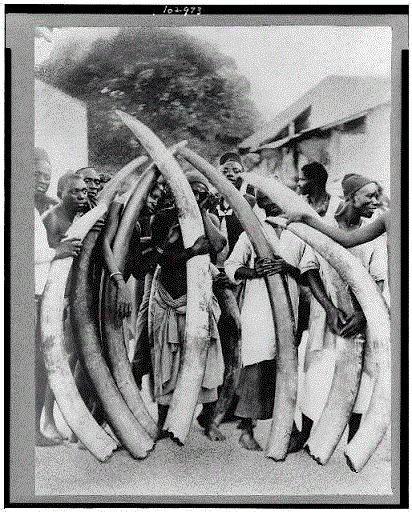
3c02973r.gif
Natives with ivory tusks, Dar Es Salaam, Tanganyika” ca 1900, LOC

I’d like to quietly propose a few dots or data points…

*

Alex Shoumatoff has a fine article titled “Agony and Ivory”, in Vanity Fair:

The riverbank is littered with elephant dung. Andrea kicks apart one of the boluses, and it is full of big, hard-shelled seeds — Pandanus, Drypetes, and Gambeya. A new study has found that forest elephants are essential to central Africa’s forests for tree-seed dispersal. They can carry heavy seeds like these (which wouldn’t get very far on their own) in their gut for 50 miles before voiding them. Another study measures the rapid, prodigious growth of the forest trees and concludes that central Africa is the second-most-important equatorial sink for atmospheric carbon after the Amazon, so elephants are important for controlling global warming, on top of everything else.

Here is Shaykh Usama bin Laden, in his radio message “The Way to Save the Earth” from As-Sahab Media:

This is a message to the whole world about those who cause climate change and its dangers — intentionally or unintentionally — and what we must do. Talk of climate change isn’t extravagant speculation: it is a tangible fact which is not diminished by its being muddled by some greedy heads of major corporations. The effects of global warming have spread to all continents of the world. Drought, desertification and sands are advancing on one front, while on another front, torrential floods and huge storms the likes of which only used to be seen once every few decades now reoccur every few years.

From UBL’s perspective, this is clearly a moral issue:

First, the corruption of the climate stems from the corruption of hearts and deeds, and there is a close relationship between the two types of corruption.

And here’s Shoumatoff again, on the situation in Kenya:

A few weeks ago, two poachers were killed and a ranger was wounded in a firefight in Meru National Park. Al-Shabaab, the Islamist youth militia which is in league with al-Qaeda and controls most of Somalia, has been coming over the border and killing elephants in Arawale National Reserve. Ivory, like the blood diamonds of other African conflicts, is funding many rebel groups in Africa, and Kenya, K.W.S. director Julius Kipng’etich told me, “is in the unenviable position of sharing over 1,700 kilometers of border with three countries with civil wars that are awash with firearms: Somalia, Ethiopia, and Sudan.” Nothing less than a full-scale military operation is going to stop the poaching in the north.

*
Now, as EM Forster suggested, Only connect!

Google Ideas SAVE conference

Friday, July 8th, 2011

[ by Charles Cameron — cross-posted with brief intro from Alix Levine‘s blog — topic: Google’s Summit Against Violent Extremism ]

.

Google Ideas — the Google “think/do tank” — recently co-hosted (with the CFR and Tribeca Film festival) a conference on countering radical extremism in Dublin, with a mix of “former extremists, activists, academics, survivors, executives and public sector officials” in attendance.  Blog-friend Matt Armstrong was there, live-tweeting with enthusiasm. Dr William McCants of Jihadica and CNA wasn’t terribly impressed with the outcome, and posted at Foreign Policy:

I am not ready to give up on the enterprise of countering violent extremism just yet, but I am less sanguine about its chances of success than I was before I started working on the problem. Google Ideas’ summit has not increased my optimism, but its resources and potential do.

Alix Levine of Cronus Global attended the event, and reported back on her blog. I’ve commented briefly on McCants’ piece on FP, but wrote a longer piece as a comment on Alix’ blog, and am cross-posting it here in the hope that it will stir further discussion…

*
I’m comparing Will McCants‘ response to the Google Ideas conference on FP with yours, and I’m glad you wrote as you did.

McCants – whose work I generally admire — opens his comments by quoting Jared Cohen to the effect that the purpose of the conference was to “initiate a global conversation”. McCants then more or less dismisses the conference itself a couple paragraphs later with the words “If these are indeed the conclusions of the conference, Google Ideas needs more thinking and less doing in its approach”.

Conclusions? How does he get so quickly from “initiate” to “conclusions”?

Okay, we all know that a conference can lead to a volume of proceedings read mostly by the authors themselves and a few aspiring students eager to follow-my-leader and dead end there – but this conference was very clearly intended to be the start of something, not the wrap-up.

So your comment, Alix, “Instead of critiquing Google’s effort, it will be more productive and valuable to work in unison with Google on their mission to ‘initiate a global conversation'” seemed to me to bring us back to the actual intent Google had announced for the conference, and you reinforce that when you write, “I hope that more people will join in on the conversation in a meaningful and (gasp) positive way.”

My questions are: how and where do we do this?

There will have been contacts made at the conference that will lead to an exchange of emails, no doubt – but that’s not a global conversation.

Here are some of the problems I foresee:

(a) siloing: the conversation limiting itself to a few constituencies, each of which talks mainly among its own members, leading to

(b) group think: in which the widely assumed gets even more firmly entrenched as “wisdom”, with

(c) secrecy: meaning that potentially relevant information is unavailable to some or all participants, all of which add up to

(d) blind spots: topics and approaches that still don’t get the attention and exploration they deserve.

The solutions would need to include:

(a) networked diversity: by which I mean a structured means of getting the unpopular or minority opinion front and center (compare business brainstorming in which a facilitator ensures even the “quiet ones” get heard, and that even poor ideas are expressed without critique until a later, evaluative stage),

(b) contrariety: meaning that whatever ideas are “easily dismissed” get special attention, with

(c) transparency: meaning that whatever could be redacted and made partially available is made available, not (as in US Govt “open source” material, closely held), so that

(d) oddballs and outriders get to participate…

Jami Miscik who was Deputy Director for Intelligence at the time, caught my attention when she said in 2004, “Embrace the maverick”. Oddballs aka mavericks make the best contrarians, because they start from different premises / different assumption bases. Miscik accordingly invited science fiction and film writers to interact with her analysts at CIA, and found that when they did, they produced 80% already known ideas, 10% chaff, and 10% new and “valid” scenarios. But even then, “science fiction and screen writers” is a box…

Cross-fertilization, questioning of assumptions, passion, reverie, visualization, scenario planning, play – the number of strategies that could be employed to improve the chances of a successful new insight emerging are many and various – unkempt artists probably know some of them better than suits with high IQs and clearances, and Google clearly knows this, too…

But where?

I mean, what Google+ circles do any of us join, to join this global conversation? What twitter hashtag brings us together under one roof? When’s the follow up in my neck of the woods, or yours?

What’s the method for getting the conversation widespread, well-informed – and scaleable, so the best of the grass roots and local ideas can find their way to the influential and informed, and the best insights of the influential and informed can percolate through to the grass roots and local?

Lastly, I’d like to thank Google for getting a dialog going between those with a range of subjective experiences of radicalization, and those whose job it is to understand and thus be able to interdict it. Demonization never got the situation in Northern Ireland anywhere near peace – listening did.

And thank you too, Alix, for your own contribution. Let’s move the conversation onwards.

Guest Post: Shipman Reviews Dancing in the Glory of Monsters by Jason K. Stearns

Wednesday, May 18th, 2011

J. Scott Shipman, the owner of a boutique consulting firm in the Metro DC area that is putting Col. John Boyd’s ideas into action, is a longtime friend of this blog and an occasional guest-poster.

Book Review:Dancing In The Glory of Monsters, The Collapse of the Congo and the Great War of Africa, Jason K. Stearns

by J. Scott Shipman

Several thoughts come to mind when reflecting on Jason K. Stearns’ epic Dancing In The Glory of Monsters, The Collapse of the Congo and the Great War of Africa, but “dancing” doesn’t figure into any of those thoughts, and monsters are writ large, center stage. And make no mistake; we’re talking fiendishly horrific monsters, almost inhuman, as if drawn from a dictionary definition: “Anything horrible from…wickedness, cruelty or commission of extraordinary or horrible crimes; a vile creature…” So the reader should be advised, some of the stories are very disturbing.

Indeed, Mr. Stearns paints a gut-wrenching portrait of a nation and region ravaged by colonial meddling, venal and brutish politician/military leaders, and centuries old ethic strife all culminating in “many wars in one” beginning in 1996 in Congo (the former Zaire) and including active participation of neighbors Rwanda and Uganda just to name a couple.  In terms of geography, Congo straddles the equator and is the size of Western Europe, or slightly less than one fourth the size of the United States. According to the CIA World Fact Book, the literacy rate is 67% and the mortality rate a surprisingly “high” 54 years for men, and 57 for women; given the slaughter since 1996, my guess would have been a much lower number.

The Congo Wars were largely a by-product of the epic 1994 genocide in Rwanda where in the space of 100 days an estimated 800,000 Rwandans (primarily Tutsis and moderate Hutus) were killed. The killing was “organized by the elite but executed by people.” Stearns says, “…between 175,000 and 210,000 people took part in the butchery, using machetes, nail-studded clubs, hoes, and axes.” The killing was done in public and almost no one was untouched either as “a perpetrator, a victim or witness.” For internal political reasons, this resulted in over one million Hutu refugees/rebels fleeing over the border from Rwanda to Zaire. A massive tug-of-war across the border began with the ailing Zairian president Mobutu Sese Seku providing support to the rebels, and eventually a ten-year struggle within Zaire proper of both the Rwandan civil war and wars to control what became in 1997, Congo.

Dancing With Monsters is divided into three parts. Part 1 ended with the collapse of Mobutu’s government in May 1997. Following a brief respite in the fighting, Congo’s new president Laurent Kabila “fell out with his Rwanda and Ugandan allies” resulting in the second Congo war in August 1998 which “lasted until a peace deal reunified the country in 2003.” But the fighting in the eastern part of the country continues to this day and is considered the third Congo war.

Stearns tells the Congo story based on first person interviews with both perpetrators and victims of extraordinary atrocities, although he focuses more on the perpetrators who “oscillate between these categories.” A perpetrator one day becomes tomorrows victim and vice versa. Stearns has worked the better part of 10 years in the Congo, and is to be commended for the raw physical courage necessary to live, much less interview many of the “monsters” in his revealing book.

Interestingly, Stearns chose to focus on a system “that brought the principal actors to power, limited the choices they could make, and produced chaos and suffering.” That “system” is in a word, a mess. The chaos and suffering are of a kind with no contextual parallel in the modern Western experience. Stearns attempts to provide a context in an excellent introduction that offers insight into the violence, which more often than not, appears maddeningly senseless and consistently brutal. The culture of the region appears to be one where everyone is on the take, where everyone is corrupt simply to survive. To quote one of Stearns’ sources: “”If you don’t bribe a bit and play to people’s prejudices, someone else who does will replace you.” He winked and added, “Even you, if you were thrown into this system you would do the same. Or sink.”” This tone of resignation and an “ends justifies the means” justification permeates the attitudes of the political/military types Stearns interviews; in fact this philosophy colors a good portion of the book, and therein points to a large part of the systemic problem. A quote attributed to another monster, Stalin kept coming to mind: “You can’t make an omelet, without breaking a few eggs.”

From this attitude of resignation, my guess is that perhaps the “system” Stearns has documented is the extreme end result of Che Guevara-style of Soviet Marxist totalitarianism. Guevara himself spent 1965 fighting in the Congo but concluded, “they weren’t ready for revolution.” The Congolese may not have been ready for revolution, but it appears they bought the philosophy hook, line and sinker. This mentality reminded me of a passage from another book of horrors, The Whisperers, by Orlando Figes, where he writes: “she had subordinated her own personality and powers of reason to the collective.” The subordination of reason is pandemic in Congo; a place where mostly ethnically based discrimination and killing is conducted without so much as an apology. Many of Stearns’ political/military leaders spoke of “democracy,” but in my reading I did not get the sense this was anything more than a rhetorical fig leaf to remain in the good graces of the UN and the West, for there has been little in the behaviors of these leaders to suggest a level of seriousness and understanding as to what democracy means; political accountability comes to mind. Meanwhile, the killing continues.

Speaking of democracy, a good portion of the West was and continues to be indifferent to the Congo and the wars. Stearns points out, “the response, as so often in the region, was to throw money at the humanitarian crisis but not to address the political causes.” This sounds accurate. Stearns believes the West should do more, comparing the response to Kosovo in 1999, where “NATO sent 50,000 troops…to Kosovo, a country one-fifth the size of South Kivu“(part of Congo). Many of those interviewed by Stearns agree, but with a twist. In the concluding chapter, Stearns quotes a Rwandan political advisor offering what he called a “typical view” of the US from the region:

“When the United States was attacked on September 11, 2001, you decided to strike back against Afghanistan for harboring the people who carried out the attack. Many innocent civilians died as a result of U.S. military operations. Is that unfortunate? Of course. But how many Americans regret invading Afghanistan? Very few.”

Many Americans regret the extent of our operations in Afghanistan, more with each passing day. In my opinion, this seems to be offering an all-too-typical moral equivalence argument; since innocents die in American wars, our slaughter of innocents is justified. Stearns correctly follows this quote with extension of the Rwandan official’s line of thought:

“This point of view does not allow for moral nuance. Once we have established that the genocidaires are in the Congo, any means will justify the ends of getting rid of them, even if those means are not strictly related to getting rid of genocidaires.”

This official’s argument is as dangerous as the wars he and his neighbors have endured. In delegitimizing any moral nuance his prescription is amoral, or worse, claims an exclusive role defining morality thereby justifying a continuation of the slaughter. I don’t have a solution, but this prescription will yield only more of the same. Political accountability doesn’t pass the buck, or hide behind a general truth that tragedies occur, but rather learns from mistakes made and steadfastly strives to avoid further bloodshed.

In conclusion, I would offer one bit of advice to those who read this important book: use Google Earth or a good atlas; the book has maps, but the maps aren’t sufficient to the level of detail provided in the book. This is a minor nit, but one that can be enhanced through an external source.

Stearns concluded on a note of optimism and confidence in the Congolese people, whom he calls extremely resilient and energetic peoples. One could conclude nothing less from this excellent and truly frightening recounting of their story. Highly recommended.

Pantucci at Prospect: the glitter and the gold

Tuesday, April 12th, 2011

[ by Charles Cameron ]

*

Prospect magazine just published Raffaello Pantucci‘s piece Jihadi MCs — which is about Omar Hammami and his jihadist rap songs, and more generally, the use of pop culture and tech in jihadist recruitment.

Culture as recruitment: that interests me a great deal.

*

I keep an eye out for Pantucci’s work. He’s an Associate Fellow at the International Center for the Study of Radicalisation, and one of the people who writes about contemporary jihadism with insight. I follow his tweets and mostly click through up on the links he suggests, and we’ve exchanged emails a couple of times. So I clicked through to the Prospect site and read his piece.

And because I’m a writer, I tried to imagine his audience. Who, for instance, is this intended for?

But it is Somali group al Shabaab (“The Youth”) that is at the forefront of this new media approach. Omar Hammami’s recent hip-hop release is merely the latest from the jihadi MC. In his earlier work “First Stop Addis” he rapped about his earnest desire to become a martyr, over shots of him and his “brothers” training and fighting in Somalia. Released through extremist websites, but also widely available on YouTube, the MTV-inspired videos and songs seek to show kids how cool it is to be a mujahedin. Other videos released by the group show young warriors from around the world speaking happily into the camera as they boast, sometimes in perfect English, of how much fun it is to be fighting against the “kuffar” (unbeliever) government in Somalia.

First, like every researcher worth his salt, I imagine Pantucci peers into these things to inform himself, to figure out significant currents in the world he lives in: he’s interested, he’s engaged. Second, it seems to me, he must be writing with an eye to his peers in the field of jihadist studies, to inform them of what he’s been able to piece together, to alert and inform those who are actively engaged in decision-making as part of the war of ideas, and perhaps to hammer some sense into the pundits who routinely misinform the public.

But on this occasion he has a third audience: he’s also addressing interested parts of the general public himself — in this case, the readers of a British magazine.

*

For most of his Prospect readers, this article will be informative background reading – but not, so to speak, “actionable intelligence”.

Let’s say that the “actionable” part of what he writes – more accurately, the analytic content – is the gold, and everything else is the glitter.

The general reader of a magazine like Prospect takes in the gold with the glitter, but in all probability wouldn’t get the gold at all if there was no glitter surrounding it. If Prospect had published Pantucci’s paper, The Tottenham Ayatollah and The Hook-Handed Cleric: An Examination of All Their Jihadi Children (it appeared in the academic journal, Studies in Conflict & Terrorism) or his more recent ICSR paper A Typology of Lone Wolves: Preliminary Analysis of Lone Islamist Terrorists, I somehow doubt the readers of Prospect would have been so keen to read them. They contain, if you will, too high a ratio of “gold” to “glitter”.

The glitter is there in his Prospect piece on Hammami, we might say, to catch and hold those readers’ attention. To, if you will, recruit their interest.

Nothing new or bad about that, we all write for different audiences, with different ratios of anecdote and statistic, fact and anecdote, humor and persuasion…

*

Here’s what interests me.

The “glitter” in Pantucci’s piece isn’t from Pantucci – it’s the glitter that the jihadists themselves are adding to the “gold” of their Islamist message.

So if you read Pantucci’s piece not just to inform yourself on a few new data points about al-Shabaab but in the relaxed mode of your average magazine reader, all the bits that seem like the neat “glitter” that make the article well-written and readable …

hip-hop .. rap .. socially networked revolution .. funky imagery and slang .. fanzine .. videos and songs .. how cool it is to be a mujahedin .. other non-traditional means .. dial-in conference calls .. how much fun it is to be fighting against the “kuffar” .. Facebook messages .. “‘Sup dawg. Bring yourself over here” to “M-town.”

… are also the specifics that al-Shabaab is using to recruit the attention of those who more or less idly surf YouTube and run across one of their videos…

The glitter is the gold.

In this case, I mean, the cool is the recruitment.

__________________________________________________________________________________________

Update:

Of course, if the rap itself is uncool as rap, that’s not so cool after all…

Daveed Gartenstein-Ross @DaveedGR tweets: “Seriously, John Walker Lindh is a better rapper than Omar Hammami: http://bit.ly/ifoafQ” — and Adam Serwer @AdamSerwer: “The lyrics to Omar Hammami’s rap don’t do it justice. Dude just has absolutely no rhythm whatsoever.”

Dawg.

On Libya

Friday, April 1st, 2011

I thought it might be interesting to look at some views of the Libyan War and then offer some remarks of my own. Of course, readers are encouraged to read each source in full rather than just my excerpt: First up….

CNAS (Andrew Exum & Zachary Hosford)Forging a Libya Strategy: Policy Recommendations for the Obama Administration

….The most dangerous outcome for the United States is also the most likely, which is a stalemate that prolongs U.S. and allied military intervention in Libya. The relative lack of sophistication and organization among rebel fighting forces means they may be unable to regain the momentum in Libya and defeat Gadhafi’s forces in open combat absent significant direct and indirect support from U.S.and allied militaries – which is not explicitly authorized by UNSCR 1973 and might not be supported by the U.S. Congress.

A stalemate in Libya would effectively result in a de facto partition of the country with a severely underundergoverned and disorganized safe haven in eastern Libya for the rebels that could provide refuge for various militant and criminal groups capable of exporting violence and instability to other countries in North Africa and the Middle East. Such a scenario would prolong U.S. and allied military intervention as only a major Western investment in developing the independent governance, economic and security force capacity of eastern Libya would be likely to forestall this outcome. However, such an investment is highly unlikely due to the overarching fiscal constraints facing the United States and NATO countries and competing priorities.

Nice work on a very important policy brief by Exum and Hosford. This one was “tight”, written to the point, properly focused on strategic variables rather than getting bogged down in debatable specialist minutia and delivering clear policy option scenarios. Written in exactly the right mode for a White House/NSC staffer or deputy to SEC to digest and disseminate to their boss or peers. Kudos, gents.

I think Ex and Hosford have correctly diagnosed Libya as a potential albatross for the US from which we stand to gain very little benefit even in the best case scenario. I disagree with their assertion that it would be a tolerable outcome to leave Gaddafi in power. No, that ship has already sailed and we have had enough Lockerbies. To imagine that there will not be ongoing blowback from a rump Gaddafi regime in a fragile neighborhood with which the US will repeatedly have to deal is just not at all realistic.

The Allies badly wanted Gaddafi out. They will have to be pressured now to follow through and the US needs to make it clear that we will neither babysit an enraged, cornered, Gaddafi for the next seven years, tying down an aircraft carrier group and costing the US taxpayer billions, nor we will accept the Brits and French hanging Gaddafi’s triumphant survival on our doorstep as an “American defeat” while skating away diplomatically (which is their Plan B if we refuse to do a Panama type operation for them). They will have to finish the job on the ground themselves and ensure Gaddafi’s death or departure with our support, but not the reverse. Or Paris and London can help build a real rebel army, salted liberally with PMC units and SOF “advisers” to stiffen spines.

CRS Report ( Christopher M. Blanchard) – Libya Unrest and US Policy

….The complexity of these factors and the stress that ongoing fighting places on their interrelationships creates challenges both for Qadhafi supporters and opposition groups. As both parties seek to navigate the political waters of the upheaval and look ahead to potential postconflictscenarios, they face difficult questions about current tactical choices and future means for promoting national reconciliation and governing effectively.

For the opposition, the question of foreign military intervention is complicated by opposition leaders’ desire for external assistance and their appreciation for the strong nationalist, anticolonial sentiment shared by most Libyans. Internally, political differences and competing demands among the opposition’s constituent groups may complicate the maintenance of a united front against Qadhafi counterattacks and complicate efforts to speak with one voice in dealings with the international community. Other regional examples suggest that such internal differences may prove even more challenging for any transitional authority in the aftermath of the conflict…

In a sea of government waste and middling competence, the Congressional Research Service stands out as a gem, giving the taxpayers a tremendous informational “bang for the buck” in reports prepared by experts on a vast array of subjects. While not an advocacy piece, the report is a valuable “backgrounder” on the Libyan War of a kind that you cannot get from the MSM.

Marc Lynch – Why Obama had to act in Libya

….And my conversations with Arab activists and intellectuals, and my monitoring of Arab media and internet traffic, have convinced me that the intervention was both important and desirable.  The administration understood, better than their critics, that Libya had become a litmus test for American credibility and intentions, with an Arab public riveted to al-Jazeera.  From what I can see, many people broadly sympathetic to Arab interests and concerns are out of step with Arab opinion this time.    In the Arab public sphere, this is not another Iraq — though, as I’ve warned repeatedly, it could become one if American troops get involved on the ground and there is an extended, bloody quagmire.  This administration is all too aware of the dangers of mission creep, escalation, and the ticking clock on Arab and international support which so many of us have warned against.  They don’t want another Iraq, as Obama made clear…. even if it is not obvious that they can avoid one. 

Lynch is an Arabist, and while the internet traffic aspect is skewing the demographic, al-Jazeera coverage is a dominant information effect in Arab public with limited literacy. It is sort of the Walter Cronkite effect from the 60’s in play again, if the primary trusted source is broadcasting an interpretation, it takes on the air of truth for a majority of viewers. That said, it matters very little whether al-Jazeera is giving kudos to the US if the average rebel can’t fire an RPG, quickly unjam and reload his AK-47 under fire, get water or food in the field or dig simple trench and sandbag defenses. Guys milling about nervously out in the open road, brandishing weapons and arguing amongst themselves will get their clocks cleaned by any opponent with even marginal military training and leadership. Gaddafi’s military forces are fourth rate – this is not Saddam’s army of 2003, much less of 1991 – but they can handle untrained and leaderless groups easily enough.

Which brings us to…..

Thomas P.M. BarnettArming the Libyan rebels

…There’s also al-Qaeda in the Islamic Maghreb (AQIM), but that group has frankly struggled to be taken seriously as a force, as it’s mostly a relabeling of an existing group that was going nowhere (bigger the territory in the title, more likely, in my mind, that it’s not exactly succeeding anywhere). Up to now, no one has portrayed that group as Libyan-centric.  Yes, they will show up, but that’s standard.  The reality, as noted in the piece, is that you have to train on what you provide, so we’ll have people on the ground (besides the CIA already there).  If things go really sour, then we burn that bridge when we come to it.  But this is not a logical showstopper.  A Libyan long divided in two and suffering civil conflict will do the same – or far better – for AQIM than a concerted arms push to dethrone the guy.  So, again, factor them in as the cost of doing any sort of business here, but do not elevate them into the decision-tilting bogeyman, because they’re not, and speculating in the press doesn’t make them so.

Going the Reagan Doctrine route was my original preference on Libya and I am still in favor of sponsoring an insurgency war against Gaddafi, with a couple of caveats.

First, SECDEF Robert Gates’ strong aversion to doing this gives me some pause, given his background as a former head of the IC and his access as SECDEF to our best current intelligence (which, admittedly, may not be that much). His judgment should be given considerable weight. Secondly, where are the Arabs? A hundred or so experienced NCO’s and junior officers from Egypt and KSA would be of immense help in establishing unit discipline and basic training for the rebels. The Saudis very well might be contributing substantial amounts of cash but that’s no longer good enough. The Arab League needs to show it’s alleged support for helping the rebels and removing Gaddafi with boots and not just empty words.

Reflexively, American policy makers face a great temptation to “own” the crisis and micromanage the Libyan War against some impossibly unrealistic standard of success. Let’s resist it. We should help drive nails in Gaddafi’s coffin but we don’t need to be the main hammer. Sometimes less is more and the Libyan rebels getting rid of their tyrant badly is better than us doing it for them well.


Switch to our mobile site
