zenpundit.com » army

Archive for the ‘army’ Category

A Light at the End of the Tunnell

Tuesday, October 23rd, 2012


Colonel Harry Tunnell 

Michael Yon recently published a remarkable and courageous letter by US Army Colonel Harry Tunnell to the Secretary of the Army regarding deficiencies in our military operations in Afghanistan.  Colonel Tunnell is now retired, but the letter was sent while he was on active duty in 2010. Yon calls it “stunning” and I wholeheartedly agree. It is a “must read“.

Colonel Tunnell is a controversial figure in the Army. A bluntly outspoken critic of COIN with strong views on military professionalism and tactical leadership, he served as a commander of combat troops in Afghanistan and in Iraq, where he was badly wounded. Overcoming his injury, Colonel Tunnel returned to command a Stryker brigade in Afghanistan and clash with his ISAF superiors over his use of older Army doctrine on counter-guerrilla operations instead of the pop-centric COIN of FM 3-24.  Tunnell aggressively and repeatedly attacked the Taliban in his area of operations, pressing them, which resulted in frequent combat and casualties on both sides – something that was out-of-step with ISAF’s tactical guidance. Several enlisted soldiers in the Stryker brigade were convicted of the infamous “Kill Team” murders which led to Tunnell being investigated and cleared by the Army which found no causal responsibility from Tunnell’s advocacy of aggressive tactics but nonetheless reprimanded him for “poor command climate”.

In light of  Tunnell’s letter to the Secretary of the Army, interpret that administrative action as you wish. Afterwards, Colonel Tunnell continued to be a harsh critic of COIN and the focus of periodic,  extremely one-sided, negative stories in the media.

When Yon published his piece on Tunnell’s letter, I commented to him on a private listserv and he asked permission to use it, which I gave:

Mark Safranski Comments Col (ret.) Harry Tunnell 

The following email came from Mark Safranski subsequent his reading this letter from Colonel (ret.) Harry Tunnell.  The letter.

===Email from Mr. Safranski:===

Interesting, this part in particular:

“”A gross lack of concern for subordinates,” Tunnell wrote, “manifests itself in guidance that ‘zero’ civilian casualties are acceptable and coalition soldiers may have to be killed rather than defend themselves against a potential threat and risk being wrong and possibly resulting in injury or death of a civilian.”
….Tunnell’s memo exhibits particular disdain for British Maj. Gen. Nick Carter, commander of NATO forces in Regional Command South, which includes the Arghandab District where Sitton was killed.

It was Carter, Tunnell wrote, whose verbal order led commanders to risk their own troops rather than Afghan civilians – something Sitton complained about two years later in an email to his wife.”

Very helpful. I finally get it now.

I was always curious, reading threads [on private listserv] here on Afghanistan, how Colonel Tunnell was able to openly pursue counter-guerrilla operations in Afghanistan when pop-centric COIN was the heavy-handed, top-down and rigidly enforced tactical paradigm; Harry, IMHO, could do this because the *verbal* orders being issued went far beyond FM 3-24 theory into an unauthorized and unofficial but *politically desired* British policing model used in Northern Ireland. A kind of tactical guidance that could not be put in writing and enforced through the UCMJ because the American people would have found that guidance to be politically intolerable and morally outrageous – and rightly so.

Unlike Catholics in Ulster who are subjects of the Crown, Afghans are not American citizens and American soldiers and Marines are not cops in a bad neighborhood. Nor is the Taliban the IRA. Minimizing civilian casualties is a good and worthy goal; valuing political atmospherics over American lives is a sign of gross incompetence, at best.

Hence the anonymous leaks and smears about Harry to politically connected  Beltway scribes instead. Tunnell’s superiors were afraid to air their real dispute…..

Read the rest here.

In my view, Tunnell’s letter raises critical questions that every officer has a duty to raise with his superiors in the chain of command if, in their view, operations are not properly being carried out, which endangers the campaign and the lives of the troops. Moreover, if the United States military is to adhere to some bizarre, complicated, unworkable “law enforcement model” ROE not required by the Laws of War, or even our own COIN doctrine, then this is a subject for Congressional hearings and testimony from the administration, not something to be instituted on the sly using allied foreign officers.

Wanting to police the world is hard enough without making our soldiers into policemen.

Turning Away From Strategy

Thursday, August 23rd, 2012

It appears that the Pentagon no longer intends to educate the most talented members of the officer corps to think strategically.

I say this because the status of the premier professional military education institutions – the war colleges and NDU – have been devalued, their leadership slots demoted and their educational mission degraded. As a guest columnist for Tom Ricks noted back in June:

….The new uniformed leadership of the Armed Forces, i.e., General Dempsey and his staff, apparently intend to prune NDU back to where it was a few decades ago. There will be some modest resource savings, but since the entire university budget doesn’t amount to the cost of a single joint strike fighter, one has to wonder what is motivating all of what is happening here. In the cuts that have been discussed, Dempsey’s deputy, Marine Lt. Gen. George J. Flynn has wielded the meat axe, often with the aid of micromanaging action officers. No one here in the rank-and-file is sure if the urbane chairman is on board with the details of all of this. (Ironically, both the chairman and J-7 are NDU graduates with advanced degrees.)

This set of changes took place in stages. First, while very few general or flag officer slots were cut in the armed forces, the three-star president of the university slot was downgraded to two, and the school commandants, downgraded from two to one star. No big deal, one might say, but one would be wrong, very wrong. A three star in Washington can go head-to-head with a principal on the joint staff or a senior OSD bureaucrat to protect the university. To compound the problem, the last three star president was retired in the spring and the university was left for a few months under the command of a senior foreign service officer, a former ambassador, a woman of great diplomatic talent and experience with no clout in the Pentagon. The new commandant — a highly regarded Army two-star — will not report until deep into June, when all or most of the cuts have been set in concrete. (Interesting question: can an employee of the State Department legally or even virtually assume command of a DoD organization?)

….A new “charter” was subsequently published by the Chairman. It focused the university on joint professional military education and training, which in itself, is a good thing. Immediately, however, the research and outreach activities of the university, often more focused on national strategy than military affairs, came under intense scrutiny. These outfits had grown way beyond their original charters and had become effective and highly regarded servants of a wider interagency community. Much of their work was not done for the joint staff but for OSD Policy, and some of that in conjunction with civilian think-tanks. The research arm of the university was productive, even if not always useful in a practical way to the joint staff. It also was helpful to the colleges in a much more proximate and direct fashion than other think tanks, like RAND.

….The research, gaming, and publications arms of the university — a major part of the big-think, future concepts and policy business here — will be cut to somewhere between half and a third of their original sizes. To make things worse, many of the specific cuts appear to have been crafted in the Pentagon, and nasty emails have come down from on high, about how the university is bankrupt and going into receivership, which was never the judgment of the military and civilian accrediting officials, who inspect us regularly and have generally given the university high marks.

If it would be impressive if some of our senior generals had been as effective on the battlefield as they are in the bureaucracy.

Uncreative destruction of intellectual seed corn is a bureaucrat’s way of telling everyone to shut up, don’t question and get in line. There’s nothing wrong with having excellence at joint operations as an educational goal for most future brigadiers and major generals but our future theater commanders, combatant commanders, service chiefs and their respective staff officers need something more – they need strategy.  More importantly, the Secretary of Defense, the President, the Congress and the American people need the DoD to have an in-house capacity to generate deeply thought strategic alternatives, question assumptions and red-team any self-aggrandizing options the services or bureaucracy feel like offering up in a crisis.

The motivation here is simple, really. If you put out all the strategic eyes of the Pentagon, then the one-eyed men can be King. Or he can always contract out his strategic thinking to highly paid friends to tell him what he wishes to hear.

Naturally, this will have bad effects downstream in a superpower whose civilian leadership seldom has as good a grasp of geopolitics and the fundamentals of classical strategy as they do of law or the partisan politics of running for office. They will be in need of sound strategic advice from uniformed military leaders and they will be much less likely to get it. Instead, they will have senior officers who are less likely to balk when the President’s back-home fixer turned “adviser” or superstar academic with delusions of grandeur pushes a half-baked plan at an NSC meeting to “do something”. When that happens, the jackasses kicking down this particular barn will have long-since retired and cashed out with consultancies and sinecures on boards of directors.

While a lack of strategic thinking can undermine even a lavishly funded and well-trained military, the reverse is also true; strategic leadership can revive an army that is but a half-dead corpse.

A brief illustration:


After WWI the two states that made the most extreme cuts in military power were defeated Germany and the victorious United States. Germany was forced to do so by Versailles, but responded by opting under General von Seeckt to reduce to 100,000 men by making the Reichswehr a qualitatively superior nucleus of a future expanded German Army. Prohibited from having mass, the Germans opted for class with every long-serving recruit being considered officer material and being superbly trained (even to the extent of covert training and weapons testing jointly with the Red Army deep inside the Soviet Union to evade Allied inspections). Von Seeckt also instituted a shadow general staff office that thought deeply about tactical lessons, operations and strategy for the next war. Without the Reichswehr being what it was it is highly dubious that Hitler could have so rapidly expanded the Wehrmacht into a world-class land fighting force in so few years time.

.

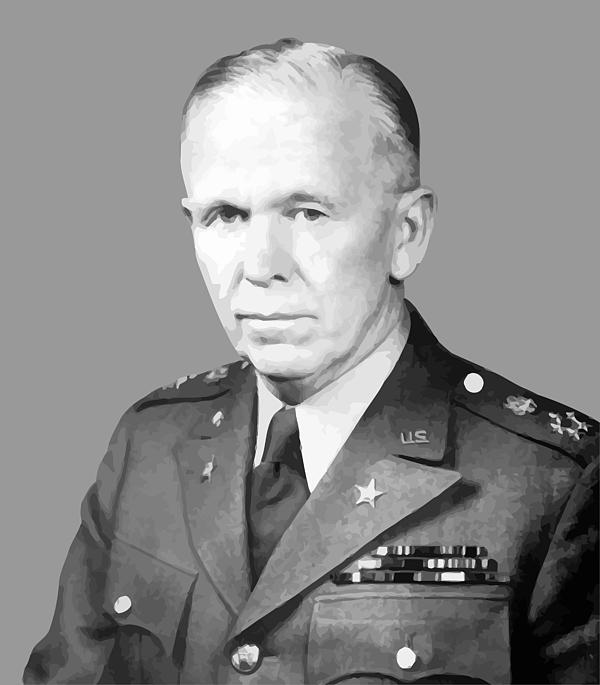
In contrast, the United States radically reduced the size of the regular Army and starved it of weapons, ammunition, gasoline, training and basic supplies. Promotions slowed to a crawl where ancient colonels and elderly majors lingered on active duty and future four and five star generals like Eisenhower, Patton, and Marshall all despaired and contemplated leaving the service. The Army’s – and to extent, America’s – salvation was in the fact that George Marshall persevered as a major and colonel in keeping a little black book of talented, forward thinking, officers and thought deeply and reflectively about building armies, helping enact “the Fort Benning Revolution” in military training. When FDR placed the power in Marshall’s hands as Chief of Staff he knew exactly what to do because he had a well-conceived vision of where the US Army needed to go to meet the national emergency of WWII. He was the American von Seeckt, except that Marshall was an infinite improvement morally, strategically and politically on his German counterpart. We were extremely fortunate to have had him.
.
We may not be as lucky next time.

Book Review: The Snake Eaters by Owen West

Friday, June 8th, 2012

The Snake Eaters by Owen West 

Owen West, commodities trader, novelist and USMC Major in the Reserves has written a remarkable book in his war story of counterinsurgency in Khalidiya, a decaying rural town in the deadly Anbar province, heartland of Iraq’s Sunni insurgency. A success story for COIN, but also a very cautionary tale of the transformation of the Iraqi Brigade 3-1, from a dispirited, ill-equipped, poorly led unit distrusted and ignored by it’s American “partner” battalion and under siege by a hostile population into a self-confident, elite, combat force, “the Snake-Eaters”, feared by insurgents and respected by townspeople – and of their American advisors of Team Outcast who struggled to broker this transformation.

After reading The Snake-Eaters and reflecting, the book speaks to readers at different levels.

For the casual reader,  West has a narrative with no shortage of colorful characters – the inexperienced jundis, “Hater”, the grim Major Roberson, Colonel Troster, “Captain Bomb”, “Private Crazy”,  the treacherous police chief Shalal, the Superfriends, the beloved Doc Blakley, the indomitible Major Mohammed, Sheikh Abbas, the no-nonsense Huss, “Ogre” McCarthy, the Sadiqiya Sniper and some advisors who were “strange by any measure”.

The chronically undermanned, underesourced handful of  Team Outcast advisors in might resemble a Middle-eastern version of The Magnificent Seven, except that unlike Yul Brynner, Colonel Troster arrived in Khalidiya only to find Calvera and his bandits in control of the town, completely invisible and supported by a community that was implacably hostile:

….To protect a fellow Sunni was the duty of every Khalidiyan. Even if they didn’t love AQI, they were socially connected to and literally enriched by, the local insurgency. In the same way small Texas towns follow their football teams, everybody in Khalidiya knew an active resistance fighter and kept score. The Americans promised security but had brought a hurricane of damage. They passed through Khalidiya in their armored trucks like tourists on glass bottomed boats admiring exotic fish.

The Khalidiya sheikhs, a title loosely used in Anbar for any man with influence, implored the AQI fighters to remain cautious. If they paraded in their black balaclavas too prominently in town, mugging for pictures on al Jazeera, they would draw the attention of Marine headquarters in nearby Fallujah. It was best to inflict some casualties on each American unit that rotated through the area – enough to keep Americans on the defensive but not so many that the Marines would mass their forces and crush the city, as they had done to Fallujah in 2004.

The 3-1 of the New Iraqi Army in Khalidiya bore scant resemblance to a unit of the mighty, Soviet equipped, legions with which Saddam Hussein had daunted his neighbors, held off Iran for ten years of bloody combat or sacked and pillaged Kuwait. Or even the shadow version of Saddam’s Army, decimated by American arms  and hollowed out by a decade of UN sanctions after the Gulf War. West describes the Iraqi soldiers initially as a mendicant mob of ill-fed, untrained, Shia jundis without heavy arms, patrolling as seldom as possible, with beat-up Nissan junkers and a pray and spray shooting reaction to the frequent IED blasts that injured and killed them with regularity.

Like any underdog story, with much suffering and lessons learned counted in the lives of men, the American advisors bond with their Iraqi charges through a herculean effort at non-stop  patrolling of  Khalidiya’s bomb and sniper-ridden streets. Training Iraqis in aggressive tactics while learning Iraqi mores from them, the 3-1 evolves up into the Snake-Eaters, winning over the townspeople of Khalidiya and demoralizing, defeating and driving away the insurgents and gaining the respect of their American mentors. This is the level at which most readers will enjoy and be impressed with The Snake -Eaters.

A second level of reading will be for defense intellectuals, policy wonks, COIN and CT theorists, military historians and other academics. Despite West writing with tactful restraint, avoiding directly criticizing senior brass or national civilian leadership by name, The Snake-Eaters is, in it’s own way, an incredibly damning indictment by virtue of empirical observations of the conditions and restrictions under which Team Outcast labored, driving home the disconnect between leaders, indifferent bureaucrats or FOBbits and the men waging COIN on the ground.  Only in the last chapters, when West himself appears in the narrative, does the author permit himself something approaching real and embittered criticism of the Alice-in-Wonderland myopia that sometimes prevailed during the Iraq War:

“If he does this again, I will end his life! Dhafer threatened. “I will burn his house down!”

It was an empty threat. Every day in Iraq, troops encountered suspected insurgents who had previously been arrested. When I first joined the team, I had read Troster’s after-action report excoriating the “ridiculous evidentiary justice system” that “had no place in a wartime environment”. Most detainees were let go because their crimes could not be proved to the satisfaction of corrupt Iraqi judges, or to US military lawyers. We didn’t have prisoners of war in Iraq, only criminal suspects entitled to many of the same rights as in the States. Most detainees were set free within a few months. The advisors called it “catch and release”.

That’s an excellent of example of policy sabotaging strategy and undoing tactical success for transient to nonexistent political benefits for those in comfortable, clean offices far, far away from the crack of rifle fire and the cries of wounded men.

In his Epilogue, West is even more frank regarding counterinsurgency and respect for his efforts in Khalidiya and in the writing of this book require excerpting it here:

While writing this book over the past four years, I’ve tried to figure out how much influence an advisor team really has on it’s unit., and whether institutional expectations match those limitations. I have again read the field manuals taught in our Army and Marine schools where we train advisors. The manuals have an upbeat, culturally correct tone, suggesting that our soldiers and Marines will succeed as advisors based on their tact and sensitivity. The manuals need drastic revision: they are misleading a generation of advisors.

That the recent conference at Leavenworth on the COIN rewrite has been an insular affair may not bode well for the acceptance of critical, empirically-based, views of COIN being offered by Major West.

The final level of reading is one to which West alludes several times in the text, but one in which I cannot share, is that of the soldier or marine who was “outside the wire”. For those men, there is a poignancy in the stories of the figures portrayed in The Snake Eaters that goes beyond mere words, which West bluntly states comes with a sense of despair at the lack of comprehension in the civilian world. Perhaps these feelings of isolation are also shared by veterans of earlier wars, when they speak of Kasserine Pass, the Bulge,  Chosin or Khe Sanh; or perhaps not, as every war is horrible in it’s own way. But if we cannot understand these shades of grief and meaning that West indicates are harbored in our veterans, the rest of us can at least acknowledge them and respect it.

The Snake-Eaters is an important book that delivers a microcosm of the COIN war in Iraq, gritty and unromanticized, as experienced by jundis, marines, soldiers and Iraqis in sweltering and crumbling Khalidiya. It is a success story but it is where the phrase “winning ugly” comes to mind; dedication and valor, stubborness and cunning, pitted against dolorous bureaucracy and savage insurgency.

Strongly recommended.

High Ground

Monday, May 21st, 2012

Hat tip to Kanani Fong of Kitchen Dispatch

The award -winning film HIGH GROUND  is due for release in August 2012:

Since 2002, almost 50,000 U.S. soldiers have returned home from Iraq and Afghanistan with their lives radically altered by war. With the improvement of battlefield medical treatments, these soldiers return alive yet not whole, and face long painful paths to recovery.

Full integration back into their community and the civilian world is a treacherous road, fraught with obstacles and pitfalls. After initial rehabilitation, these veterans are often left to fend for themselves, and struggle with physical and mental roadblocks, depression, and alienation.

This issue affects every aspect of society, not just families and hometown communities, but our national character and our legacy. How these wounded soldiers transition is one of the most important repercussions of these wars and an adversity with which we will contend for generations.

igh Ground was a showcase expedition bringing together disabled war veterans with world recognized mountain climbers to demonstrate what could be achieved by climbing a Himalayan giant. A key outcome of the expedition was to produce a documentary film that would tell the inspiring stories of these heroes and spread a healing message to a national audience.

This film, featuring stunning cinematography and capturing powerful emotions, will touch the hearts of concerned citizens, military families, outdoor enthusiasts and most of all, soldiers who find themselves wondering how to face the days and months and years ahead. It is an honest and gripping portrayal of our American warriors, telling an action packed story that unfolds in unexpected ways as the team makes their way high into the mountains, through the villages of Nepal, over raging rivers and up terrifying steep terrain risking injury and death for a chance at the summit.

A second and equally important goal is to continue to impact those thousands of injured soldiers in the midst of their own daunting recoveries through the use of the film at veteran’s hospitals and military bases around the United States. In the fall of 2011, a multi-city nationwide tour will be launched to welcome our soldiers home, celebrate their spirit and sacrifice, and to encourage them to pursue their dreams.

Efforts are currently underway to assess the potential of additional expeditions and to create a long-term strategy as a non-profit organization. By getting involved and supporting this project you can participate directly in this vital process and connect your company to the message that our soldiers can indeed… return home to live again.


Boyd & Beyond 2012

Saturday, May 19th, 2012

Colonel John Boyd

This is a head’s up early warning so people can get their schedules and plans together.

From J. Scott Shipman at the Disciples of Boyd’s Strategy Group:

Greetings! A gentle reminder that Boyd & Beyond 2012 is scheduled for 12 & 13 October 2012 at Quantico, VA. 

I would encourage those interested in presenting to contact me or Colonel Stan Coerr. As far as I know, Stan doesn’t have a presenters list. As in the last couple of years, we discourage the use of PowerPoint. The last two years have been two compelling days, and I’ve no doubt this year will be no exception.

There is no charge to attend, as the Command & Staff College makes space available. So check you schedules and make plans to attend, and consider submitting an idea for a presentation.


Switch to our mobile site