zenpundit.com » army

Archive for the ‘army’ Category

There Will Be Blood…..

Thursday, January 19th, 2012

All In: The Education of General David Petraeus by Paula Broadwell, with Vernon Loeb

The official biography of CIA Director General David Petraeus, by Harvard researcher Paula Broadwell, has long been anticipated in the .mil/COIN/NatSec/Foreign Policy communities and blogosphere.  I can hear pencils scrawling furiously away in the margins even as I type this post. 🙂

Broadwell,  herself a reserve Army officer, West Pointer, Harvard grad, doctoral student at King’s College War Studies Department , and by all accounts, an impressive up and coming individual,  had very extensive access to her subject – allegedly, far more than the official Army historian assigned to General Petraeus’ last command. Given the subject is General Petraeus, the precarious state of American policy in Afghanistan and 2012 as a circus of political excess, All In will be one of the few “must read” books this year.

And, I must commend Miss Mrs. Broadwell highly here, she will be donating 20 % of her net proceeds to help wounded veterans.

That said, in terms of reaction to this book, there will be blood.

Reviews of All In will afford the opportunity to tear the scabs off of the well-worn COINdinista/COINtra debate and rub salt in the exposed wounds – I for one am especially looking forward to reading future back to back reviews by Carl Prine and Thomas Ricks and Abu Muqawama vs. Colonel Gian Gentile. In the mainstream press, the opportunity for newspaper columnists to get in gratuitous potshots against figures like Presidents Bush and Obama, Dick Cheney, Don Rumsfeld, Robert Gates, Joe Biden, Hillary Clinton, Stan McChrystal and numerous others or grind partisan axes will be too tempting to resist, regardless of how relevant these remarks are to Broadwell’s biography of Petraeus. The looming specter of draconian cuts to defense budgets will also add to the rancor of the discussion of the book within the defense community.

Somewhere in that debate will be the book Broadwell actually wrote and within the book, perhaps, we will come to see David Petraeus. Or not.

Get your popcorn ready!

Right now, I am deep into reading the superb George Kennan biography by eminent diplomatic historian John Lewis Gaddis but All In is definitely next on my list.

And it will be reviewed.

Iconic: compare and contrast

Thursday, December 22nd, 2011

[ by Charles Cameron — iconic images, riot police, compare and contrast, repetition with variation ]
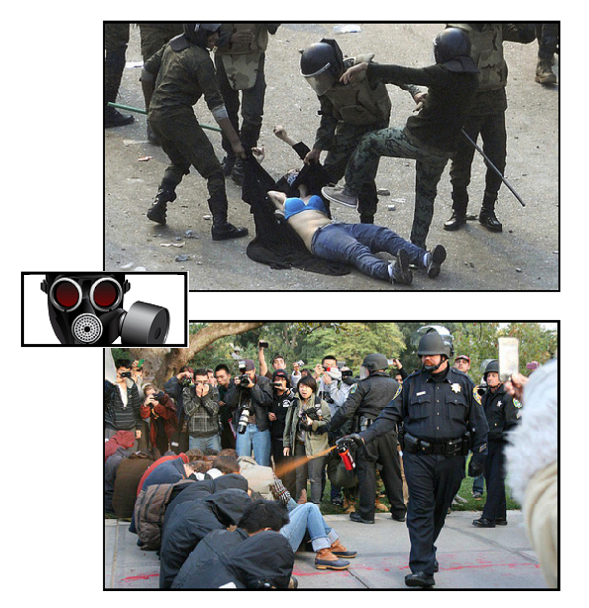
First, let’s be clear that both these images have been widely considered iconic.

Thus NPR reported of the first photo:

There have been countless accounts of violence recorded during the uprisings in Egypt but the image that perhaps has captured the most attention is the most recent. The image has been widely referred to as the “girl in the blue bra.”

While Real Clear Politics quotes Michael Moore on the second:

“The images have resonated around the world in the same way that the lone man standing in front of the tanks at Tiananmen Square resonated. It is an iconic movement in Occupy Wall Street history,” Michael Moore declared on MSNBC’s “Last Word” program.

Moore was referring to police pepper spraying students at an “Occupy” protest at UC Davis.

So we have two similarities between the two images: they both show police in riot gear taking action against demonstrators, and they have both caught the public eye as somehow being representations that can “stand in” for the events they seek to portray.

Beyond that, it’s all compare and contrast territory — or variations on a theme, perhaps — and different people will find different reasons to attack or defend the demonstrators or the police in one, the other, or both cases.

1.

These are, for many of us, “home” and “away” incidents, to borrow from sports terminology, and some of our reactions may reflect our opinions in general of what’s going on in Egypt, or in the United States.

We may or may not know the rules of engagement in effect in either case, on either side.

In a way, then, what the photos tell us about those two events, in Tahrir Square and on the UC Davis campus, may tell us much about ourselves and our inclinations, too.

2.

As I’ve indicated before, I am very interested in the process of comparison and contrast that the juxtaposition of two images — or two quotes — seems to generate. And I’ve quoted my friend Cath Styles, too:

A general principle can be distilled from this. Perhaps: In the very moment we identify a similarity between two objects, we recognise their difference. In other words, the process of drawing two things together creates an equal opposite force that draws attention to their natural distance. So the act of seeking resemblance – consistency, or patterns – simultaneously renders visible the inconsistencies, the structures and textures of our social world. And the greater the conceptual distance between the two likened objects, the more interesting the likening – and the greater the understanding to be found.

I’d like to examine these two particular photographs, then, not as images of behaviors we approve or disapprove of, but as examples of juxtaposition, of similarity and difference — and see what we might learn from reading them in a “neutral” light.

3.

What I am really trying to see is whether we can use analogy — a very powerful mental tool — with something of the same rigor we customarily apply to questions of causality and proof, and thus turn it into a method of insight that draws on our aha! pattern recognition and analogy-finding intuitions, rather than the application of inductive and deductive reason.

And that requires that we should know more about how the mind perceives likenesses — a topic that is often obscured by our strong emotional responses — you’re making a false moral equivalence there! or look, one’s as bad as the oither, and it’s sheer hypocrisy to suggest otherwise!

So among other things, we’re up against the phenomenon I call “sibling pea rivalry” — where two things, places, institutions, whatever, that are about as similar as two peas in a pod, have intense antagonism between them, real or playful — Oxford and Cambridge, say, and I’m thinking here of the Boat Race, or West Point and Annapolis in the US, and the Army-Navy game.

Oxford is far more “like” Cambridge than it is “like” a mechanic’s wrench, more like Cambridge than it is a Volkswagen or even a high school, more like it even than Harvard, Yale, Princeton or Stanford — more like it than any of the so-called “redbrick universities” in the UK — so like it, in fact, that the term “Oxbridge” has been coined to refer to the two of them together, in contrast to any other schools or colleges.

And yet on the day of the Boat Race, feelings run high — and the two places couldn’t seem more different. Or let me put that another way — an individual might be ill-advised to walk into a pub overflowing with partisans of the “dark blue” of Oxford wearing the “light blue” of Cambridge, or vice versa.  Not quite at the level of the Zetas and the Gulf Cartel, perhaps, but getting there…

4.

So one of the things I’ve thought a bunch about is the kind of analogy that says a : A :: b : B.

As in: Egyptian cop is to Egyptian protester as UC Davis cop is to UC Davis protester.

Which you may think is absolutely right — or cause for impeachment — or just plain old kufr!

And I’ve figured out that the reason people often have different “takes” on that kind of analogy — takes so different that they can get extremely steamed about it, and whistle like kettles and bubble over like pots — has to do with the perceptual phenomenon of parallax, whereby some distances get foreshortened in a way that others don’t.

5.

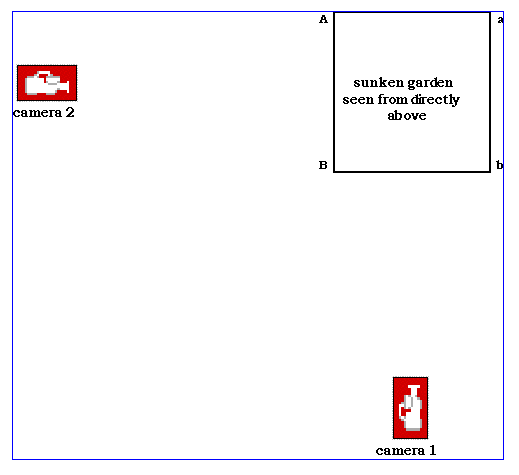
So my thought experiment sets up a sunken garden — always a pleasure, with two video cameras observing it, as in this diagram:
And from the two cameras, the respective views look like this:
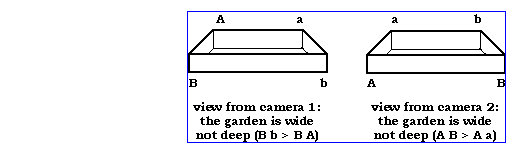
In this scheme of things, Aa (Oxford) seems very close to Bb (Cambridge) seen from the viewpoint of camera 1 — but from camera 2’s standpoint, Aa (Oxford) and Bb (Cambridge) are at opposite ends of the garden, and simply couldn’t be father apart.

6.

Now, my thinking here is either so obvious and simple as to be a platitude verging on tautology — or one of those subtle places where the closer examination of what looks tautological and obvious leads to the emergence of a new insight, a new “difference that makes a difference” in Bateson’s classic phrase.

And clearly, I hope that the latter will prove to be the case here.

7.

What can we learn from juxtapositions? What can we learn from our agreements about specific juxtapositions — and what can we learn from our specific disagreements?

Because it’s my sense that samenesses and differences both jump out at us, as Cath Styles suggested — and that both have a part to play in understanding a given juxtaposition or proposed likeness.

Each juxtaposition will, in my view, suggest both a “sameness” and a “difference” — in much the same way that an arithmetic division of integers, a = qd + r, gives both quotient and dividend.

And then we have two or more observers of the juxtaposition, who may bring their own parallax to the situation, and have their own differences.

8.

Tahrir is to Tienanmen as Qutb is to Mao?

Or is pepper spray just a food additive?

And how do icons become iconic anyway? Are they always juxtapositions, cops against college kids, girl vs napalm, man against line of tanks?  Even in the iconic photo of Kennedy from the Zapruder film, the sudden eruption of violence into the stateliness of a presidential parade is there — a morality play in miniature.

Any thoughts?

Odierno’s Reading List

Tuesday, December 6th, 2011

General Ray Odierno, Chief of Staff of the US Army has a pretty good prospective professional reading list in the works with many titles of general interest to people in national security and foreign policy fields. He’s asking for feedback too.

Minus the Mustache of Understanding, whose inclusion seems to be required on lists of these kind, there are titles here that I would strongly recommend including McPherson’s Battle Cry of Freedom,  The Landmark Thucydides, Luttwak’s Grand Strategy of the Byzantine Empire and the best of military historians and strategists like Paret, Keegan, van Creveld and Parker.

I would recommend adding Acheson’s memoir Present at the Creation, for an understanding of policy and national strategy and Alan Schom’s critical and monumental biography, Napoleon Bonaparte: A Life, for a comprehensive understanding of Napoleon’s campaigns in context with his psychology and political leadership.

But what seems to really be missing from the General’s list is a good book on intelligence history and tradecraft.

Since the list is intended for military officers, it would not have to be a technical critique along the lines of Roberta Wohlstetter’s Warning and Decision (though that would not hurt) but something that gave a good overview, spymaster biography or history, would help.

I can think of many, but I’d like to see what the readership would nominate in the comment section. Have at it!

Hat tip to Lucien.

The Human Face of War, a second review

Wednesday, November 16th, 2011

[by J. Scott Shipman]

images-1.jpeg

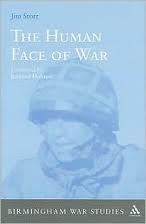
The Human Face of War by Jim Storr 

[Zen reviewed this book earlier here. I had forgotten that I wrote a rather long review at Amazon after finishing in January 2010. Perhaps Storr will gain a wider audience as a result.]

Mr. Storr’s The Human Face of War will be I predict, a book studied by military professionals (and smart policy makers) for years to come. Using straightforward prose, Mr. Storr seeks to provide a philosophical approach to war—as he says, “In practice we are concerned so much with war as with waging it.” Storr goes on to differentiate between war and warfare; where war is an “issue” with history and warfare dedicated to methods/methodology. Storr rejects notion that war is art or science, and prefers instead to embrace pragmatism and limited empiricism. He points out correctly: “Pragmatism has obvious application to warfare. A significant aspect of warfare is `a process of trial and error; seeing what wins and exploiting it.” Storr continues that “empiricism is not just trial and error: it is a logical process based on structuring observed facts.” What “works” will suggest a way ahead. 

Storr uses broad themes of what has worked and what has not worked in military history by explaining the nature of combat and tools and models available to the practitioner. He uses Clausewitz’s “dialectic of aims and means” in conjunction with Systems Theory to describe the holistic nature of military units; where effective/efficient output is dependent on input—where a good outcome is “winning” (as Storr repeatedly observes throughout the book, armies aren’t paid to come in second). Hence, organization of military units is fundamental; efficient/effective organizations are more likely to succeed. He observes: “Cohesion and collective performance indicate the whole is greater than the sum of the parts. There is a systemic effect, and we should see armed forces as systems.” 

Storr is a proponent of forcing decision making to the folks on the ground using brief and succinct communications. His chapter on Commanding the Battle is excellent. Storr advocates lean command staff’s and dispersed decision making. “We should employ the best brains in small groups, rather than try to assemble a collective brain.” He points out that “when staff numbers are reduced, the effectiveness of HQ improves.” “Reducing staff numbers would increase speed with which they could get things done.” [Amazingly, Storr quotes a work from 1998 that reports a typical Western division commander has 600 people supporting!—and that number has, I’m sure increased in 10 years.] He concludes this excellent chapter making a distinction between technology and the human factor: “…the future is not digital: it’s human. What is needed is things that bind talents together as a team, not more bandwidth…given time, resources, open minds and not much money we could revolutionize land tactical command. The key problems are human, cultural and institutional.” 

Storr asserts that successful modern commanders are most likely intuitive thinkers and possess the ability to learn from experience. He suggests further the “tendency to learn is more critical. It implies a tendency to reflect on experience and to learn from it, to maximize the benefit of the experience.” This tendency is key to the development of “skills”. He encourages a “permissive man-management regime that allows those who can learn rapidly from their experience to do so.” At the opposite end, Storr makes clear the unsuitability of many leaders who use bullying tactics and fear to motivate. 

Storr concludes by observing that “institutional conservatism” inhibits armed forces from improving significantly during times of peace; that “the current size and shape of Western armies reflect issues that are not primarily related to warfighting effectiveness.” He insists that doctrine should be explicit, relevant,(descriptive and where appropriate, prescriptive), coherent, and practical. The short tours common in western armies harm team integrity—which is “huge”. Innovation is vital, and in many cases military members aren’t with a unit long enough to have the experience necessary to truly innovate. Storr advocates “experience is the best way to achieve practical coordination and overcome the fog of war, as long as the experience gained is positive.” He discourages the common use of lieutenant-colonels in jobs where a captain or major could function/thrive/learn; as these junior officers will have less experience when they are promoted and will have probably developed the habit of “referring decisions upwards, and hence develop little initiative.” 

According the Storr, the “human” aspect of war should take prevalence over technology. He acknowledges the utility of technology, but asks the reader to “…pause and look for a moment at the Vietnam War, which suggests that superior technology is not always the deciding factor.” [9-11 is illustrative of this point on the “terror” side; determination and box cutters wreaked havoc.] 

My review does not do justice to the wealth of information, insight, and counsel in Storr’s book and I quote him frequently because his style is better than a summary. This book was aimed at a narrow audience, hence the high price. When I began, I was concerned about Storr’ opinions concerning John Boyd’s OODA loop; but in late 2009 I rejected Boyd’s deterministic underpinnings of OODA—Storr’s pragmatic and partial empiricism makes more sense. OODA remains, in my humble opinion, a valuable and versatile methodology in both the military/law enforcement and business arenas. 

This book is highly recommended; particularly for junior officers and NCO’s—the price is high, but what you will gain will be worth the cost.

UPDATE 11.17.2011: Jim Storr contacted me and confirmed the issue of a paperback for about $40.

The Myth of British Counterinsurgency?

Sunday, October 30th, 2011

This SSI monograph by Dr. Andrew Mumford should stir some robust debate in the COIN community:

Puncturing the Counterinsurgency Myth: Britain and Irregular Warfare in the Past, Present, and Future

Most of Mumford’s points are valid criticisms but I need to quibble with Myth # 1 The British Military is an Effective Learning Institution:

MYTH #1: THE BRITISH MILITARY IS AN EFFECTIVE LEARNING INSTITUTION

According to John Nagl, the British succeeded in Malaya-in contrast to the American failure in Vietnam-because the British army had an organizational culture akin to a so-called “learning institution,” whereby the army quickly adapted to COIN conditions and changed tactics accordingly.2 The array of operational activity, ranging from limited to total war, that the British army has experienced has arguably led to a greater degree of pragmatism in its military outlook. A dogmatic adherence to rigid military doctrine has been absent, which, when compared to the generation-long postmortem on the failure of U.S. strategy in Vietnam, perhaps explains more than most other factors why an almost mythic reputation has descended upon the British. However, this does not explain, nor should it obscure, the languid application of appropriate irregular warfare tactics and the absence of swift strategic design. When it comes to COIN, the British are slow learners.

The early phases of nearly every campaign in the classical era were marred by stagnancy, mismanagement, and confusion. The military was 2 years into the Malayan Emergency before it conceived of a cohesive civil-military strategy in the form of the Briggs Plan. The crucial early years of the troubles in Northern Ireland were marked by displays of indiscriminate force and an inability to modulate the response.3

The Director of the United Kingdom (UK) Defence Academy also concedes that, in relation to Northern Ireland, “[I]t is easy in the light of the later success . . . to forget the early mistakes and the time it took to rectify them.”4 As Lieutenant General Sir John Kiszely rightly observes, the Malayan Emergency was, “a much lauded counterinsurgency campaign, but often overlooked is the fact that in the early years . . . the British Army achieved very little success.” In COIN terms, therefore, the British have been consistently slow to implement an effective strategy and achieve operational success. Moreover, the vast body of campaign experience has not translated into a cogent COIN lesson-learning process within the British military. The very need to re-learn COIN in the post-September 11, 2001 (9/11) conflict environment has undermined assertions as to the British military’s being an effective learning institution. Such amnesia has created an imperative for the armed forces now to hone their lesson-learning abilities while simultaneously adapting to the intricate challenges of sub-state and transnational post-Maoist insurgent violence in the third millennium.

What sort of time frame is reasonable for “organizational learning” – that is, transforming a large, hierarchical, bureaucratic entity’s conceptualization and understanding of a situation and reforming and adapting it’s practices in light of experience? How fast can this really happen? An org is not an individual, two years while under fire does not seem slow to me. Am I missing something in Mumford’s argument?

Furthermore, I infer from the third paragraph that Mumford expects evidence of learning were for the Brits to have arrived in Basra good-to-go on COIN doctrine. Learning, whether in a person or org, is not represented by doctrine (lessons frozen in time) but rather a capacity to adapt to new circumstances. Mumford is on firmer ground criticizing British general officers for their blind assumption that they had all the answers on counterinsurgency  while the ragtag Mahdi Army bullied and ran circles around British units.

A monograph worth reading.

Hat tip to Lexington Green and SWJ Blog)


Switch to our mobile site