zenpundit.com » 21st century

Archive for the ‘21st century’ Category

Pete Turner on “Collecting Instability”

Friday, June 12th, 2015

[by Mark Safranski, a.k.a. “zen“]

Collection Center Collects Instability

Pete Turner of The Break it Down Show had a powerful post that encapsulated what is wrong with the American approach to intervention in foreign societies, both in terms of our aid and development programs as well as COIN and military assistance of various kinds.

Collection Center Collects Instability 

….A good example of what we did involves things called Collection Centers, which our government built to afford Afghan farmers a place to showcase products to vendors. The Center is supposed to create greater revenue for farmers. Despite the best of intent, and a lot of hard work, the program was and remains an utter disaster.

Why has the program been such a flop?

We, the US, came in and established these centers without ever considering how the existing system worked. We never bothered to determine how changing the system might be accepted or rejected, or cause harm to those we intended to help. We didn’t consider if the Afghans even had a system (which, of course, they did).

Instead of defining the existing system and assessing whether or how our tool might address a need, we just came in and started changing things It didn’t work, and we barely cared that it didn’t; and we reported the opposite.-

An aside–the if you read the report, look for mentions of Afghan involvement in the process. You won’t find it.  

I spoke with an Army Major in charge of the program and asked him about the existing local market chain from grower to consumer. He admitted that he didn’t know about it. When I asked why he was trying to change it, I was met with silence.

We also never considered if we were creating a harmful situation for farmers, and that ignorance caused unexpected and undesirable outcomes. At the most basic level, Taliban fighters notice “western” influence. A farmer who uses (though they never actually did) the collection center is exposing his allegiance with the US and therefore putting his family and himself in jeopardy. Further, the farmer buyer relationship is established relationship. Changing the nature of their transaction is reckless in such a conservative, Taliban influenced place. What we can’t do is create a situation that is perceived to increase uncertainty for farmers.

We built these centers throughout Afghanistan. At every instance, covering multiple units, I observed the same poor US decision-making. We never bothered to involve our Afghan partners in the decisions and never allowed them to guide us on how to work within their system. We forced these centers upon the people of Afghanistan, and wasted more than money and resources in the process. We wasted opportunities to actually improve the lot of the farmer, which makes de-legitimizing the Taliban fighters more challenging.

Read the whole post here.

Turner wore many different hats in Iraq and Afghanistan but in one extended tour in Zabul, Pete worked closely with political science Professor Richard Ledet, who in addition to his scholarly expertise, was uncannily good at donning local attire and blending in with Afghan villagers.

Dr. Richard Ledet

Turner and his partner Jon, interviewed Ledet recently on their program:

What happens when an institution attempts to make changes intending to improve the lot of others? What if they ignore culture and fail to communicate with the people designed to receive a benefit from the change? We address these questions in ourepisode with Dr. Richard Ledet.

We are fans of Rich. He’s a warrior, professor, surfer, hunter, all-around brilliant, rugged dude. His current gig is working as a Poli Sci professor at Troy University in Troy Alabama. Rich and I worked together in Afghanistan studying how effective or “affective” our work was as US assets helping Afghans. It’s not common for Poli Sci professors to get so close to the ground truth, and then to be able to test our policy and strategic programs as they implemented at the lowest level. This experience, we believe, is fascinating and applies directly to the real world.

Listen to the interview here on The Break it Down Show.

Lucky?

Wednesday, June 10th, 2015

[ by Charles Cameron — where two negatives (OPM and Secret Service) may make an ironic positive — a DoubleTweet ]
.

On the one hand…

— while on the other…

Taken separatedly, they’re both on the sinister side — but together, almost dextrous?

It sure Ain’t: Elkus on Why Congress Isn’t Good at Foreign Policy

Sunday, March 15th, 2015

[by Mark Safranski, a.k.a. “zen“]

Adam Elkus had a nice post on the sound and fury over the open letter by 47 Republican senators to the government of Iran, asserting Congressional prerogatives regarding contractual relations with in foreign powers:

“Congress Isn’t Good At Foreign Policy.”

In the midst of the ongoing fracas over GOP congressional officials’ attempt to undermine Obama’s Iran policy initiatives, Max Fisher made the observation that maybe Congress just isn’t that good at foreign policy after all. Other analysts warned that legislators were “bullying” the US back into another Iraq war,  and others hyperbolically denounce the insistence of GOP hawks that they sign off on the war against the Islamic State. In particular, Foreign Policy‘s Micah Zenko, however, was far more puzzledthan upset about Congress’s apparent desire for an open-ended war in Iraq juxtaposed with its fury over Obama’s initiative to make peace with Tehran: 

Funny when Congress weighs-in on FP:  Start open-ended airwar, no problem. Broker non-binding nonpro agreement, outrage.Zenko, however, is by no means alone. Other critics have similarly slammed Congress, arguing that it acts as if Obama is no longer the president, and ridiculing GOP insistences that Obama must include a ground war plan in his strategy to defeat the Islamic State. To hear some critics, the opposition-dominated legislature is reckless, irresponsible, even potentially traitors against the state. There was, however, something quite fishy about this. Hadn’t the roles reversed, as we had seen this kind of fight before but in the opposite direction

The biggest problem with many of these criticisms, however, was their denigration of the legislature. The way it sounded, a disinterested observer might be forgiven for wondering if someone should be exercising, ahem, some oversight over that silly Congress before it really makes a mess of things! But it was not so long ago, however, that Zenko and many othershad a different opinion about the executive branch and its use of power vs. the legislative branch. That, namely, the latter needed to reign in the former. Oversight was the name of the game, and Congress and the Senate apparently really needed to exercise sorely lacking control, opposition, and critical questioning when it came to an President that was about to drone, Navy SEAL, and air-war America into “endless war.” [….]

Read the rest here.

My thoughts, in brief….

The clerical-security regime in Tehran was probably a distant third as a messaging target for Republicans, coming behind activist conservative primary voters and the Obama administration itself. The letter is, in other words, a stupid, meaningless, P.R. stunt to play to domestic politics and indicates Republicans are not serious about stopping or improving any potential Iran deal or forcing the administration to submit any agreement to the Senate.

Furthermore, the truth is that many Democrats in Congress are uneasy about Secretary Kerry giving away the store to Iran to secure anything he could call “a deal”, are smarting from six years of habitually high-handed treatment from the inept White House staff and the conveniently timed  indictment of Senator Robert Menendez (D-NJ), the ranking member of the Senate Foreign Relations Committee who is critical of Obama policies toward Iran and Cuba. If Senate Republicans were intent on peeling away unhappy Democrats into a veto-proof majority for an Iran related bill, the letter was an unneeded jab in the eye to their Democratic Senate colleagues who might otherwise be persuaded to register their discontent.

That said, the ape-shit reaction of the Obamabot faction of the Left (which is neither the whole Left nor the entire Democratic Party) to the Republican Open Letter is illustrative of the creeping authoritarianism and increasingly illiberal nature of American politics. These people really think down deep that their guy is a kind of King and that Americans can be guilty of Lèsemajesté and that Lèse-majesté is “treason” and the politically treasonous or “mutinousshould be jailed. Essentially, a plurality of one of the major political parties really likes the idea of the US government behaving like a Hugo Chavez-style dictatorship. Really.

Lastly, my confidence in the Obama administration to negotiate responsibly with Iran is effectively zero. How can an insular group that takes little outside advice and won’t negotiate (or even talk) with their own supporters in Congress (!), much less the majority Republican opposition, get the better of foreigners that they understand even less well?

Immaturity vs. authoritarianism in service to incompetence. We are headed down a bad road.

Sisi followup: two publications of significant interest

Friday, January 16th, 2015

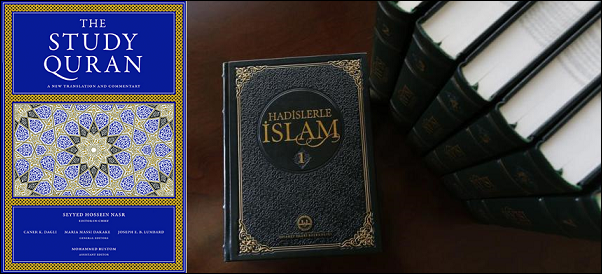
[ by Charles Cameron — SH Nasr’s The Study Quran and the Diyanet collection of ahadith ]
.

Quran & Ahadith

**

In a recent post I quoted President Sisi‘s speech calling for “a revolution” in Islamic thinking about “that corpus of texts and ideas that we have sacralized over the centuries” and which is now “antagonizing the entire world”. I would like to bring your attenbtion here to two publications which may well provide support for such a rethinking: SH Nasr’s The Study Quran and the Diyanet collection of ahadith

**

The Study Quran:

I have seen some of the proofs of this Quran, and it strikes me that once it is published (in Fall this year) it is likely to be the resource of record for anyone lacking in depth Arabic language skills and knowledge of Islamic thought across history. Superb, and very auspiciously timed.

From their prospectus:

In The Study Quran, renowned Islamic scholar Seyyed Hossein Nasr and a team of editors address the deeper spiritual meaning of the Quran, the grammar of difficult passages, legal and ritual teachings, ethics, theology, sacred history, and the place of various passages of the Quran in Muslim life.

For the first time, both Muslims and scholars will have a clear and reliable resource for looking up the history of interpretation for any passage in the Quran—together with a new, accurate English translation.

From the book itself:

The Quran is the constant companion of Muslims in the journey of life. Its verses are the first sounds recited into the ear of the newborn child. It is recited during the marriage ceremony, and its verses are usually the last words that a Muslim hears upon the approach of death. In traditional Islamic society, the sound of the recitation of the Quran was ubiquitous, and it determined the space in which men and women lived their daily lives; this is still true to a large extent in many places even today. As for the Quran as a book, it is found in nearly every Muslim home and is carried or worn in various forms and sizes by men and women for protection as they go about their daily activities. In many parts of the Islamic world it is held up for one to pass under when beginning a journey, and there are still today traditional Islamic cities whose gates contain the Quran, under which everyone entering or exiting the city passes. The Quran is an ever present source of blessing or grace (barakah) deeply experienced by Muslims as permeating all of life.

Inasmuch as the Quran is the central, sacred, revealed reality for Muslims, The Study Quran addresses it as such and does not limit it to a work of merely historical, social, or linguistic interest divorced from its sacred and revealed character. To this end, the focus of The Study Quran is on the Quran’s reception and interpretation within the Muslim intellectual and spiritual tradition, although this does not mean that Muslims are the only intended audience, since the work is meant to be of use to various scholars, teachers, students, and general readers. It is with this Book, whose recitation brings Muslims from Sumatra to Senegal to tears, and not simply with a text important for the study of Semitic philology or the social conditions of first/seventh-century Arabia, that this study deals.

**

The other publishing venture of great interest in this context is Turkey’s Diyanet project for a contemporary selected edition of the Hadith.

Emran El-Badawi, co-director of the newly formed International Qur’anic Studies Association, told the Christian Science Monitor in 2013:

Change is certain to come to the Islamic world, not just to the streets of Cairo or Istanbul but deep within Islam’s religious tradition as well. The Turkish Directorate of Religious Affairs, called the Diyanet, recognizes this with its seven-volume revision of the Hadith – which is the source of Sharia law and second only to the Quran.

Thousands of the prophet’s sayings and traditions were circulated and eventually collected in the centuries after his death in 632. The sheer size of Hadith collections and their archaic 7th century Arabian context have made the texts too intractable for many Muslims today. This is the challenge which the six-year Turkish Hadith project, with its selections and interpretive essays, seeks to overcome.

The central issue surrounding the Hadith, as with other foundational religious works such as the Bible, is whether it should be read literally or in a historical context and for its inspired message. A literal reading, for instance, may seek to justify medieval practices like severing the hands of thieves or allowing underage marriage. An inspired interpretation would see them as historical practices absent the kind of rule of law that democracies like Turkey have today.

The question for Turkey’s new multi-volume set is whether its contemporary interpretations can be widely appreciated by the Islamic community, or whether they will be considered too avant-garde – the fate of previous modern interpretations.

Elie Elhadj, in his post A Turkish Martin Luther: Can Hadith be Revised? on on Joshua Landis‘ Syria Comment blog wrote in 2010:

The Indian Islamic thinker Muhammad Ashraf observed that it is curious that no caliph or companion found the need to collect and write down the Hadith traditions for more than two centuries after the death of the Prophet (Guillaume, Islam, 1990, 165). Ignaz Goldziher concludes “it is not surprising that, among the hotly debated controversial issues of Islam, whether political or doctrinal, there is none in which the champions of the various views are unable to cite a number of traditions, all equipped with imposing Isnads” (Goldziher, Muslim Studies, 1890, Vol. II., 44). John Burton observes, “the ascription of mutually irreconcilable sayings to several contemporaries of the Prophet, or of wholly incompatible declarations to one and the same contemporary, together strain the belief of the modern reader in the authenticity of the reports as a whole” (Burton, An introduction to the Hadith, 1994, xi).

Leaders of Turkey’s Hadith project say successive generations have embellished the text, attributing their political aims to the Prophet Muhammad (BBC, February 26, 2008).

And Tom Heneghan, Religion Editor for Reuters noted in 2013:

The collection is the first by Turkey’s “Ankara School” of theologians who in recent decades have reread Islamic scriptures to extract their timeless religious message from the context of 7th-century Arab culture in which they arose.

Unlike many traditional Muslim scholars, these theologians work in modern university faculties and many have studied abroad to learn how Christians analyse the Bible critically.

They subscribe to what they call “conservative modernity,” a Sunni Islam true to the faith’s core doctrines but without the strictly literal views that ultra-orthodox Muslims have been promoting in other parts of the Islamic world.

As to its likely influence, in Egypt and thus (I infer) on Sisi’s project, Heneghan offers this hint:

“Among intellectuals in Egypt, there is a welcome for this new interpretation which they think is very important for the Arab world to be exposed to,” said Ibrahim Negm, advisor to Egypt’s grand mufti, the highest Islamic legal authority there.

**

I haven’t seen any reference as yet to the preparation of an English translation.

Aircraft Carriers and Maritime Strategy – a debate

Tuesday, January 13th, 2015

[by J. Scott Shipman]

Last Friday night at the U.S. Naval Academy, retired Navy Captain Henry “Jerry” Hendrix and Commander Bryan McGrath debated the future of the aircraft carrier. My wife and I were fortunate to attend. Given the pressure placed on the Navy’s shipbuilding budget, the debate could not have been more timely. Commander McGrath argued the “nuclear aircraft carriers with air wings are the most cost effective and efficient platform to project power in the maritime and littoral realm to support U.S. national security interests in current and future security environments.” Captain Hendrix argued against this resolution. While both arguments hold much merit, I tend to side with Captain Hendrix.

Lots of numbers and statistics were thrown around, but one issue did not enter the debate: it has been 70 years since an aircraft carrier was shot at. The lesson of the Falklands War underscores the potential power of modern precision munitions, and carriers are big targets.

This video is highly recommended. C-SPAN also recorded the debate with a transcript here.


Switch to our mobile site