zenpundit.com » 21st century

Archive for the ‘21st century’ Category

Simultaneity II: the pictorial eye

Wednesday, April 11th, 2012

[ by Charles Cameron — when sequence becomes simultaneous, the pictorial eye, rethinking thinking, continuing from Simul I ]
.

What better day to begin writing this second post on simultaneity than the day on which Google celebrated the birthday of Eadweard Muybridge with a Google Doodle — not that I’ll get the post finished within those same 24 hours!

The film — sequence of frames? stills? which would you call it? — that Muybridge took of a horse, used in that Google Doodle [view it in motion, here], is celebrated as showing beyond a doubt that when galloping, all four of a horse’s hooves may be in the air at the same time.

But is it — Muybridge’s work product — sequential, ie a film, or simultaneous, ie the presentation of many moments at one time?

That question gets to the heart of an issue that all narrative faces, as we shall see. First, the pictorial side of things.

*

Hans Memling‘s Passion of Christ (above) tells the gospel narrative, from Christ’s entry into Jerusalem and the Last Supper through his crucifixion, entombment and resurrection to his appearances in Emmaus and by the sea of Galilee in one canvas, much as Bach’s Matthew Passion [link is to Harnoncourt video] tells major portions of the same narrative in three hours of unfolding musical drama.

*

David Hockney has recently been working on forms of what I can only call “asynchronous synchrony” — as exemplified here:


Stills from Woldgate 7 November 2010 11:30 AM (left) and Woldgate 26 November 2010 11 AM (right). Credit: ©David Hockney

This image comes from a fascinating article describing Hockney’s current work by Martin Gayford, titled The Mind’s Eye, which you can find in MIT’s Technology Review, Sept/Oct 2011:

We are watching 18 screens showing high-definition images captured by nine cameras. Each camera was set at a different angle, and many were set at different exposures. In some cases, the images were filmed a few seconds apart, so the viewer is looking, simultaneously, at two different points in time. The result is a moving collage, a sight that has never quite been seen before. But what the cameras are pointing at is so ordinary that most of us would drive past it with scarcely a glance.

As with the Muybridge video above, “the viewer is looking, simultaneously, at different points in time”. Here Hockney does this with video cameras — but he achieves something of the same effect of time-displacement with still photos, too, as you can see in his brilliant portrait of the sculptor Henry Moore, hosted on the British Council’s Venice Biennale site.

Here is Gayford’s concluding paragraph, tying Hockney’s work into the larger context of our need for multiple frames of reference:

“Don’t we need people who can see things from different points of view?” Hockney asks. “Lots of artists, and all kinds of artists. They look at life from another angle.” Certainly, that is precisely what David Hockney is doing, and has always done. And yes, we do need it.

*
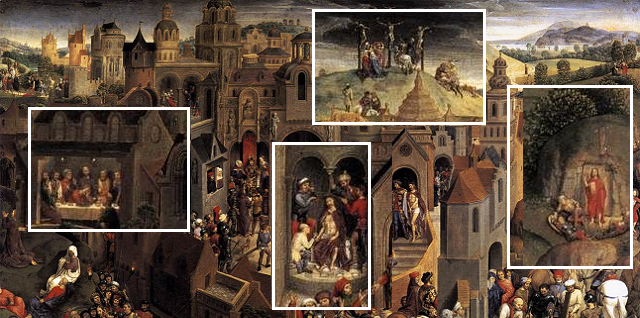
Memling again — and here I have enlarged and “framed” four of the 23 scenes from the passion of Christ which he has incorporated in the one painting: the Last Supper, the Crowning with Thorns, the Crucifixion, the Resurrection — Thursday evening through Sunday, and from life to death and back again.

*

It was Holy Week for Christians just last week, so perhaps you will forgive my having been preoccupied with images of the passion during the season set aside for such meditations — but what I want to point out to you is timeless, and indeed brings the transcendent into the everyday. Let’s take a look at a Hitchcock film next, then, and see how a contemporary videographer Jeff Desom has remixed the already Hockney-like Rear Window [link to IMDb] to create his own time-lapse telling of the tale [link to Vimeo], from which I took this screen-grab:

*

Time-lapse — simultaneity? The philosopher Alfred North Whitehead once wrote:

The communion of saints is a great and inspiring assemblage, but it has only one possible hall of meeting, and that is the present; and the mere lapse of time through which any particular group of saints must travel to reach that meeting-place, makes very little difference.

And so it is with this other Memling painting — and many others like it, by artists old and new:

Here we see the Virgin Mary and Christ child with Saints Dominic and James — there’s an eleven centuries gap right there, St Dominic lived from 1170 – 1221, more than a millennium after Christ — and Memling has St Dominic presenting his patron, the spice trader Jacques Floreins with his family to Christ, circa 1490. With everyone dressed in late 15th-century fashions…

Whitehead — co-author with Bertie Russell of Principia Mathematica — see how amazing this is? — could have been thinking of Memling: “the mere lapse of time through which any particular group of saints must travel to reach that meeting-place, makes very little difference”.

*

Coming up next: how this affects our understanding of story.

____________________________________________________________________________

For an understanding of the setup David Hockney uses for his multiple-video takes, see here and specifically this and this. For the setup used by Jeff Desom in his Rear Window remix, see here and specifically this.
Perception and Strategy Part I.

Tuesday, March 20th, 2012

Jason Fritz at Inkspots had a thoughtful post about Afghanistan in light of recent events and made some points regarding strategy well worth further consideration. I suggest that you read his post in full, but I will comment on excerpts of his remarks below in a short series of posts. Here’s the first:

Delicate strategic balancing: perception’s role in formulating strategy

…..That all said, incidents in Afghanistan these past few months have caused me to question the validity of strategies that hinge upon the perspectives of foreign audiences*. This is not to negate the fact that foreign perspectives affect nearly every intervention in some way – there has been plenty of writing on this and believe it to be true. I firmly believe that reminding soldiers of this fact was possibly the only redeeming value of the counterinsurgency manual. To say nothing of this excellent work. But strategies that hinge upon the perspectives of foreign populations are another matter altogether. 

I think Jason is correct to be cautious about either making perception the pivot of strategy or throwing it overboard altogether. The value of perception in strategy is likely to be relative to the “Ends” pursued and the geographic scale, situational variables and longitudinal frame with which the strategist must work. The more extreme, narrow and immediate the circumstances the more marginal the concern about perception. Being perceived favorably does not help if you are dead. Being hated for being the victor (survivor) of an existential war is an acceptable price to pay.

Most geopolitical scenarios involving force or coercion though, fall far short of Ludendorf’s total war or cases of apocalyptic genocide. Normally, (a Clausewitzian would say “always”) wars and other violent conflict consist of an actor using force to pursue an aim of policy that is more focused politically and limited than national or group survival; which means that the war or conflict occurs within and is balanced against a greater framework of diverse political and diplomatic concerns of varying importance.  What is a good rule of thumb for incorporating perception into strategy?

According to Dr. Chet Richards, the advice offered by John Boyd:

….Boyd suggested a three part approach:

  • With respect to ourselves, live up to our ideals: eliminate those flaws in our system that create mistrust and discord while emphasizing those cultural traditions, experiences, and unfolding events that build-up harmony and trust.  [That is, war is a time to fix these problems, not to delay or ignore them. As an open, democratic society, the United States should have enormous advantages in this area.]
  • With respect to adversaries, we should publicize their harsh statements and threats to highlight that our survival is always at risk; reveal mismatches between the adversary’s professed ideals and how their government actually acts; and acquaint the adversary’s population with our philosophy and way of life to show that the mismatches of their government do not accord with any social value based on either the value and dignity of the individual or on the security and well being of society as a whole.  [This is not just propaganda, but must be based on evidence that our population as well as those of the uncommitted and real/potential adversaries will find credible.]
  • With respect to the uncommitted and potential adversaries, show that we respect their culture, bear them no harm, and will reward harmony with our cause, yet, demonstrate that we will not tolerate nor support those ideas and interactions that work against our culture and fitness to cope. [A “carrot and stick” approach.  The “uncommitted” have the option to remain that way—so long as they do not aid our adversaries or break their isolation—and we hope that we can entice them to join our side. Note that we “demonstrate” the penalties for aiding the enemy, not just threaten them.]

I would observe that in public diplomacy, IO  and demonstrations of force, the United States more often than not in the past decade, pursued actions in Afghanistan and Iraq that are exactly the opposite of what Boyd recommended. We alienated potential allies, regularly ignored enemy depredations of the most hideous character, debased our core values, crippled our analysis and decision-making with political correctness and lavishly rewarded treachery against us while abandoning those who sacrificed at great risk on our behalf . We are still doing these things.

Most of our efforts and expenditures at shaping perception seem to be designed by our officials to fool only themselves.

The Said Symphony: move 19

Sunday, March 18th, 2012

[ by Charles Cameron – extended analytic game on Israeli-Palestinian conflict — for those who wish to catch up, our game thus far consists of an intro to the game and game board, followed by moves 1-5, 6-9, then moves 10-11 which together constitute a meditation, moves 12, 13-15, 16-17, and most recently before this, move 18 with cadenza ]

Move 19: The view from above

Move content:

Discussing strategy, the very canny LTG (USMC, Ret’d.) Paul Van Riper had this to say:

What we tend to do is look toward the enemy. We’re only looking one way: from us to them. But the good commanders take two other views. They mentally move forward and look back to themselves. They look from the enemy back to the friendly, and they try to imagine how the enemy might attack them. The third is to get a bird’s-eye view, a top-down view, where you take the whole scene in. The amateur looks one way; the professional looks at least three different ways.

A bird’s-eye view, a hawk’s eye view, a top-down view, an overview, a view from 30,000 feet, a God’s eye view, a view from above, a zoom…

If move 18 and its cadenza gave us a view of the depth of vision or insight that is necessary for a full and rich understanding of the world we live in — its qualitative or spiritual scope, if you like — this next move, with its picnic and drone-sight, addresses its breadth in space and time — materially and quantitatively speaking.

The classic expression of the sheer material scope of the universe was put together by Charles and Ray Eames in their justly celebrated film, Powers of Ten, from which the lower of these two images is drawn:

Here are some other relevant scans of the scope of things, in terms of time and space:

The Scale of the Universe 2
A Brief History of The Universe
The Known Universe
A Time-Lapse Map of Every Nuclear Explosion Since 1945

These are impressive videos to be sure, but as an aside I’ll invite you to ask yourselves how well they compare with this zoom in words, a poem by the zennist, ecologist, essayist and poet Gary Snyder, from his book, Axe Handles: Poems:

Such breadth of vision, such craft.

*

If this “material scope of things” too has a cadenza, it would be that all of this is shot through with some primary oppositions, dappled as the poet Gerard Manley Hopkins would have it, with swift, slow; sweet, sour; adazzle, dim — as indicated in the drone-sight and picnic double image at the head of this move.

This dappling, this constant flux of opposites, takes many forms — day and night lead to the more abstract light and dark, which can then be interpreted morally as good and evil, to which we respond with repulsion and attraction as the case may be, building our worldviews from love or fear…

At different scales the opposites that matter most to us may have different names and shadings, but here I’d just like to draw attention to the dappling of our world with:

competition and cooperation
Darwin‘s natural selection and Kropotkin‘s mutual aid
duel and duet (ah! — a favorite phrasing of mine)
war and peace

Provocatively, we find this dappling in scriptures, too, wherein the ripples of such verses as “The LORD is a man of war: the LORD is his name” (Exodus 15.3) dropped like a stone into the pond of the human mind, meet with the ripples of other verses such as “God is love; and he that dwelleth in love dwelleth in God, and God in him” (I John 4.16).

There are times when we take such oppositions literally, perhaps too literally, and times when we begin to see oppositions as abstract and theoretical end-points to what is in fact a yin-yang process continually unfolding…

Which brings me by a commodius vicus of recirculation to this image of the great opposition between war and peace, its dappling, its unfolding:

Links claimed:

To the Lamb, move 18: this move presents the material scope of the universe in counterpoint to its visionary scope as laid out in move 18 with its cadenza.

To Revelation, move 17 — the word revelation means unveiling, as we have seen, and our sciences and technologies, with their spectra of telescopes, microscopes, cameras and zooms, are unveiling and revealing to us much about the physicality of the world we live in — much that was accounted for in other times and places through intuition, vision and poetry.

This scientific and technical revelation of material existence, for many of us moderns, has largely eclipsed the mode of visionary revelation of move 17 — yet it cannot eradicate it. Implicit in this move, then, is the sense that we carry with us both subjective and objective, inner and outer, qualitative and quantitative understandings — though the data that “sight” and “insight” provide us with may be different in kind, and resolving them may be something of a koan to us, the deep problem in consciousness as philosophers of science have named it — and that we can discount neither one if we are to have and maintain a rich sense of our situation.

Comment:

If the two previous moves have shown us the scope of the universe we co-inhabit, perhaps we should now make our own zoom in, much as James Joyce did when he had the schoolboy Stephen inscribe his name and address in his geography book as Stephen Dedalus, Class of Elements, Clongowes Wood College, Sallins, County Kildare, Ireland, Europe, The World, Universe – an address that Stephen then read both forwards and backwards, finding himself in one direction, and finding in the other that he had no means of knowing what might lie beyond the universe…

Imagine then, skipping rapidly from (unimaginable) cosmos via such things as the intriguingly named End of Greatness to galaxy or nebula…

…solar system and planet — whence we can slow down and zero gently in on the Middle (or as my friend Ralph Birnbaum would call it, the Muddle) East, Israel / Palestine, Jerusalem / Al Quds / the Temple Mount / Noble Sanctuary – and to such matters of contemplative vision and tribal passion as the first, second and projected third Temples, the al-Aqsa mosque.

Our increasing focus will bring us, then, to that the rock which Jews believe marks the place where Abraham bound his son Isaac (the Akedah), and which Muslims believe to be the place of ascent of the Prophet to the celestial realms (the Mi’raj) on his Night Journey (Qur’an, Al-Isra).

Here again myth and history collide, and both visionary and material considerations merge in the heart of the what my friend the Israeli journalist Gershom Gorenberg has justly called “the most contested piece of real estate on earth”.

“Our enemy is adaptable, we must be, too.” Adaptability & Simplicity, Random Thoughts

Saturday, March 17th, 2012

[by J. Scott Shipman]

This is cross-posted at http://tobeortodo.com

Earlier this week I had the privilege of speaking at the Navy Expeditionary Forces Conference (NAVEXFOR 2012) in Virginia Beach, VA. The theme for this year’s conference was “innovation in constrained environments.” In my talk, I focused on potential internal cultural constraints and deliberate actions to mitigate resulting threats. Not surprisingly, other speakers focused on our enemies and the constraints they place on our forces, and the fact those enemies impose constraints with innovative methods and weapons like roadside IEDs.  Yesterday, through a friend on Twitter, I learned that insurgents in Iraq had used cell phone geotags to destroy AH-64’s; innovation, indeed.

One speaker made the comment in this post’s title: “Our enemy is adaptable, we must be, too.” He went on to characterized their adaptations as “simple.”

Using this description, through simple adaptation, our enemies disrupt our activities, destroy our equipment, and kill or maim our service members using cheap, simple, but deadly tools. The resulting affect isn’t limited to physical casualties; their innovations also disrupt our ability to control the initiative, and perhaps just as importantly our sensemaking abilities. The ability to alter an opponent’s sensemaking will inform and increase the complexity of an already complex environment, so adaptability is essential.

In most situations we counter these simple adaptations by employing complex and expensive solutions. This has been accurately called, “adaptation at acquisition speed.” Those expensive and complex solutions must make it through byzantine acquisition processes rife with political maneuvering, operating in a culture of “no,” which results in increased costs, schedule, and ultimately our frequent inability to be responsive to troops in field. Institutional inertia in the defense bureaucracy prevents significant change in the short-run, so these facts must be considered an on-going constraint.

In spite of these constraints, our troops are thinking and acting—they are adapting, using simple tools, like remote control vehicles.  This “toy” was used to inspect vehicles and detect IEDs. Instead of an expensive long lead-time solution, they went to Radio Shack—and the vehicle lasted for several years—so they got another. According to the report, at least six lives were saved as a result. Not surprisingly, the folks closest to the problem produced an effective solution. No doubt there are other stories of ingenuity and adaptation, but this story exemplifies the possible. The underlying point is this soldier was thinking and acting—he was adapting in a way that allowed him and his colleagues to remain more safe.

Sun Tzu and the ultimate in adaptability

The speaker’s quote reminded me of this quote from Sun Tzu’s The Art of War, Chapter VI Weaknesses and Strengths (page 153 in the Samuel B. Griffith translation):

Now an army may be likened to water, for just as flowing water avoids the heights and hastens to the lowlands, so an army avoids strength and strikes weakness.

And as water shapes its flow in accordance with the ground, so an army manages its victory in accordance with the situation of the enemy.

And as water has no constant form, there are in war no constant condition.

Bear with me, as I like word pictures and synonyms and what follows is a bit like “plodding,” but I’ve found adjacencies in language illuminating (if I could draw this, I would). Water as a metaphor for adaptability presents any military force (or any other group) a daunting task. Considering the physical qualities of water several synonyms come to mind:

  • Water is transparent, so to be adaptable, we need to promote and practice clarity in internal communications and actions. Keeping ambiguity to a minimun is one method of promoting clarity, and practicing honesty is a good way to practice.
  • Water is physically cohesive, while being ultimately pliable. Think about it; put water in a jar, it conforms to the jar, pour it out, it follows gravity, and water surrounds whatever is submerged in it. Water moves as one, just as a group adaptability needs to be a key characteristic of any successful team. But in a larger sense, when one considers what I call the “bordering language” of synonyms, one discovers a greater depth to the concept of coherence, words like intelligence, comprehensibility, understandability, intelligibility, decipherability,  conncinity (my favorite),  unity, and harmony—just to name a few. Concinnity is a harmonious arrangement of things; where a culture is arranged and led in such a way as to promote and sustain harmony. My friend Ed H. has the best working definition for harmony that I’ve found. Ed derived his description from the novelist Douglas Adams and French impressionist painter Georges Seurat:

You don’t get harmony when everybody sings the same note. Harmony is the marriage of the contrary and of the similar; marrying discordant elements, regardless of tone, of color, of line, of thought and of purpose…

  • Water as described by Sun Tzu is fluid. Fluidity can be a blessing and a curse. On the one hand, fluidity implies adaptability, flexibility, fluency, smoothness, and ease. On the other, fluidity implies instability, unstableness, fickleness, inconstancy, changeableness, shifting, and flux. For cultures in a competitive environment, having the first form of fluidity is desired, while inflicting the second on the competitor. In addition, fluidity’s synonym fluency implies an eloquent and skillful use of language—or mediums of exchange. Fluency is possible only through practice, lots of practice. So much practice the skill becomes tacit knowledge, thus simple (effortless?)…even intuition.

Simplicity

Articulation in language and action are elements of simplicity. Simplicity implies tacit. As simple as the force of gravity directing water down a hill, going around and engulfing obstacles, thus is the potential of a group that has made their purpose/mission tacit and have the freedom to act. In fact, the sum of the skill sets may be so simple as to defy explanation—and more often than not in these cases, others learn by close association; watching, failing, learning, and making tacit those capabilities needed to cope and adapt. Boyd said as much in the abstract of Conceptual Spiral:

To flourish and grow in a many-sided, uncertain and ever-changing world that surrounds us, suggests that we have to make intuitive within ourselves those many practices we need to meet the exigencies of that world.

“To make intuitive within ourselves those many practices we need” implies the development and nurturing of habits that will enable us to adapt.That which is habitual becomes simple (and as mentioned above, yet another route to tacit).

Close

To the troops using the remote control vehicle mentioned above, the solution was obvious, and seemingly simple. Importantly, they were in a unit where they could act on their idea—and they did so outside the bureaucracy at little cost, and saved six lives (maybe more).

Taking a riff from the conference title, our leaders should be checking to make sure the rules of engagement (ROE) and other rigid rule sets aren’t implicitly making their folks hopelessly incapable of adaptability. As we increase adaptability, the more adaptability becomes a habit—and when it is a habit, it becomes simple. Just a thought.

Postscript:

The best short book I’ve read on tacit knowledge is Michael Polanyi’s The Tacit Dimension, the best long book on the same topic is Personal Knowledge by the same author.

Supporting Our Troops by Treating them as Children and Drunkards

Friday, March 16th, 2012

Secretary of the Navy, Ray Mabus

This is one of the more inane, disrespectful and lavishly wasteful ideas to come out of the Federal government in some time.

Secretary of the Navy Ray Mabus, who should have more sense, has proposed in his “21st Century Sailor and Marine Initiative” the idea of normalizing a breathalyzer test (!) for Sailors and Marines reporting for duty. Yes, that’s correct. Showing up for duty is going to be regarded as probable cause for drug testing, as if our AVF were composed primarily of skid row derelicts.

Nice move Mr. Secretary. Stay classy.

That this is yet another example of the demeaning, exploitative, contempt towards normal Americans by our Creepy-state bipartisan elite goes without saying, but the reaction of those so insulted is worth noting:

Best Defense (guest post):

….This is among the most paternalistic, professionally insulting concepts I’ve seen in all my years of service, and I’m not sure I will submit. Yes, I know my options, and I just may exercise them and go right over the side the first time the duty blowmeister shoves a plastic tube in my face and treats me like a drunk driver for daring to report for duty. To the CNO, CMC, CMC of the Navy, and SgtMaj of the Marine Corps, here’s my question:  At what point will one of you four exercise your duty to tell the Secretary of the Navy, “Hey, Boss, WTF, over?” and that he really ought to fire whichever clown came up with this idea to screen everyone to identify serial alcohol abusers who are readily identifiable through other means.  One or more of you needs to find the moral courage to recommend relegating this part of the initiative to the dustbin of really bad naval ideas.

USNI Blog (BJ Armstrong):

….Recently a string of new policies and programs have washed over the decks of our Navy. We’re told they are designed to address everything from the surge in CO firings, to alcohol abuse, to the identified need to increase “diversity.” Training, trackers, new layers of bureaucratic offices, and new ways of testing/identifying the “bad apples” are all in the works. Some of the initiatives appear more connected to reality than others. The issues, like sexual assault and substance abuse, are serious and are challenges that our Navy should be addressing. In many cases, however, we are attempting to install programmatic and bureaucratic solutions to what are essentially humanistic problems. These are problems of leadership, character, and integrity and must be addressed with wisdom as much as programs and bureaucracy.

I suspect, if we were to scrape away the insincerely saccharine and frankly deceptive rhetoric offered by Mabus for this kind of a camel’s nose in the tent program, we will see old fashioned venality at work.  Off the shelf commercial breathalyzers are not exactly cheap and testing 500,000 active duty personnel who make up the Navy and Marine Corps daily,(!) the DoD civilian contractor support for counseling and “training” program development, supplemental extensions for testing the reserves and so on, will represent lucrative paydays in the billions for somebody.

Will those “somebodies” be friends of the current administration? Let’s place our bets now.

[ Sidebar: Let’s also guess how long before this initiative is extended elsewhere, in the civilian world, with results, recorded, tracked and shared without your consent by your employer. Can’t happen here? Oh, Really? I bet you once never expected to have government employees demand to take nude pictures of you at the airport either]

The diversion of resources this proposed insanity represents from warfighting, acquisition, real military training or PME, medical care for our wounded or a thousand other authentic needs of the Navy or Marine Corps would be a scandal in an earlier era.  But we do not live in an earlier era, and the defense budget is just another pile of seed corn to eat as far as the beltway boomer oligarchy are concerned.

Arthur Wellesley, the Duke of Wellington, Great Britain’s greatest military hero, when asked about his soldiers, described them as “The scum of the Earth, enlisted for drink”.  Winston Churchill, over a century later, said the culture of the Royal Navy was based upon “Rum, sodomy and the lash”. This encapsulates an aristocratic worldview of rulers toward their servants and comprises a long military tradition in whose footsteps Navy Secretary Mabus is following.

It just isn’t an American military tradition.


Switch to our mobile site