zenpundit.com » America

Archive for the ‘America’ Category

Octavian Manea interviews MIT’s Roger D. Peterson

Friday, April 19th, 2013

Another installment of Octavian Manea’s excellent COIN interview series at SWJ. This one focuses on social science and varieties of insurgency:

Breaking Down “Hearts and Minds”: The Power of Individual Causal Mechanisms in an Insurgency 

….OM: In your research you pointed out to a spectrum of conceivable individual roles in an insurgency. What is the methodology behind this typology?

RDP: This methodology comes from my 2001 book (Resistance and Rebellion: Lessons from Eastern Europe) which focused on Lithuanian resistance to Soviets in the 1940’s. Insurgency is a complex phenomenon, especially in how violent organization and networks are created and sustained, and the methodology of that book involved breaking down this complexity into component parts and then building back up into a coherent whole. At the base of this process is the way individuals position themselves relative to the dramatic and violent events of insurgency. Most people may wish to remain neutral and just take care of their families but events push significant numbers of individuals into roles of unarmed support of insurgents, or local armed position of a militia, membership in a mobile non-local organization, or equivalent positions in support of the government.  Furthermore, individuals may move back and forth along this spectrum of roles. If one is skeptical of broad and vague theories at a high level of aggregation, as I am, then you need to get down and observe dynamics at a basic level. Observing movement along this spectrum of roles is one way to do that. 

…..Is it FM 3-24 and the whole contemporary Western COIN discourse too narrow, too much focused on rational, cost/benefit models of decision-making? Is it too restrictive when making this inventory of driving motivations or causal mechanisms?

RDP: I think there is a tendency in the Western academic analysis to focus on rational theories. Those theories are straightforward.  But they also might be too straightforward, too simple.  In Iraq, the coalition did not plan on the emotion of resentment stemming from a status reversal affecting Sunni calculations in the beginning stages of the conflict. We did not understand the revenge norms that exist in some of the places. We did not fully understand the social norms that helped to produce the tribal militias in Anbar province.  We did not understand the psychological mechanisms underlying the Sunni view of the new world they were living in. 

The last part is a curious lacuna.

The incompetence of the planning for the occupation of Iraq has been amply recorded – the high level disdain of General Tommy Franks and Secretary Rumsfeld for what befell the day after victory, the keeping of professional Arabists at arms length in preference for Beltway contractors and college kids with AEI connections, the haplessness of Jay Garner and the political obtuseness of Paul Bremer ad so on. This is not what I mean about lacuna.

I mean something more fundamental, in terms of understanding human nature as the root of political behavior and therefore political violence. We are all familiar with the Clausewitzian trinity (or should be) but less attention is paid to the motivational factors that make men decide to stand, fight and die or stand aside. Thucydides also had a trinity that did not attempt to capture the nature of war but rather explain why wars happened and it seems to me to be of particular use for evaluating the decision in small wars to pick up a gun or not, to side with the government or join the rebellion:

“Surely, Lacedaemonians, neither by the patriotism that we displayed at that crisis, nor by the wisdom of our counsels, do we merit our extreme unpopularity with the Hellenes, not at least unpopularity for our empire. That empire we acquired by no violent means, but because you were unwilling to prosecute to its conclusion the war against the barbarian, and because the allies attached themselves to us and spontaneously asked us to assume the command. And the nature of the case first compelled us to advance our empire to its present height; fear being our principal motive, though honour and interest afterwards came in. And at last, when almost all hated us, when some had already revolted and had been subdued, when you had ceased to be the friends that you once were, and had become objects of suspicion and dislike, it appeared no longer safe to give up our empire; especially as all who left us would fall to you. And no one can quarrel with a people for making, in matters of tremendous risk, the best provision that it can for its interest. 

Fear, honor and interest are ever present in “calculation” both by men and by the political communities they compose and the factions that threaten to tear them apart. All the more so in a defeated and broken country divided by ethnicity and sect where all parties were uneasily eyeing the conqueror. No special knowledge of Arab culture should have been required to anticipate that Iraqi men, if made desperate by uncertainty and circumstance, might have at least seen it in their interest to achieve some measure of security with the gun and to enact policies of carrots and sticks a priori to discourage that, before the insurgency gained critical mass.

Awareness of the universality of the Thucydidean trinity would not have in itself guaranteed success in Iraq but knowing it is a rudimentary minimum of political competence upon which you can at least build.

Boston: of motives and munitions

Tuesday, April 16th, 2013

[ by Charles Cameron — the prayer response at least is wordless and direct ]
.

**

The most deeply felt post about the Boston Marathon massacre I’ve seen was Caitlin Fitz Gerald‘s Boston’s best Day:

If you’ve never been to Boston on Patriots’ Day, you might not know this, but it’s the best day of the year in Boston. It’s a state holiday, spring is hitting, the Red Sox play a morning game, and thousands of runners and hundreds of thousands of people come from all over the world for the Boston Marathon. The marathon is a 26-mile party. Every runner hears cheers from every person the whole way down the route. It is a gorgeously international event, with runners and spectators coming from all corners of the earth, filling the city and lining the marathon route. In the ultimate Patriots’ Day experience, you can go to Fenway to see the Sox, then walk out to Kenmore Square to watch the runners come through. They are tired then, they are in their last mile, but people line the route 10 and 15 deep hooting and cheering and clapping to help them through to the end. It’s amazing to watch the elite runners fly through the toughest course in the world, and just as amazing to watch the regular runners, most of them raising money for charity, people who have trained months and years to do this superhuman thing.

This didn’t just hit close to home, it hit my home.

Caitlin is also responsible for the elegant Clausewitz for Kids.

**

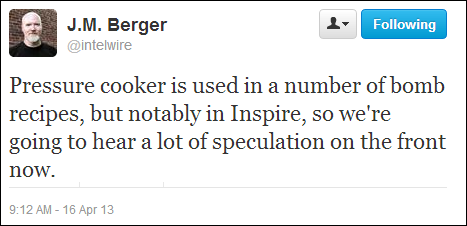
The most sensible response to the various premature speculations as to who’s to blame is JM Berger‘s tweet:

The speculations themselves ranged from dangerous incitement (Muslims or North Koreans, kill em all) to dangerous incitement (d’oh, it’s the Mossad)

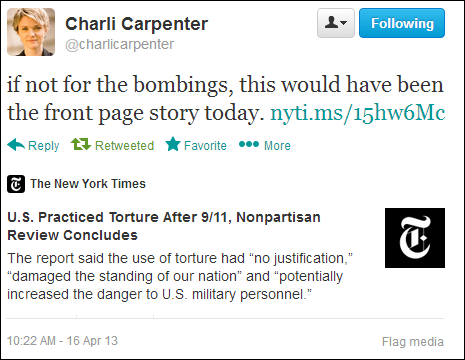
The least expected insight came from Charli Carpenter:

**

Pressure cookers:

For background, here’s a DHS release on pressure cookers from 2010.

It’s beginning to seem likely that the bomb or bombs were made with a pressure cooker or pressure cookers — normally unsuspicious items that can be found in many homes, or easily purchased online.

JM Berger would be my resource for ongoing analysis of the Boston event, but Betsy Ross sees to be the one to follow for information about pressure cookers as weaponry. Their history goes back at least as far as the Croatian nationalist hijacking of TWA flight 355 in September 1976, although the “pressure cooker bomb” in that case was a threatening fake rather than the real thing. Max Fisher tells us their use in bomb-making is mentioned in the Anarchist’s Cookbook — I’m not about to spend money on something that would only tell me how to maim people in any case — but Berger pointed out (first in my feed) that AQAP’s Inspire magazine featured them:

The Inspire mention appears in their first issue, in a piece by “AQ Chef” titled Make a bomb in the kitchen of your mom.

**

But you know what most interested me in that article?

It’s not the recipe, no sireee, I have no interest in how to blow things — much less, people — up. It’s the warning that the writer attached. Explosive devices can easily — all too often and all too literally — blow up in the faces of those who are trying to make or set them.

Bomb making is a hazardous occupation — and that’s why the order and emphasis with which the AQ Chef [promotes his three dafety precautions interests me so much:

The following are a few safety precautions:

1. Put you trust in Allah and pray for the success of your operation. This is the most important rule.
2. Wear gloves throughout the preparation of the explosive to avoid leaving behind fingerprints.
3. This is an explosive device so take care during preparation and handling.

Did you get that? The most important advice is to trust in God and pray for success — taking care during preparation and handling comes a distant third.

That’s piety, people — piety before practicality.

And — as if to prove the point — three Palestinian would-be suicide bombers were killed by their own devices back in 1999, because they refused to comply when Israel announced a “premature switch from daylight savings time to accommodate a week of pre-sunrise prayers“.

So much irony, so much stupidity, so much sorrow.

**

A few other pages to note:

Bruce Schneier, The Boston Marathon Bombing: Keep Calm and Carry On
Jeff Stein, How They Will Investigate the Boston Bombing

Andy Kroll, Question Everything You Hear About the Boston Marathon Bombing
Dana Liebelson and Tim Murphy, 6 False Things You Heard About the Boston Bombing
Adam Serwer, Terror Attacks on Sporting Events, Especially Marathons, Are Surprisingly Rare

Mike Adams via Alex Jones, Boston marathon bombing happened on same day as ‘controlled explosion’ drill by Boston bomb squad — conspiracist, reminiscent of Ruppert on 9/11

XKCD, Pressure cooker: the worst thing? — see graphic above

Zoketsu Norman Fischer, In Times of Trouble — a Zen view from just post 9/11.

Boston 4/15/13

Tuesday, April 16th, 2013

The Boston Marathon was bombed today near the finish line with allegations of multiple other unexploded devices:

CBS Boston station WBZ-TV reports one of the three who died from the attack was an 8-year-old boy.

 Two bombs exploded near the crowded finish line of the Boston Marathon on Monday, killing three people and injuring more than 125 others in a terrifying scene of broken glass, smoke and severed limbs, authorities said.

Police reportedly set off at least one other explosive device with a water cannon. On Monday night, a federal law enforcement source told CBS News correspondent Bob Orr that an earlier report was incorrect that authorities had found one other device that was intact and had not been detonated. Orr reports that authorities are not in possession of such a device.

 CBS News senior correspondent John Miller reports that a Saudi national is being questioned by authorities. He was seen “acting suspiciously” running from the explosion, and a civilian chased him down and tackled him. He was turned over to Boston police and is being questioned by the FBI. He is being cooperative and denies any involvement.

 “This could mean a lot, or this could mean very little,” Miller said. “It’s too soon to call him a suspect.”

 Miller reported earlier that authorities are also reviewing surveillance video that shows a man from behind carrying two backpacks near the site of the explosions. Authorities are not sure whether the subject in the video is linked to the blasts.

Boston police say no suspect has been taken into custody. 

There is much speculation and misinformation at the present time and a rush to analytic judgement is premature when crucial physical evidence is in the early stages of being found, identified and tested by expert investigators. White House officials have classified the attack – which featured a second blast to harm first responders and bystanders – “terrorism”.

Terrorism would appear to be accurate. Whether this is by a group or a “lone wolf” is not yet determined. The presence of multiple, coordinated bombs would be very difficult for one person acting alone to plant without detection but not impossible, a small cell is more likely. A high failure rate of bombs may indicate a determined amateur rather than a professional bomb-builder from a group like the IRA, Hezbollah or Lashkar-e- Taiba, all of which are noted for their skill with explosives. Nor can a foreign state security agency be definitively ruled out at this time, though that is much less likely a possibility ( Pointlessly bomb the Boston Marathon and get yourself a 2 carrier group aerial “regime decapitation” campaign).

Before jumping to conclusions about the possible identity of the Boston Bomber, recall first guesses are frequently wrong and as with the “Anthrax Letters”, we may never know for certain. Or the FBI may run down the culprits in the next 48 hours. People using this attack to score cheap partisan political points right now in the media or on social network sites  are supreme asshats

In between Big Bang and Heat Death

Thursday, March 21st, 2013

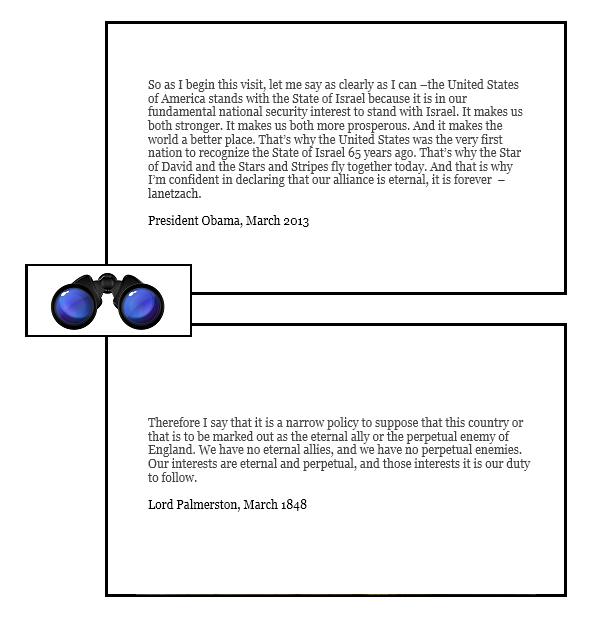
[ by Charles Cameron — a terrific example of the DoubleQuote form, drawing on Obama at Ben Gurion Airport and Palmerston in the House of Commons, and why the form is useful ]
.

Some time in between t-zero and t-aleph-null, some time between the First Day of Creation and Judgment Day, some time in between the Big Bang and the Heat Death of the Universe, there’s a stretch of time known as always.

**

What does juxtaposing the two statements allow us to understand?

  • That times have changed?
  • That what you tell a foreign government is not what you tell your own?
  • That Brits are more understated and Americans more plainspoken?
  • That President Obama is showing specific support for Israel, while Palmerston was expressing the general rule which covers all such utterances?
  • That the word “always” doesn’t necessarily mean “for ever”, “unto the ages of ages” as the Eastern Church has it?
  • Perhaps “for the foreseeable future” would be a better phrase to use, if it didn’t sound so iffy. I’d say it means something closer to “in continuity” than to “in perpetuity”.

    **

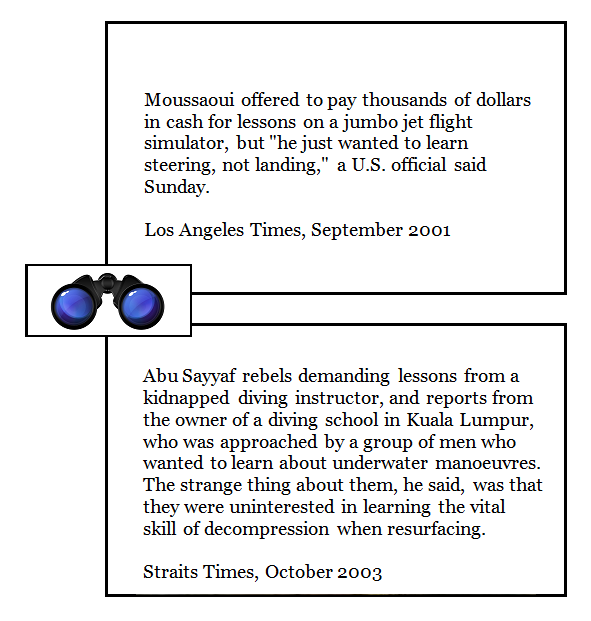
    The great thing about DoubleQuotes as a form is that they jump-start you into thinking about samenesses and differences, without demanding which particular implications you will select, thus giving rise to multiple possibilities and enlarging the scope of narrative or discussion.

    And while I’ve sharpened the pairing of quotes — or graphics — into a tool for repeated use, it’s already a habitual form of thinking, as we can see from the fact that these two particular quotes were juxtaposed by Sam Roggeveen in his post, America’s BFF: Obama calls it, in the Lowy Institute’s Interpreter today.

    **

    We naturally pair similars to contrast and compare them: it may be the most basic device that human memory affords us — this reminds me of that.

    Here are a few of my own old favorites…

    **

    You can read Obama’s speech, from which the excerpt above was taken, on this Israel Times page.

    Argo

    Monday, March 18th, 2013

    Argo 

    Finally watched the Academy award -winning Argo the other night and must give it an endorsement.

    While the film’s introduction initially made me groan, repeating as it did the popular ahistorical rubbish about Mossadegh and Operation Ajax,  the CIA coup that toppled him along with other new inaccuracies, it otherwise did an admirable job capturing the dismal spirit of those times.

    Iran was portrayed every inch the chaotic, unpredictably despotic, backward, violently thuggish, theocratic Islamist regime wallowing in ignorance and hatred it remains to this day. Bodies swing from construction cranes, angry mobs burn US  flags and chant slogans, burly and bearded Basiji and Revolutionary Guardsmen ride motorcycles, scream and brandish automatic rifles, bullying Iranians and conducting mock executions of American hostages. Sneering revolutionary bureaucrats chain smoke in decrepit, steamy offices and stamp yellowed documents.

    The American side has the Carter administration in all it’s  ineptitude with a country that is dispirited and visibly decaying – a mood captured perfectly by the visual shots half-demolished state of the Hollywood landmark sign. A weary cynicism and defeatism hangs in the air of the offices of high officials. Cyrus Vance is uncharitably but accurately portrayed as calling the shots on Hostage policy and State favors their plan of sneaking the six escapees hiding in the Canadian ambassador’s residence some bicycles with which to pedal 350 miles to the Turkish border.

    In winter.

    The CIA is not much better, barring Ben Affleck’s character – exfiltration expert operative Tony Mendez – who defies the orders from the White House or State to stand down and allow the escapees be captured by Iranian security – and his boss who leaps into action to support him and revive the canceled operation.

    I won’t give the twists and turns, you can watch those yourself. The film is replete with actual news footage from the time of the American Hostage Crisis and it is just shocking how bad things were back then, which if you lived through it, will jar some memories.

    Recommended.


    Switch to our mobile site