zenpundit.com » America

Archive for the ‘America’ Category

The Hunt for KSM

Thursday, March 15th, 2012

The Hunt for KSM: Inside the Pursuit and Takedown of the Real 9/11 Mastermind by Terry McDermott and Josh Meyer

This courtesy review copy just arrived from Machette Book Group. The authors are investigative journalists, one of whom, Meyer, has extensive experience reporting on terrorism, while McDermott is also the author of the 9-11 highjackers book, Perfect Soldiers. Thumbing through the pages, I note the authors have little time and much contempt for the cherished DoD-State canard that the Pakistani government and the ISI are an ally of the United States, which has already given me a warm feeling.

The review copy index pages are blank, something I usually see only before a book has been finalized for mass printing. Odd.

I will be reading and reviewing this soon – Shlok advises that “it reads like a novel”

One quick illustrated quote from Secretary Clinton

Wednesday, March 14th, 2012

[ by Charles Cameron — sometimes i post things so obvious they might actually be useful ]
.

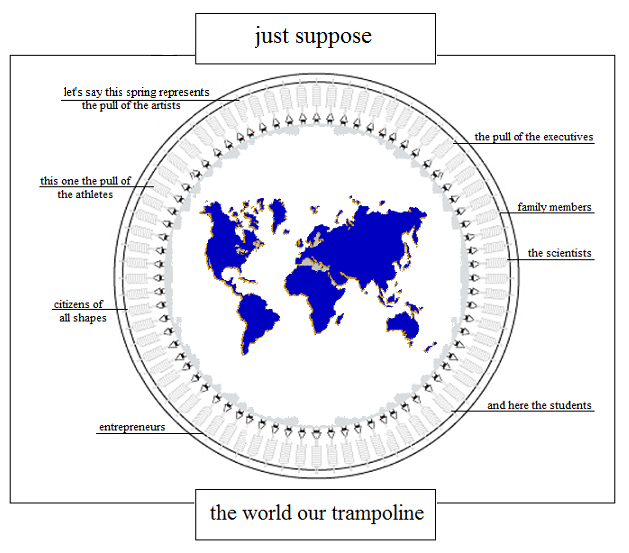
One quick annotated quote from Sec. Clinton‘s speech at the U.S. Institute of Peace China Conference, March 7th:

Now when I say “we,” I do not mean only our governments, as important as they are. Every day, across both of our countries, executives and entrepreneurs, scientists and scholars, artists and athletes, students and teachers, family members and citizens of all kinds shape and pull and add to this relationship. Together, they represent a vast range of priorities, concerns, and points of view. And they are all stakeholders in how we build toward a shared future.

It’s really that list I’m after…

There are seven billion individuals bouncing up and down on our trampoline, some of them holding hands, some of them in gangs that want to trip up rival gangs, or make a clearing for themselves and themselves alone, some too weak to bounce much at all…

and each time each one of us lands, we impact the trampoline from a different angle, stretch it a different way – tugging it to the will of the artist, the entrepreneur, the child, the retiree, the curious, the aggressive, the meek…

As we know, the earth is round, which is to say three-dimensional – but the tugs on it, the tensions, are more complicated than that, in fact they’re complex, n-dimensional – and constantly shifting.

Hilary Clinton wants to wake up in the morning, have coffee – and model that! – along with, and in balance with, her counterpart in another huge mass of population, half a globe and at least six philosophies away…

The coffee’s good, but it’s not enough — what we all could use is a new mode of thinking.

*

Maps courtesy of www.theodora.com/maps used with permission

The End and Ends

Tuesday, March 13th, 2012

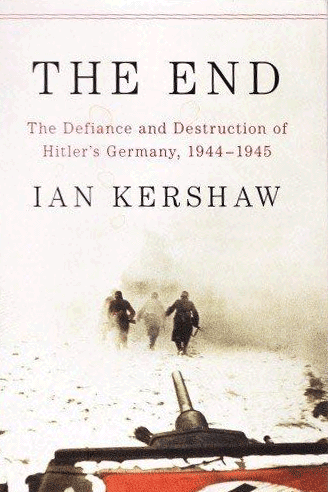
The End by Sir Ian Kershaw

I am currently reading The End, about the last year of the Third Reich and the Nazi death spiral toward Germany’s absolute destruction. It is a fascinating, mass suicidal, political dynamic that was mirrored to an even greater degree of fanaticism by Nazi Germany’s Axis partner, the Imperial Japanese. Facing the prospect of certain defeat, the Germans with very few exceptions, collectively refused every opportunity to shorten the agony or lighten the consequences of defeat and stubbornly followed their Fuhrer to the uttermost doom. It made no sense then and still does not now, seven decades later.

Adolf Hitler’s personal authority over the life and death of every soul in Germany did not end until his last breath. When surrounded by Soviet armies, trapped in his Fuhrerbunker in the ruin of Berlin, all it took for Hitler to depose his most powerful paladins, Hermann Goering and Heinrich Himmler was a word. They still commanded vast military and paramilitary security forces – Himmler had been put in charge of the Home Army as well as the SS, Gestapo and German police – but when Hitler withdrew his support and condemned them, their power crumbled. Goering, the glittering Nazi Reichsmarchal and second man in the state, was ignominiously arrested.

Even in Gotterdammerung, the Germans remained spellbound, like a man in a trance placing a noose around his own neck.

Currently, the chattering classes of the United States are uneasily working their way toward a possible war with Iran, or at least a confrontation with Teheran over their illegal nuclear weapons program (some people will object that, technically, we are not certain that Iran has a weapons program. This is true. It is also irrelevant to the diplomatic dynamic created by Iran’s nuclear activities which the regime uses to signal regularly to all observers that they could have one).  There is much debate over the rationality of Iran’s rulers and the likely consequences if Iran is permitted to become a nuclear weapons state. There is danger and risk in any potential course of action and predictions are being made, in my humble opinion, far too breezily.

In the run-up to war or negotiation, in dealing with the Iranians and making our strategic calculations, it might be useful to recall the behavior of the Germans.

The Era of the Creepy-State is Here

Tuesday, March 6th, 2012

George Orwell was more right than he knew….

Congress passed a law – by unanimous consent in the Senate and by a suspension of rules in the House – to permit the Federal government to arbitrarily arrest and imprison for up to ten years members of the serf class (formerly known as “American citizens”) whose presence annoys or offends specally designated members of the elite and foreign dignitaries. A list that will no doubt expand greatly in future legislation to include very “special” private citizens.

Think about that, future “Joe the Plumbers” or Cindy Sheehans, before you ask an impertinent question of your betters or wave your handmade cardboard sign. Is ten seconds of glory on your local ABC affiliate news at 5 o’clock worth that felony arrest record and federally funded anal exam?

No? Then kindly shut your mouth, sir. Learn your place.

Two nebbish Representatives, one Republican and one Democrat, distinguished only by their lack of legislative or political importance, sponsored the bill on behalf of the big boys who fast-tracked it under the radar (they learned from the SOPA debacle). Forget ideology or boasts about carrying a copy of the Constitution in the breast pocket of their suit, whether you are in an archconservative Congressional district or an ultraliberal one, almost every member of Congress voted “aye” to trash multiple amendments in the Bill of Rights.

Almost every one.

This is an accelerating trend in recent years and in particular, a bipartisan theme of the 112th Congress, which views Constitutional rights of nobodies as an anachronistic hindrance to the interests (or convenience) of their powerful and wealthy political supporters. Our elected officials and their backers increasingly share an oligarchic class interest that in important matters, trumps the Kabuki partisanship of  FOXnews and MSNBC and inculcates a technocratic admiration for the “efficiency” of select police states.

It is from this demographic-cultural root of incestuous corruption that our creeping – and increasingly creepy – manifestations of authoritarianism in American life springs. The SOPA/PIPA internet censorship bills, naked scanners at airports, Stasi-like expansion of expensively wasteful TSA security theater, proposed 24/7 monitoring of  every American’s online activities, migration of police powers to unaccountable private firms, replacement of elected municipal governments with “emergency managers” (favoring financiers over taxpayers), Federal agencies monitoring political critics , the Department of Justice retro-legalizing corporate racketeering, fraud, perjury and conspiracy on a national scale, plus other infringements of liberty or gross corruption that I could list, ad nauseum.

We have reached the point where we as Americans need to stop, step back from moment by moment fixation on nonsensical, “white noise” fake political issues like “contraception” ginned up to keep the partisans distracted and become seriously involved in determining the direction in which our nation is headed. Our elite are telegraphing their strong preference for a “soft dictatorship” but we still have time to check their ambitions and rein in their looting.

It is almost quaint these days to pick up Friedrich von Hayek’s classic,  The Road to Serfdom and thumb through it. The libertarian antistatists of the 20th century were so focused on the clear and present dangers of totalitarianism that the idea of a weak state that endangered liberty through a mixture of corruption and regulatory capture eluded them. The Westphalian state at it’s apex was so overweening that the enemy of free societies, after foreign monsters like Hitler and Stalin, could be ambitious intellectual pygmies like Harold Laski or Tom Hayden. The state was so omnipotent that even it’s efforts at benevolence, to build a “Great Society” of the Welfare State were injurious to individual freedom because the expanse of statism crowded and weakened civil society , the market and private life. The argument gained political traction because, to varying degrees, it was true and looked prophetic when the Welfare-state began to crash economically in the 1970’s on stagflation.

Give the Welfare-state liberals and Social Democrats of the past their due though, their intentions by their own lights were benign. They wanted to make a safer, more secure, more equal, more just life through a more powerful state (whether that was a good idea or a realistic endeavor was the central political question between right and left). The current elite in comparison is so inferior in moral character and overconfident in their abilities that they may soon make us yearn for the former’s return.

What have now in our ruling class,  are the  builders of a Creepy-state and their intentions are not benign, except toward themselves, for as long as the looting of the American economy can last.

Unlike the Welfare-state, the Creepy-state, shot through with corruption, is  not omnipotent  because it is to be the servant and gendarme of the emerging oligarchy and not their master – but it is to be omniscient and omnipresent, constantly watching, monitoring, investigating, recording, interrogating, coercing, sorting, muzzling, gatekeeping and shearing the sheep on behalf of the shepherds.

Or the wolves.

The Creepy-state is not there to protect you or give you a higher standard of living or ensure justice or democracy, but to maintain a hierarchical public order from “disruption” (formerly known as “politics” or “democracy”). If the classical liberal ideal was the night watchman state, this state is the shadowy and ill-disposed watcher in the night.

The American political elite, Democrat and Republican, Conservative and Liberal, are in are largely in consensus that the government should, in regard to the American people:

Read your email
Listen to your phone calls
Track your movements on GPS
Track your online activity
Track your spending
Track your political activity
Read your medical records
Read your financial records
Scan your body
Scan your house
Scan your DNA
Keep you under video surveillance in public
Detain you at random in public places for security checks
Close off public spaces for private use
Seize private property for private use
Censor your speech
Block your access to judicial relief
Determine your educational and career path
Regulate your diet, place of residence, lifestyle and living standards (ever downwards)
Charge you with secret crimes for breaking secret regulations
Share or leak information about you at will

Is this the America we wish for our children or grandchildren? One that epitomizes the values of our Constitution or Declaration of Independence, or is it some kind of tawdry and shameful dime store fascism of a small Latin American country? Perhaps life is finally imitating fiction?

Fortunately, it is not too late. Irrevocable changes in the constitutional order have yet to be engineered. Our politicians are followers, not leaders here. They are a small and cowardly lot for the most part and will recoil in fear from this authoritarian ethos if a sufficiently large number of elected officials are thrown out of office at once. We can still roll this back – at least the most egregiously anti-American aspects – if we get sufficiently angry come November.

Self-interest is their only lodestone.

A Wound That Does Not Cease to Bleed: The War in Vietnam

Wednesday, February 29th, 2012

Amigo of ZP blog, West Point military historian Colonel Gian Gentile, throws down the gauntlet in his review of Lewis Sorley’s new biography, Westmoreland: The General Who Lost Vietnam, in The National Interest:

The Better War That Never Was

DID GENERAL Westmoreland lose Vietnam? The answer is no. But he did lose the war over the memory of the Vietnam War. He lost it to military historian Lewis Sorley, among others. In his recent biography of William C. Westmoreland, Sorley posits what might be called “the better-war thesis”—that a better war leading to American victory was available to the United States if only the right general had been in charge. The problem, however, is that this so-called better war exists mostly in the minds of misguided historians and agenda-driven pundits.

In the battle over the memory of the Vietnam War, Sorley annihilates Westmoreland and leaves his character and reputation in smoldering ruins. Yet Sorley’s victory in the fight for the memory of Vietnam has not brought us a balanced historical biography of Westmoreland.  

 ….The better-war thesis argues that if only the U.S. Army had concentrated from the start on building up the South Vietnamese armed forces and winning the hearts and minds of the South Vietnamese people through limited applications of military force, we would have won the war. But the question remains: Precisely how could tactical adjustments early in the war have overpowered the political constraints placed on the army by the Johnson administration, which kept it from taking the fight to the North Vietnamese? Or the dysfunctional nature of the South Vietnamese government and military that precluded them from standing on their own? Or the declining popular support and political will in the United States as the war dragged on without a decent end in sight? Or, perhaps most importantly, how could tactical adjustments toward better methods of counterinsurgency have overpowered a communist enemy that fought the war totally while the United States fought it with limited means? In his Westmoreland biography, Sorley essentially ignores these questions.

Could the United States have prevailed in Vietnam? Yes, but it would have had to commit to staying there for generations, not a mere handful of years. The Vietnam War was an attempt at armed nation building for South Vietnam. Nations and their societies, however, are not built overnight, especially when they are violently contested by internal and external enemies. Thus, to prevail in Vietnam, the United States would have needed the collective will that it mustered to win World War II and would have had to be able to maintain it for generations. That kind of will—or staying power—was never a real possibility.

In war, political and societal will are calculations of strategy, and strategists in Vietnam should have discerned early on that the war was simply unwinnable based on what the American people were willing to pay. Once the war started and it became clear that to prevail meant staying for an unacceptable amount of time, American strategy should have moved to withdraw much earlier than it did. Ending wars fought under botched strategy and policy can be every bit as damaging as the wars themselves.

Well worth the read, not least for Gian’s model of how one historian carefully dismantles the thesis of another.

We are a mere three years from the fiftieth anniversary of Lyndon Johnson’s escalation of the Vietnam War, less than two years from the fiftieth anniversary of the assassination of John F. Kennedy that brought LBJ into power and a year from the fiftieth anniversary of the infamous coup d’etat against American client, President Ngo Dinh Diem, that JFK had approved. Finally,  fifty years ago, Kennedy drastically increased the American military advisory mission to South Vietnam to just under 10,000 men and signed off on clandestine operations against North Vietnam.

All those fiftieth anniversaries amount to a golden jubilee of rancor.

The bitterness sown by the lost war in Vietnam still burns in American politics like red hot coals. Less bright perhaps than the open flame of 1968, but if you scratch the surface, you will find with no less heat. The war spawned division and polarization that twisted our politics and poisoned public debate to this day, echoing now as farce as much as tragedy.

During the 1980’s, Vietnam historiography was virtually a cottage industry. It was the subject that ate the profession as a generation of academics who cut their academic teeth during the era of antiwar protest on campus acquired tenure, middle-aged paunches and lost hair while nursing their political grievances in their scholarship. I personally recall, as an  undergraduate, the war being referenced (usually along with vitriolic abuse of Ronald Reagan) in every humanities class, no matter how remote the course, with some professors being known for the quality of their off-topic rants.

While Westmoreland bears heavy responsibility for his part in a losing a war, even as theater commander in Saigon he was only an executor, not a maker, of strategy, much less national policy. Westmoreland did not lose Vietnam in a stunning battlefield capitulation, so Gentile is right to defend “Westy” from being scapegoated for the poor strategic reasoning hatched in the Oval Office. Where Westmoreland was at fault was in his inability to either intellectually comprehend the bigger strategic picture in which he found himself struggling (most likely) or if he did, to effectively articulate the strategic environment in Southeast Asia to a domineering President who was stubbornly determined to brook no contrary advice (possible). Had Westmoreland tried, he likely would have failed (Brute Krulak’s effort in this regard got him physically ejected from the Oval Office by the seat of his pants by Johnson himself. I am dubious that LBJ would have been any happier with contradiction of policy from Westmoreland).

Gentile, much like my professors of yore, is deeply interested in the congruence between events in his own time with those of the Vietnam era., in particular, the salience of counterinsurgency doctrine in the wars of Iraq and Afghanistan. There is, of course, some continuity between the Vietnam era and today present, a historical thread seized by the COINdinistas themselves in their veneration of Galula and slurping knife-blade portions of soup, but the continuity has limits. I suspect a Millennial generation vet of Kandahar or Fallujah, should they venture to become a historian, will frame and seek to explain their wars without much reference to the societal touchstone that is Vietnam.

Perhaps by then, for American society, Vietnam will have finally ceased to bleed.


Switch to our mobile site