“…. But when the sons of these men received the same position of authority from their fathers-having had no experience of misfortunes, and none at all of civil equality and freedom of speech, but having been bred up from the first under the shadow of their fathers’ authority and lofty position-some of them gave themselves up with passion to avarice and unscrupulous love of money, others to drinking and the boundless debaucheries which accompanies it, and others to the violation of women or the forcible appropriation of boys; and so they turned an aristocracy into an oligarchy. But it was not long before they roused in the minds of the people the same feelings as before; and their fall therefore was very like the disaster which befell the tyrants.”-Polybius
One of the tenets of pop-centric COIN is that better governance will deliver the loyalty of the people who are the center of gravity over whom the insurgent and state contest. This usually means cajoling the state to reform and remove the worst abuses that serve to politically fuel the insurgency. Occasionally this is successful (El Salvador), frequently it is not (South Vietnam, Afghanistan) and in other cases it may be irrelevant as the method is eschewed in favor of indiscriminate brute force and punitive expeditions (Sri Lanka, Soviet COIN) but it begs the question of:
“What kind of governance is most likely to create insurgencies in the first place?”
Of insurgencies that are wholly indigenous, what form of government spawns them most frequently? A chart of historically recent insurgencies is given below containing who fought and who won (“negotiated” indicates a political settlemt “tie” of sorts, with some political accomodation and not settlements that are trucial “exit agreements” for the defeated belligerent):
| COUNTRY |
GOVERNMENT |
VICTOR |
| Aden |
Colonial |
Insurgents |
| Afghanistan (1979-1989) |
Communist/Occupied |
Insurgents |
| Afghanistan (2001-2011) |
Republic/Occupied |
Ongoing |
| Algeria (1954-1962) |
Colonial |
Insurgents |
| Algeria (1991-2006) |
Dictatorship |
Government |
| Angola(1961-1975) |
Colonial |
Insurgents |
| Angola (1975-2002) |
Communist |
Negotiated |
| Bolivia |
Dictatorship |
Government |
| Britain (N. Ireland) |
Democracy |
Negotiated |
| Cambodia (1970-1975) |
Dictatorship |
Insurgents |
| Cambodia (!978-1991) |
Communist/Occupied |
Negotiated |
| Colombia |
Democracy |
Ongoing |
| Chechnya |
Republic |
Government |
| China (1911-1949) |
Dictatorship |
Insurgents |
| Cuba |
Dictatorship |
Insurgents |
| Cyprus |
Colonial |
Insurgents |
| El Salvador (1930’s) |
Dictatorship |
Government |
| El Salvador (1970’s-1980’s) |
Dictatorship/Democracy |
Government |
| Greece |
Monarchy |
Government |
| Guatemala |
Dictatorship |
Government |
| India |
Democracy |
Ongoing |
| Indonesia (1945-1949) |
Colonial |
Insurgents |
| Indonesia (1965) |
Dictatorship |
Government |
| Iraq |
Democracy/Occupied |
Government |
| Israel (1st Intifada) |
Democracy/Occupied |
Negotiated |
| Israel (2nd Intifada) |
Democracy/Occupied |
Government |
| Jordan (Black September) |
Monarchy |
Government |
| Libya |
Dictatorship |
Insurgents |
| Malaya |
Colonial/Republic |
Government |
| Mexico |
Democracy |
Ongoing |
| Mozambique |
Communist |
Negotiated |
| Nepal |
Monarchy |
Insurgents |
| Nigeria (Biafra) |
Dictatorship |
Government |
| Nigeria (Delta) |
Democracy |
Ongoing |
| Nicaragua (1979) |
Dictatorship |
Insurgents |
| Nicaragua (1980’s) |
Dictatorship |
Negotiated |
| Palestinian Mandate |
Colonial |
Insurgents |
| Philippines (1899-1902) |
Colonial |
Government |
| Philippines (Huk Rebellion) |
Republic |
Government |
| Philippines |
Dictatorship/Democracy |
Ongoing |
| Rhodesia |
Colonial/Apartheid |
Insurgents |
| Saudi Arabia (Ikhwan Revolt) |
Monarchy |
Government |
| South Africa (Boer war) |
Colonial/Occupational |
Government |
| South Africa |
Apartheid |
Insurgents |
| Soviet Union (Basmachi Revolt) |
Communist |
Government |
| Soviet Union ( partisans) |
Communist |
Government |
| Syria (Hama Revolt) |
Dictatorship |
Government |
| Syria |
Dictatorship |
Ongoing |
| Vietnam (1930’s) |
Colonial |
Government |
| Vietnam (French War) |
Colonial |
Insurgents |
| Vietnam (American War) |
Dictatorship |
Insurgents |
| Yemen |
Dictatorship |
Ongoing |
| Yugoslavia |
Occupied |
Insurgents |
The chart is fairly comprehensive, but I have not accounted for all movements or conflicts that can loosely be grouped under the heading of “insurgency” in the previous century. There are more. Corrections and additions are welcomed in the comments section. I also recognize that such a broad historical comparison as this chart involves a fairly massive degree of simplification of diverse examples. To some extent, simplification is unavoidable if insurgency is to be studied as a phenomenon at all rather than as an event in the history of a particular state or people.
EXCLUSIONS:
Insurgencies before 1900. A blog post cannot aspire become the encyclopedia of insurgency.
The Russian Civil War (1918-1921) and the Lebanese Civil War of the 1980’s on the basis that while these conflicts contained many aspects of irregular warfare, they were primarily civil wars with extensive foreign intervention. The Greek and Chinese civil wars, by contrast are included because, despite foreign intervention in each case, the character of one of the belligerents in each conflict remained authentically and continuously insurgent in nature. The Greek communist army supported by Tito had previously been an anti-Nazi partisan force while Mao ZeDong’s Red Army were in rebellion against the Nationalist government before, after and to some extent, during, the WWII Japanese invasion of China.
Unlike the Vietnam War, the Korean War was neither an insurgency, nor a civil war, the adjunctive use of guerrilla operations by the North Korean and Chinese armies and the pro-DPRK apologetics of historian Bruce Cumings notwithstanding. The Korean War is better understood with Clausewitz than Galula.
The Soviet Bloc cases of Czechoslovakia in 1968 and Hungary in 1956 were excluded primarily because the resistance to Soviet domination was led by, or at least included, the leadership of the local satellite Communist Parties and governments, making those examples partially state vs. state conflicts. Of the two, Hungary presents a better empirical case for inclusion but from my readings of Soviet history, Khrushchev’s concerns were rooted in what he saw as counterrevolutionary and anti-Soviet elements in the Hungarian Party, army and security agencies and the Soviet response was a conventional invasion. I could be persuaded otherwise, but for now I am excluding Hungary.
The Katangan Secession – the reason here is my own lack of familiarity with the subject, as well as Mobutu’s later fall from power. Readers are invited to weigh in here or on any point.
Inadvertantly awol but intended to be included was Sri Lanka which recently crushed the Tamil Tigers. My error and one not easily remedied at this point for technical reasons, having tweaked the chart with another software program.
ANALYSIS:
Foreign Invasion
First, if we wish to know what kind of governments most frequently suffer insurgencies, let us set aside insurgencies that derive primarily from resisting foreign invasion and occupation. While these conflicts are legitimately considered insurgencies, the cause of them is fundamentally external to the nature of the state. People have a natural, visceral and ingrained tendency to fight violent intruders and that reaction ought to be taken for granted and planned for accordingly. Even the much abused and absolutely impoverished peasantry of Russia rose up against Napoleonic armies and Nazi conquerors. So we would remove from consideration the cases of Afghanistan after the Soviet and American occupations, Yugoslavia, the Boer War, the Vietnamese occupation of Cambodia and the American occupation of Iraq and the Philippines as being externally provoked.
Likewise, insurgencies that are predominantly the creation of foreign powers, which would eliminate the US supported Contras in the 1980’s and parts of the Taliban like the Haqqani Network or Lashkar-e-Taiba in Kashmir (India however, has something like 17 ongoing insurgencies so it remains on the list). Also gone is Che Guevara’s quixotic and numerically insignificant expedition in Bolivia.
Totalitarian Dictatorships
To look at the chart, the type of government that seems to endure insurgency least often are, ironically, totalitarian governments. The USSR is listed with two revolts – the Basmachi in Central Asia in the 1920’sand the Banderists of Ukraine in the late 1940’s. The former began prior to the Revolution and Stalin’s absolute ascendancy and continued while Soviet governmental authority in Central Asia was still relatively weak. In the Ukraine, Bandera’s partisans only took root as a result of the chaos created by the Nazi invasion of the Soviet Union in 1941, which demolished the democidal grasp of Stalin’s NKVD apparatus there while replacing it with that of the genocidal SS.
Historically, governments that exercised analogous control via terror to Stalin’s USSR simply did not endure insurgencies except in foreign territories they invaded, like Vietnam’s occupation of Cambodia. North Korea today, despite inhuman cruelties has not provoked an insurgency, nor did Nazi rule in Germany, the Khmer Rouge in Cambodia or even minor regimes like Enver Hoxha’s Albania, where efforts by the CIA to spark a guerrilla movement failed miserably. There is simply very little social “space” in a society atomized by terror and continuous surveillance for an insurgency to get started except by a spontaneous riot.
It is important to note however, as Jeane Kirkatrick did long ago, that totalitarian rule is qualitatively distinct from authoritarian rule. The USSR before an after Stalin was a different regime, regardless of outward continuity – and the same can be said of Communist China under Mao.
Democratic States
The type of government that is next least likely to be fighting an insurgency at home are democratic ones – though they are perhaps very likely or most likely to be the states fighting them abroad. The democratic states listed include Britain, Colombia, Israel, India, Mexico and Nigeria while the Philippines and El Salvador transitioned to democracy while fighting insurgencies and Iraq emerged from American occupation while an insurgency raged.
Of the democratic governments that fought insurgencies at home, Nigeria and the Philippines inherited their conflicts from previous dictatorships and all of the states have significant to severe demographic divisions based on language, religion, caste, tribe, ethnicity or legal status that are reinforced by economic discrimination and (except for Britain) serious to severe levels of corruption.
The economies of Mexico, El Salvador, Philippines and Colombia are historically oligarchic with the economic status quo being reinforced by extralegal violence in the rare instances where the government did not formally side with elite interests (usually because of factional disputes among the elite). The social complexities of Nigeria or India are too great to be delved into here but traditional structures and social relations were neither free nor highly mobile and that these legacies negatively impact or undermine democratic governance.
Of democracies that have not or have never needed to fight an insurgency, the supposition would be that liberal democracy represents the best vehicle for satisfying popular demands and defusing grievances. Further, there is an implicit assumption that democracies are functionally better at solving social and political problems and are less aggressive than dictatorships or traditional regimes. Therefore, a a key tenet of pop-centric COIN theory, the need for good governance, tends in practice to become conflated with implementing democratic and liberal reforms of regressive and repressive states, as was successfully done in El Salvador, to win over the loyalty of the population for the state.
I would like to believe that this theory is correct for intuitive and anecdotal reasons – it seems like common sense because our experience is that citizens of liberal democracies lead more prosperous, freer and more peaceful lives and are therefore unlikely to pick up arms against their government. Unfortunately, this reasonable assumption may be shakier than it appears and have little relation to success or failure of a COIN campaign.
The first problem with this line of COIN thinking is first, it mirrors the flaw in Democratic Peace theory – most democracies are of such new vintage historically that we are not assessing risks and probabilities from an adequate data set. Democracies have been, until the last twenty years, rare historical outliers. Of those democracies that have been around for the longest period of time – the European great powers, the United States and Japan – these nations have a formidibly warlike track record of military intervention or establishing the colonial empires that created the conditions for insurgency in most of the world’s hotspots. This alone should give us pause about the pacifistic nature of democracies if we have failed to learn this lesson from Thucydides.
The second problem is that good democratic governance does not equate with or guarantee military effectiveness of the counterinsurgent forces in the field. The shooting part of COIN wars matter and the “good guys” can lose when out-thought and out-fought; “bad guys” can be courageous, adaptive, highly motivated and militarily skillful adversaries. Nor does democratic governance ensure that wars of choice are fought for sound strategic reasons to accomplish affordable goals. The tendency toward idealism in democratic politics, making a war of choice attractive to an electorate can mitigate against maintaining a strategic perspective and tilt toward pursuing open-ended and ill-defined goals.
The third problem is that the population is not always the “center of gravity” in 4GW or other non-maoist model insurgencies that have as a strategic objective something other than a takeover of the state. The population itself may in addition, be fundamentally illiberal in their orientation and inclined toward customs that are incompatible with Western notions of democracy or “good governance”.
Overseas, democracies are also historically active in fighting foreign insurgencies or aiding states to do so. Many of these examples are derived from the age of imperialism and the aftermath of decolonization that, as in the Malayan Emergency, became amalgamated with Cold War conflict between the West and Communism. It is also important to note, that liberal democracies are not strictly counterinsurgent/counterrevolutionary powers. Democratic states are also known to frequently aid or sponsor foreign insurgencies for ideological reasons, as under the Reagan Doctrine or the recent R2P intervention by NATO to aid rebels against Libyan dictator Col. Gaddafi.
Colonial regimes:
Colonial regimes along with authoritarian dictatorships most frequently faced insurgencies and generated many of the insurgent movements that lingered on into independence, fighting successor governments (Vietnam, Angola, Rhodesia etc.). While not the sole source of inspiration and historical experience, colonialism was the cradle of COIN theory with such luminaries as Callwell, Templer, Galula, Thompson and Fall as patron saints and the “red team” of Mao, Giap, Che, and Fanon on the other side.
Anti-colonial insurgencies are not considered to be in the same category here as insurgencies fighting foreign invasion because of the duration of colonial rule, decades or even centuries in length, mean that there are always other proximate causes for an insurgency than just the violent intrusion by foreign conquerors, though that grievance will always be present even if the memory of the event is purely historical. No power maintains itself for long periods of time without securing at least grudging political acceptance from a plurality of the population over which it rules and developing enough economic growth to make the imperial enterprise at least self-sustaining.
That said, despite their variable political nature of imperial powers, colonial administrations are almost always engaged in upholding unequal de jure privileges, even when the colonial territory is to be politically integrated into the mother country (ex. Algeria as a French department) or the imperial authorities are more liberal and solicitous of the indigenous population than are the colonial settlers ( ex. British Cape Colony). These unequal colonial priviliges typically relate to economic concessions that range from relatively normal productive capital investments (ex. British railroads in India) to rapacious looting and imposition of slave labor on a vast scale (ex. the Congo Free State under Leopold).
Colonial states are almost always minority governments of a settler/creole population and allied indigenous subgroup dominating a resentful majority excluded from the lion’s share of any economic benefits the regime is capable of generating. In the meantime, while badly outnumbered , colonial regimes tend to lack the overwhelming internal security capacity of the totalitarian police states, making control relatively fragile and dependent in part upon “divide and rule” political tactics. Markets do not operate freely but are arranged under mercantilist restrictions designed for an export-driven economy based extraction of raw materials and commercial agriculture, a system that directly benefits only a narrow elite even within the privileged settler population. The mercantilist colonial economic structure is so durable that it is seldom dislodged even by independence, as the history of Latin America testifies, with a political elite assuming the privileged role once played by the imperial authorities and settler population.
Authoritarian dictatorships:
This category contains a highly diverse set of regimes, including the absolute monarchies on the list, with widely differing attitudes on political economy, foreign policy and social control. An authoritarian state may be a generally despised government controlled by a minority group (Baathist Syria, Rhodesia under Ian Smith) or it may enjoy nationalist legitimacy (Tito’s Yugoslavia, Egypt under Nasser) or even international respect (Singapore). They may also be bizarrely personalist tyrannies, like that of Jean-Bedel Bokassa, the cannibal emperor of the Central African Republic, or the aforementioned Colonel Gaddafi in Libya. Finally, most Communist states eventually mellowed from totalitarian dictatorships with supreme leaders to collective leadership based party oligarchies, China being the most successful example of such transitions.
In terms of insurgency, it is more difficult to generalize among authoritarian dictatorships than totalitatian ones, or even democracies. Repression alone is not the crucial variable as not all authoritarian states face an insurgent challenge at home and almost no totalitarian states do despite being several orders of magnitude more oppressive. It would be useful to draw distinctions between authoritarian states that faced insurgencies and those that did not.
Looking at authoritarian regimes that are or were free of insurgency – say for example, Nasser’s Egypt, Pinochet’s Chile, Tito’s Yugoslavia or Singapore and China today we notice that they share some nominally positive traits – competent leadership, nationalist or populist appeal, pro-active security policies, provision of public goods and/or effective economic policies – that reinforce or maintain the regime’s political legitimacy. Repression, even brutality, is more easily swallowed when the state is delivering a rising standard of living and is seen by the public as an effective guardian of communal values and reliable protector against threats. Even a certain amount of corruption is tolerable, from the perspective of the average citizen, if the elite polices its members to remediate gross abuses of power. Some minor corruption (baksheesh, na levo) humanizes a rigid system on the margins for people without access to powerful patrons and relieves frustration.
Authoritarian or autocratic states that faced serious insurgencies lack these qualities – South Vietnam, Afghanistan under Karzai, Nigeria, Batista’s Cuba, Nationalist China, the Philippines under Marcos – coupled repression with incompetence, alienation from the public, massively dysfunctional levels of corruption and economic stagnation that magnifies and focuses popular resentment against the regime and provide fertile soil for insurgency and revolution. Contrary to Machiavelli’s famous advice, the rulers of these states made themselves more hated than feared – and usually were also helping themselves to the “patrimony” of their citizens along the way via looting on a scale that exceeded even that of the European colonial powers. The Arab Spring began in Tunisia where hatred for the family of the wife of President Zine El Abidine Ben Ali as a bloodsucking mafia burst like a flood and most recently toppled the mad Colonel Gaddafi, who is now estimated to have stolen $ 200 billion dollars from the Libyan people over the course of his 41 year regime.
CONCLUSIONS:
- Insurgencies do not appear everywhere and where they appear they do not all enjoy similar success. Some are crushed virtually before they begin; others take over the state only to face new insurgencies against their own brand of government. Local conditions matter a great deal in determining whether an insurgency will appear at all, with some of the most monstrous governments in human history reigning unchallenged while relatively mild tyrannies are ignominiously toppled. A sufficiently omnipresent security regime, while economically wasteful, can make an insurgency’s emergence virtually impossible.
- Oligarchical policies seem to increase the likelihood of rebellion by being repressive, economically exploitative, politically unrepresentative and also incompetent, governing in opposition to the interests of a majority of the population. Most of the states comprising historical cases on the insurgency table, though not all, were oligarchical to a significant degree, including the democratic states. However we can qualify this by recognizing that some states that are politically organized as oligarchies, one-party dictatorships such as China, are also capable of moderation and pursuing a version of enlightened authoritarianism and competent governance that secures a degree of genuine popular support. At least for a time.
- Democracies are janus-faced in terms of insurgency. On the one hand, excepting the French Fourth Republic, advanced liberal democracies in the last century have rarely faced a serious rebellion at home (the 1970’s wave of upper-class Marxist terrorism never exceeded a handful of terrorists). On the other hand, these same democracies have an extensive historical record of provoking insurrection in overseas colonial possessions, fighting insurgencies on behalf of client states or even sponsoring insurgents as proxies against unfriendly states. This uneasily complicated relationship between democratic governance qand insurgency mitigates any unstated assumptions regarding promotion of democracy as a natural adjunct of COIN; democracy can be highly subversive of traditional mores or it can manifest itself as intolerant and illiberal majoritarianism.
- Pop-centric COIN is a paradigm for fighting insurgency that is more suitable for some scenarios than others. As such, it would an error to keep it as official doctrine but it would likewise be an error to get rid of it entirely. An array of different COIN approaches of which pop-centric COIN is only one, would be a more realistic replacement; with the caveat, stated many times by many experts, that local conditions should determine and shape a COIN campaign rather than resorting to an established template.


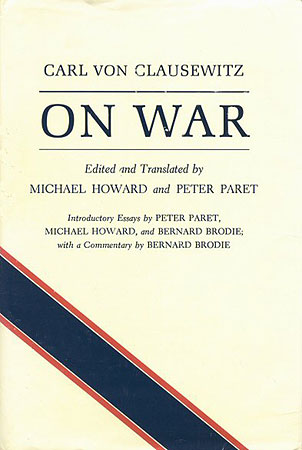 cholera, having finally risen to a military post his talents merited. He had been writing On War since 1816 and it was far from completed or refined to his satisfaction and it is highly unlikely, in my view, that Clausewitz would have consented to it’s publication in the condition in which he left it. His determined and intellectually formidible widow, Marie von Clausewitz, further shaped the manuscript of On War, guided by her intimate knowledge of her husband’s ideas and was likely the best editor Clausewitz could have posthumously had.

