zenpundit.com » military history

Archive for the ‘military history’ Category

Book Review: BRUTE by Robert Coram

Monday, March 28th, 2011

Brute: The Life of Victor Krulak, U.S. Marine by Robert Coram

Robert Coram has taken a different tack with BRUTE, the story of USMC Lt. Gen. Victor H. “Brute” Krulak, the diminutive legendary Marine general with the outsized personality, relentless ambition and far-reaching vision. It is an edgier, more sharply judgmental, more concise Coram who has made a biography of a challenging and not entirely sympathetic subject into a page-turner.

There are two stories in BRUTE. The first is of the life of the book’s namesake and his rise through the ranks of the Marine Corps, a career path that helped determine a critical element of American warfighting in WWII and saw the darkest sides of the wars in Korea and Vietnam before Krulak was denied promotion to Commandant because of the last war. The second story is that of the Marine Corps itself and it’s 20th century struggle for survival as a military branch of service against the bureaucratic machinations of the Army, the Navy and the ill-will of several presidents, a struggle in which Brute Krulak played a key part.

Reading between the lines, I sense that Coram, who delights in chronicling military mavericks, struggled with Krulak as a subject in a way he may not have with previous biographies like Boyd. Brute Krulak was a contradictory and controversial figure. Brilliantly innovative, absolutely dedicated, courageously outspoken, fiercely loyal, intensely driven and a physically brave Marine officer who led by example, Brute Krulak was also extremely and persistently deceptive, given to sins of omission as well as a relish to embellish and a machiavellian capacity to manipulate. The biography makes clear that Coram could not easily rely on the veracity of the anecdotes that an elderly but still mentally keen Brute Krulak grudgingly related to him.

Krulak could also be cold and emotionally abusive in his private life. It is clear that Krulak’s eldest son, Victor bore significant scars from treatment at his hands and Krulak , as much as he was able, effectively banished his extended family, including his parents, from his adult life in order to conceal his Jewish origins from a Marine and Navy hierarchy rife with anti-semitism. Like many young men on the make in the 19th and early 20th centuries, Krulak shed his religious traditions for the enhanced social mobility of the Episcopalian Church, the prestigious Protestant denomination of the Eastern Establishment elite, marrying into a wealthy, socially prominent family. Krulak so thoroughly reinvented himself and obscured his humble origins that late in life, his sons, who included two protestant ministers, were shocked to discover that their paternal grandparents and father were actually Jewish and not “Moravian” as they had been told.

In terms of operational art, Brute Krulak figures prominently in the history of two areas for which the United States Marines are best known: amphibious landings and counterinsurgency ( making this biography exceptionally timely). In both cases, Krulajk’s story intertwines with Coram’s theme of the Marine Corps at war with a predatory Army and Navy, each looking for their own reasons to demote the Marines to the “police force of the Navy” and end forever the role of the Marine Corps as a combat arm of the United States military. It is here that Coram’s pen acquires the sharpest edge.

Criticism of General William Westmoreland is common enough, and he comes in for his share of it in BRUTE, as are negative assessments of General Douglas MacArthur. That breaks little new ground as most historians see both men as flawed military leaders, albeit in different ways.  What is highly unusual is the willingness of Robert Coram as a historian to boldly level audacious charges of undermining civilian control of the military against hallowed figures of the US Army such as General George Marshall, that Marshall and other senior generals of the Army conspired during the postwar creation of the Department of Defense to usurp power over the armed forces properly belonging to Congress and to concentrate it in the hands of a Prussian-style “general staff”; that General Dwight Eisenhower attempted to lie to Congress about his role in the JCS 1478 papers. Unlike in Boyd, where Coram found some key high-ranking Air Force generals who acted as protectors of Colonel John Boyd against a hostile hierarchy, in BRUTE Coram emerges as a squared away partisan for Marines in their battle with “Big Army”.

Robert Coram has written a fast-moving, often sympathetic, at times troubling portrait of Victor “Brute” Krulak, one of the legendary Marine generals who never made Commandant because he told his Commander-in-Chief unwelcome truths about the president’s war and suffered the natural consequences.

Strongly recommended.

The Existence of the Operational Level of War, For and Against

Wednesday, March 16th, 2011

I was involved in a discussion elsewhere regarding the excellent and thought provoking article at SWJ by General Huba Wass de Czege on operation art, design and thinking:

Operational Art is Not a Level of War

Strongly recommend you read the article first. My remarks follow, slightly revised:

I have only read a few pieces by General Wass de Czege, those published at SWJ but the caliber of the general’s self-reflective, professional, thinking is something we should strive to emulate.

Here is what seems to be the crtical point in his article, after which I have a comment:

 “We doctrine writers of the 1980’s inserted operational art as a mid-level of war between tactics and strategy – making it the art of translating the governing strategy into the implementing tactics of the “tactical echelons.” And thus, making operational art the province of “campaigning” generals. Because of the way I was conditioned to think then, that strategy was the business of the upper echelons and tactics the business of the lower ones, I miss-translated an idea borrowed from Soviet doctrine about the mediation between strategy and tactics. I was then a product of indoctrination in the US Army’s War and Command and Staff Colleges. These institutions, and the business schools of the time, taught based on the industrial age organizational model of the head (where strategic decisions are made) and the rest of the body (where tactical decisions implement the strategy). I now believe that, without violating the historical meaning of the terms strategy and tactics, this is a much more useful and natural way to think of the relationship between tactics, strategy and operational art.

In fact, this allows one to close the conceptual gap between our bifurcated way of thinking about warfare between nation states and that between states and armed movements of any kind. It also helps do the same for the two tactical operating modes that have recently surfaced in new Army concepts – “combined arms maneuver” and “wide area security.”

Campaigning, another word for operational art, can occur at any scale, and in any milieu, as a close look at what our best company, battalion, and brigade commanders have been doing in Iraq and Afghanistan. “

I think maybe this should be qualified – re; operational art is not a “level”. It is a level of war and it is not at the same time.
 
The difference between the two I think is *how* we are employing the term: “Operational art” as a historical, taxonomic, description of how a military-political command structure has behaved/behaves as a warfighting institutional culture vs. methodologically how they *could* and *should* think about warfare and in turn behave at any “level”.
 
It is not surprising to me, thinking in terms of history, that Wass de Czege, where he wrote that he was in error, was drawing from Soviet examples. If we think about “operational art” as a “level of war” we are led to military powers where powerful ideological constraints systemically interfered with the “natural” clausewitzian connection between Policy and Strategy.
 
The USSR’s Red Army, from the early days of Commissar-Commander relationships in battle, through the Stalinist era to the more modern and restrained (i.e. non-murderous) controls of the Army’s Political Department and vetting security checks for promotion carried out jointly by the military, State Security and Party organs, created an atmosphere where deferral of political implications caused a) a segregation of an officer’s intellectual initiative to organizational and technical military questions and b) constructing military strategy and operational campaigns to at least nominally reflect Marxist-Leninist dogma and the Party line as a matter of necessity, and for a period, in an effort to try and avoid being physically liquidated.
 
Most of the Soviet Union’s most gifted military strategists and tacticians were unsuccessful in this regard and perished (ex. Svechin, Tukhachevskii, Blyukher). Arguably that left an institutional legacy in it’s wake that narrowed the conceptual framework with which Soviet Marshals and generals approached planning for war, including nuclear war.
 
Germany is another example, with the policy-strategy split favoring a professional military focus on operational art emerging as early as 1870 in tensions between Bismarck and Moltke over the war with France, growing worse during the Great War until during the Third Reich, a state of enforced paralysis occurs after 1942 on the Eastern Front. In theory, Hitler, who was his own war minister and commander-in-chief of the Army in addition to being the Supreme Commander, Fuhrer and Reich Chancellor, could (like Stalin) have resolved any contradictions or discordance between Policy and Strategy. Hitler deliberately chose not to do so and his paranoia led him to eventually limit even his field commander’s tactical flexibility (some generals, like Rommel, resisted this more effectively than others).
 
The US military, in my view, suffers a similar fixation. The reasons are very different – proper constitutional deference to civil authority coupled with a limited or absent capacity of most civilian political authorities to think in a complementary strategic fashion that would allow them to best guide their military commanders in jointly constructing a seamless bridge between policy-strategy-operational campaign. Another reason, though I do not want to go into it here, is a cultural reaction to the experience of the Vietnam War that became embedded in the officer corps during the shift to the AVF starting with the Nixon administration.
 
Tom Ricks had a very interesting post at Best Defense while back on the Hew Strachan article in which Ricks argued against the existence of an operational level of war, but as we are not discussing platonic forms, militaries are at whatever “level” of war for which their culture institutionally encourages officers to think about and plan. So in that sense, Wass de Czege is absolutely correct – they can and should be thinking across the whole range and not in “slots”. However, if they don’t do what he suggests and if they do predominantly focus on one “level” as most of their thinking and planning, be it tactics, operations, strategy. Then that level “exists”, it leaves a bureaucratic “trail”, grows a structure to execute it and will be put into practice during a war – at least initially until events force a change of practice from below (the field) or above ( political leaders).

Government by Assassination

Monday, March 7th, 2011

Pakistani Islamist militants, with the political support of the ISI and some of Pakistan’s higher military leadership, are trodding down a path we have seen before. Assassinations of democratic or tolerant political figures at odds with Islamist extremists and the military elite has become de facto “normalized” in Pakistan.

And popular among many Pakistanis.

Bhatti Killing Should Alarm Pakistan’s Minorities

The murder last week of Shahbaz Bhatti, Pakistan’s minority affairs minister and the only Christian in the cabinet, is a reminder of how dangerous it can be to voice one’s opinion in violence-riddled Pakistan. Bhatti was a liberal who spoke often against Pakistan’s blasphemy laws and their narrow-minded application.

His murder comes just weeks after the assassination of Punjab Governor Salman Taseer, another prominent moderate. Both men were targeted by Islamic extremists because of their calls to reform the blasphemy laws. The purpose of their murders — besides depriving moderates of some of their most courageous leaders — is to frighten moderates and minorities into silence and submission.

What Salman Taseer’s assassination could mean for Pakistan

Experts believe the outpouring of praise for the killer of Salman Taseer, the former governor of Punjab who was slain by his own security detail in Islamabad on Tuesday, reflects deep support for religious intolerance and will have a chilling effect on reform-minded public figures.

“It’s highly dangerous for these religious scholars to say things that do not fit into the legal context of [an] issue. Are they saying Taseer was guilty of blasphemy simply by criticizing a law? In that case, hundreds of thousands are guilty. This is a clear incitement to violence,” says Badar Alam, editor of Pakistan’s Herald magazine and an expert on Islamist groups.

Pakistan’s Bhutto assassinated – World news – South and Central …

NAUDERO, Pakistan – The body of Pakistan opposition leader Benazir Bhutto arrived in her family village for burial on Friday, hours after her assassination plunged the nuclear-armed country into one of the worst crises in its 60-year history.

Enraged crowds rioted across Pakistan and hopes for democracy hung by a thread after the former prime minister was gunned down as she waved to supporters from the sunroof of her armored vehicle.

The death of President Pervez Musharraf’s most powerful opponent threw the nation into chaos just 12 days before elections and threatened its already unsteady role as a key fighter against Islamic terror.

A cadre of military leaders manipulate and orchestrate civilian fanatics to methodically murder and intimidate civilian officials and radicalize the larger society, where have we seen this before? Oh, yes:

Pakistan is a Muslim version of 1930’s Japan.

US policy has hitched itself to a dangerously evolving and increasingly Fascist leadership class in Pakistan that is steadily veering away from any pretense of civilized conduct or partnership with the US, reifying a witch’s brew of Islamist extremism, militarism and anti-Indian and anti-American nationalism.  We need to disengage from and de-fund this monstrosity that bends most of it’s efforts against our interests and values. 

Pakistan is a strategic black hole of an “ally” that is going to blow up in our face someday.

A Clausewitzian on “Cohesion”

Thursday, December 30th, 2010

Long time ZP readers are probably familiar with seydlitz89, a dedicated Clausewitzian and retired former military officer who comments here occasionally and blogs at Milpub regularly. I first read seydlitz89 at Dr. Chet Richards’ late, great, DNI site and seydlitz89 went on to participate in two extensive events at Chicago Boyz, the Clausewitz Roundtable and the Xenophon Roundtable and also had some of his more extensive writings featured on Clausewitz.com.

I would like to draw attention to one of those articles and seydlitz89’s focus on Clausewtz’s concept of “cohesion” and an implicit “theory of political development”. I am going to excerpt for my own purposes, but suggest that you read seydlitz89’s argument in full:

The Clausewitzian Concept of Cohesion as a Theory of Political Development

….The concept of cohesion comes up in various forms in On War and to lesser extent in Clausewitz’s other writings.   These forms of the overall concept include:

  • Cohesion as the moral (think tribalism, nationalism) and material (think constitution, institutions, shared views of how to define “civilization”) elements that make up the communal/social organizations of political communities, as exemplified in the three ideal types discussed below. Moral cohesion can be seen as the traditional communal values of a political community, what values and motivations guide people in their actions with family, friends and neighbours, whereas material cohesion are the modern cosmopolitan values associated with society or those social actions associated with institutions of various types. The two types exist is a certain state of constant stress and tension with modern values actually being destructive to the retention of traditional values (following Weber). Cohesion here is Clausewitz’s theory of politics which also includes the abstract concept of money. (Book VIII, Chapter 3B & the essay titled “Agitation”)
  • Cohesion provides the process behind which the center of gravities of both participants in a conventional war are formed. Lack of a center of gravity would indicate the inability to win decisively, which would include the target of conventional militaries committed to unconventional/guerrilla warfare. (Book VI, Chapter 27, Book VIII, Chapter 4)
  • Cohesion is the target of strategy in that tactical success is extended by strategic pursuit in order to expand the sphere of victory and bring about the disintegration of the enemy. Cohesion links the whole sequence of decisions (contingency) that allows the political purpose to be achieved through the means of the attained military goal, that is cohesion provides the chain of decisions/outcomes that unite political purpose with strategy and strategy with tactics, or vice versa. (Books II, IV, & Book VI Chapter 8)
  • Cohesion acts within the balance of power among various states – especially in terms of interests – with an aggressor having to contend with all the other states having an interest in maintaining the status quo. This would include the tendency for Clausewitz of a potential hegemon to fail in its attempt to dominate other peer states. (Book VI Chapter 6)
  • Cohesion can also be seen has having an influence in the varying states of balance, tension and movement through which all conflicts proceed. The cohesion (moral and material forces, willingness to take risks, soundness of the military aim in connection with the political purpose, etc) of each side being relatively equal while in balance, but increasing on one side during tension until a release of the tension (attack) and decreasing again during movement until balance is once again achieved or the conflict ends. (Book III, Chapter 18)
  • At the most abstract level the concept of cohesion could be seen as providing the unifying concept which maintains the various elements (the remarkable trinity and the operating principles) of Clausewitz’s general theory as part of a whole, the fields of attraction and tension that provide the general theory with its dynamic quality. (Book I Chapter 1)

Thus cohesion can be seen as a very broad concept, but for my purpose I am using only the first point listed above. 

and later:

….The third type of theory I wish to mention is what I refer to as Clausewitz’s theory of politics, or maybe more accurately, a theory of political development, which I see as inseparable from his concept of cohesion as I described in point one above in discussing the various forms of cohesion. 

For our purposes here we are interested in Clausewitz’s concept of cohesion as it pertains to this first point, the physical and moral cohesive elements of political communities, how cohesion acts in effect as a sliding scale of ever increasing (or deceasing) concentration, integration and organization of a political community. 

This is a very useful elucidation by seydlitz89, regardless if one favors Clausewitz or Sun Tzu or is altogether indifferent to military-strategic concerns and are more interested in broad questions of political philosophy and social policy.

Furthermore, I think Clausewitz’s speculations on cohesion were, like many of his systemic perceptions in On War, remarkably farsighted and intuitively rooted in a scientific reality that was unknown and untestable in his day. The conservative and eponymous scholar, Paul Johnson noted in his book Birth of the Modern that the 1820’s represented a time of great intellectual ferment when the arts, humanities and sciences were not yet compartmentalized, professionalized and estranged from one another. To paraphrase Johnson, it was still an era when a scientist like Faraday and an artist ( probably Harriet Jane Moore) could and did have a productive conversation about the properties of light in complete seriousness. As an intellectual, Clausewitz shared that zeitgeist.

In a military frame of reference,  the concept of “cohesion” brings to mind the Greek-Macedonian Phalanx as a representative example

but the phenomena appears not merely in military tactics or in human social relations but throughout the animal kingdom. Howard Bloom, the popular science writer using a sociobiological perspective, used “Spartanism” and “Phalanx” as metaphors for documented behaviors of creatures as disparate as bacteria, baboons and hard shell Baptists. “Groups under threat, constrict” Bloom wrote in Global Brain and this characteristic of cohesion appears to apply even when the groups are not sentient. Network theorists and scientists can explain collective behavior in terms of “strong” and “weak” ties, nodes and hubs and resilience, including emergent behavior of systems are not even alive.

Cohesion is an aspect of the natural world.

Ancient Days….

Wednesday, December 29th, 2010

Took the children, who had a fistful of gift cards, to Barnes & Noble’s yesterday and picked up a couple of books for myself:


The Spartacus War by Barry Stauss

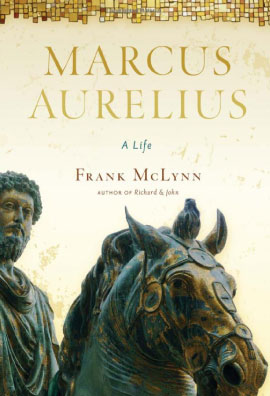
Marcus Aurelius: A Life by Frank McLynn

The legendary slave rebellion of Spartacus has yielded a relatively thin book by Strauss but it is an opportunity for me to get a fresh interpretation of “Roman COIN” (as if Caesar were not clear enough about how Romans dealt with insurgency in his Commentaries). Marcus Aurelius too has acheived almost mythic status, the stoic philosopher-Emperor who is the gold standard to whom other rulers are compared, and frequently found wanting.

Not sure when I will get to these…into the antilibrary pile they go 🙂


Switch to our mobile site