zenpundit.com » navy

Archive for the ‘navy’ Category

Iconic: compare and contrast

Thursday, December 22nd, 2011

[ by Charles Cameron — iconic images, riot police, compare and contrast, repetition with variation ]

First, let’s be clear that both these images have been widely considered iconic.

Thus NPR reported of the first photo:

There have been countless accounts of violence recorded during the uprisings in Egypt but the image that perhaps has captured the most attention is the most recent. The image has been widely referred to as the “girl in the blue bra.”

While Real Clear Politics quotes Michael Moore on the second:

“The images have resonated around the world in the same way that the lone man standing in front of the tanks at Tiananmen Square resonated. It is an iconic movement in Occupy Wall Street history,” Michael Moore declared on MSNBC’s “Last Word” program.

Moore was referring to police pepper spraying students at an “Occupy” protest at UC Davis.

So we have two similarities between the two images: they both show police in riot gear taking action against demonstrators, and they have both caught the public eye as somehow being representations that can “stand in” for the events they seek to portray.

Beyond that, it’s all compare and contrast territory — or variations on a theme, perhaps — and different people will find different reasons to attack or defend the demonstrators or the police in one, the other, or both cases.

1.

These are, for many of us, “home” and “away” incidents, to borrow from sports terminology, and some of our reactions may reflect our opinions in general of what’s going on in Egypt, or in the United States.

We may or may not know the rules of engagement in effect in either case, on either side.

In a way, then, what the photos tell us about those two events, in Tahrir Square and on the UC Davis campus, may tell us much about ourselves and our inclinations, too.

2.

As I’ve indicated before, I am very interested in the process of comparison and contrast that the juxtaposition of two images — or two quotes — seems to generate. And I’ve quoted my friend Cath Styles, too:

A general principle can be distilled from this. Perhaps: In the very moment we identify a similarity between two objects, we recognise their difference. In other words, the process of drawing two things together creates an equal opposite force that draws attention to their natural distance. So the act of seeking resemblance – consistency, or patterns – simultaneously renders visible the inconsistencies, the structures and textures of our social world. And the greater the conceptual distance between the two likened objects, the more interesting the likening – and the greater the understanding to be found.

I’d like to examine these two particular photographs, then, not as images of behaviors we approve or disapprove of, but as examples of juxtaposition, of similarity and difference — and see what we might learn from reading them in a “neutral” light.

3.

What I am really trying to see is whether we can use analogy — a very powerful mental tool — with something of the same rigor we customarily apply to questions of causality and proof, and thus turn it into a method of insight that draws on our aha! pattern recognition and analogy-finding intuitions, rather than the application of inductive and deductive reason.

And that requires that we should know more about how the mind perceives likenesses — a topic that is often obscured by our strong emotional responses — you’re making a false moral equivalence there! or look, one’s as bad as the oither, and it’s sheer hypocrisy to suggest otherwise!

So among other things, we’re up against the phenomenon I call “sibling pea rivalry” — where two things, places, institutions, whatever, that are about as similar as two peas in a pod, have intense antagonism between them, real or playful — Oxford and Cambridge, say, and I’m thinking here of the Boat Race, or West Point and Annapolis in the US, and the Army-Navy game.

Oxford is far more “like” Cambridge than it is “like” a mechanic’s wrench, more like Cambridge than it is a Volkswagen or even a high school, more like it even than Harvard, Yale, Princeton or Stanford — more like it than any of the so-called “redbrick universities” in the UK — so like it, in fact, that the term “Oxbridge” has been coined to refer to the two of them together, in contrast to any other schools or colleges.

And yet on the day of the Boat Race, feelings run high — and the two places couldn’t seem more different. Or let me put that another way — an individual might be ill-advised to walk into a pub overflowing with partisans of the “dark blue” of Oxford wearing the “light blue” of Cambridge, or vice versa.  Not quite at the level of the Zetas and the Gulf Cartel, perhaps, but getting there…

4.

So one of the things I’ve thought a bunch about is the kind of analogy that says a : A :: b : B.

As in: Egyptian cop is to Egyptian protester as UC Davis cop is to UC Davis protester.

Which you may think is absolutely right — or cause for impeachment — or just plain old kufr!

And I’ve figured out that the reason people often have different “takes” on that kind of analogy — takes so different that they can get extremely steamed about it, and whistle like kettles and bubble over like pots — has to do with the perceptual phenomenon of parallax, whereby some distances get foreshortened in a way that others don’t.

5.

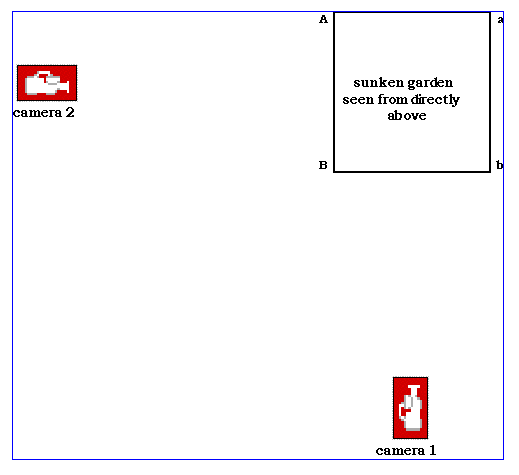
So my thought experiment sets up a sunken garden — always a pleasure, with two video cameras observing it, as in this diagram:
And from the two cameras, the respective views look like this:
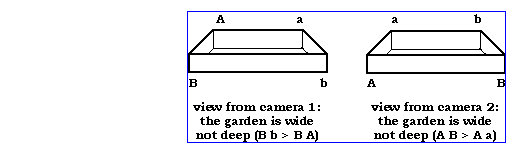
In this scheme of things, Aa (Oxford) seems very close to Bb (Cambridge) seen from the viewpoint of camera 1 — but from camera 2’s standpoint, Aa (Oxford) and Bb (Cambridge) are at opposite ends of the garden, and simply couldn’t be father apart.

6.

Now, my thinking here is either so obvious and simple as to be a platitude verging on tautology — or one of those subtle places where the closer examination of what looks tautological and obvious leads to the emergence of a new insight, a new “difference that makes a difference” in Bateson’s classic phrase.

And clearly, I hope that the latter will prove to be the case here.

7.

What can we learn from juxtapositions? What can we learn from our agreements about specific juxtapositions — and what can we learn from our specific disagreements?

Because it’s my sense that samenesses and differences both jump out at us, as Cath Styles suggested — and that both have a part to play in understanding a given juxtaposition or proposed likeness.

Each juxtaposition will, in my view, suggest both a “sameness” and a “difference” — in much the same way that an arithmetic division of integers, a = qd + r, gives both quotient and dividend.

And then we have two or more observers of the juxtaposition, who may bring their own parallax to the situation, and have their own differences.

8.

Tahrir is to Tienanmen as Qutb is to Mao?

Or is pepper spray just a food additive?

And how do icons become iconic anyway? Are they always juxtapositions, cops against college kids, girl vs napalm, man against line of tanks?  Even in the iconic photo of Kennedy from the Zapruder film, the sudden eruption of violence into the stateliness of a presidential parade is there — a morality play in miniature.

Any thoughts?
More on Boyd & Beyond II and Boydian Theory

Wednesday, October 19th, 2011

Two posts of note:

USNI Blog (Lucien Gauthier) – Training Sailors to be Autodidactic

….The conference spent a lot of time on the first half of the OODA-Loop, Observing and Orienting.  At some point I became convinced that the type of Sailor we need is one that is a “situational autodidact”.  Major Marcus Mainz, USMC, during his presentation made the brilliant comment that “training is for the known, education is for the unknown” in this sense, the spirit in which we must educate our Sailors must be towards making them capable of educating their self as needed when the unknown presents itself to them.

….For Sailors to take greater advantage of their experiences, they need to actively question their actions.  By this, I mean that a person analyses a question more than they do a statement.  But, it has been my experience that when someone recants an experience they had, it is a rare thing to hear someone say anything in terms of ‘why’ they did something.  Much more often someone only tells the ‘what’ of their actions.  Think of the Socratic Method, where Socrates would answer his students questions with another question.  A Sailor who has internalized such a ‘Socratic process’ would be in a position to provide more cogent feedback as well as learn from their mistakes more often than we do today.

What I am saying is not that the training we offer Sailors falls short of its objectives as they stand today.  But, that the spirit of the training is not where it needs to be-we focus our objectives too much on acting rather than orienting.  The training our Sailors receive are based on concrete and testable objectives that can be measured, quantified and turned into metrics, that fit well into powerpoint.  We do no help Sailors to become autodidactic-we are not training them to become students of their environment, but rather students of their school house.

We start to approach training Sailors to be autodidacts of their environment in the Operational Risk Management training we receive (One thing about ORM:  It is Boyd’s OODA-Loop operationalized.  The Navy has totally ripped off Boyd, and yet we never mention his name outside of the Warfare Universities-shame on us).  We need more and deeper training on ORM and how this method applies to everything we do, whether we consciously realize it or not.  In giving this deeper level or ORM, we should also find Sailors able to be more articulate of the process they’ve gone through.  Thereby becoming able to better train others of their experiences….

Naval affairs is not my bailwick, but my understanding of following online discussions by experts in the field like General Robert Scales, is that Professional Military Education across all the services is a) in need of significant reform and b) is facing a future of restricted budgets and possible deep cuts. My only firsthand knowledge of PME comes from a brief stint in June at The Army War College, courtesy of Dr. Steve Metz. The AWC curriculum was explained to me in detail by Col. Bill Lord, and while they were hitting the right notes in terms of trying to inculcate a strategic epistemology, the time frame allowed for doing so is extremely compressed.

Fast TransientsBoyd’s Conceptual Spiral – New Edition

This is from Dr. Chet Richards as well as Chuck Spinney….

Download Conceptual Spiral (152 KB PDF), Boyd’s take on the origin and importance of novelty:

Novelty is not only produced by the practice of science/engineering and the pursuit of technology, it is also produced by the forces of nature, by our own thinking and doing as well as by others. Furthermore, novelty is produced continuously, if somewhat erratically or haphazardly. Now, in order to thrive and grow in such a world, we must match our thinking and doing, hence our orientation, with that emerging novelty. (28)

Adds the original page numbers, which may seem a little odd because for readability this edition spreads several of Boyd’s originals over two or even three pages.  All of these will have the same number.

We are wired to crave and be attracted to novelty, it sets us thinking and generates insights and stimulates our creativity.

Wylie’s Military Strategy

Saturday, July 23rd, 2011

 by J. Scott Shipman

Wylie

Military Strategy, by Rear Admiral J.C. Wylie, Jr., USN (1911-1993)

This is a very brief review and recommendation for a book that I discovered recently. Admiral Wylie’s short Military Strategy (about 85 pages in the original edition) was published in 1967, but written in the mid-fifties while Wylie was “at sea in a single-screw low-speed amphibious cargo ship.” He remarked these ships were “not demanding  of a captain’s attention as is, for instance, a destroyer.”My copy was published in 1989 by the  Naval Institute Press  as part of their Classics of Seapower series and has an excellent preface by John B. Hattendorf that will give those unfamiliar with Wylie’s life experience a good foundation. This copy also has a postscript written by Wylie “twenty years later” and three related essays published previously in Proceedings magazine.

Given Military Strategy’s brevity, I’ll resist the urge to provide long quotes. Wylie and an associate’s search for articulating the relevance of the navy in the never-ending budget battles brought them in contact with the famed mathematician John von Neumann of Princeton. Wylie used a paraphrase of von Neumann as a starting point: “With respect to strategy as a subject of study, its intellectual framework is not clearly outlined, and its vocabulary is almost nonexistent. These two primary tasks are badly in need of doing…” He sets out to do just that and does a nice job.

Wylie defines strategy as: “A plan of action designed in order to achieve some end; a purpose together with a system of measures for its accomplishment.” He discusses the military mind and strategy, and how often the military focuses on principles to the exclusion of real strategy. Wylie outlines methods of studying strategy that are simple and well thought-out. Wylie makes a compelling case for a general theory of strategy. He says: “A theory is simply an idea designed to account for actuality or to account for what the theorist thinks will come to pass in actuality. It is orderly rationalization of real or presumed patterns of events.” Further, he continually stresses the importance of assumptions being based in reality, and not wishful thinking or the last war/battle.

His chapter on existing theories is worth the price of the book. He provides a type of Cliff’s Notes overview of the four theories he sees as core: the maritime, the air, the continental, and the Maoist. Of the last, he masterfully lifted sections from Mao’s On Guerilla Warfare, Che Guevera on Guerilla Warfare, and Vo Ngugen Giap’s People’s War People’s Army. He observed of the later, “these books are not only theory, the portray a hard reality of contemporary warfare.” To our people in uniform, in particular, unfamiliar with these books, Wylie provides an accessible and informative introduction to the type of war being waged by Islamic jihadists and how they attempt shape the battle field.

He develops a brilliant point that destruction doesn’t necessarily translate into control, and that often destruction is driven more by emotion than strategy.

Wylie goes on to provide a general theory of strategy that, using his words, has “substance and validity, and practicality.” As Seydlitz89 said in a recent comment thread here: “Wylie is amazing.  So many ideas in such a small book!  He misread Clausewitz and overrated Liddell Hart – which are probably connected, but overall?  He comes up with some very basic ideas about strategic theory which are ever sooooo useful.  I’ve re-read his small book several times and always come up with something that either I’d forgotten or that I had missed earlier.  Wylie’s basic approach to theory is as a practitioner, not as an academic, much like Clausewitz before him.”

Indeed, Wylie provides a nice scaffold for any type of strategy, military or business. For me his approach was refreshing in a genre where, more often than not, dogma and ego walk hand-in-hand.  Time and again, he offers that his ideas may be wrong and encourages readers to think and wrestle with the concepts provided. Wylie writes in his postscript: “As far as I know, no one as ever paid attention to it [the book]. I don’t know whether this is because it is so clear and obviously valid that no one needs to, or because it is of no use at all. I suspect it could be the latter, but I really do not know.”

This little book comes with my highest recommendation. If you’re in uniform and just getting started with strategic concepts/thinking, this is an excellent place to start.

Interesting referenced titles:

Military Concepts and Philosophy, Henry E. Eccles 

The Military Intellectuals in Britain, 1918-1939, Robin Higham 

An Introduction to Strategy, General Andre Beaufre 

Theory of Games and Economic Behavior, John von Neumann 

Strategy in Poker, Business and War, John McDonald 

Diesel Boats Forever! or ever?

Thursday, July 14th, 2011

German and Italian Type 212

Modern German Diesel Electric Submarines (Type 212)

by J. Scott Shipman (diesel electric submarines, naval strategy, Taiwan, Republic of China, submarines)

David Trombly at the new Fear, Honor, and Interest blog posted a thought provoking article on Taiwan, sea denial, and the bounding of US dominance.

This post caught my eye for several reasons, not the least of which is that in another life I rode submarines (ballistic missile subs: USS VON STEUBEN (SSBN-632) and the commissioning crew of USS PENNSYLVANIA (SSBN-735). Another is I attended on behalf of a former employer in 2001/2002 an industry day event soliciting interest in the US production of diesel electric submarines for the use of Taiwan (Republic of China, or ROC). US production was authorized (see background: here) because the ROC was having difficulty purchasing through European diesel boat manufacturers. Germany, Sweden, and France have proven platforms, as do the Russians and their KILO class. All of these nations export submarines, but few want to antagonize the ROC’s increasingly global neighbor China.

The industry day event was well attended, but as I sat there I had little confidence there would ever be a diesel electric submarine produced in a US shipyard. Here’s why: the US Navy is heavily vested in nuclear powered submarines which are incredibly expensive, with the most modern VIRGINIA Class coming in at around $2B a copy. When compared to modern diesel boats which run between $200-$300M, Big Navy understandably wants to avoid any possible comparisons—or for the question even to be raised. The industry event was more a public show of supporting Congress and the president than a serious inquiry, and nothing more than slides were produced (which is often the case in Washington, btw).

The USN is overextended by almost any measure, our national shipbuilding infrastructure is perhaps at its lowest point and our Fleet has less ships (about 283) than any time since WWI. We have about 70 submarines (18 OHIO Class of which 4 are guided missile submarines, 7 VA Class, 3 SEAWOLF, and about 43 older Los Angeles Class). These boats spend about half their time deployed, which drives up maintenance costs and cost to crew separated from family [the OHIO Class ships rotate crews about every 90 days] Our submarines are built exclusively in Groton, CT, and Newport News, VA. We have naval shipyards for heavy modifications, nuclear refueling/overhauls in Norfolk, Portsmouth, Bremerton, and Pearl Harbor (though I don’t believe Portsmouth or Pearl are authorized refueling facilities).

In this environment of increased op-tempo, and low numbers of ships/boats we have continuing challenges to the maritime domain, including China’s increasingly muscular approach in the South China sea and that age old naval scourge, piracy. (H/T Feral Jundi at Facebook)

These realities, combined with an ally in need (and perhaps many more potential customers) seem to form a perfect storm of need for a small fleet of stealthy, American-made diesel electric submarines. If the Obama administration wanted to strengthen it bonafides in East Asia and with the American public, it would reengage on the Taiwan submarine issue and this time, instead of a deal neither side could abide (our side the very thought and insane requirements, their side appropriating the funds). If Taiwan is willing to pay for R&D, allow the building shipyard to keep the design, and find an American suitor, that all translates into that three letter word Joe Biden is so fond of: jobs. Jobs that would have little to no reliance on the increasingly precarious federal government and shrinking defense budgets. Taiwan and the region would gain stealthy deterrents to potential Chinese mischief, the US could invigorate a fairly inbred shipbuilding industry with new talent, new ideas, and new competition, and maybe, just maybe we could build a few boats for those missions too mundane or cost-prohibitive for our nuke boats (like the piracy problem for a starter).

Postscript: As a former nuclear navy submariner, I am intimately familiar of the many positives nuke boats offer (I once spent 82 days submerged). My musing here is not a call for replacement, but rather to point out yet again (see this analysis), that our navy should have room for both in our increasingly complex world.

Please read my exchange with David at the Fear, Honor, and Interest post, as some innovative ideas not included in this post are presented. But I thought I’d share with the zenpundit audience as we spend a great deal of time talking strateegery here, but rarely naval issues, and I don’t post often enough…

A Culture of Punitive Raiding

Saturday, July 9th, 2011


Robert Haddick agrees with me, albeit with greater eloquence and length ( hat tip to Colonel Dave).

From SWJ Blog:

This Week at War: Rumsfeld’s Revenge

….Rumsfeld’s and Schoomaker’s redesign of the Army into a lighter, more mobile, and more expeditionary force seems permanent. Gone is the Cold War and Desert Storm concept of the long buildup of armor as prelude to a massive decisive battle. Instead, globally mobile brigade combat teams will provide deterrence, respond to crises, and sustain expeditionary campaigns. Gen. Martin Dempsey, the current Army chief of staff (and soon to be chairman of the Joint Chiefs of Staff) recently described a sustainable brigade rotation system, an expeditionary adaptation that the Navy and Marine Corps have employed for decades. In addition, both the Army and Marine Corps have drawn up plans to shrink their headcounts back near the Rumsfeld-era levels. Rumsfeld’s concerns about personnel costs sapping modernization are now coming to pass.

There now seems to be a near-consensus inside Washington that the large open-ended ground campaigns that Rumsfeld resisted are no longer sustainable. The former defense secretary’s preference for special operations forces, air power, networked intelligence, and indigenous allies is now back in vogue. Even Gen. David Petraeus, who burnished his reputation by reversing Rumsfeld’s policies in Iraq, will now implement Rumsfeld’s doctrine in eastern Afghanistan. According to the New York Times, the U.S. will counter the deteriorating situation there not by shifting in conventional ground troops for pacification, but with “more special forces, intelligence, surveillance, air power … [and] substantially more Afghan boots on the ground.”

While we agree that this is “Rumsfeld’s revenge”, unlike Haddick, I would not choose “doctrine” to describe it. This is really about a “Community of Operators” across services , agencies and their White House superiors adopting a culture of punitive raiding for at least the medium term. A doctrine might come along later but there are downsides to institutionalizing punitive raiding that have already been very well expressed by others (see comments section at SWJ). I’d prefer punitive raiding remain a flexible tool rather than a reflexive response ( it might help if we created a “Community of Thinkers” before we get too comfortable as an international flying squad).

At this point, I will stop and recommend a fine piece by Adam Elkus on the subject of punitive raiding, From Roman Legions to Navy SEALs: Military Raiding and its Discontents. A good primer on the history, implications and drawbacks.

Why is this happening?  Economics and the subsequent electoral politics of a finance-sector driven global depression. The same thing that brought COIN to an end and then finally killed it as an operationally oriented policy.

Punitive raiding is relatively cheaper. It permits defense cuts in the size of the Army and Marine Corps that are badly desired by the administration and Congress. It preserves and justifies investments in naval and air striking power that will bring joy to the Lexington Institute and satisfy many MoC concerned about defense jobs for constituents. On a point of genuine importance, this also hedges against near peer competitors (ahem…cough…China).

Is it a done deal? Unless the economy roars back, yes.

ADDENDUM:

Check out these two directly related posts by Pundita and Joseph Fouche:

America’s Light Footprint Era (Revised) 

Unhappy Medium: The Perils of Annoyance as Your Strategic Default


Switch to our mobile site

