zenpundit.com » society

Archive for the ‘society’ Category

Ruminating on Strategic Thinking II. : Social Conditions

Tuesday, January 3rd, 2012
A follow up to Part I.

How does a society, as opposed to individuals, develop a capacity for “strategic thinking” ?

While war is an obvious answer, it is not an advisable first resort. First of all, although war teaches hard lessons about strategy, the costs of losing a war are high. Secondly, the costs of winning a war can be high. Thirdly, few people, relatively speaking to the number involved, have any direct input into genuinely strategic decisions during wartime; most will either gain tactical experience or be relegated to support functions. At best, wars seem to create a cohort of excellent tactical leaders with the potential to, someday, mature into strategic leaders or strategists. At worst, from a war, the wrong lessons may be drawn and institutionalized to create a future disaster.

What conditions produce strategic thinkers for a state? A brief example from American history:

Here are some of the US leadership of WWII, the postwar “Wise Men” and their Cold War successors, collaborators, thinkers and military chiefs:

Franklin Roosevelt, Henry Stimson, Joseph Grew, Dean Acheson, Douglas MacArthur, Charles E. Bohlen, George F. Kennan, Paul Nitze, George C. Marshall , Harry S. Truman, Robert A. Lovett, Dwight D. Eisenhower  , John J. McCloy , W. Averell Harriman, William Donovan, James F. ByrnesChester Nimitz,  John Foster Dulles,  James Forrestal, Vannevar Bush,  Allen Dulles, Ernest King, Albert Wohlstetter, Dean Rusk, Hyman RickoverHerman Kahn, Robert McNamara,  Bernard Brodie, Fritz G. A. KraemerMcGeorge BundyRichard Nixon, Thomas Schelling, Henry Kissinger

Some commonalities that these individuals shared, sometimes in pluralities and others in large majorities:

Above average to very high IQ
Middle class to high socioeconomic status
Eastern Establishment
Fraternal organizations
Male
Protestant
Episcopalian
Ivy League education
Law 
Politics
Military service
Diplomacy
Wall St.
Harvard
Yale
Princeton
Columbia
Harvard Law
Military Academy
University of Chicago
Berkeley
Skull & Bones
Scroll & Key
WWI
WWII
RAND
Executive Branch
Nuclear weapons/arms control/power

This list could be expanded or reduced on a number of grounds. For example, the list is composed of men primarily because almost no women, with very few exceptions, even from elite backgrounds, had an opportunity during the first 2/3 of the 20th century to contribute to strategic decisions or policy making. We could also include other characteristics, but what we have is sufficient for some broad generalizations.

  • First, these men generally engaged in careers that featured complex activities that stressed and rewarded incisive analysis of factual scenarios, assessment of risk and potential benefits, intuitive judgment and organizational abilities – law, politics, the stock market, diplomacy and corporate leadership. A minority of the list had formal training in advanced mathematics.

  • Secondly, the men all had the social wherewithal and ambition to gain entry into educational and social institutions that were by definition, highly exclusive on more than a strictly meritocratic basis. For many from higher SES families, this presented no significant barrier but for the “outsiders” like Kennan, Nixon or Rickover, it was a formidable obstacle to overcome. In either case, there were social mores or even commonly held prejudices to which they had to adapt in order to “fit in”. Despite this demonstration of social intelligence, most members of our list were not  professional politicians (but those that were made an impact on American history much greater than that of an “average” president).

  • Thirdly, the presence of such overlapping experiential commonalities, while not creating a formal “strategic community” was probably sufficient to impart a strategic mentalité as to how the world really worked, red in tooth in claw, as well as implicit ideological assumptions as how the world ought to work, if perfected. This meant that strategic debates about American national security could take place within the framework of commonly held assumptions and reference points. While certain individuals might be disliked (MacArthur, Truman, Nixon) or regarded warily, with little trust (Nixon, FDR, Kahn) their strategic arguments were nevertheless widely understood within the elite and could be assessed on their merits – an excellent environment for building an elite consensus and continuity on matters of policy and strategy. This condition may be a political prerequisite for a democratic state’s formulation and adoption of a successful grand strategy.

If we wonder why the United States has been so ineffective at strategy in recent years, maybe we should look at how our current (and most importantly, future) elite’s formative experiences have sharply diverged from their strategically gifted WWII-Cold War predecessors.

Zen’s Iconic Compare and Contrast: Nine Years

Saturday, December 24th, 2011

I would like to depart from my usual style and take a leaf out of Charles Cameron’s playbook – notably his last post. Consider this a “Part II”.

Here are my selections:

Friendship Bridge, Afghanistan – February 16, 1989

….Many troops wondered how the Iraqis, whom they had worked closely with and trained over the past year, would react when they awakened on Sunday to find that the remaining American troops on the base had left without saying anything.

“The Iraqis are going to wake up in the morning, and nobody will be there,” said a soldier who identified himself only as Specialist Joseph. He said he had emigrated to the United States from Iraq in 2009 and enlisted a year later, and refused to give his full name because he worried for his family’s safety…..

Tampa Highway, Iraq – December 18, 2011

War without a strategy is like driving without a map – and in both cases you may not like your destination.

Ruminating on Strategic Thinking

Wednesday, December 21st, 2011

“Let the Wookiee win….”

Warning! Thinking out loud in progress…..

Strategy is often described as the alignment of “Ends-Ways-Means” and “planning” to achieve important goals and several other useful definitions related to matters of war, statecraft and business.  That great strategists have come in many forms, not just between fields but demonstrating tremendous variance within them – ex.  George  Marshall vs. Alexander the Great vs. Carl von Clausewitz – indicates that strategic thinking is a complex activity in terms of cognition.

What are some of the mental actions that compose “strategic thinking” or “making strategy”? A few ideas:

  • Recognition of important variables
  • Assessment of the nature of each variable
  • Assessment of the relative importance of each variable
  • Assessment of the relationships among the variables
  • Assessment of the relationship between the variables and their strategic environment
  • Assessment of current “trajectory” or trend lines of variables
  • Assessment of costs to effect a change in the position or nature of each variable
  • Assessment of the strengths and weaknesses of the variables as a functioning system
  • Recognition of systemic “choke points”, “tipping points” and feedback loops.

  • Probabilistic estimation
  • Logical reasoning
  • Introspection 
  • Extrapolation
  • Simplification
  • Metacognition
  • Horizontal Thinking
  • Insight
  • Imagination (esp. at “grand strategic” level)

  • Logistical estimation of costs
  • Normative evaluation of potential benefits
  • Understanding of temporal constraints
  • Recognition of opportunity costs
  • Recognition of boundary conditions
  • Recognition of physical constraints of strategic environment (terrain, weather, distance etc.)
  • Recognition of patterns in the history of the strategic environment

  • Net assessment of the maximum capabilities of a political community (first ours, then theirs)
  • Understanding of organizational structure of a political community
  • Recognition of stakeholders in the political community 
  • Understanding of decision making process of the political community
  • Understanding the power relationships of the decision making process of the political community
  • Understanding the distribution of resources within the political community
  • Recognition of the touchstone points of the cultural identity of the political community (positive and negative) and worldview
  • Assessment of morale of the political community and the community’s moral code
  • Assessment of psychology of individual adversary decision makers
  • Identification of points of comparative advantage
  • Recognition of how different bilateral outcomes/shifts will affect third parties
  • Assessment of relationship between the adversaries and between them and third parties

This list is not comprehensive. In fact, I have a question for the readership, particularly those with military service and/or a good grasp of military history:

Where do the interpersonal skills or “emotional intelligence” abilities that comprise the activity we term “leadership” fit into strategic thinking? Or is it a separate but complementary suite of talents? We often assume that great strategists are the great leaders, but we tend to forget all of the generals who were popular yet mediocre in the field and gloss over the human faults of those who won great glory.

I have some ideas but I would like to hear yours. Or any additional suggestions or comments you would care to make.

Going 3D

Wednesday, December 14th, 2011

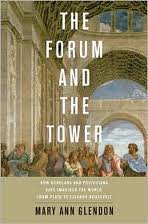
The Forum and The Tower, a review

Sunday, November 20th, 2011

[by J. Scott Shipman]

the-forum-and-the-tower.jpeg

The Forum and The Tower by Mary Ann Glendon

“The relationship between politics and the academy has been marked by mutual fascination and wariness since the time of Plato.”

The first sentence on the flap of the dust jacket of this very good and informative small book. Professor Glendon, who is the Learned Hand Professor of Law at Harvard Law school, set out to write a book for her students that would answer ageless questions such as:

“Is politics such a dirty business, or are conditions so unfavorable, that couldn’t make a difference? What kinds of compromises can one make for the sake of getting and keeping a position from which one might be able to have influence on the course of events? What kinds of compromises can one make for the sake of achieving a higher political goal? When does prudent accommodation become pandering? When should one speak truth to power no matter what the risk, and when is it acceptable, as Burke put it, to speak the truth with measure that one may speak it longer? When does one reach the point at which one concludes, as Plato finally did, that circumstances are so unfavorable that only the reasonable course of action is to “keep quiet and offer up prayers for one’s own welfare and for that of one’s country”?”

Professor Glendon answers these questions and more through brief examinations of the lives and works of some of history’s most important figures:

Plato

Cicero

Justinian, Tribonian, and Irnerius

Machiavelli

Thomas Hobbs and Edward Coke

John Locke

Jean-Jacques Rousseau

Edmund Burke

Tocqueville

Max Weber

Oliver Wendell Holmes

Eleanor Roosevelt and Charles Malik

All in all, I believe Professor Glendon has provided a uniquely valuable book to help her students and other readers to answers those questions. In short but focused chapters of about 20 pages each, she provides mini-biographies of the subjects above and how they answered the some of the questions both in their lives and in their philosophy. Some of her subjects were thinkers lacking the abilities for the public square, Plato, for instance, but were enormously influential just the same. Rare were those like Cicero and Burke who were equally comfortable in the political arena or the academy.

My favorite chapters were on Plato, Cicero, Machiavelli, and Burke—mostly because I’ve read a respectable amount of their work. That said, I have not read Plato’s The Laws—and Professor Glendon suggests it is much better than The Republic—which I have read and did not much enjoy. Not surprisingly, The Laws will be on my list for this winter.

The inclusion of Eleanor Roosevelt and Charles Malik was something of a surprise, but Professor Glendon is weaving a sub-story through each chapter and illustrating how Roosevelt and Malik’s work on the Universal Declaration of Human Rights was something of culmination and extension of over 2,000 years of thinking and political action—not in the context of human progress towards a utopia of sorts, which she wisely rejects,  but rather a reflection the common threads of political thought throughout history.

While this is not criticism, I would have liked to have seen a chapter on John Adams and Thomas Jefferson, and a chapter on Karl Marx, whom she frequently mentions.

This is a book that is approachable and readable, and in our tumultuous domestic and global political climate, important.

She closes with this illuminating sentence:

“If one message emerges from the stories collected here, it is that just because one does not see the results of one’s best efforts in one’s own lifetime does not mean those efforts were in vain.”

Professor Glendon is to be commended for a job “well done!”

The book comes with my highest recommendation and may be the best book I’ve read this calendar year. Add this book to your must read list.

.
Referenced works you may find of interest (some of these works are out of print and expensive—for simplicity I’ve used Amazon links): 

The Laws of Plato, translated by Thomas Pangle

Cicero: The Life and Times of Rome’s Greatest Politician, by Anthony Everitt

Cicero, A Portrait, by Elizabeth Rawson (Glendon praised this book.)

A Panorama of the World’s Legal Systems, John Henry Wigmore

The Life of Nicolo Machiavelli, Roberto Ridolfi

The Prince, translated by Harvy Mansfield

Machiavelli, by Quentin Skinner

The Lion and the Throne, Catherine Drinker Bowen

The Spirit of Modern Republicanism, by Thomas Pangle

Statesmanship and Party Government, by Harvy Mansfield

The Great Melody, A Thematic biography of Edmund Burke, by Conor Cruise O’Brien (I read this wonderful book in 1992 when it was released: highly recommended.)


Switch to our mobile site