zenpundit.com » art

Archive for the ‘art’ Category

Landmines in Paradise Garden

Wednesday, August 8th, 2012

[ by Charles Cameron — pros and cons of an important piece by Scott Atran — who among us can comprehend religion? ]
.
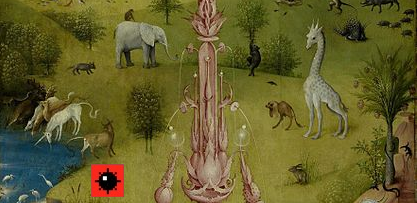
At play (Minesweeper) in the Fields of the Lord (Bosch, Garden of Eden)

.
Scott Atran, the anthropologist who gave us the book Talking to the Enemy, has got it right (as to importance) but wrong (as to procedure) in his latest, significant piece on Foreign Policy, God and the Ivory Tower: What we don’t understand about religion just might kill us.

First, the importance of the issue he’s discussing – understanding religions (emphatically plural, IMO):

Religion molds a nation in which it thrives, sometimes producing solidarity and sacred causes so powerful that citizens are willing to kill or die for a common good (as when Judea’s Jews around the time of Christ persisted in rebellion unto political annihilation in the face of the Roman Empire’s overwhelmingly military might). But religion can also hinder a society’s ability to work out differences with others, especially if those others don’t understand what religion is all about. That’s the mess we find ourselves in today, not only among different groups of Americans in the so-called culture wars, but between secular and Judeo-Christian America and many Muslim countries.

Time and again, countries go to war without understanding the transcendent drives and dreams of adversaries who see a very different world. Yet we needn’t fly blindly into the storm.

Atran is exactly right: we needn’t fly blindly into the storm — but to avoid flying blindly we need to understand those “drives and dreams of adversaries who see a very different world” — and to avoid flying into the storm at all we may (all of us, friends and foes alike) need to understand our own “transcendent drives and dreams” better than we do at present.

The question is, who can help us do that?

That’s what I mean by the procedure — the path that should be taken to achieve that kind of understanding. And note: there are different kinds of understanding — theoretical, imaginative, visceral… dispassionate, empathetic, impassioned…

**

Atran’s answer is science:

Science can help us understand religion and the sacred just as it can help us understand the genome or the structure of the universe. This, in turn, can make policy better informed.

There’s only one problem there. I can believe that scientists of extraordinary breadth and insight – Einstein, Bohr, Oppenheimer, Gell-Mann, Feynman probably – and social scientists — Bateson certainly, Victor Turner, Atran perhaps – my lists are not exhaustive – could make useful suggestions for scientific approaches to the field of religion.

But scientists in general? As Atran notes:

If you look at the prestigious U.S. National Academy of Sciences or Britain’s Royal Society, well over 90 percent of members are non-religious. That may help explain why some of the bestselling books by scientists about religion aren’t about the science of religion as much as the reasons that it’s no longer necessary to believe.

Non-believers may “get” what’s dangerous about religions, but they almost certainly won’t “get” what’s marvelous and inspiring about them.

And believers are no better – they may get what’s great about their own tradition, but still see nothing but perdition in the traditions of others…

So to get a decent set of insights worth experimenting with — or modeling, for that matter — requires a blend of subtle thinkers to include some social anthropologists, some scholars of comparative religion, some sociologists with fine-tuned statistical skills, some depth psychologists… believers, skeptics, atheists and agnostics… with a whole wild variety of plumages, specialties and interests.

Yes, and some poets, historians, some hard scientists. Yes.

**

How easy is it to get things wrong?

In his paper Reframing Sacred Values [link is to .pdf] written with Robert Axelrod — the political scientist whose contest for winning strategies for the iterated Prisoner’s Dilemma game put “tit for tat” and agent based modeling on the map in his books The Evolution of Cooperation and The Complexity of Cooperation — Atran speaks of “Rational versus Devoted Actors“.

The distinction is a significant one. And the paper itself is important because, as Atran and Axelrod suggest:

Counterintuitively, understanding an opponent’s sacred values, we believe, offers surprising opportunities for breakthroughs to peace. Because of the emotional unwillingness of those in conflict situations to negotiate sacred values, conventional wisdom suggests that negotiators should either leave sacred values for last in political negotiations or should try to bypass them with sufficient material incentives. Our empirical findings and historical analysis suggest that conventional wisdom is wrong. In fact, offering to provide material benefits in exchange for giving up a sacred value actually makes settlement more difficult because people see the offering as an insult rather than a compromise. But we also found that making symbolic concessions of no apparent material benefit might open the way to resolving seemingly irresolvable conflicts.

But who is to say which actors are “devoted”?

The most devoted may be the one who stands in most need of redemption, the one who has sinned the most, not the one who has been the most pious. Let me put that another way: the most devoted may be the drunken reveler rather than the regular church- or mosque-goer.

**

Consider:

Inigo was a courtier, a conquistador, a musketeer. The commandments were of course unquestionable in theory, but practice was entirely another matter. Church was for times of danger or for celebration of victory, and he never prayed so hard to our Lady as before a duel. In his last years when he had no need to be boastful, he was quoted by his secretary- biographer: “Though he was attached to the faith, he lived no way in conformity with it and did not avoid sin. Rather, he was much addicted to gambling and dissolute in his dealings with women, contentious and keen about using his sword.”

Inigo found plenty of trouble…

A scientist might not think such a person a reliable example of religious fervor. An antagonist of religion might think it illustrates the flaws of religion perfectly.

The passage in question comes from a life of St. Ignatius of Loyola, founder of the Jesuits.

Religion is a subtle matter. We may think it a matter of belief, but it may be a matter of behavior – orthopraxy vs orthodoxy is the distinction the folks in religious studies make — or of visionary experience.

It may “take one to know one” – as Thomas Merton, the Catholic contemplative understood the Buddhist contemplatives he met. But then he was open to the possibility that others might have intuitions not dissimilar to those he himself had had. “I’m deeply impregnated with Sufism,” he once wrote — Sufism being the mystical strand in Islam. Indeed, I received a letter from him myself while still a student at Oxford, in which he wrote of his life in the Abbey of Gethsemani, “here you get beaten for being a dervish. I am bruised for this all day long.”

**

But again, one can be blinded by one’s own faith to the merits of the faiths of others. And this is also a subtle business.

Retired US Gen. Jerry Boykin, for instance, said in April last year (link is to YouTube video):

Sharia law is a very serious threat in America. We are being invaded by a group of people who see it as their absolute imperative to establish a legal system in America which will in fact destroy our Constitution to be replaced by this thing called Sharia law.

One wonders what Boykin might make of the late California Presbyterian teacher, RJ Rushdoony — a figure, I’m guessing, far to the General’s right?

As is widely known, the New Testament contains a “Great Commission” which Christ gave to his apostles after his Resurrection:

Then Jesus came to them and said, “All authority in heaven and on earth has been given to me. Therefore go and make disciples of all nations, baptizing them in the name of the Father and of the Son and of the Holy Spirit, and teaching them to obey everything I have commanded you. And surely I am with you always, to the very end of the age.” — Matthew 28:18-20.

Rushdoony, in his master work The Institutes of Biblical Law, makes it clear that in his views, this constitutes a divine mandate to bring Biblical law into effect in all nations: “The fulfillment of that covenant is their great commission: to subdue all things and all nations to Christ and His law-word” (Institutes, p. 14) and this is to be achieved in terms of a single world order, “The goal is the developed Kingdom of God, the New Jerusalem, a world order under God’s law” (Institutes, p. 357).

Sadly, the church no longer recognizes the full implications of the Great Commission, and has fallen into a heresy that is political in nature: “The church today has fallen prey to the heresy of democracy” (Institutes, p. 747). In truth, the laws of a democratic society will need to be replaced by the laws of God as set forth in the Old Testament: “While all Scripture is God’s law word, the heart of that law is the law of Moses” (Institutes, p. 675).

Here’s where it gets trickier, though:

Slavery, too, will need to be reinstituted: “The (Biblical) Law here is humane and also unsentimental. It recognizes that some people are by nature slaves and will always be so. It both requires that they be dealt with in a godly manner and also that the slave recognizes his position and accepts it with grace” (Institutes, p. 251).

**

This thing called “religion” is difficult to pin down. It has extremes that appear unconscionable even to many who claim devotion to the same scriptures as do the extremists. It features violence, peace, apocalypse as destruction and apocalypse as fresh creation.

Atran is an anthropologist – he surely knows this.

The study of religion involves walking through a minefield — in the gardens of Paradise…
Numbers by the numbers: four

Wednesday, July 18th, 2012

[ by Charles Cameron — importance of the ratio form (“this is to that as thus is to so”) as a bridge between domains and silos, creative leaps, the glass bead game, and finally, Chittick’s joke about camels, sex and translations from the Arabic ]
.

.

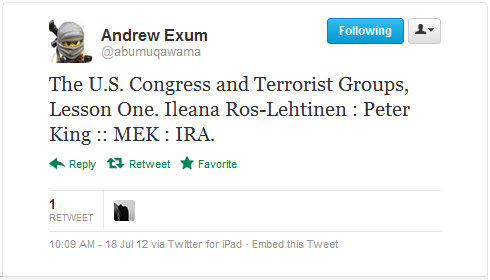
I retweeted this tweet of Andrew Exum‘s to my friend Paul Pilkington because I know he’s working on a project to find out what “this is to that” is to some other “this is to that” — across a wide swathe of human culture.

Note particularly that Exum is using this formal device to illuminate, to give insight, in an area of importance to analysts, strategic thinkers and decision makers.

I’m also retweeting Exum to Paul because I believe Paul’s simple experiment, based as it is on his reading of Hermann Hesse‘s Glass Bead Game, has the capacity to build an architecture of thought (a) crossing all disciplines and (b) spanning the trivial with the profound.

I’m doing something similar with Cath Styles in our Sembl games project — but this time I want to concentrate on Paul’s approach, and since there are four moving parts in an a is to be as c is to d configuration, I’m calling this post Numbers by the numbers: four — number three will just have to wait a while.

**

To get a sense of what Paul is up to, we can go to his Twitter Project page, which describes the fourth in a series of books he’s writing — and also follow him on Twitter, where he posts as Just Knecht.

Two of Paul’s recent tweets express his sense of the task pretty incisively:

The whole of language is the holding up of one unlike thing to compare, contrast and connect with another

Curating is a matter juxtaposition of work against work, artist against artist, place against place – A.Searle on Documenta 13, The Guardian

On his Twitter Project Page, he tells us:

Each tweet is an individual Glass Bead Game move, which is a comparison (metaphor, simile or analogy) across different areas, and may be either a statement or a question.

In question form, these are not unlike analogy questions from SAT tests with an additional dimension of general knowledge, cultural invention and intellectual playfulness. The basic challenge is to work out the relationship between two terms in one context, and apply it in another. Sometimes a tweet will extend an analogy further, which would be the beginning of forming a larger game from an individual move.

Some of the most interesting moves do not have right or wrong answers. Some have canonical or original answers, but they’re not necessarily right. In fact, very often I will post something I’ve picked up from elsewhere which I would love to see improved on, challenged, or at least better explained by others.

He then poses some of the sorts of questions that intrigue him:

Who is the J.H.Prynne of contemporary dance? Like Prynne in contemporary poetry they need to have been ‘out there’ right at the edge of theory and practice for some time, and also deeply steeped in tradition at the same time. Merce Cunningham? Suggestions welcome … And Heston Blumethal or Ferran Adrià might be the Prynne of cookery. But what about the Prynne of contemporary warfare?

What is the equivalent of sonata form in architecture? Goethe and Hegel both said ‘architecture is frozen music’ but neither really explained what they meant. If it is, then is there an architectural equivalent in Western architecture of the key structural form in Western art music? Suggestions welcome …

So, Zenpundit readers — who is the JH Prynne of contemporary warfare?

**

Not so long ago, in Numbers by the numbers: one, I posted a series of self-referential tweets that I’d collected over the last month or two — here I’d like to present some of Paul’s recent tweets:

Let’s start with one that’s a foreign policy insight, arguably as significant to day as it was when Vance first said it:

16 Jul @justknecht
“The Strait of Hormuz is the jugular vein of the West” (Cyrus Vance)

If these tweets can be timeless, they can also be timely:

4 Jul @justknecht
The Higgs boson is the quantum of the Higgs field, just as the photon is the quantum of the electromagnetic field

As they accumulate over time, they can build a conceptual “mesh” that engages an entire field — in this case, recent classical music — while linking it to a variety of other areas:

16 Jul @justknecht
“Boulez’ Derive 2 sounds like birthday cakes ought to” – Philip Clark, Gramophone

22 Jun @justknecht
Wagner was a beautiful sunset that was mistaken for a dawn – Claude Debussy, quoted by Geoffrey Norris in Gramophone

30 May @justknecht
Fauré’s Theme and Variations (no. 9) is like an evening star falling slowly from the sky – Bryce Morrison cites Alfred Cortot in Gramophone

11 May @justknecht
Kraftwerk is the Warhol of pop music – The New Yorker

There’s profundity here:

9 Jun @justknecht
“Space is to place as eternity is to time.” – Joseph Joubert

This could be, as Paul says, “the beginning of forming a larger game from an individual move” — that quote in itself could plausibly be the keystone of an architecture bridging science with religion…

There are historical parallels to consider:

31 May @justknecht
Robert Burton : Oxford :: Jeremy Prynne :: Cambridge

Catty remarks by Nobel laureates:

21 May @justknecht
“Thinking is to humans as swimming is to cats” (Nobel laureate Daniel Kahneman)

Near-tautologies:

21 May @justknecht
Macon Telegraph: Recipes are to food as blueprints are to buildings.

And, ooh, exotic forms of slander!

18 May @justknecht
“[Your daughter] has lovers as numerous as the striking of tablas on Palm Sunday” – Arabic satire by Abu Nawas, 756 – 813 AD

Once again, it’s form that generates insight, not content. Get used to form, play around with it, and content will leap out at you from the page, from the screen.

**

I’m no Arabist myself, but ah! that last quote reminds me irresistibly of the difficulties faced by translators from the Arabic, as recounted by William Chittick in The Self-disclosure of God: Principles of Ibn Al-‘Arabi’s Cosmology (SUNY Press, 1998, pp. xxxv-xxvi.)

An old joke among orientalists tells us that every Arabic word has four meanings: It means what it means, then it means the opposite of what it means, then it has something to do with sex, and finally it designates something to do with a camel …. The rational mind tends to push the meaning of a word away from experience to ‘what it means’ but the imaginal mind finds the self-disclosure of the Real in the sex and the camel … it is in the world’s concrete realities that God is found, not in its abstractions.

I’d been looking for an excuse to post that quote on Zenpundit — now I’ve found it!

Prophecy, Poetry and Prediction

Tuesday, July 17th, 2012

[ by Charles Cameron — personal preference, gangs, Chicago, insurgency, Afghanistan, and admitting the uncomfortable ]
.

Albrecht Durer, The Blessed Virgin enthroned on the crescent moon

**

Poetry, on the whole, has a liking for prophets. Thus Sylvia Plath writes:

By the roots of my hair some god got hold of me.
I sizzled in his blue volts like a desert prophet.

There’s an undeniable affinity there, the sense of giving voice to a lightning strike. Or as Randall Jarrell puts it:

A good poet is someone who manages, in a lifetime of standing out in thunderstorms, to be struck by lightning five or six times; a dozen or two dozen times and he is great.

**

Okay. I’m a poet, I think, partly because I have such a damnably literal mind that I need to break out in metaphor the way athletes break out in a sweat.

And the trouble with prophecy, from my point of view, is that it’s all too often read in damnably literal-minded ways, as though:

And there appeared a great wonder in heaven; a woman clothed with the sun, and the moon under her feet, and upon her head a crown of twelve stars

wasn’t clearly poetry. Let me clarify: it is.

And it is because prophecy (not “false prophecy”) is all too often read literally that the end of the world is so regularly promised, without once having come to pass thus far.

Even though the scriptures proclaim, But of that day and hour knoweth no man, no, not the angels of heaven

**

I suppose it goes along with being a poet rather than a statistician that I’m far more interested in qualitative than in quantitative approaches to modeling — or understanding, as we used to call it.

There are times, though, when it’s advisable to acknowledge the approaches most different from one’s own — for they too have their moments.

**

A Reporter’s Notebook entry yesterday on Fox News titled Chicago gang database intends to predict and prevent further violence tells us “One shooting sets the next shooting in motion.” That’s poignant even if a tad banal. But what comes next is interesting:

In an attempt to predict the next violent act, Chicago police are turning to technology. They have established a database that includes information on more than 100,000 known gang members. Even the lowest members of the gangs are entered as soon as police become aware of them. Their arrest records and affiliations are all entered and cross-referenced and available to the cop on the street. This is the kind of information a good beat cop would keep in his head; now it’s available to every cop on every beat. Sgt. Tom Ryan is in the gang unit on the South Side. “This is just a great way that we can look at all the information gathered because it is hard for the detectives to talk to all the different units. This is a good way of filtering down data through the departments to each other.

Probably of greatest use to the officers, when a guy gets shot, police see who his buddies are. “We can make predictions about where retaliations might be likely to happen,” says Commander Jonathan Lewin.

**

And I bring this to your attention because today I ran across an article in Wired’s Danger Room with the headline Study: WikiLeaked Data Can Predict Insurgent Attacks which resonated with yesterday’s Chicago gang report:

Insurgencies are amongst the hardest conflicts to predict. Insurgents can be loosely organized, split into factions, and strike from out of nowhere. But now researchers have demonstrated that with enough data, you might actually predict where insurgent violence will strike next. The results, though, don’t look good for the U.S.-led war.

And they’re also laden with irony. The data the researchers used was purloined by WikiLeaks, which the Pentagon has tried to suppress. And the Pentagon has struggled for years to develop its own prediction tools.

That data would be the “Afghan War Diary,” a record of 77,000 military logs dated between 2004 and 2009 that were spilled onto the internet two years ago by WikiLeaks. In a paper published Monday by the Proceedings of the National Academy of Sciences, a team of researchers used the leaked logs to (mostly) accurately predict violence levels in Afghanistan for the year 2010. (Behind a paywall, alas, but a summary is available for free in .pdf.)

**

I’m focused on minds and hearts, as the saying goes — but I’ll admit that mines and HK417s are also significant.

If the quant side of the house can reduce casualties, I’m all for that.

The best war game is a library of windows

Tuesday, July 3rd, 2012

[ by Charles Cameron — Escher, Borges, simulating the future, wargames, A Pattern Language, Sembl ]
.

MC Escher, Relativity

.
Ridiculous phrase, a library of windows. Unless you think, as I do, of books as windows onto different worlds, in which case it makes a whole lot of sense, and a decent library has more windows onto more profoundly different worlds than any physical room — and here we are getting into the territory of Jorge Luis Borges (links to Library of Babel) and Maurits Escher (image above).

And let me just state for the record that Godel Escher Bach could just as well have been Escher Carroll Borges, and that a comparison between the logics of Escher and Borges is one of the desiderata of our times.

That’s a Sembl move.

**

Let’s expand the concept of window to include the sort of inter-worldview glimpse that Haaretz describes today here:

Last week, in a small beit midrash (study hall) named after Rabbi Meir Kahane in Jerusalem’s Shmuel Hanavi neighborhood, an emergency meeting was convened to discuss instigating freedom of religion and worship on the Temple Mount. It was a closed meeting attended by representatives of the Temple Institute, HaTenu’ah LeChinun HaMikdash (the Movement to Rebuild the Holy Temple) and the Temple Mount Faithful, as well as two representatives of Women for the Mikdash, and others. The activists met to try to understand how they could overcome the authorities, who they believe are plotting against them, and return to the Temple Mount. At this meeting, Haaretz was offered a rare behind-the-scenes glimpse of the most ardent activists in the battle to Judaize the Temple Mount.

**

Here’s the meat of the post, as yet uncooked. Back in 2005, but brought to my attention today by Rex Brynen at Paxsims, is this piece from Strategy Page:

After eight years of effort, and spending over $300 million, the U.S. Army has officially received its new wargame (WARSIM) for training battalion, brigade, division, and as big as you want to get, commanders, and their staffs. Now even the most elaborate commercial wargame would not get $300 million for development, and eight years to create the system. But wargames for professional soldiers have different requirements, and a troublesome Department of Defense bureaucracy to deal with. First, the requirements. Commercial wargames shield the player from all the boring stuff (support functions, especially logistics.) But professional wargames must deal with these support activities, because in a real war, these are the things commanders spend most of their time tending too. …

WARSIM covers a lot of complex activities that a commander must deal with to achieve battlefield success. Besides logistics, there’s intelligence. Trying to figure out what the enemy is up to is, next to logistics, the commanders most time consuming chore.

— which in turn was referenced by Michael Peck writing in a Kotaku piece today titled Why It’s So Hard to Make a Game Out of the 21st Century:

Let’s build a game. Let’s make it a strategy game. We will realistically simulate global politics in the 2030s. Perhaps a sort of Civ or Supreme Ruler 2020-type system.

Where shall we start? How about something easy, like choosing the nations in the game? It’s simple enough to consult an atlas. We’ll start with Britain…but wait! Scotland is on the brink of declaring independence from the United Kingdom. Should Britain be a single power, or should England and Scotland be depicted as a separate nation? What about Belgium splitting into Flemish and Walloon states? And these are old, established European nations. How will states like Syria and Nigeria look in two decades? It was only a bit over 20 years ago that the Soviet Union appeared to be a unshakeable superpower that controlled Eastern Europe and Central Asia.

**

Let’s cook that meat, let’s make a meal of it.

Peck’s piece goes into many other ways in which predictive gaming isn’t terribly productive.

But it left me asking the question, what would I do with a game-sized budget, if my aim was to push military and intelligence towards greater insight.

And my answer would be to embed information in walls. In corridors…

To build windows at sparse and irregular intervals into the internal corridors that connect any given office in the Pentagon or three-letter agency — or my local preference (hush, I know it’s the Glorious Fourth tomorrow) MI-5 and -6 — through which analysts and decision makers can glimpse snippets of information.

Which can then fall into the deep well of memory.

It is deep within that well of half-forgotten knowledge, ST Coleridge tells us, that the “hooks-and-eyes of memory” link one thought with another to build a creative third.

**

A wall, then. I would build a wall embedded with facts and fancies, maps and illustrations, graphs and stats, film clips and news clips, anecdotes and quotes — even, perhaps, tiny alcoves here and there with books free for the taking, music CDs, DVDs of movies, old, new, celebrated, strange…

And I would be constantly shifting and rearranging the “views” from my windows, so that what was seen yesterday would not be what would be seen tomorrow — yet with a powerful index of words, topics, themes, memes, image contents, names of actors, newscasters, authors and so forth, so that what was once seem and dimly recalled could be recaptured.

**

The concept here is pretty much the exact opposite of having a huge black poster proclaiming Creativity Matters!

Don’t get me wrong, creativity does matter (get that poster and others here), but it “works in mysterious ways its wonders to perform” — and the way to entice it is to see things out of the corner of the eye…

The windows I’m looking for, therefore, offer glimpses you wouldn’t necessarily notice if you were deep in thought or conversation, and conversely, wouldn’t see twice and grow so familiarized to that they’d become irrelevant by repetition. They’d be glimpsed in passing, their esthetic would be that of Christopher Alexander’s Zen View, pattern 134 in his brilliant work — the closest we have to a Western I ChingPattern Language:

The idea, then, is to seed the memory with half-conscious concepts, patterns, facts and images, carefully selected and randomly presented — so that those hooks and eyes have the maximum chance of connecting some scrap of curious information with a pressing problem.

Which is how creativity tends to work.

**

That way each corridor becomes a game-board — but it is in the analyst’s focused mind that the game is played and won.

What you’d get, in effect, would be community-wide, ongoing free-form gameplay in complete alignment with the web-based game we’re currently developing at Sembl. Games of this genre will also have powerful application in conflict resolution.

And peace.

Miracles and rumors of miracles

Saturday, June 30th, 2012

[ by Charles Cameron — Timbuktu tombs, cultural preservation, WWII, miracle stories, della Robbia ]

.

.

A report on Al Jazeera today is sub-headed:

Al-Qaeda-linked group in northern Mali attacks tombs of Sufi saints just days after sites put on UNESCO endangered list.

**

My friend Michael Robinson just pointed me to this piece by Dr. Laurie Rush on “Cultural Property Protection as a Force Multiplier, from the March-April edition of Military Review:

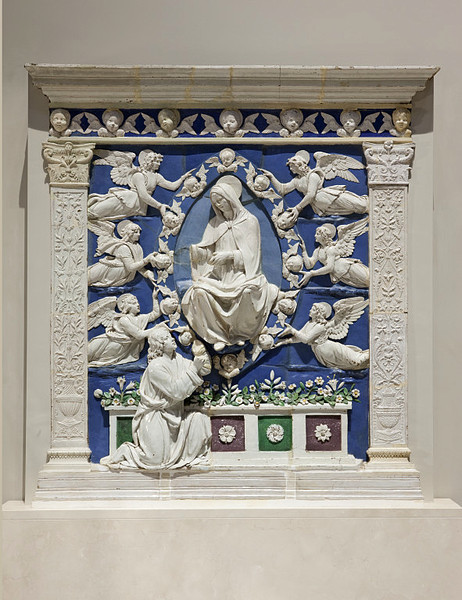
Preservation of cultural property can be critical for social restoration in a devastated community. During World War II, the Germans systematically blew up every single structure in the small town of Pieve Santo Stefano, Italy. Incredibly, they failed to destroy the Andrea della Robbia altarpiece relief, Assumption of the Virgin, in the local church. The MFAA wanted to remove the piece for its own protection, but the prospect of its relocation was unthinkable to the citizens of the community. Instead, the MFAA worked with them to save the altarpiece as part of the town’s restoration. Cultural property that survives war, sometimes miraculously, offers hope when all else seems lost.

**

Miracles and rumors of miracles…

Picking up where I left off last time: people with a non-miraculous worldview are apt to use the word “miraculous” to describe something like that altarpiece surviving, meaning roughly “fortunate” — while those whose worldview includes and welcomes miracles will use the same term in a very different sense, and with very different feeling.

These are differences that make a difference.

**

Here, because I was curious, is another Andrea della Robbia Assumption of the Virgin altarpiece, this one from the Victoria and Albert Museum collection, London:

Miraculous? Me personally, I’d say so.


Switch to our mobile site