zenpundit.com » military

Archive for the ‘military’ Category

Guest Post: Duncan Hunter and Human Terrain System by Turner

Sunday, February 14th, 2016

[by Mark Safranski / “zen“]

ZP is pleased to bring you a guest post by Pete Turner, co-host of The Break it Down Show and is an advocate of better, smarter, transition operations. Turner has extensive overseas experience in hazardous conditions in a variety of positions including operations: Joint Endeavor (Bosnia), Iraqi Freedom (2004-6, 2008-10), New Dawn (Iraq 2010-11) and Enduring Freedom (Afghanistan 2011-12).

ON REPRESENTATIVE DUNCAN HUNTER’S QUESTIONS ABOUT HTS

by Pete Turner

Today I was sent this USA Today article about Rep. Duncan Hunter (R-Ca) and Human Terrain System with a request for comments. An excerpt:

….A critic of the program, Rep. Duncan Hunter, a California Republican and member of the Armed Services Committee, demanded answers about the program from Acting Army Secretary Patrick Murphy in a letter sent Monday. Hunter noted “striking similarities between the two programs” and called on the Army to explain how the Global Cultural Knowledge Network differed from Human Terrain System. He also asked for an accounting of its cost and the number of people it employs.

“Unless the Army can show real differences between programs, then there should be no doubt that this constitutes a blatant attempt to rebrand and reboot a failed program under another name and a launch it with a reworded mission statement,” Hunter told USA TODAY on Tuesday. “What’s obviously lost on the Army is that it wasn’t just the implementation of HTS that was the problem, it was the whole thing, to include the program’s intent and objective.”

I have no faith in TRADOC’s ability to get Human Terrain System or HTS 2.0 any more right than last time.  The program was full of prima donnas, liars and academics who lacked the ability to relate to the military and commanders.  Also, commanders aren’t trained in how to best use HTS assets either – and that matters. For example:

COL: “Pete, I want you to tell me who the most influential person in our region is….can you do that?”  

Pete: “Yes Sir, I have the answer already…it’s you…until the people recognize their own governmental leaders, police and military, our focus has to be in ramping your influence down while we enable them to ramp up, Sir.”   

That statement is the essence of what an HTS does – we identify and translate the intersection of the ramps.  There is no book on how to do it well. The ground truth is where the best work is done.  It’s a shame that Rep Duncan Hunter and DoD cannot see that.

For those who aren’t familiar with my work, I have 70+ months of time working in combat zones.  I’ve worked most of this time at the lowest level interacting with locals on well over a 1000 patrols.  A great deal of this time I worked in the HTS program mentioned in the article.

Rep D. Hunter questioned the need and was critical of the original HTS program.  Like any program we absolutely had our share of fraud, waste and abuse.  Here’s the thing…the HTS program even when legitimately run is expensive.  Units work hard, long hours and a relentless schedule.  On numerous occasion, I’d work a 20 hour day followed by an 18 hour day followed by a string of 16 hour days.  An 84 hour week is the minimum I’d work.  Working at the minimum pace of 12 hours a day 7 days a week, a person will “max out” on their federal pay for the year and accumulate “comp time” or paid days off.

Since there are always things to do, lives at stake, command directives to pursue…missions to go on, planning to complete, analysis to run, reports to write, meetings to attend…it’s not hard to work 90+ hours a week and be seen as not doing enough.  How about this – some units will practice for a meeting for hours prior to the actual meeting?  If a unit is going to spend 6 hours prepping for and executing a meeting, that’s just ½ of a day…yes, legitimate work will result in paid leave.

If my patrol leaves at 3AM because there is a full moon and we move up and over a mountain arriving at a village before dawn…then spend the rest of the morning patrolling more and finally return to base at 2 in the afternoon…I still have to report on what I saw, a report may take 3-4 hours to write….and then prep for the next day’s patrol…unless your unit is doing 2 patrols a day.

I recall one specific time when a brigade from the 82nd that I was attached to was going to rotate home.  The brigade commander wanted to provide the new unit with the best possible handoff in terms of data, relationships etc.  To facilitate this handoff, my team was tasked to improve a “smart book” of dossiers on prominent Iraqis.  At one point I sat in the same chair for 24 hours writing, rewriting and then updating the book…simply because we HAD to work – the books weren’t getting better, just being constantly reworked.

Why do I bring this up?  Two reasons: First, the 82nd works HARD and if one is attached to them, that person works hard too, or suffers from irrelevance.  The 82nd spent a lot of taxpayer money on HTS people writing those books with the best intentions.  Secondly, the next unit came in and literally, never used the books.  When I asked why,  the new unit said, “we really don’t do that.”

When Rep Hunter originally questioned, the need for the program, I reached out to him to illustrate how when done properly, HTS work saves money and creates the kind of wins that unit’s cannot do without a HTS capability.  I also sent several notices to the my district’s congressional rep Mr. Mike Thompson.  Both he and Mr Duncan are veterans; I thought, surely they’d value my unique “ground truth” based knowledge.  I was wrong, both representatives ignored my offer to provide feedback.

The answer to Rep Duncan’s question about the need for this program is this:

Commanders need an outside element to translate what the US is doing for locals; in this case Afghans.  Meanwhile the HTS person also translates back to the US military what the locals are experiencing.  What an HTS person really does is works as a cultural translator allowing the different sides to understand the reality of their “partner.”

I worked in a valley that had a steep narrow canyon.  The local US Army agricultural development team (ADT) a truly myopic, xenophobic program that commonly created instability more than anything else, decided to build a check dam.  The dam was supposed to elevate the water in the river high enough to charge the irrigation ditches that ran the length of the river valley.  Over the course of 18 or more months the ADT fought with locals to improve the dam, while the locals rejected it and attempted to destroy it on several occasions.

The Dam Project

I was able to talk to locals who reasonably explained why the dam was an issue.  Simply put, they didn’t want it – and it was predicted to fail as soon as the first rain came.  Further, the region had an Afghan leader chosen to handle water issues for the families.  He agreed that the dam was a bad idea; and also predicted it would fail with the first rain.  We never effectively engaged the water elder–instead the ADT insulted this person and ignored his position and influence with the farmers.  A commander can’t know these things without an HTS person on the ground studying the human terrain.

I spoke with the ADT engineer responsible for the final “upgrade” to the dam.  I mentioned the concerns of the people and the water elder about the long term viability of the dam, which was visibly failing – the ADT hydrologist said, the elder may be right. Exacerbating this further, the dam project was done, updated and repaired all without any planning with the local Afghan governor.  All in all, the dam cost well in excess of $100k

Then the first rain came…

If one was to look at the ADT reporting, the dam was a hit.  It was accomplishing great things for the valley’s farmers.  Without an human terrain operator like myself, the ADT and the local US commander likely would never have found out how miserably they’d failed.  Rep Duncan, you want to fix things? Give me a call and I’ll show you where the money is really being wasted.

It gets worse…not only did the dam fail; when locals began to engage the governor about his plan to deal with the dam (this BTW is a small win, as most farmers a month prior saw no benefit from the government) the governor had no capacity to change anything.  This in effect confirmed for many locals that the governor had no ability to help them and therefore,  the Taliban would remain the dominant force in the region.  Ultimately, the ADT had closed the books on the region and meanwhile security further eroded.  Our efforts to create capacity resulted in us undermining the fledgling power of the governor.  Within a few months of my leaving the region, a district once considered to be a model of stability, had three service members assassinated by their Afghan partners.

Without an HTS asset, we never learn these lessons.  This is one of dozens of tales I was able to illustrate as an HTS operator.  Of course, since Reps Duncan and Thompson can’t be bothered with the ground truth – its all fraud waste and abuse, isn’t it?

The ROE to Nowhere

Wednesday, December 23rd, 2015

[by Mark Safranski, a.k.a. “zen“]

Many of you have seen the controversial NRO essay by David French on absurdly restrictive rules of engagement that enlisted men and their NCO’s and junior officers have been forced to wrestle with in Iraq, Afghanistan and miscellaneous conflict zones. This is a problem that began under the Bush II administration as the Army and Marine Corps wrestled with pop-centric COIN theory, but ROE became increasingly self-defeating under the Obama administration’s philosophy of micromanaging the world from the White House staff conference room. If you have not read the article yet, here it is with a blurb:

.

….This evening, however, our troopers believed that the car ahead wasn’t full of civilians. The driver was too skilled, his tactics too knowing for a carload of shepherds. As the car disappeared into the night, the senior officer on the scene radioed for permission to fire. His request went to the TOC, the tactical operations center, which is the beating heart of command and control in the battlefield environment. There the “battle captain,” or the senior officer in the chain of command, would decide — shoot or don’t shoot.

.

But first there was a call for the battle captain to make, all the way to brigade headquarters, where a JAG officer — an Army lawyer — was on call 24 hours a day, seven days a week. His job was to analyze the request, apply the governing rules of engagement, and make a recommendation to the chain of command. While the commander made the ultimate decision, he rarely contradicted JAG recommendations. After all, if soldiers opened fire after a lawyer had deemed the attack outside the rules, they would risk discipline — even prosecution — if the engagement went awry.

.

Acting on the best available information — including a description of the suspect vehicle, a description of its tactics, analysis of relevant intelligence, and any available video feeds — the JAG officer had to determine whether there was sufficient evidence of “hostile intent” to authorize the use of deadly force. He had to make a life-or-death decision in mere minutes. In this case, the lawyer said no — insufficient evidence. No deadly force. Move to detain rather than shoot to kill. The commander deferred. No shot. Move to detain.
 .
So the chase continued, across roads and open desert. The suspect vehicle did its best to shake free, but at last it was cornered by converging American forces. There was no escape. Four men emerged from the car. American soldiers dismounted from their MRAPs, and with one man in the lead, weapons raised, they ordered the Iraqis to surrender. Those who were in the TOC that night initially thought someone had stepped on a land mine. Watching on video feed, they saw the screen go white, then black. For several agonizing minutes, no one knew what had happened. Then the call came. Suicide bomber. One of the suspects had self-detonated, and Americans were hurt. One badly — very badly. Despite desperate efforts to save his life, he died just before he arrived at a functioning aid station. Another casualty of the rules of engagement.
.
Such a system, where brigade headquarters must be consulted by low level patrols or checkpoints before any combat action can be taken is essentially organizational paralysis of the fighting force, an fundamental principle of the art of defeat. What to do?
 .

If we are to take the premises of the domestic-politics driven ROE imposed on front-line troops by the Obama administration and a pliant senior leadership because they believe that our soldiers and Marines cannot be trusted with even the smallest decisions, the solution is obvious: we could field platoons composed entirely of lawyers. At least until robot soldiery becomes fully autonomous.

 .
Our newly established ObamaCorps Lawyer-Infantry units would have troops all certified as JAG officers in charge of supervising themselves in decisions to fire. No officers or NCOs will be required since they are effectively expected to defer to a lawyer over the radio anyway, they no longer serve a useful purpose in modern battle.
 .
We will save time, save money on radios and radio operator positions ( we will have lawyer-pilots to do CAS and lawyer-artillery men to decide on when to bombard the enemy). We can also save money on general officers by drafting retired Supreme Court justices to serve as a Board of Appeal in place of a theater or combatant commander. Should work better than what we do now at least.
 .
[End rant]
 .
JAG officers are not to blame for this situation, they are inserted where commanders and politicians demand they be inserted and they must follow orders in interpreting ROE as best they can.  You could remove the lawyers entirely from this process and a SSG or LT having to call up a 24 hour “hot line” to brigade headquarters (!) to talk to staff officer colonels of infantry before letting privates fire their weapon in a normal combat situation remains equally ludicrous and ineffective.
 .
What the Obama administration has done by incremental steps, aided by a careerist and risk averse leadership, is put American troops under unworkable “police model” warfighting constraints without openly admitting this is their policy goal.  Moreover, the longer these constraints and procedures remain in place, the more institutionalized they become as the new “American way of war” and legal Catch-22 for low level troops is the normal way of doing business.
 .
Without serious pushback, the risk to troops and tactical harm becomes likely to endure long after the Obama staff apparatchiks leave office.

DEF 2015 – the People and the Ideas are the Magic

Tuesday, November 10th, 2015

[by Mark Safranski, a.k.a. “zen“]

“We’re starting an insurgency of critical thinkers” – Darya Pilram, Red Team Instructor

Last weekend was my first Defense Entrepreneurs Forum conference, DEF 2015 . I came away extremely impressed by the diverse talents and intellectual firepower of the participants and their dedication to being positive change agents. Entrepreneurs mixed with active duty military personnel, senior leaders with juniors, Silicon Valley with Beltway, veterans with academics, journalists and authors; despite such obvious differences of perspective, discussion commenced not just with great civility but a sense of fraternity and esprit de corps. “Like a reunion” was how most attendees of DEF 2015 described it.

The conference received special support from The Atlantic Council, The University of Chicago’s Booth School of Business and their Polsky Center for Entrepreneurship and Innovation and Bunker Labs.  Additionally, there was strong representation at DEF 2015 by the U.S. Naval Institute in the persons of USNI CEO VADM (ret) Pete Daly and LCDR BJ Armstrong, editor of the Institute’s 21st Century book series (Armstrong was kind enough to slip me some copies of Naval Strategy and Naval Tactics, edited by Thomas Cutler and Captain Wayne Hughes, Jr. respectively). DEF 2015 was held at the Booth School’s Gleacher Center and the itinerary can be viewed here:

1st Day Agenda

2nd Day Agenda

3rd Day Agenda

#DEF2015 twitter feed

The advantage of the DEF 2015 conference program was the array of interesting speakers and workshops available (more than are listed online) running different lengths of time; the downside was that at some point, you had to miss something cool to do something great. I invested the largest chunk of time in attending the excellent three-part Design Thinking workshop run by Major (ret) John Silk as this had the most added-value relevance to my job, but I would have liked to have also heard the Bitcoin case study, the DARPA talk and the DEF Consultancy by VADM Daly and Josh Marcuse of DoD. Fortunately, many talks were recorded and will be on the DEF site and YouTube once they are edited.

A few highlights from DEF 2015:

Embedded image permalink

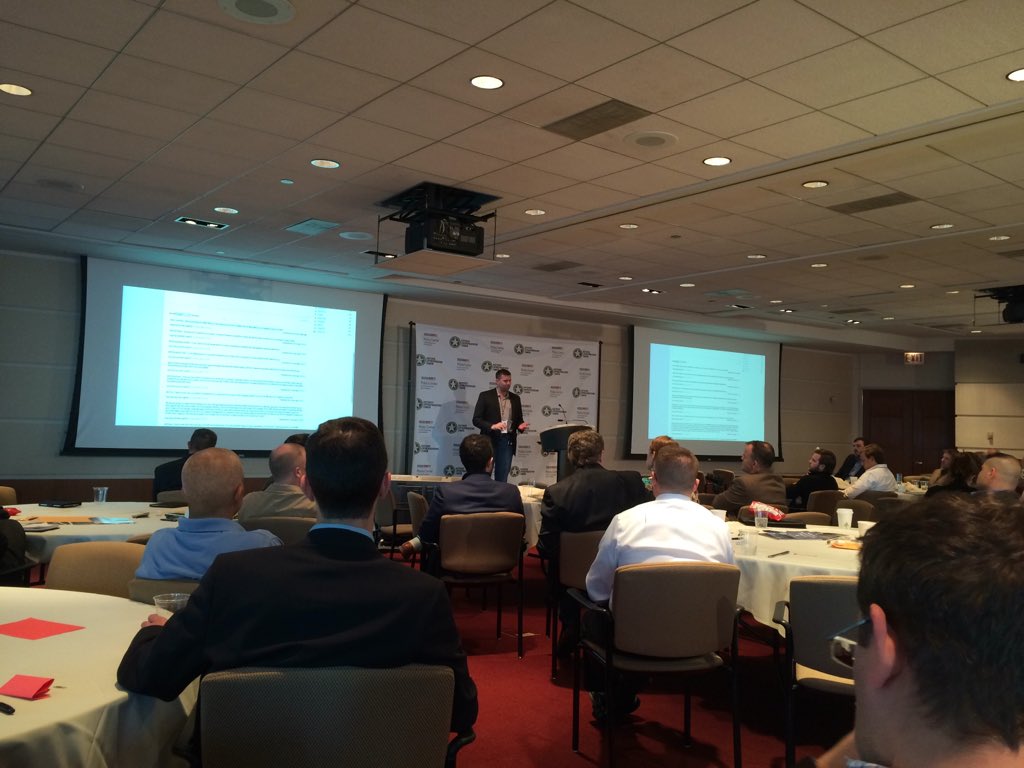
August Cole of the Atlantic Council and co-author of Ghost Fleet gave the closest thing to a keynote speech with his talk Ghost Fleet and the Art of Future War. Cole delved into the utility of artists and science fiction writers in futurist theorizing about armed conflict (one such writer is ZP’s own managing editor, Charles Cameron whose contribution to Cole’s futurism project was War in Heaven) including ” urban warfare in mega-cities”.

Embedded image permalink

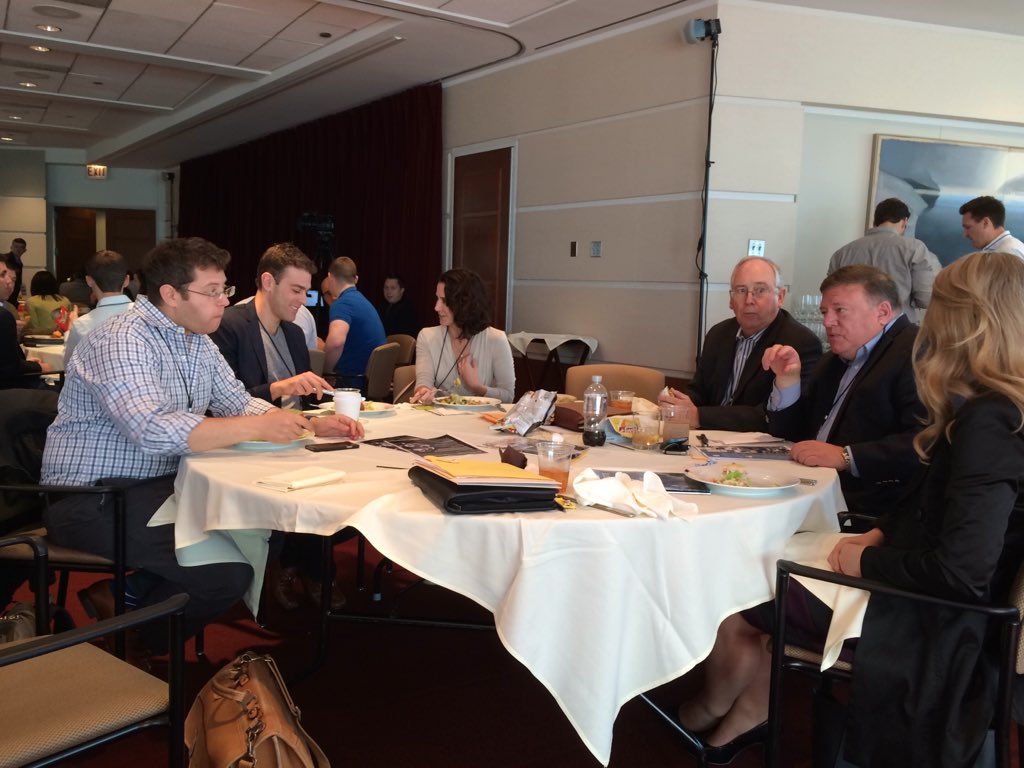
A textbook example of the high quality of F2F interaction at DEF 2015: A debate over the technical, tactical and strategic capacities of drones in non-permissive environments broke out during lunch between VADM Pete Daly (gesturing) and NDU researcher Joshua Steinman (far left) that drew in the rest of the table as well as August Cole and several passers-by.

Embedded image permalink

Richard Walsh of the U.S. Navy’s CNO Innovation cell advised everyone to “rock the boat” in a way that epitomized Boyd’s maxim of “Doing something” instead of “Being somebody”. Walsh explained his experience in terms of “grit” where people rise to an idea, a philosophy that resonated strongly with the audience.

Embedded image permalink

Embedded image permalink

William McNulty of Team Rubicon gave one of the most inspiring and moving of all the DEF 2015 talks regarding American veterans who have stepped up to forge one of the world’s most effective, first responder, humanitarian NGOs. I saw McNulty speak about Team Rubicon number of years ago at Boyd & Beyond and it was stunning to hear how the organization has since grown in its reach and capacity to make the world a better place.

It is important also to emphasize that great value of the informal networking times built into DEF 2015 both during the conference and at the evening socials, respectively at 25 Degrees and Moe’s Cantina (both located in the Chicago Loop). I made new friends and met old ones I have known from the strategy-sphere, Twitter and Facebook F2F for the first time. Stimulating convos were had with BJ Armstrong, Nate Finney, Joe Byerly, Josh Steinman, Mikhail Grinberg, Rich Walsh, August Cole, Nick Kesler, “Micah of West Point and “Emily of Loyola”.

Embedded image permalink Embedded image permalink

Finally, thanks needs to be given to the DEF leadership team for making DEF 2015 an outstanding success, including but not limited to Ben Kohlmann, J. P. Mintz, Mikhail Grinberg, Jen Walsh and Joe “the Leaderboard” Byerly. See you all next year!

Ben Kohlmann.jpg Mintz.jpg Embedded image permalink Jennifer Walsh Joe Byerly


KILO TWO BRAVO – The Teaser Post

Saturday, October 31st, 2015

[by Mark Safranski, a.k.a. “zen“]

Friend of ZP, Kanani Fong sent me early access to watch and review Kilo Two Bravo, due to be released November 13th. It is the true story of a platoon of British paratroopers who are caught in a minefield by the Kajaki Dam in Afghanistan’s deadly Helmand Valley. As I have just finished a monumental, six month long, project from Hell, this weekend seems to be a timely moment to settle down and watch. Looks intense. Review pending.


DEF 2015

Friday, October 23rd, 2015

[by Mark Safranski, a.k.a. “zen“]

The Defense Entrepreneur’s Forum is one of the major national conferences dedicated to exploring innovative ideas and cultural change in defense, military leadership and national security and it is being held in Chicago on November 6-8th. It is an outstanding opportunity to meet both emerging and senior military leaders, defense intellectuals, policy wonks, national security and business gurus and experts from diverse professional fields.

1st Day Agenda

2nd Day Agenda

3rd Day Agenda

Register here!

Previously, I’ve had to miss DEF due to schedule conflicts but this year I am able to attend and will cover DEF 2015 here at ZP ( I believe Lexington Green will do the same over at Chicago Boyz). I look forward to meeting some of the thoughtful folks I know mainly as internet entities on Small Wars Journal, War on the Rocks, the Bridge, the Warlord Loop, Twitter and Facebook. Perhaps I will see some of you there as well!

A few samples of past DEF talks:

BJ Armstrong ” The Nuclear Option”


Karen Courington ” From Start-up to Mark-up”

 
Joe Byerly “DEF2.0 Story”


Switch to our mobile site