zenpundit.com » authors

Archive for the ‘authors’ Category

Chicago Boyz at National Review

Saturday, September 18th, 2010

ChicagoBoyz.net has hit in the last few weeks a) The Glen Beck Program, b)  Rush Limbaugh and now, c) National Review. Jeez, a conservative trifecta if there ever was one.

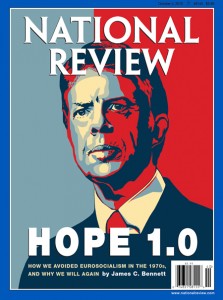
James Bennett, who is in my experience, an extremely smart man and the author of The Anglosphere Challenge: Why the English-Speaking Nations Will Lead the Way in the Twenty-First Century, collaborated on the featured cover article in the latest edition of National Review.

 Lexington Green has the details:

Jim Bennett Article on Cover of National Review

Bennett NR cover

The current issue of National Review features an article by my future co-author Jim Bennett:

For decades, America had been on a course toward a more centralized society. But 1980 – with the arrival of Reagan and the departure of Carter – marked the point at which the nation reversed course. Thenceforth it would be headed in the opposite direction, toward a new vision of individualism and decentralism.

I have read Jim’s piece in draft, and I strongly suggest you read it.

I second.

Congratulations to Mr. Bennett!

Summer Series 2010: Koran, Kalashnikov and Laptop by Giustozzi

Wednesday, September 15th, 2010

Summer Series 2010: Reviewing the Books! has begun. This review was originally posted in July, 2010 and is being re-posted as part of Summer Series:

Koran, Kalashnikov and Laptop by Antonio Giustozzi

I just finished reading Koran, Kalashnikov and Laptop: The Neo-Taliban insurgency in Afghanistan by historian Antonio Giustozzi who has subsequently gone on to write in rapid succession, Decoding the New Taliban: Insights from the Afghan Field and Empires of Mud, which I intend to read as well. Giustozzi is doing something important with his study of the Neo-Taliban insurgency that twenty years ago, a professional historian would have eschewed: applying his his historical expertise and methodology in a disciplinary synthesis to understand a dynamic, emerging, phenomenon at the center of current policy.

At the outset, Giustozzi writes:

This book is written by a historian who is trying to understand contemporary developments making use of not just the historical method, but also drawing from other disciplines such as anthropology, political science and geography. As a result, this book combines an analysis of the development of the insurgency based on available information with my ongoing work, focused on identifying the root causes of the weakness of the Afghan state.

This is a useful investigative methodological approach. “Useful” in the sense that while adhering to scholarly standards, Giustozzi offers readers the benefit of his capacity as a professional historian to evaluate new information about the war with the Neo-Taliban, while orienting it in the appropriate cultural-historical context. Not all of the information dealt with is reliable; Giustozzi candidly explains the disputes around particular unverified claims or accusations before offering his educated guess where the truth may be or the probabilities involved in a fog of war and ethno-tribal animosities.

Koran, Kalashnikov and Laptop is an academic book with a fairly detached tone and heavily endnoted chapters, which Giustozzi divided in the following manner:

1. Sources of the insurgency

2. How and why the Taliban recruited

3. Organization of the Taliban

4. The Taliban’s strategy

5. Military tactics of the insurgency

6. The counter-insurgency effort

The chapters have a wealth of detail, bordering at times on minutia, on Afghanistan’s complex and personalized system of politics which help shed light on why the effort at providing effective governance, a key COIN tenet, is so difficult. One example:

“….Strengthened as it was by powerful connections in Kabul, Sher Mohammed’s ‘power bloc’ proved quite resilient. Some of the Kabul press reported ‘criticism’, by former and current government officials from Helmand, of Daoud, whose attempts to restrain and isolate the rogue militias and police forces of helmand were described in terms of collaborationism with the Taliban. Daoud reacted by accusing the local ‘drug mafia’ of plotting against him and tried to convince President Karzai to leave him in his post, but not even British Prime Minister Tony Blair’s efforts sufficed to save him. Karzai sacked Daoud in the autumn of 2006. His replacement, Asadullah Wafa, was widely seen as a weak figure who for several months even refused to deploy to Lashkargah.”

This example is a typical one for political life in the provinces. Karzai’s counterinsurgency strategy does not have much to do with ours, and is largely antithetical to it. What we call “corruption”, Karzai sees as buying loyalty; what we call good governance, Karzai views as destabilizing his regime. We are not on the same page with Hamid Karzai and perhaps not even in the same playbook.

Giustozzi is exceptionally well-informed about Afghanistan and the political and military nuances of the old Taliban and the Neo-Taliban insurgency and the structure of Koran, Kalashnikov and Laptop is clear and well-organized. Giustozzi is informed about COIN in this context but less so generally (in a minor glitch, he posits Mao as primarily waging guerrilla war against an Imperial Japan – Mao didn’t – which did not have much of a “technological edge” – which Japan certainly did over Chinese forces, Nationalist or Communist, for most of the war) but Giustozzi is not writing to add to COIN theory literature, as he specifically noted. What the reader will get from Giustozzi is a grasp of who the Neo-Taliban are as a fighting force and the convoluted, granular, social complexity of Afghan political life in which the US is attempting to wage a COIN war.

Koran, Kalashnikov and Laptop is strongly recommended.

Summer Series 2010: The Human Factor by “Ishmael Jones”

Thursday, September 9th, 2010

Summer Series 2010: Reviewing the Books! has begun. This review was originally posted in June, 2010 and is being re-posted as part of Summer Series:

The Human Factor: Inside the CIA’s Dysfunctional Intelligence Culture by Ishmael Jones

A former clandestine officer of the CIA who operated overseas without benefit of diplomatic cover, “Ishmael Jones” has painted one of the most damning insider accounts of a puportedly self-serving and risk-averse CIA’s management culture that has ever been written. Jones’ description of a mendacious and incompetent CIA headquarters bureaucracy has less in common with critical documents like the 9/11 Commission Report or the legendary Church Committee hearings than it does with the literature produced by Soviet dissidents and defectors during the Cold War.

Jones, who quotes from the iconic 1990’s film Glengarry Glen Ross, yearned to be in an aggressive covert intelligence service whose case officers would “Always Be Closing” . Instead, he finds a Central Intelligence Agency topheavy with career managers averse to approving operational approaches to potential sources, eager to recall effective and productive officers permanently home on the slightest pretexts, comfortable with padding their incomes through familial nepotism and not above lying to Congress or political superiors in the Executive Branch. Jones navigates successfully through three consecutive overseas assignments via a strategy of keeping HQ in the dark about his activities, never becoming known as an “administrative problem” to HQ paper-shufflers and advancing operational costs from his own pocket, with the CIA eventually in arrears to Jones to the tune of $ 200,000.

CIA management in The Human Factor resembles nothing so much as the Soviet nomenklatura crossbred with the Department of Motor Vehicles. Even if we were to allow for exaggeration for humorous effect, or frankly discount 50 % of Jones’ examples outright, the remainder is still a horrifying picture of Langley as an insular bureaucracy that excels far more at Beltway intrigue than at foreign espionage or covert operations. Jones also discusses the tenure of CIA directors George Tenet and Porter Goss, the Valerie Plame story and the post-9/11 intelligence “reforms” that aggravated the CIA management culture’s worst tendencies. Jones concludes by stating flatly that the CIA cannot be fixed and should be abolished, with its useful operational personnel transferred to the Departments of State and Defense.

ADDENDUM:

An excellent – and more detailed – review of The Human Factor by by fellow Chicago Boyz blogger, James McCormick:

Mini-Book Review – Jones – The Human Factor

….Other reviews of this book have proclaimed Human Factor a rather boring recollection of examples of institutional ineptitude and better as a guidebook for potential employees than a useful description of the CIA but I feel this is in fact the most useful book on the CIA’s clandestine service since:

Orrin Deforest and David Chanoff, Slow Burn: The Rise and Bitter Fall of American Intelligence in Vietnam, Simon & Schuster, 1990, 294 pp.

David Atlee Phillips, The Night Watch: 25 Years of Peculiar Service, Atheneum, 1977, 309 pp.

which covered clandestine case officer activities, first person, in Vietnam and Latin America.

Like these two aforementioned titles, Human Factor focuses on the day-to-day challenges of being a covert case officer … the “teeth” in any intelligence organization. It is noteworthy that the Director of Central Intelligence has rarely, if ever, been one of those covert (non-State Department) officers. It’s as if your dentist was being overseen by experts in small-engine mechanics.

Ishmael recounts the minutiae of what reports he needed to write, the porous e-mail systems he had to manipulate, and the permissions he needed to gain. The timing and delays of decisions from Langley … the phrasing and terminology that was necessary to get anyone back in the US to allow any activity whatsoever. As a former stock broker, Jones was entirely comfortable with the challenges of “cold-calling” and dealing with “No” over and over again. But this wasn’t the case for his fellow trainees or for any of his superiors. At every turn, he was able to contrast his experience in the Marines (and military culture), and with Wall Street’s “make the call” ethos, with what he was experiencing as one of the most at-risk members of the Agency

Summer Series 2010: WAR by Sebastian Junger

Wednesday, September 8th, 2010

Summer Series 2010: Reviewing the Books! has begun. This review was originally posted in June, 2010 and is being re-posted as part of Summer Series:

WAR by Sebastian Junger

I just finished reading my courtesy review copy of WAR by journalist and author Sebastian Junger, on his firsthand observation of the war against the Taliban in the Korengal Valley, waged by the soldiers of the 2nd Platoon of Battle Company. I cannot say that I found WAR to be an enjoyable read – though Junger is a polished writer – a more accurate description is that WAR is powerful, thought-provoking, at times moving and, ultimately, a very disturbing account of the war in Afghanistan.

Junger, whose previous works include The Perfect Storm: A True Story of Men Against the Sea and Fire, was embedded along with photojournalist Tim Hetherington, with 2nd Platoon during their COIN campaign in Korengal, a mission that resulted in some of the bloodiest firefights and highest American casualties of the Afghan war and withdrawal from a rugged valley sometimes known as “Afghanistan’s Afghanistan”. The Korengalis, related to the people of Nuristan, are noted for their xenophobic hostility to outsiders, which was directed at times toward the Taliban as well as Americans. Junger reports that the US only succeeded in controling a quarter of Korengal and contesting roughly half of the six mile by six mile valley with the Taliban and local “accidental guerrillas”motivated by money, excitement, religious zeal or revenge to attack the Americans.

WAR is not an especially “political” or “policy” book discussing the war from some remove. Junger’s primary interest are the men of second platoon at Restrepo, an outpost dedicated to the memory of a valorous medic who had been killed. O’Byrne, Anderson, Stitcher (who has “INFIDEL” tattooed across his chest), Jones, Moreno, Bobby to name just a few soldiers Junger interviewed and witnessed how they lived in the moment. That moment could comprise the adrenaline high of combat, agonies of grief, anticipatory tension before the next ambush, the angst of boredome behind the wire and especially the iron bonds of brotherhood in a small unit tempered by fire.

What comes through in War, aside from the extremity of the terrain and the uncertainty of ever-present danger, men being shot without warning by the enemy, even in Restrepo, is how very few men are actually involved in combat. Battle Company is the vaunted “tip of the spear” but when only a few hundred men were taking a wildly disproportionate percentage of all combat contacts in a nation the size of Afghanistan ( Junger cites 20 %) the spear begins to look more like a tiny sewing needle connected to a Leviathan-like noncombatant-administrative tail, surreally outfitted with fast food courts.

There’s a peculairly granular quality to Junger’s WAR, the grittiness of the squalid conditions in which soldiers live, the depths of their physical sufferings and mental exhaustion, their primal fear of letting their comrades down in battle and being responsible for getting friends killed. There are also epiphanies of bravery and carrying the day against the odds, men living who but for chance would have died on some rock strewn hill and lusty celebration after the deaths of their enemies. The sort of politically incorrect, atavistic, jubilation that is culturally frowned upon by people who are comfortably safe and far away.

What disturbed me most about WAR was not just how few Americans are carrying the burden of the combat in Afghanistan but how disconnected these few soldiers and their sacrifices are from the rest of the military itself. Junger’s epilogue with O’Byrne, a fine soldier who is a major figure in the book, and his inability to readjust and shift from the battlefield to garrison or civilian life is deeply depressing. “The Army’s trying to kill me” O’Byrne declared, finding a momentary refuge in alcohol, but little help from the military bureaucracy.

Junger attempted to show the war in Korengal as seen from the perspective of the privates, NCO’s and junior officers of Battle Company who lived and died there, from his interviews and his own participation in their patrols as they came under fire or as they gingerly parleyed with Korengali elders in isolated villages. Eschewing theory or a historian’s search for causation, Junger attempts to let the soldiers words and actions drive the narrative.

Sebastian Junger’s WAR is raw and undecorated by sentiment.

Summer Series 2010: Reviewing the Books!

Saturday, September 4th, 2010

Every year I make an effort to increase my reading of books during the summer months. Inevitably, I fail at completing whatever overambitious reading list that I compose while somehow finding time to read other books that were never on the list. This year was no exception.

Starting this weekend, I am going to be reviewing all the books I did read from late May to early September. It was an eclectic collection and I hope to complete this series of posts by mid-September. A few reviews that have already appeared in this time period will be re-posted to make the series complete.

Readers are free to offer comments and recommendations about their own favorite summer books or their idiosyncratic reading habits as the series rolls along……


Switch to our mobile site