zenpundit.com » authors

Archive for the ‘authors’ Category

The Kilcullen Doctrine

Friday, May 29th, 2009

Dr. John Nagl, president of CNAS, lead author of The U.S. Army/Marine Corps Counterinsurgency Field Manual, retired lieutenant colonel and top COIN expert, has penned an important review of Accidental Guerrilla by Col. David Kilcullen, in the prestigious British journal RUSI. Unfortunately, at present no link is is available, but my co-author Lexington Green is a subscriber and sent me a copy of the review, which I read last night. I now look forward to reading Kilcullen firsthand and have put Accidental Guerrilla near the top of my summer reading List.

I state that Nagl’s review is important because beyond the descriptive element that is inherent in a review, there is a substantive aspect that amounts to an effective act of policy advocacy. First, an example of Nagl’s descriptions of Kilcullen’s arguments:

We do not face a monolithic horde of jihadis moti vated by a rabid desire to destroy us and our way of life (there are some of these, although Kilcullen prefers to call them takfiris); instead, many of those who fight us do so for conventional reasons like nationalism and honour. Kilcullen illustrates the point with the tale of a special forces A-Team that had the fight of its life one May afternoon in 2006. One American was killed and seven more wounded in a fight that drew local fighters from villages five kilometres away who marched to the sound of the guns – not for any ideological reason, but simply because they wanted to be a part of the excitement. ‘It would have shamed them to stand by and wait it out’, Kilcullen reports

Tribal and even “civilized” rural people, often find ways of making social status distinctions that relate to behaviour and character rather than or in addition to the mere accumulation of material possessions (Col. Pat Lang has a great paper on this subject, “How to Work with Tribesmen“). We can shorthand them as “honor” cultures and they provide a different set of motivations and reactions than, say, those possessed by a CPA in San Francisco or an attorney in Washington, DC. People with “honor” are more obviously “territorial” and quick to defend against perceived slights or intrusions by unwelcome outsiders. This is a mentality that is alien to most modern, urbanized, 21st century westerners but it was not unfamiliar all that long ago, even in 19th and early 20th century, Americans had these traits. Shelby Foote, the Civil War historian, quotes a captured Southern rebel, who responded to a Union officer who asked him, why, if he had no slaves, was he was fighting? “Because you are down here” was the answer.

While relatively short and designed, naturally, to help promote a book by a friend and CNAS colleague, Dr. Nagl has also taken a significant step toward influencing policy by distilling and reframing Dr. Klicullen’s lengthy and detailed observations into a reified and crystallized COIN “doctrine”. A digestible set of memes sized exactly right for the journalistic and governmental elite whose eyes glaze over at the mention of military jargon and who approach national security from a distinctly civilian and political perspective:

There is much first-hand reporting in this book, based on Kilcullen’s [Robert] Kaplan-esque habit of visiti ng places where people want to kill him. After chapters detailing his personal experience in Afghanistan and Iraq, he returns to his doctoral fieldwork in Indonesia, discusses the insurgencies in Thailand and Pakistan and evaluates the complicated plight of radical Islam in Europe. While all of these confl icts are related to each other, they are not the same, and cannot be won based on a simplistic conception like the global War on Terror; instead, the enemy in each small war must be disaggregated from the whole, strategy in each based on local conditions, motivations, and desires. One size does not fit all, and there are many grey areas. A ‘with us or against us’ approach is likely to result in far more people than otherwise being ‘against us’ in these conflicts.

John Boyd would have agreed that isolating our enemies and winning over groups as allies is much preferred to needlessly multiplying our enemies. That paragraph is more or less boilerplate in the COIN community but this RUSI review is aimed not at them but at political decision makers, national security bureaucrats, diplomats and elite media and constituted a necessary set up by Nagl for “The Kilcullen Doctrine” [bullet points are my addition to Nagl’s text, for purposes of emphasis]:

….In direct oppositi on to the ideas that drove American interventi on policy two decades ago, Kilcullen suggests ‘the anti -Powell doctrine’ for counter-insurgency campaigns.

  • First, planners should select the lightest, most indirect and least intrusive form of intervention that will achieve the necessary effect.

  • Second, policy-makers should work by, with, and through partnerships with local government administrators, civil society leaders, and local security forces whenever possible.

  • Third, whenever possible, civilian agencies are preferable to military intervention forces, local nati onals to international forces, and long-term, low-profile engagement to short-term, high-profile intervention.

New doctrines emerge because ideas are articulated at the moment in time when they both fit the circumstances and the intended audience is ready to accept their implications. George Kennan, the father of Containment in 1946-1947 had attempted to give the State Department and the Roosevelt administration essentially the same advice about Soviet Russia in the 1930’s and the reaction of the White House was to order the State Department’s Soviet document collection destroyed and exile critics of Stalin like Kennan from handling Eastern European affairs ( Kennan saved the collection by storing it in his attic). Neither Stalin’s nature nor Kennan’s opinion of the USSR changed much in the next decade, but the willingness of American liberal elites to consider them did, making Containment doctrine a reality.

The post-Cold War, Globalization era elite is in the ready state of mind for a “Kilcullen Doctrine”. They are ready to hear it because systemic uncertainties have made them justifiably skeptical of old prescriptions and they are seeking new perspectives the way the Truman White House invited Kennan’s Long Telegram. This situation is both good and bad in about equal measure.

The good comes from the fact that the Kilcullen Doctrine is operationally sound, at least for specifically handling issues of complex insurgencies. It is also politically astute, in that it encourages statesmen and military leaders to first tinker with minimal measures while listening acutely for feedback instead of charging in like a bull in a china shop, to empower locals rather than engaging in the military keynesianism equivalent of enabling welfare dependency, as the U.S. did in South Vietnam and initially in Iraq. Kilcullen is also a reluctant interventionist, a healthy sentiment, albeit one unlikely to survive in doctrinal form.

The bad is multifaceted. None of these are dealbreakers but all should be “handled” by the COIN advocates of a “Kilcullen Doctrine”:

First, Kilcullen’s three principles are an operational and not a genuinely strategic doctrine. In fairness, no major COIN advocate has ever said otherwise and have often emphasized the point. The problem is that a lot of their intended audience – key civilian decision makers and opinion shapers in their 30’s-50’s often do not understand the difference, except for a minority who have learned from bitter experience. Most of those who have, the Kissingers, Brzezinskis, Shultzes etc. are elder statesmen on the far periphery of policy.

Secondly, this operational doctrine requires a sound national strategy and grand strategy if it is to add real value and not merely be a national security fire extinguisher. Kilcullen may say intervention is unwise but that is really of no help. Absent a grand strategy with broad political acceptance, policy makers, even professed isolationists, will find situational (i.e. domestic political reasons) excuses for intervention on an ad hoc basis. That George W. Bush entered office as a sincere opponent of “nation-building” and proponent of national “humility” should be enough to give anyone pause about a president “winging it” by reacting to events without a grand strategy to frame options and provide coherence from one administration to the next.

Thomas P.M. Barnett, a friend of this blog, has been articulating a visionary grand strategy since 2004 in a series of books, the latest of which is Great Powers: America and the World After Bush, where he essentially models for the readers how a grand strategy is constructed from historical trajectories and economic currents to make the case. Barnett’s themes have a great consilience with most of what COIN advocates would like to see happen, but Dr. Barnett’s public example of intellectual proselytizing and briefing to normal people outside of the beltway is even more important. Operational doctrine is not enough. It is untethered. It will float like a balloon in a political wind. It is crisis management without a destination or sufficient justification for expenditure of blood and treasure. If these blanks are not filled in, they will be filled in by others.

COIN advocates will have to bite the bullet of working on national strategy and grand strategy, building political coalitions, speaking to the public and wading into geoeconomics and the deep political waters of the long view. For a some time, they have had the excuse that as uniformed officers, such questions were above their pay grade – and this was the scrupulously, constitutionally, correct position, so long as that was the case.

That era is swiftly passing and most of these brilliant military intellectuals now have (ret.) in their titles and wear business suits rather than fatigues. COIN is not an end in itself. The horizon is much wider now and we should all be ready to pitch in and help.

ALSO POSTING ON THIS TOPIC:

SWJ Blog –  Weekend Reading and Listening Assignment

Thomas P.M. Barnett – Safranski on Nagl on Kilcullen

The Strategist – Sunday reflection: on “The Accidental Guerrilla”

MountainRunner –Recommended Reading: Kilcullen Doctrine

Abu Muqawama – Dogs and cats, living together. Mass hysteria!

HG’s World – A Brief on the Accidental Guerrilla by Zenpundit

Information Dissemination New Doctrines Without Strategic Foundations

Galrahn is right, I have not quite fleshed things out in my post and could use the help. He’s also clarified that the discussion needs to shift to the “why”, the objectives, with which I was not particularly clear by the use of “strategy” which means different things to different people, even those versed in military affairs.

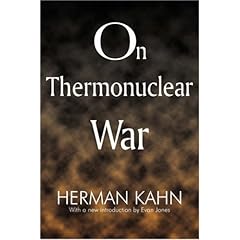
The Wrath of Kahn

Wednesday, May 13th, 2009


The post title is tongue in cheek. Herman Kahn was anything but wrathful and came across in his day as a remarkably cheerful strategist of the apocalypse and deep futurist. Long time readers have noted my admiration for Kahn’s metacognitive strategies but for those unfamiliar with Herman Kahn, he was one of those polymathic, individuals of the WWII generation who, like Freeman Dyson and Richard Feynman, could jump into high level nuclear physics research without bothering to first acquire a PhD in the field (Feynman later received a doctorate, Dyson and Kahn never did). Kahn was noted for his forthright willingness to consider humanity’s long term prospects despite the worst calamities imaginable – unlike most optimists, he assumed the events most terrible could happen – but life nevertheless would go on. A position that caused many of his critics to go ape, including the editors of Scientific American.

I bring this up because his daughter, Deborah Kahn Cunningham, emailed to say that Kahn’s classic On Thermonuclear War  had been reissued by Transaction Publishing and there would soon be a new edition of On Escalation the latter of which will have a new foreword by the eminent nuclear strategist Thomas Schelling.
This could not come at a better time. The Obama administration is making grandiose gestures with America’s nuclear deterrent based less on a hardheaded and comprehensive strategic analysis than self-serving political showmanship, tailored to mollify a Left-wing base deeply resentful of the COIN strategy the administration is starting to take in Afghanistan. Nuclear weapons affect the strategic calculus across the entire spectrum of potential decisions, they’re not just shiny, anachronistic, bargaining chips but the overwhelming reason that great power war came to an end in 1945. Period.

Human nature has not made much moral progress since the end of the Third Reich but its very worst instinct for total destruction has, so far, been held at bay by the certainty of self-destruction.

We need someone to remind us again of how to think about the unthinkable.

The First 100 Days and Threats in the Age of Obama

Thursday, April 30th, 2009

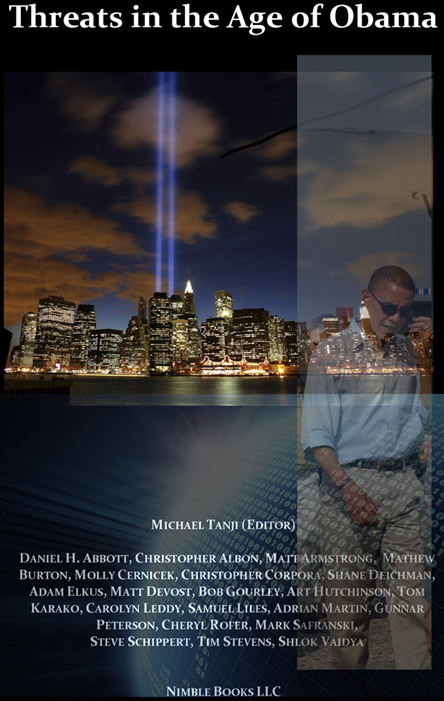
tttaob_cover_cropped.jpg 

Threats in the Age of Obama

Editor:

Michael Tanji.

Authors:

Dan tdaxp, Christopher Albon, Matt Armstrong, Matthew Burton, Molly Cernicek, Christopher Corpora, Shane Deichman, Adam Elkus, Matt Devost, Bob Gourley, Art Hutchinson, Tom Karako, Carolyn Leddy, Samuel Liles, Adrian Martin, Gunnar Peterson, Cheryl Rofer, Mark Safranski, Steve Schippert, Tim Stevens, and Shlok Vaidya

President Barack Obama has hit the 100 day mark which has become a traditional (if unfairly high) bar for measuring a new President of the United States during his “honeymoon” period, ever since the historic “first hundred days” of President Franklin Roosevelt, that ushered in the New Deal. At the time, the United States and the world was on the precipice of financial implosion and the Congress effectively permitted Roosevelt to rule by decree, ratifying his crisis management by passing 15 bills of such sweeping scope that the relationship of the Federal government to the states and the American people was changed forever.

The United States and the world is again in the grip of a great economic crisis, though not quite of the magnitude of the Great Depression, it can be said that only a few presidents in the last century – FDR, Truman, Nixon and Reagan – inherited a similar number of gravely serious problems from their predecessor as did Barack Obama. I was part of the collection of authors of Threats in the Age of Obama above who attempted to discern the major challenges the new administration would face. As a group, we spanned the political spectrum and fields of expertise, many having or had governmental, military or academic backgrounds or significant projects in the private sector and if something united us, it was the 21st century would require new approaches than did the Cold War.

The publisher of Nimble Books, W. F. Zimmerman  suggested that the authors take a moment today and asses what we each got right, what we got wrong and what has surprised us regarding Barack Obama’s first 100 days and where we think we are headed.

This request puts me in an odd position because having the last chapter in the book, I opted for a deep futurist perspective to try to cover the “first one hundred years” of Obama with an essay entitled “A Grand Strategy for a Networked Civilization“. Here is an excerpt:

….The difference between leaders today and those in the past – not only past centuries but as recently as the Cold War – is a certain loss of perspective as to longitudinal scale and societal fundamentals. American politicians think primarily in terms of the present, mentally cycling with the nightly news or   the upcoming elections, which gives more weight to superficial, tactical, objectives than they deserve, and waste time, resources and opportunities.  Not only has the political will to make long term, strategic investments in the national interest faded, it is questionable as to the degree to which they are even considered.  The current economic crisis requires action, naturally, but if the incoming Obama administration wishes to make their mark on history, they should give at least as much thought to 2100 as they do to 2010.

….Moral legitimacy of the state, the nature of the homeland it governs and the political economy that satisfies the needs of the people are the fundamentals of strategic calculation; the longer the time frame to be considered, the more that getting the fundamentals right matters.

It is premature for me, given the nature of my chapter, to make a hard and fast judgment yet about where I went right or wrong. I will say that the Obama administration does seem to be taking “moral legitimacy” seriously, as they understand it from their political perspective. Many of President Obama’s gestures in foreign policy, agree or disagree with them, have been designed to recalibrate the global opinion of America’s moral standing as a world leader without costing too much in terms of concessions or cash.

Changing Bush administration policy on Gitmo, “harsh interrogations” and “no negotiations” with adversarial states is an intentional signal that the Obama administration has a different diplomatic posture. On the other hand, the Obama administration has refused to formally sign onto infinitely expensive, utopian, schemes such as Gordon Brown’s “global new deal”. Unlike the Clinton White House in its early days, the administration has also cleverly avoided trying to hand its conservative opponents an outrageous “bright red line” issue like “Gays in the Military” or “Whitewater”, around which Republican activists could galvanize public support and media attention.

What surprised and pleased me is the degree to which the Obama administration has lined up their national security positions behind the leadership of Secretary of Defense Robert Gates, embracing the “military reform” and “COIN” factions as their own. Secretary of State Hillary Clinton is trying to step up the role of the State Department in shaping policy; this is a long term necessity but State isn’t up to the task without a major cultural and organizational overhaul. If Clinton does not invest the effort early, she will be a “road show Secretary” without the supporting cast to be a success. The NSC, by contrast, is being reorganized to maximize presidential control, perhaps to the point of going overboard with micromanagement, if the Somali pirate incident is a representative example. The only senior figure in the administration who seems both out of political step and out of her depth is the Secretary of Homeland Security, Janet Napolitano.

What worries me, naturally, is the political economy aspect and the profound centralization of power over the economy being ushered in by Obama,  that is accumulating in the hands of very few people as the response to the economic crisis. The inevitable ripple effect, if such a concentration of power were to become the new status quo, would be one of stasis and stagnation. A globalized economy is too complex an “ecosystem” for top-down, ad hoc, hierarchical management to be an efficient or adaptive response. A re-focus on the fundamentals of new growth and not just legacy dinosaurs is in order.

Early Announcement: Xenophon’s Anabasis Roundtable

Tuesday, April 28th, 2009

After his skilled moderation of The Clausewitz Roundtable, my friend Lexington Green has announced a new roundtable at Chicago Boyz for Fall of 2009 that will be dedicated to Xenophon’s  The Anabasis of Cyrus.

For those interested in participating in this roundtable, leave a note here in the comments for Lex or over at Chicago Boyz.

Chet Richards: Review of The Scientific Way of Warfare

Monday, April 20th, 2009

Dr. Chet Richards has a methodical review up at DNI on Antoine Bousquet’s new book The Scientific Way of Warfare: Order and Chaos on the Battlefields of Modernity:

The Scientific Way of Warfare

….Bousquet opens with and ultimately answers the question of “does network-centric warfare (NCW) work?” To reach his conclusion, he proposes four “regimes” in the application of science to modern warfare:

  1. Mechanism, whose “key technology” was the clock, whose scientific framework was Newtonian, and whose military format was what we’d call first generation warfare — line, column, conformance, regularity
  2. Thermodynamics, characterized by engines, whose framework included entropy, energy, and probability, and whose military paradigm was 2GW (Bousquet does not use the generations of war model)
  3. Cybernetics — computers — whose scientific concepts included “negentropy,” negative feedback, homeostasis and whose military model would be modern 2GW, with heavy top-down, real time command and control
  4. Chaoplexity, where networks reign, whose framework is built upon the new sciences of non-linearity, complexity, chaos, and self-organization, and where warfare is conducted by decentralized cells, teams, or swarms — what we would call both 3GW and 4GW (p. 30)

Subsequent chapters take the reader on a tour of these ideas in turn, exploring their evolution as scientific patterns and their influence on the warfare of their, and subsequent, eras. So the chapter on mechanistic warfare introduces Vauban, close-order drill, and culminates in Frederick the Great’s Clockwork Army. The next chapter, Thermodynamic Warfare, concludes with Clausewitz, which is a stretch, of course, since the great Prussian died in 1831, some 20 years before the first publications in that discipline. But with liberal interpretation of the massive text of On War, passages can be found that seem like precursors of the Second Law. Bousquet does point out that these interpretations were not made in Clausewitz’s day but were retrofitted by later analysts and generals, including as he also notes, John Boyd.

Read the rest here. Good stuff!


Switch to our mobile site

