zenpundit.com » authors

Archive for the ‘authors’ Category

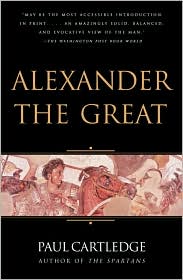
Book Review: Paul Cartledge’s Alexander the Great

Sunday, April 19th, 2009

” …he was one of the most extraordinary individuals to have ever walked the earth. He above all others deserves to be called, “the Great’.”

Alexander the Great by Paul Cartledge

Cambridge classicist Paul Cartledge has the rarest of talents among professional historians – the ability to write books that simultaneously appeal to academics and popular audiences alike. Alexander the Great has his trademark “concise depth” that Cartledge also brought to bear in The Spartans and later to Thermopylae: The Battle That Changed the World; there is enough historiographic “meat” for the scholar and the casual student of history or of war will enjoy Cartledge’s depiction of Alexander as a “ruthless pragmatist”, engaging in calculated gestures of epic magnaminity and brutal murder of his closest comrades in arms with equal certitude. One who, despite his mysticism and growing tyranny, had imperial ambitions that “….can symbolize peaceful, multi-ethnic coexistence”.

Cartledge, despite the above quotation, is not an Alexander-worshipper but a realist or a mild skeptic, rejecting hyperbole and hidden agendas in the ancient sources, which he discusses in detail, along with the more extreme portraits painted of Alexander by modern historians, such as “…the titantic and Fuhrer-like Alexander of Fritz Schachmeyer“. Cartledge’s Alexander is a military genius and an inspirational visionary to be sure, but his icy ruthlessness of calculated murder of potential opponents and superannuated followers like Callisthenes or Parmenion is never far away. Cartledge uses the term “purges” several times in the text and it is appropriate; Alexander, with his suspicions aroused, had the same irrevocable instinct for savage reprisal as did Joseph Stalin. Alexander running through Cleitus the Black with a spear in the midst of a banquet, a man who had saved Alexander’s life, or who ordered the destruction of Thebes was the same Alexander who honored the religions and customs of his conquered subjects and tried to build his Overlordship of Asia on a fusion of Pan-Hellenism and ancient Persia:
“Alexander’s importation and integration of oriental troops into the Macedonian army was a crucial and controversial issue. by the end of 328 he had units of Sogdian and bactrian cavalry, so presumably he was drawing also upon the excellent cavalry of western and central Iran. In 327 he recruited more than thirty thousand young Iranians. Since Greek was to be the lingua franca of the new Empire, replacing the use of the Achaemenids use of Aramaic, he arranged for them to be taught the Greek language as well as the demonstrably supeior Macedonian infantry tactics. when they arrived at Susa in 324, he hailed them as ‘ successors’ – to the Macedonian soldiers understandable consternation” [ 204 ]

Cartledge discusses Alexander’s generalship and his abilities as an adaptive military innovator, building on a his father Philip’s original military reforms or improvising when faced with unexpected difficulties at river crossing or in siege warfare. He misses though an opportunity to explain the dreadful effectiveness in Alexander’s hands of the Macedonian phalanx, a more heavily armed, lightly armored, mobile and deadly version of the original Greek Hoplite formation.  While Alexander and his cavalry garnered most of the glory, the ordinary Macedonian phalanx cut through Persian ranks like an implacable meat grinder, mowing down enormous numbers of the enemy and trodding their dead and dying bodies underfoot. Understandably though, this is a biography of Alexander and not a history of his wars but the real scale of the slaughter Alexander inflicted is given far less attention than the skill with which he inflicted it, or his political and religious policies that came in their wake.

Alexander’s religious sentiments and his mysticism, which spilled over in to his political vision for Asia and for himself as a semi-divine ruler are given much consideration by Cartledge, ranging from his at a distance dealings with subject state Athens, to his “contracting” a relationship with the Egyptian god Ammon, to his ideation with Achilles as a model for himself.  There appears to have been something of a feedback loop between Alexander’s military acheivments, which were truly superhuman, and his growing religious superstitions, both of which fed a kind of megalomania according to Cartledge, and led to Alexander’s unsuccessful demand that his Greek and Macedonian soldiers adopt proskynesis in the Persian style. A more or less blasphemous act of hubris ( though not quite absolutely, as Cartledge explains, given the precedent of the deification of Lysander) that led to a break between Alexander and his most loyal followers. This craving for divinity later was expanded posthumously to fabulous extremes in the traditions of the Alexander Romance, where Alexander the Great becomes a symbolic and heavily mythologized figure for dozens of peoples and regimes. Alexander himself began cultivating the myths.

Cartledge has done an excellent job demystifying one of the archetypal figures of Western history, the man whom other would-be world conquerors had to measure themselves against – reportedly, Julius Caesar wept in despair because Alexander’s glory was beyond his reach. He has also brought out the extent to which Alexander saw himself not as a Westerner, or a Hellene, but as a bridge to the East, a synthesizer of civilizations.

Excess Complexity is the Route to Extinction

Friday, April 10th, 2009


Nassim Nicholas Taleb, author of The Black Swan: The Impact of the Highly Improbable and Fooled by Randomness: The Hidden Role of Chance in Life and in the Markets, had an op-ed in FT.com entitled “Ten principles for a Black Swan-proof world” (Hat tip to John Robb and Pundita). Taleb was addressing the global economic crisis, but I was particularly drawn to Taleb’s fifth principle, which has a more general implication:

5. Counter-balance complexity with simplicity. Complexity from globalisation and highly networked economic life needs to be countered by simplicity in financial products. The complex economy is already a form of leverage: the leverage of efficiency. Such systems survive thanks to slack and redundancy; adding debt produces wild and dangerous gyrations and leaves no room for error. Capitalism cannot avoid fads and bubbles: equity bubbles (as in 2000) have proved to be mild; debt bubbles are vicious.

Taleb has encapsulated many important concepts very well here. Up to a certain point, increasing complexity represents a advantage for an evolving system (biological, financial, physical etc.) by increasing efficiency through adding specialization, interconnection, diversification, redundancy and checks for mitigation of risks. Complexity, in the earlier part of a development curve can add to a system’s overall resiliency – to a point.

Superfluous complexity, that which goes beyond the minimum required for additional gains in systemic efficiency or productivity, is a net drag on the system, an economic waste, a source of friction, a cancer,  a useless eater of resources and the earliest sign of the system’s inevitable decay. Worse, excess complexity represents an increasing probability of systemic failure by multiplying the number of variables involved in the normal process of the system. There are more things that can go wrong and more choke points where a catastrophic failure can occur. Increasing the degree of complexity moves the system away from simplicity and reliability and toward chaos and the creativity of emergent properties, but like an ice skater seeking ever greater range, go too far and the ice will crack under one’s feet.

This is an effect familiar to engineers and scientists but one that appears to escape the majority of politicians, corporate executives and economists. My co-blogger at Chicago Boyz, Shannon Love,  took GE to task for trying to get on the Federal dole by advocating needlessly complicating the nation’s power grid:

If Your Grid Had a Brain

GE is advertising to build political support for Obama’s plan to purchase billions of dollars of GE tech in order to make the power grid “smart”.  After all, who would want a “dumb” anything when they could have a “smart” something? 

The reason we should keep things dumb is that in engineering the word “dumb” has a different connotation. In engineering, “dumb” means simple and reliable. 

Increasing complexity in any networked system increases possible points of failure. Worse, the more interconnected the system, i.e., the more any single component affects any other randomly selected component in the system, the faster point-failures spread to the entire system. Power grids are massively interconnected. Every blackout starts with a seemingly trivial problem that, like a pebble failing on a mountain side, triggers an avalanche of failure. 

In the social and political domain, back in the 1990’s Philip K. Howard wrote a book called The Death of Common Sense: How Law is Suffocating America in which he detailed example after example of how the overlawyering of regulatory systems in America by an emerging and hyper-aggressive legal class was producing neither restraint on government abuses nor fine-tuned social outcomes but instead created a state of paralyzed rigidity, risk aversion, perverse incentives and general dysfunction; in other words, chaos instead of order.

The Obama-ites in the White House are not “socialists” ( at least not most of them) but there is a great love of liberal-minded technocracy there, and a seemingly boundless self-confidence in the ability of high-minded, upper-middle class, progressive, wonks and lawyers from the “good schools” (or investment houses – in some cases, both) to micromanage not just our lives for us, or even the United States of America but the global economy itself. Sort of a Superempowered Oligarchy of Good Feelings.

The ancient Greeks had a word for that: hubris. More importantly, the Obama-ites are wrong here – adding endless amounts of regulatory complexity is not going to give them the kind of granular control or positive returns that they seek to obtain from the system. Counterintuitively, they should be radically simplifying where and to the degree they safely can instead.

Building the Antilibrary

Wednesday, April 8th, 2009

Due to a combination of good fortune, review copies sent by publishers and exercising wide-ranging discretion over a budget account at work, I’ve added an eclectic mix of tomes to the ever rising Antilibrary book pile.  Some of these are recommendations from readers left in my comment section last January ( working on improving my traditionally lame following -up skills)

   Alexander II The Last Great Tsar by Edvard Radzinsky

    Engaging the Muslim World  by Juan Cole

    The Osama bin Laden I Know: An Oral History of al Qaeda’s Leader by Peter Bergen

      The Open Society and Its Enemies, Vol. 1: The Spell of Plato

                          and  The Open Society and Its Enemies, Vol. 2: Hegel and Marx by Karl Popper

      Emergence: The Connected Lives of Ants, Brains, Cities, and Software

and   Mind Wide Open: Your Brain and the Neuroscience of Everyday Life by Steven Johnson

            How the Mind Works by Steven Pinker

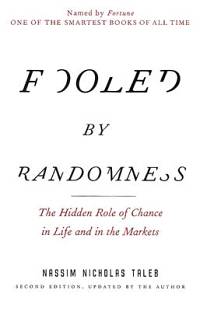
    Fooled by Randomness: The Hidden Role of Chance in Life and in the Markets 

                                 by Nassim Nicholas Taleb

  Real Education: Four Simple Truths for Bringing America’s Schools Back to Reality  

                                by Charles Murray

   Outliers: The Story of Success by Malcolm Gladwell

  Here Comes Everybody: The Power of Organizing Without Organizations 

                                by Clay Shirky

   The Hyperlinked Society: Questioning Connections in the Digital Age 

                                  by Joseph Turow & Lokman Tsui

  Islands in the Clickstream: Reflections on Life in a Virtual World 

                                   by Richard Thieme

Engaging the Muslim World is not long for the Antilibrary, as I have already begun reading it and will review it here soon. Some of these books can be read relatively quickly, a day or two but others, like The two volume The Open Society, I expect will require a greater investment of time and thought. It pays rich dividends though.

Note, Richard Thieme, despite his past as a scholar-clergyman of the Episcopalian Church, is not t be confused with the historicist, fundamentalist, theologian, Colonel R.B. Thieme.

UPDATED!:

Ha! A good one arrived today, courtesy of Columbia University Press:

   The Scientific Way of Warfare: Order and Chaos on the Battlefields of Modernity

                                        by Antoine Bousquet

WIRED for WAR the TED Talk

Sunday, April 5th, 2009

P.W. Singer at TED

Remember to check out the Wired for War Symposium at CTLab Review!

Also check out How to Maintain America’s Strategic Advantage co-authored by my twitteramigo Zach Tumin of Harvard’s Leadership for a Network World (LNW) Program at the John F. Kennedy School of Government.

Book review: With Great Powers comes Great Responsibilities….

Wednesday, March 11th, 2009

Great Powers: America and the World After Bush by Thomas P.M. Barnett

Great Powers: America and the World After Bush is a book whose influence will be deep and long. It is also a book that will be loved and reviled. Loved because in it, Barnett connects history with strategy and foreign policy and does so with unvarnished, supremely confident, optimism regarding a future of an americanized Globalization and a globalized America. It will also be bitterly reviled for exactly same reason.

In essence, Great Powers is an intellectual-political rorschach test.

This will not be a traditional book review. By way of disclaimer, I was one of the people who read the earliest draft version of Great Powers as Tom Barnett was writing it ( at times Tom was writing faster than any of us could keep up reading it!) and offered comments and advice. I have seen various iterations of different parts of Great Powers as it was shaped by Dr. Barnett, Mark Warren and Neil Nyren and discussed the book during this time with others in Tom’s circle who were also readers. As a result I cannot possibly be considered an objective or impartial reviewer but what I am, however, is a well informed one.

What I will offer instead of a traditional review is my thoughts on why Great Powers should be read whether you admire Thomas Barnett’s philosophy or not.

First, Great Powers represents the first attempt to critically distill the meaning and the context of the historical mark of the George W. Bush presidency in a way that is not beholden to the needs of domestic partisans, Right or Left. As a result, some of these people will go absolutely ape in Chapter One and will be riding their hobby horse to the uptopian horizon of choice and never really read anything else in the book except through heavily rose colored glasses.  For everyone else, Barnett’s handling of Bush-Cheney is a needed step back from presentism and into analysis of causes and effects, risks and opportunities, which make up the global legacy of President Bush.

Secondly, Barnett is enunciating a theory of historical evolution heavily influenced by economic determinism but not only economic determinism. Very few reviewers have picked up on this element ( John Robb was a notable exception) but Tom has revived and synthesized the “Frontier Thesis” of Frederick Jackson Turner into postmodern, 21st century,  transnational terms. “The frontier” is not just an economic margin but a verge for deep but decisive conflicts of personal identity and cultural renewal. Frontiers are dynamic and psychological, not fixed entities and the momentum is usually running toward civilizational expansion or collapse. We can find the frontier at home in “feral” neighborhoods mere miles from our houses or thousands of miles distant in far off Pushtunistan and the Fergana valley. There is no maginot line we can build, no place to “bring the boys home” to when the frontier exists as much in cyberspace as on the ground.

Thirdly, Barnett articultes the strategic macro-choices (“Realignment”) that we face in the first decades of the 21st century based on the framework that our past choices have created. This last part of the book is where he generates enormous amounts of friction with more traditional policy wonk experts by de-compartmentalizing their pet issues into the agonizingly interrelated gordian knot that they represent in reality while re-buffing the idea that they add up to a collection of worst-case scenarios fusing into a mega-apocalypse. The integrated perspective pushed by Barnett also denies the likelihood of securing neat little zero-sum policy “wins” just for America (or Russia, or China or the EU). Tom gets bashed for simplifying in his briefs but briefs are not books and the problem his critics have is not his simplicity but the complexity that Barnett chooses to put on the table for debate.

That approach makes a lot of people whose education and experience is in selling or consuming the inch-wide, mile-long, tunnel -vision perspectives very uncomfortable. It is a repudiation not of their policies but of their whole mode of thinking about policy.

That brings me to why I think Great Powers should be read. An old mentor of mine used to warn his grad students of books that made them feel good by confirming their prejudices and dulling their thinking with smug superiority. Good books cause you to scrawl furiously in the margin. Despite the fact that I am in sync with many of Tom Barnett’s strategic ideas, there are parts of Great Powers that caused me to grit my teeth (case in point, his entertaining the faddish, Left-Fem polemicist, Susan Faludi as a serious thinker) or take a second look at my previously held opinions. This is what good books do and great books are the ones that do so for many people and thereby become potential game-changers.

Great Powers is one of those books.


Switch to our mobile site