zenpundit.com » iraq

Archive for the ‘iraq’ Category

Reflecting on Neo-COIN and the Global Insurgency, Part I.

Saturday, February 27th, 2010

Read a very interesting theoretical paper critiquing the merits of “Neo-Classical COIN” contrasted with the concept of “Global Insurgency” by Dr. David Martin Jones and Dr. M.L.R. Smith in The Journal of Strategic Studies, which drew a sharp rebuttal from Dr.John Nagl, the president of CNAS, and Brian M. Burton in defense of a universally applicable COIN paradigm (big hat tip to Steve Pampinella). 

The papers deserve much wider circulation and I encourage you to find yourself a copy. Unfortunately, they are behind an irritating subscription wall, so we have to do this in 20th century, stone-age, fashion….

David Martin Jones* and M.L.R. Smith**. “Whose Hearts and Whose Minds? The Curious Case of Global Counter-Insurgency”. The Journal of Strategic Studies. Vol. 33, No. 1, 81-121, February 2010.

*University of Queensland, Australia. ** King’s College London, UK.

John A. Nagl and Brian M. Burton. “Thinking Globally and Acting Locally: Counterinsurgency Lessons from Modern Wars – A Reply to Jones and Smith.  The Journal of Strategic Studies. Vol. 33, No. 1, 123-138, February 2010.

Center for New American Security (CNAS), Washington, DC, USA.

Jones and Smith are dissecting “the extraordinary renaissance of counter-insurgency thinking within the U.S. military establishment” which they argue has “produced two distinctive schools of thought about counter-insurgency”; the “neo-classical” which constructs a framework for waging COIN from the historical understanding of Maoist guerrilla warfare, and “global counterinsurgency” which is “post-maoist”, conceptual and networked rather than territorial and hierarchical and centered in the ideological turmoil or radical salafist-jihadi Islamism. Together, the two schools comprise “neo-COIN” which yields an “incoherent” and “confused and contradictory understanding” of insurgency which is rooted in a hostility and miscomprehension of Clausewitzian thought.

The breezy summary above was, by the way, a gross simplification of a forty page, heavily footnoted, academic argument, which really needs to be read in its entirety.

Jones and Smith go into considerable depth investigating the intellectual orgins of “neo-COIN” and the leading personalities who shaped the doctrine, including Nagl, Sewall, McFate, Kilcullen, Hoffman and commanding generals like Petraeus and Chiarelli.

Of the two schools, the authors find greater flaws on the neo-classical approach to COIN:

….Ultimately though, excessive deference to Maoist theories of guerrilla warfare led neo-classicism into a strategic, Iraq-centric, cul-de-sac….

….Such crude reductionism, ultimately leads to a cdrude Maoist/Counter-Maoist paradigm that assumes holding on to physical territory, no matter the cost, is the ultimate goal of any combatant. This neo-classical reductionism not only implies that any withdrawal of forces from an occupied territory represents a defeat, it also risks inducing the kind of certainties that influenced the French approach to COIN during the Algerian War with manifestly disastrous consequences

But the global insurgency school, while more accurately conceptualizing the transnational nature of the enemy in the view of Smith and Jones, is not without problems either:

However, when it comews to identifying the drivers of jihadism, global COIN theorists are surprisingly coy. Significantly, global neo-COIN writing goes to great lengths to dismiss the religious and ideological motivation for Islamist activism. Instead, it focuses upon organizational characteristics, social networks, psychological profiling, and patterns of recruitment to understand the new global threat….Like the notion of a War on Terrorism, global counter-insurgency denotes an amorphous threat, conceals hidden assumptions and obfuscates the object of the war, namely militant, ideologized Islam or Islamism.

This “negation of ideological motivation” identified by Jones and Smith in global counter-insurgency, is blamed on two sources. First, Dr. David Kilcullen, the deeply influential Australian Army officer and anthropologist who has been the COIN adviser to the Departments of State and Defense and CENTCOM, who argues for the primacy of “sociological characteristics” as drivers to jihadism; secondly, on a fear of the implications of Clausewitzian theory that causes neo-COIN advocates to purposefully “misunderstand” On War:

From a political perspective, however such neo-COIN misunderstanding is not so strange at all. McFate evidently recognizes Clausewitz’s central premise that  ‘War is a continuation of political intercourse, carried on by other means’. It is this recognition though, that unsettles COIN theorists. The reluctance to attribute religious motives to jihadist action, the emphasis on post-Maoism and the dismissal of Clausewitz, all evince a profound neo-COIN discomfort with the political dimension of war. It is the politics of modern jihadi resistance that contemporary counter-insurgency theorists wish to avoid: for politics denotes complexity, particularity, ambiguity, controversy and the need to challenge or defend specific value systems.

COMMENTARY:

Smith and Jones have identified some real weaknesses in COIN theory, a useful service. However, either they commit the same error in diagnosing the inability of COIN theorists to wrestle frankly with Islamism as they accuse Kilcullen, Nagl, McFate etc. of having made and do so for the same reason, or they evince a childish understanding of politics. I lean toward the former.

The ignorance of irhabi-salafist radical religious ideas and internal debates is a very serious analytical problem for the United States. Few scholars or analysts can boast of simultaneously having fluency in critical langues, a deep understanding of Islamist theology and expertise/experience in terrorism/counter-terrorism studies. And really, to make astute judgments, you need to have a grasp on all three. Avoiding the religious ideology dimension is a serious error on the part of COIN thinkers and Smith and Jones are right to call them out on it.  It would be very helpful, if COIN theorists in crafting doctrine, would avail themselves of the deep understanding of Islamism offered by a Gilles Kepel or an Olivier Roy.

That said, the religious ferment of Islamism applies more to the “professional” and not the “accidental” guerrilla. To the recruiter, ideologists, operational planner and other senior leaders of al Qaida and the Taliban and far less to the rootless cannon fodder, idle adventurers, middle-class losers, itinerant tribals and other flotsam and jetsam who compose the foot soldiers of modern jihad. Applying social network analysis or organizational theory adds a useful perspective to understanding to the mass-movement characteristics of violent Islamist groups.

That is not why Kilcullen or Nagl de-emphasize religious motivations though. It is not that COIN gurus at CNAS do not understand or are uncomfortable with political dimensions or are mystified about Islam and Islamism. That’s an absurd assessment. To the contrary, they understand politics exceptionally well. COIN advocates downplay the religious motivations of Islamist terrorists and insurgents because emphasizing them will cost COIN strategy the political support of many liberal-left Democrats in Congress whose PC ideology cannot tolerate such arguments to be heard, the facts be damned. To make such an analysis, before a group that is not overly supportive of the war to begin with, is to be tagged an “Islamophobe” or a “racist” (even though the latter insult makes no sense whatsoever).

For the same reason, academia having its own PC fetishes to an even greater degree than politicians, Smith and Jones do not specifically identify the domestic political incentives COIN advocates have for ignoring religious ideology.
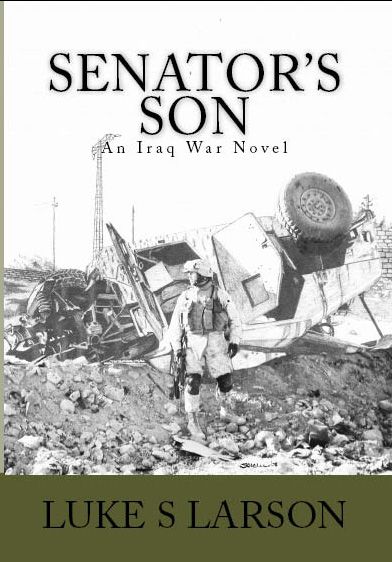
Senator’s Son

Wednesday, February 17th, 2010

larson.jpg

Senator’s Son: An Iraq War Novel  by Luke S. Larson

Just received a review copy of new author Luke Larson’s novel Senator’s Son. I can probably count on the fingers of one hand the number of works of fiction that I have reviewed at ZP, but two things caught my attention about Senator’s Son:

First, the novel is historical realism with a theme of COIN. Secondly, the author Luke Larson is a decorated Marine officer with two tours in Iraq under his belt. Flipping the pages reveals a gritty, sometimes humorous, staccato writing style and military/strategy/policy issues that are discussed here, or at SWJ or Abu Muqawama come to life through the eyes of still learning practitioners. I’m looking forward to reading Senator’s Son and reviewing it in full in late February or early March ( need to finish Carr’s Inside Cyber Warfare first).

Setting aside the book itself, something else occurred to me – that we have reached the point where the war is now appearing not as news, but as literature; Iraq and Afghanistan are proving to be culturally transformative wars for America in ways that the Gulf War or the Korean War were not.

If you consider WWI, the Great War represented an existential crisis for Western Civilization that found expression in the Lost Generation and, in Germany, the polar opposite novels All Quiet on the Western Front and Storm of Steel as well as Hemingway’s A Farewell to ArmsThe Spanish Civil War electrified international opinion, foreshadowing as it did the ideological death-match of the 20th century, and yielded Orwell’s Homage to Catalonia. WWII and the Vietnam War have generated an ocean of histories down to the minutest detail, as well as their share of novels, short stories and movies. It is noteworthy, that most of the time, literature and history followed the conclusion of peace, be it in victory or defeat.

In our time, the books on the war in Iraq, or Afghanistan or against terrorism are arriving while the conflict is still in full throttle, in time to shape the perceptions of policymakers and the public to an unprecedented extent. Something is happening out there, an inchoate need for answers or reassurance that writers are attempting to answer. Most of these books so far have been non-fiction, journalistic instant histories salted with examples of policy analysis and war memoirs.

Senator’s Son marks a new turn toward a wave of fiction addressing the crucible of America’s current wars. Literature can shape a nation’s psyche more profoundly than even the most soberly researched work of history.

Tools vs. Strategies: Or, Why “An” Alternative to COIN is Not “THE” Alternative

Friday, February 12th, 2010

Dr. Bernard I. Finel has an important and provocative article in AFJ challenging the current operational primacy of COIN in Afghanistan and Iraq that has stirred a great deal of backchannel and listserv discussion, but not nearly enough open commentary in the blogosphere. I checked an unscientific sampling of COIN blogs and did not find much discussion of Dr. Finel’s article, except one comment at SWJ Blog by respected SWC member Ken White, who called it  a “well stated and logical essay” with a “valid premise”. Finel’s article merits greater attention and debate:

An alternative to COIN

The U.S. military is a dominant fighting force, capable of rapid global power projection and able to defeat state adversaries quickly and at relatively low cost in American lives and treasure. Unfortunately, American leaders are increasingly trying to transform this force into one optimized for counterinsurgency missions and long-term military occupations. A fundamental problem with the adoption of population-centric counterinsurgency (COIN) doctrine as an organizing principle for American military operations is that it systematically fails to take advantage of the real strengths of the U.S. military.

It is true that not all political goals are achievable through the use of conventional military capabilities. However, “victory” in war is not dichotomous, and the cases of Iraq and Afghanistan – often seen as proving the necessity for COIN-capable forces as well as a commitment to nation-building – demonstrate in reality that the vast majority of goals can be accomplished through quick, decisive military operations. Not all political goals are achievable this way, but most are and those that cannot be achieved through conventional operations likely cannot be achieved by the application of even the most sophisticated counterinsurgency doctrine either.

As a consequence, I believe the U.S. should adopt a national military strategy that heavily leverages the core capability to break states and target and destroy fixed assets, iteratively if necessary. Such a strategy – which might loosely be termed “repetitive raiding” – could defeat and disrupt most potential threats the U.S. faces. While America’s adversaries may prefer to engage the U.S. using asymmetric strategies, there is no reason that the U.S. should agree to fight on these terms.

This essay argues the U.S. can largely defeat threats using conventional capabilities, and that what encourages a desire to engage in long-drawn-out asymmetric conflicts is not the elimination of threats, but rather the unattainable goal of trying to prevent threats from emerging in the future.

Read the rest here.

First, I have some sympathy with Finel’s position that COIN operations generally do not maximize the utility of America’s military comparative advantages and extended nation-building via COIN is a costly investment. Dr. Finel is correct here. I’m certain even David Kilcullen would agree with Finel that America trying to do heavy footprint, pop-centric COIN everywhere and anywhere is unwise and too expensive. We need to sync our military might with our political will as well as our wallet.

Secondly, I have no problem with punitive expeditions, or what Finel euphemistically calls “repetitive raiding”. Such “Perdicaris Alive or Raisuli Dead!” tinged operations are as old as warfare itself and a state’s demonstrated willingness to carry them out serves a useful deterrent purpose. William Lind has been advocating a combination of punitive expeditions and containment/isolation for years in his writings on 4GW. This is an option we should definitely consider first in a cost-benefit fashion prior to committing sizable deployments of troops to a long-term nation building adventure.

That said, exchanging one operatiuonal emphasis (COIN) for another (punitive expeditions) does not change our strategic situation much, it just represents a different kind of hammer, a mallet instead of a ball peen. Under Finel’s prospective doctrine, the US military will be greenlighted to fight only the wars it likes best because some foes are more targetable than others, resembling a drunkard looking for his car keys under a street lamp because that is where the light is good. If we can just convince all of our enemies to oblige us by becoming states with flags, armies and capitols, then I’d say junk COIN.

Unfortunately, they won’t and the days when only states can cause damage are long past. A well-trained, paramilitary, insurgency can wreck one hell of a lot of damage, especially when it is striking first with the element of surprise. This is why, even in the state-centric days of the Cold War, that the Soviet Union invested heavily in SPETSNAZ, OSNAZ and various GRU sleeper units to wreck havoc behind NATO lines with terrorism, assassination and sabotage in the run up to WWIII. The Soviets expected at least major tactical, if not strategic, results from such units.

Operational tools are not strategies. This was my prior complaint about COIN being oversold in Afghanistan and punitive expeditions likewise do not fit every geopolitical situation and work best with particular circumstances. The fact is, where we have a real national interest in friendly states with legitimate governments beating back insurgents, COIN is a better choice. Many problems will require a response that is altogether different from either. The enemy, when there is an enemy, has to be dealt with as they are and not as we’d really like them to be in our ten year procurement schedule. We have to select the tools that best fit operational conditions, our policy objectives and our resources.

Strategy must conform to reality and not the reverse.

The Post-COIN Era is Here

Monday, January 25th, 2010

Learning to Eat Soup with a Spoon Again……

There has been, for years, an ongoing debate in the defense and national security community over the proper place of COIN doctrine in the repertoire of the United States military and in our national strategy. While a sizable number of serious scholars, strategists, journalists and officers have been deeply involved, the bitter discussion characterized as “COINdinista vs. Big War crowd” debate  is epitomized by the exchanges between two antagonists, both lieutenant colonels with PhD’s, John Nagl, a leading figure behind the U.S. Army/Marine Corps Counterinsurgency Field Manual and now president of the powerhouse think tank CNAS , and Gian Gentile, professor of history at West Point and COIN’s most infamous arch-critic.

In terms of policy and influence, the COINdinistas ultimately carried the day. COIN advocates moved from a marginalized mafia of military intellectuals who in 2004 were just trying to get a hearing from an  indifferent Rumsfeld Pentagon, to policy conquerors as the public’s perceptions of the “Surge” in Iraq (masterminded by General David Petraeus, Dr. Frederick Kagan, General Jack Keane and a small number of collaborators) allowed the evolution of a COIN-centric, operationally oriented, “Kilcullen Doctrine” to emerge across two very different administrations.

Critics like Colonel Gentile and Andrew Bacevich began to warn, along with dovish liberal pundits – and with some exaggeration – that COIN theory was acheiving a “cult” status that was usurping the time, money, talent and attention that the military should be devoting to traditional near peer rival threats. And furthermore, ominously, COIN fixation was threatening to cause the U.S. political class (especially Democrats) to be inclined to embark upon a host of half-baked, interventionist “crusades“in Third world quagmires.

Informed readers who follow defense community issues knew that many COIN expert-advocates such as Nagl, Col. David Kilcullen, Andrew Exum and others had painstakingly framed the future application of COIN by the United States in both minimalist and “population-centric” terms, averse to all but the most restrictive uses of “hard” counterterrorism tactics like the use of predator drones for the “targeted assassinations” of al Qaida figures hiding in Pakistan.

Unfortunately for the COINdinistas, as George Kennan discovered to his dismay, to father a doctrine does not mean that you can control how others interpret and make use of it. As the new Obama administration and its new commander in Afghanistan, General Stanley McChrystal conducted its internally contentious review of “AfPak” policy in 2009 on what seemed a geological time scale, the administration’s most restless foreign policy bigwig, the Talleyrand of Dayton, proposed using COIN as nation-building on steroids to re-create Hamid Karzai’s Afghanistan as the secure, centralized, state that it has never been.  Public reaction to this trial balloon was poor and the administration ultimately pared down General McChrystal’s troop request to 30,000 men, hedging a COIN based strategy toward policy suggestions made by Vice-President Biden.

So, COIN still reigns supreme, albeit with trimmed sails?

No.

We are forgetting something important about the ascendancy of COIN. It was not accepted by a reluctant Pentagon and the Bush administration because COIN is a very effective operational tool in the right strategic context – although that is certainly true. Nor was it because the advocates of COIN were brilliant policy architects and advocates – though most of them are. COIN became the order of the day for three reasons:

1) The  “Big Army, fire the artillery, fly B-52’s and Search & Destroy=counterinsurgency” approach proved to be tactically and strategically bankrupt in Iraq. It failed in Mesopotamia as it failed in the Mekong Delta under Westmoreland – except worse and faster. Period.

2) The loudest other alternative to COIN at the time, the antiwar demand, mostly from Leftwing extremists, of immediately bugging-out of Iraq, damn the consequences, was not politically palatable even for moderately liberal Democrats, to say nothing of Republicans.

3) The 2006 election results were a political earthquake that forced the Bush administration to change policy in Iraq for its’ own sheer political survival. COIN was accepted only because it represented a life preserver for the Bush administration.

We have just had another such political earthquake. The administration is now but one more electoral debacle away from having the president be chased in Benny Hill fashion all over the White House lawn by enraged Democratic officeholders scared out of their wits of losing their seats next November.

Republican Scott Brown, the winner in a stunning upset in Massachusett’s special election for Senator, certainly had no intention of undermining President Obama’s commitment to Afghanistan. To the contrary, he is for it in a far more muscular manner than was his hapless Democratic opponent. But that’s irrelevant. What matters is that in all the recent elections, Democrats have been clobbered by a “Revolt of the Moderates” – socially liberal, fiscally conservative, independent voters who came out in 2008 for Obama and are now shifting radically away from him. For the next year, politicians of both parties will be  competing hard for this bloc which means “deficit hawks” will soar higher than defense hawks.

America’s nine year drunken sailor spending spree is officially over.

Defense experts have long known that the post-9/11, record DoD budget expenditures were not going to be politically sustainable forever and that either a drawdown of combat operations or cancellation of very big, very complicated and supremely expensive weapons platforms or some combination of both would eventually be needed. That eventuality is here and will increase in intensity over the next five years, barring an unexpected economic boom. Spending $60 billion annually on Afghanistan, a nation with a GDP of roughly $ 20 billion, for the next 7 years, is not going to be in the cards. Not at a time of 10 % unemployment, when the Congress will be forced to cut Medicare, education, veteran’s benefits, eliminate COLA’s on Social Security or raise the retirement age and income taxes. Who is going to want to “own” an ambitious “nation-building” program at election time?

There is a silver lining here. Really.

COIN is an excellent operational tool, brought back by John Nagl & co. from the dark oblivion that Big Army partisans consigned it to cover up their own strategic failures in Vietnam. As good as COIN is though, it is not something akin to magic with which to work policy miracles or to substitute for America not having a cohesive and realistic grand strategy. Remaking Afghanistan into France or Japan on the Hindu Kush is beyond the scope of what COIN can accomplish. Or any policy. Or any president. Never mind Obama, Superman, Winston Churchill and Abe Lincoln rolled into one could not make that happen.

Association with grandiosely maximalist goals would only serve to politically discredit COIN when the benchmarks to paradise ultimately proved unreachable. Austerity will scale them back to the bounds of reality and perhaps a more modest, decentralized, emphasis. COIN will then become a normal component of military capabilities and training instead of alternating between pariah and rock star status inside the DoD.

Austerity may also force – finally – the USG to get serious about thinking in terms of comprehensive and coherent DIME-integrated national strategy (Ok – this is more of a hope on my part). Instead of having every agency and service going off in its own direction with strategic nuclear arms reductions being proposed out of context from our conventional military obligations and urgent security threats we might stop and look at how the two fit together. And how these should be in sync with our fiscal and monetary policies and our need to deeply invest in and improve our unsteady economic position in a very competitive, globalized world. The latter is of much greater strategic importance to national security than Afghanistan or whether or not Israel and Hezbollah fight another mini-war.

We are all COINdinistas now. Instead of being controversial, COIN having a secure place in our operational arsenal of ideas has become the new “conventional” wisdom; it is past time to look at some of the other serious challenges America has ahead.

ADDENDUM I:

First, I wanted to thank everyone for their lively responses, both comments as well as email. The critiques are very helpful, as are the large number of PDFs and links to related material. I am trying to catch up on my replies but first, I wanted to feature a link to Andrew Exum ‘s related but inside baseball article up at Boston Review:

The Conflict in Central Asia will likely mark the end of the current era of Counterinsurgency 

 ….Whether or not the United States and its allies are successful in Afghanistan, the conflict in Central Asia will likely mark the end of the Third Counterinsurgency Era. Counterinsurgency warfare has its roots in the colonial experiences of France and the United Kingdom as well as the pseudo-colonial experiences of the United States in the Philippines and Latin America. In the First Counterinsurgency Era, nineteenth-century French colonial military commanders such as Hubert Lyautey, Thomas-Robert Bugeaud, and Joseph Gallieni devised rudimentary “hearts and minds” campaigns that were—though often just as brutal as the conventional warfare of the time—at odds with then-contemporary thought on the employment of military force. 

….Michael Semple —with two decades experience working in Afghanistan and Pakistan—believes that it is, and that the Taliban and its allies cannot win. The balance of power, he argues, has shifted toward the Taliban’s natural enemies, and the Taliban hides this reality by dressing their civil war in the clothes of an insurgency being fought against Western powers. If this assessment is right, there may yet be hope for U.S. and allied efforts in Afghanistan. Because President Obama has pledged to begin a withdrawal from Afghanistan in eighteen months, time may be too short to execute a comprehensive counterinsurgency campaign. But there may be sufficient time to build up key Afghan institutions and allow Afghans to fight a civil war that will no doubt continue after the United States and its allies begin to withdraw.

ADDENDUM II – LINKS To This Post:

Most of these bloggers have extended the discussion into new dimensions or aspects. I will put a short, explanatory tag next to each where warranted.

RBO (Pundita)The cavalry has arrived: Mark Safranski takes on COIN; Pundita takes on Pakistan  Extensive examination of Pakistan

In Harmonium (Dr. Marc Tyrell)Is the post-COIN era here?  The conceptual-perceptual-cognitive implications of this debate

Shlok VaidyaZen is right  Constraints and innovation….and a great post title!

Newshoggers (Dave Anderson)COIN’s coins; political constraints on COIN  COIN = Clausewitzian disconnect

Wings Over IraqLink of the morning is here…  And the bonus Nagl/Gentile mash-up graphic!

SWJ BlogThe Post-COIN Era is Here  Comments on link excerpt have begun……

Tom Ricks at Pritzker Military Library

Monday, August 10th, 2009


Out of sheer laziness and a nod to public service, I will re-post this notice from Lexington Green in its entirety:

Early Notice: Thomas E. Ricks at the Pritzker Military Library on September 10, 2009.

Thomas E. Ricks will be in Chicago at the Pritzker Military Library to discuss this most recent book The Gamble: General David Petraeus and the American Military Adventure in Iraq, 2006-2008. The event will be free and open to the public.

Ricks is the author of the widely-acclaimed book Fiasco: The American Military Adventure in Iraq, e.g. this review.

Ricks is a senior fellow at the Center for a New American Security.

Ricks has a blog, The Best Defense.

I hope to read The Gamble before the date, and I plan to attend the event.

I hope the weather is better than the downpour on the night that David Kilcullen spoke at the PML.

Barring any unforseen, work-related, commitments, I will be attending this event and will blog about it. Perhaps some live twittering as well.


Switch to our mobile site