zenpundit.com » analytic

Archive for the ‘analytic’ Category

Lieven on Pakistan

Wednesday, June 15th, 2011

Noted foreign policy commentator and academic Anatol Lieven has a new book on Pakistan, and holds forth at length here on the always excellent Conversations With History.

For my part, diplomatic relations with Pakistan amount to our stage managing their elite’s LIC war against us, Afghanistan and India at what our elite perceive as a tolerable level of affront , deceit and violence. And we are doing it as expensively as possible.

The Said Symphony: Introduction

Wednesday, June 15th, 2011

[ by Charles Cameron – extended analytic game on Israeli-Palestinian conflict ]

.

I have begun work on a major personal project, the Said Symphony, and I’ll be posting the work as it proceeds, privately in the Alumni forum of Howard Rheingold‘s online classes, and in public here on Zenpundit.

Here’s the deal.

The idea of the Said Symphony Game:

Edward Said, the Palestinian “public intellectual” was also an accomplished musician, and the music critic of The Nation for quite a while. One time he brought his musical and Palestinian interests together in a stunning suggestion:

When you think about it, when you think about Jew and Palestinian not separately, but as part of a symphony, there is something magnificently imposing about it…

I intend to explore that idea, in an attempt to “see” the Israeli-Palestinian question with fresh eyes, to hear it in some of the many voices – from sound-bites to scriptures – embodied in that conflict, some of the many individuals whose dreams and lives and olive trees are rooted in that sacred ground… and to present it in a way that is at once analysis and synthesis, history and work of art.

The complexity of the situation:

Let’s make this personal. Here’s a poem that expresses the way I’m thinking here:

I am Charles

My concern is the human mind in service
to an open heart, and my problem
is that the heart picks issues rich in ambiguity
and multiplicity of voices, tensions
and torsions tugging not one way but
in many directions, even dimensions, as does
a spider’s web weighed down with dew –
to clarify which a mind’s abacus is required

equal in subtlety to subtlety itself, while
in all our thinking and talking, one
effect follows one cause from question
to conclusion down one sentence or white
paper — whereas in counterpoint,
Bach’s fugal voices contain their dissonance.

Okay?

Take a look at this spider’s web, for example:

spider_web.jpg

Spiders and dewdrops do a pretty convincing job of portraying a certain level of complexity in what I think of as (virtually, metaphorically) a node-and-edge diagram of the global situation.

Mapping ideas and places:

Now, to apply that style of thinking to a serious world problem… the Palestinian-Israeli or Israeli-Palestinian conflict…

When, say, Hamas and Fatah signed their National Reconciliation Agreement on May 4, 2011, or Netanyahu won 29 standing ovations during his May 24 speech before a joint session of the US Congress, it’s like a few new drops of rain falling on that spider’s web — the droplets fall this way and that, carom into one another, the fine threads they’re on snap or stretch and swing down and around… until a new equilibrium is reached…

But try thinking the issues through before breakfast one morning if you’re the US Secretary of Defense — with the fresh winds of the Arab Spring promising a new Egypt, Iran announcing its intention to test a nuclear weapon shortly, and al-Qaida and associates training and recruiting in the background…

PakistanChina

And your problem isn’t a two-dimensional spider’s web with gravity pulling in just one direction – it’s more like an n-dimensional spider’s web, with multiple gravities, tugs, and tensions – and some of those tensions are in the category of known unknowns that one of your predecessors talked about, some of them unknown unknowns, and some of them literally unknowable – hidden in the hearts of more devious men than you, and known only to God.

That’s the complexity of the thing: to map the spaces where salaam might meet shalom.

That’s also the node-and-edge nature of the graphical approach I shall use.

Coming up shortly:

In my next post, I’ll explain the HipBone gameplay – the way in which moves are made on the board, and what their juxtapositions mean — and introduce the board.

PRISM: Col. Bob Killebrew on Criminal Insurgency

Tuesday, June 14th, 2011

Criminal Insurgency” is becoming a preferred term of art to describe entities like the Narco-cartels of Mexico that have evolved from transnational criminal organizations into groups with paramilitary and intelligence capabilities or Colombia’s FARC which formerly was a model Marxist insurgency but devolved downward into a drug trafficking army. The term is used partly to placate doctrinaire purists among defense intellectuals who see insurgency definitively as armed political movements following Mao’s three stages or bust. After all, they have only had since the late 80’s and early 90’s, when Bill Lind and Martin van Creveld warned them this was coming, to get used to the idea.

Colonel Robert Killebrew, a smart fellow at CNAS, has an article in NDU‘s PRISM that puts the problem of criminal insurgency into a hemispheric context:

Criminal Insurgency in the Americas and Beyond

….Essentially, the United States faces external and internal challenges in reorienting to more effectively fight the cartels and their allies. Refocusing U.S. policy from a “war on drugs” to a more comprehensive fight against the cartels and gangs is essential if the United States and its allies are to prevail. Since the basis of the cartels’ survival lies in the control of regions where governmental control is nonexistent and populations may be impoverished and alienated, successful counter-cartel strategies are fundamentally counterinsurgency strategies developed by the concerned states themselves and supported by the United States. Counter-cartel strategies must first be political strategies, integrating military and police activity into a broader political approach that emphasizes the rule of law as an alternative to the rule of force. Four aspects of a Western Hemisphere counter-cartel strategy follow.

First, step up the direct attacks on the cartels. Over the past decades, U.S. law enforcement professionals have developed successful operational techniques that cartel leaders fear: partnerships with effective local police (often with U.S. training), expertise with judicially approved wiretaps and electronic surveillance, rewards programs that make criminal bosses vulnerable to betrayal, and, above all, when local laws permit, extradition to U.S. courts and prisons. The United States and its allies should increase the capability for multiagency field operations in all these dimensions, as well as the professionalization of host country military forces for operations requiring holding ground while the rule of law is reinstituted by other national agencies. DEA already operates throughout the region and has solid relationships with counterpart agencies; additionally, the agency has worked closely with U.S. combatant commands, notably U.S. Southern Command, where its powerful extraterritorial jurisdiction authority supplemented the military’s own programs to help U.S. allies in the region. DEA should continue to advise and assist host country police and counternarcotics forces, but the size of the agency must be greatly increased. With 5,500 agents spread over the hemisphere-including the United States-the agency that plays such a key role in the ongoing war with the cartels is spread too thin.

Second, the U.S. and its allies must continue to attack the cartels’ financial networks and money-laundering capabilities-a key strategy that requires more resourcing at Treasury. Cartel leaders fear U.S. indictments and extradition to American courts; extradition, exposure, and seizure of “dirty” money from criminal operations are all effective strategies that identify kingpins and threaten them with trials in U.S. courts and long terms in U.S. prisons. The United States has learned to use financial analysis and indictments as weapons against the cartels, even when they are beyond the immediate reach of U.S. law. Their use should be expanded.

Third, help our neighbors build more functional state institutions, particularly courts, and stimulate economic growth. In terms of the U.S. role and our assistance to allies, our understanding of security assistance must be broadened to include effective assistance to police and courts. For example, as part of Plan Colombia-a Colombian-developed counter-cartel strategy-the United States provided the Colombian National Police (CNP) with telecommunications-intercept equipment and, working through the Department of Justice, helped the CNP build a judicial process to support wiretap investigations. The result was a powerful tool that assisted indictments against cartel leadership and extraditions to the United States for prosecution. Likewise, assisting host nations to build strong, noncorrupt judicial systems is critical to assisting or restoring stable governments in areas threatened by cartel or other insurgent violence; courts, appellate courts, and efficient prisons are key pieces. Other U.S. agencies and contractors can provide other materiel assistance, training, partnership, and, when authorized, direct help in specified areas such as the collection of certain kinds of strategic intelligence. The U.S. Department of Defense can provide advisors and trainers on the Colombia model to supplement local military and law enforcement efforts, and occasionally direct aid in the form of helicopter transportation and naval support.61

Going out of fashion, fast…

Thursday, June 9th, 2011

[ by Charles Cameron — humor, analytic indicators, fashion, dictators ]
.
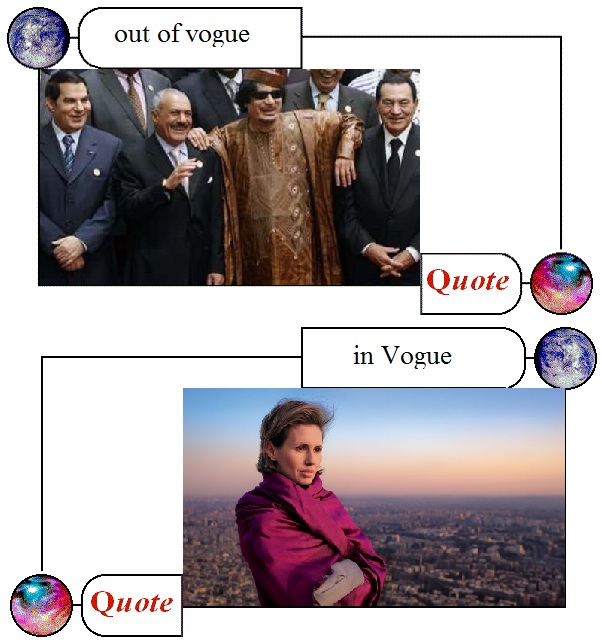
It seems likely from the first of these two images [Ben Ali, Saleh, Qaddafi, Mubarak, April] that manner of dress may be a valuable early indicator of how long a given dictator can hold onto power in the Middle East —

quo-vogue.jpg

— but where does that leave the lovely Asma al-Assad [in Vogue this February] today?

Answer:

oops.jpg

That old-time hacker religion

Saturday, June 4th, 2011

[ by Charles Cameron — care and feeding of authors and publishers, secrecy and transparency, Abu Muqawama, New Yorker ]

.

I am a writer.

I somewhat understand the need for writers to be supplied with books and food, and that publishers of various sorts, online and off, take on the costs of finding us and giving us a public hearing – but I also think it’s idiotic for the best of our thinking to take place in gated communities.

On matters concerning national security, for instance…

*

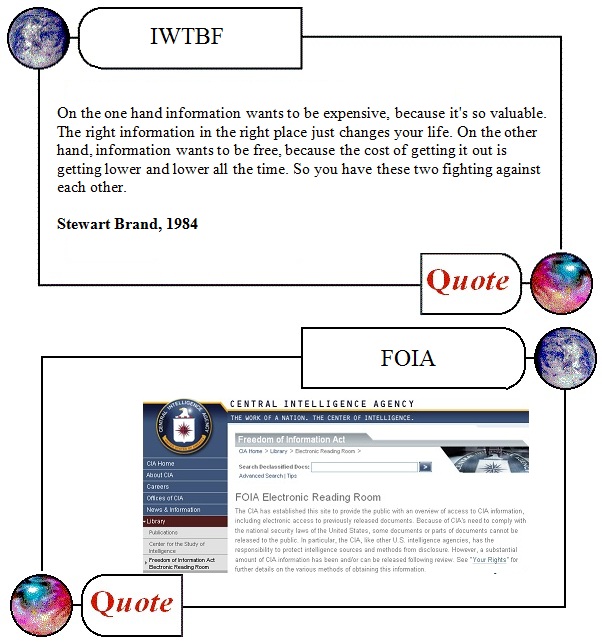
Two quick DoubleQuotes with a touch of that old time hacker religion…

quo-foia.jpg

And specifically…

quo-muqawama.gif

*

Certain things need to remain secret, I accept that. And there’s an inevitable tension, an ongoing tug-of-war between secrecy and transparency that even Stewart Brand, who coined the phrase “information wants to be free” admits, and that even the intelligence community responds to with CIA’s declassified search box, its responses to FOIA requests, and publications such as the unclassified extracts from Studies in Intelligence.

But here’s where I’m with Abu Muqawama:

The New Yorker has locked this article, which is silly, because this article has real policy relevance yet most of the people who need to read the article do not subscribe to the New Yorker.

Thankfully, Abu Muqawama / CNAS have summarized the piece in question, so you can read what it’s about and figure out for yourself whether you need to read the whole thing

*

So here’s a round of applause for all those who do bright thinking about world affairs in public view – or make such thinking available.

You are doing us all – I gasp to think of it – a public service.


Switch to our mobile site