zenpundit.com » metacognition

Archive for the ‘metacognition’ Category

Before Disruption….Thinking

Monday, April 23rd, 2012

“What you think, you become”

    – Buddha

“We are what we frequently do”

    – Aristotle

There has been a lively and still evolving debate in the milblogosphere regarding “disruptive thinkers”, starting with Benjamin Kohlman’s post at SWJ whose editor Peter J. Munson has done a fine job steering, collecting and commenting upon. A selection:

The Military Needs More Disruptive Thinkers by Benjamin Kohlman

Disruptive Thinking, Innovation, Whatever You Want to Call It is Needed for a Military in Crisis by Peter J. Munson 

The focus on disruptive thinkers coincided with a different but relevant debate over professional military education (PME) when a scathing blast was recently  leveled at the US Army War College by Major General Robert Scales (ret.) , himself the former commandant and a strong advocate of rigorous PME.  A few of the criticisms made by General Scales at a gathering at FPRI were mentioned in a post by Thomas Ricks who believes in shutting down the service academies and war colleges and maybe just sending everyone to Yale, Princeton and Harvard for MBAs. Or something.
.
What was interesting to me is that many authors and their points had less to do with a close examination of cultivating cognitive skills than related topics of changing organizational culture, the perils of groupthink, rehashing ideas from Frans Johanssen’s The Medici Effect and John Kao’s Innovation Nation, the superiority of entrepreneurshiphidebound military bureaucracy and other tangents to indirectly create an environment in which insightful or innovative behavior might happen.  Only Mike Mazarr zeroed in to the heart of the matter, writing:
….We need to improve, for example, in the detail and specificity of critical and creative thinking methodologies that we integrate into the curriculum.
Bingo!
.
There’s nothing wrong -in fact, much to the good – with the call of Kohlman and others like Joan Johnson-Freese to deliberately combine students and faculty of radically different professional backgrounds. Such a personnel mix is a good base for horizontal thinking to take place, where discussions can range across fields generating insights and analogies and accelerating learning.
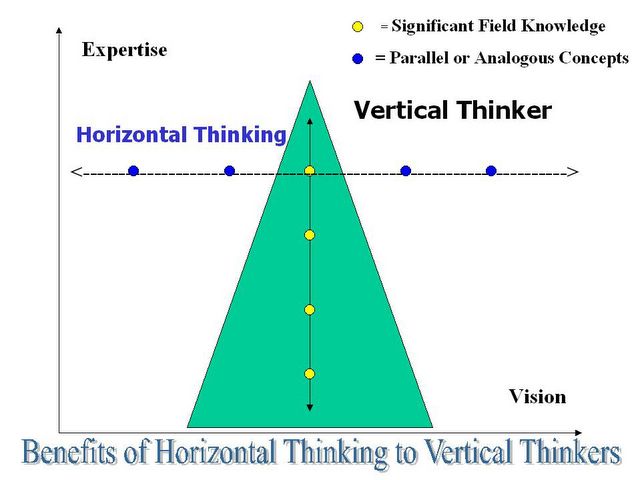
However, just assembling a broad mix of talent and putting them together in a building is not enough because it is not any more goal oriented than a MENSA social. Good things might happen, sure, but just as easily not. This is why DARPA is a lot more productive of an organization on an annual basis than the Institute for Advanced Study. There needs to be a mixture of problem-solving and play, free inquiry or experimentation and unifying goals. Communities of interest have to first have a sense of community for the vibrantly sharing and inspiring “minds on fire” effect to take place.
.
If the military or more broadly, American society, wants a larger number of creative, innovative, “disruptive”, strategic or whatever kind of thinker, then the answer is to actively and purposefully teach students creative, critical, insight-generating and strategic thinking skills and to value intellectual curiosity, skepticism, imagination and empiricism over ideology and conformity. The other indirect, “better environment”, stuff certainly improves your chance of success, but systemic improvement will only come about by making such objectives the focus of instruction and learning rather than a haphazard byproduct.
UPDATE:
At Best Defense, Ricks has provided a copy of his prepared remarks on PME as well as a link to the audiofile that I could not pull up the other day. Check out what he has to say.

The Taliban who turned himself in

Wednesday, April 18th, 2012

[ by Charles Cameron — a possible cultural parallel, also an entry for the pattern language of creativity, ourobouros ]

.

.

You’ve read about it in the news already:

U.S. officials couldn’t believe their luck last week when a suspected Taliban commander who heard there was a $100 reward for his whereabouts turned himself into authorities.

Perhaps misunderstanding the meaning of ‘wanted’, Mohammad Ashan sauntered up to police in Sar Howza, Paktika province, with a poster bearing his own face – and demanded the finder’s fee.

There are two things to note here — a parallel, and a pattern.

1.

The parallel is with an incident I mentioned earlier on Zenpundit:

I was also struck by an anecdote Tom Ricks told Fareed Zakariah on the latter’s show recently. He recounted a story first told by John Masters in his book “Bugles and a Tiger”, the memoir of a British officer serving with the Gurkhas in Waziristan in the 1930s. At the end of the war, so the story goes, some Afghans approach the British soldier and ask, “Where are our medals?” “You were the enemy,” he replies. And here’s the punchline, the Afghan respose to that: “No, no. You gave medals to the Pashtuns on your side. We want our medals, too. You couldn’t have had a good war without us.”

Tom Ricks comments, “This is very much the Afghan attitude. This is a kind of sporting event for them in many ways.”

Food for thought.

2.

The pattern is self-reference. Again,it’s something I’ve touched on here before, because it’s always of interest when it crops up:

there’s a special place in my analytic thinking for those representables which are self-referential – the category that gave rise to Douglas Hofstadter’s celebrated book, Gödel, Escher, Bach.

Indeed, I have a special glyph that I use in my games to notate ideas that are self-referential:

We don’t learn anything new about the particular instance of the Taliban walking in to claim his award for identifying himself by noting that it’s self-referential — but it intrigues us because it is, and that’s actually a sign that paradoxes of self-reference are significant at an unconscious level: that they’re a pattern worth watching for, and one that will play a role in the generation of aha! moments — whether they be analytic insights, creative breakthroughs, or (as in this case) just strange and amusing.

Kekulé von Stradonitz‘s basic insight into the structure of the benzene molecule was that it might be a serpent eating its own tail. That’s self-referential paradox at it’s finest — and a key aha! moment in the history of Chemistry.

It is also an archetypal image — the self-devouring serpent (ouroboros) crops up in alchemy (see image above) and in the Norse myth of Jörmungandr, the serpent who encircles Yggdrasil, the world tree.

Such images are important to the care and feeding of the creative mind.

Simultaneity II: the pictorial eye

Wednesday, April 11th, 2012

[ by Charles Cameron — when sequence becomes simultaneous, the pictorial eye, rethinking thinking, continuing from Simul I ]
.

What better day to begin writing this second post on simultaneity than the day on which Google celebrated the birthday of Eadweard Muybridge with a Google Doodle — not that I’ll get the post finished within those same 24 hours!

The film — sequence of frames? stills? which would you call it? — that Muybridge took of a horse, used in that Google Doodle [view it in motion, here], is celebrated as showing beyond a doubt that when galloping, all four of a horse’s hooves may be in the air at the same time.

But is it — Muybridge’s work product — sequential, ie a film, or simultaneous, ie the presentation of many moments at one time?

That question gets to the heart of an issue that all narrative faces, as we shall see. First, the pictorial side of things.

*

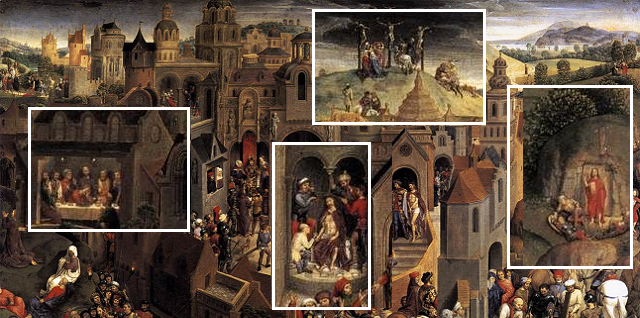
Hans Memling‘s Passion of Christ (above) tells the gospel narrative, from Christ’s entry into Jerusalem and the Last Supper through his crucifixion, entombment and resurrection to his appearances in Emmaus and by the sea of Galilee in one canvas, much as Bach’s Matthew Passion [link is to Harnoncourt video] tells major portions of the same narrative in three hours of unfolding musical drama.

*

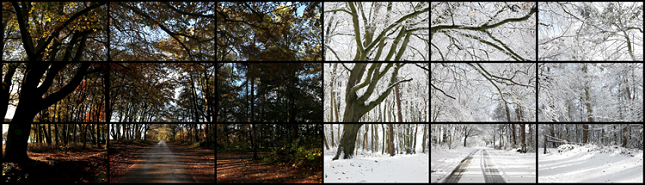
David Hockney has recently been working on forms of what I can only call “asynchronous synchrony” — as exemplified here:


Stills from Woldgate 7 November 2010 11:30 AM (left) and Woldgate 26 November 2010 11 AM (right). Credit: ©David Hockney

This image comes from a fascinating article describing Hockney’s current work by Martin Gayford, titled The Mind’s Eye, which you can find in MIT’s Technology Review, Sept/Oct 2011:

We are watching 18 screens showing high-definition images captured by nine cameras. Each camera was set at a different angle, and many were set at different exposures. In some cases, the images were filmed a few seconds apart, so the viewer is looking, simultaneously, at two different points in time. The result is a moving collage, a sight that has never quite been seen before. But what the cameras are pointing at is so ordinary that most of us would drive past it with scarcely a glance.

As with the Muybridge video above, “the viewer is looking, simultaneously, at different points in time”. Here Hockney does this with video cameras — but he achieves something of the same effect of time-displacement with still photos, too, as you can see in his brilliant portrait of the sculptor Henry Moore, hosted on the British Council’s Venice Biennale site.

Here is Gayford’s concluding paragraph, tying Hockney’s work into the larger context of our need for multiple frames of reference:

“Don’t we need people who can see things from different points of view?” Hockney asks. “Lots of artists, and all kinds of artists. They look at life from another angle.” Certainly, that is precisely what David Hockney is doing, and has always done. And yes, we do need it.

*

Memling again — and here I have enlarged and “framed” four of the 23 scenes from the passion of Christ which he has incorporated in the one painting: the Last Supper, the Crowning with Thorns, the Crucifixion, the Resurrection — Thursday evening through Sunday, and from life to death and back again.

*

It was Holy Week for Christians just last week, so perhaps you will forgive my having been preoccupied with images of the passion during the season set aside for such meditations — but what I want to point out to you is timeless, and indeed brings the transcendent into the everyday. Let’s take a look at a Hitchcock film next, then, and see how a contemporary videographer Jeff Desom has remixed the already Hockney-like Rear Window [link to IMDb] to create his own time-lapse telling of the tale [link to Vimeo], from which I took this screen-grab:

*

Time-lapse — simultaneity? The philosopher Alfred North Whitehead once wrote:

The communion of saints is a great and inspiring assemblage, but it has only one possible hall of meeting, and that is the present; and the mere lapse of time through which any particular group of saints must travel to reach that meeting-place, makes very little difference.

And so it is with this other Memling painting — and many others like it, by artists old and new:

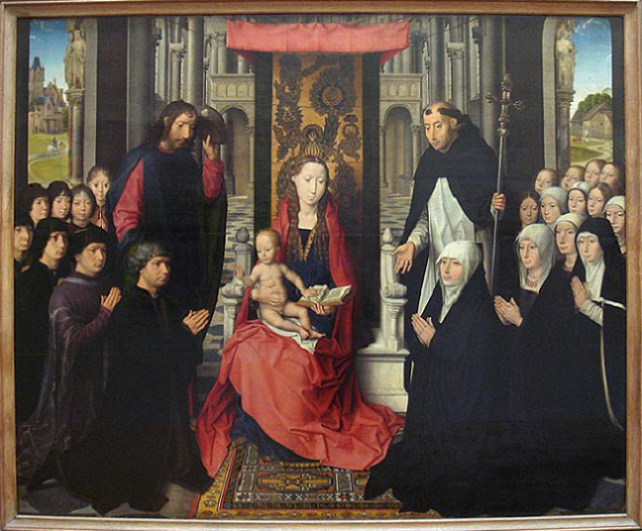
Here we see the Virgin Mary and Christ child with Saints Dominic and James — there’s an eleven centuries gap right there, St Dominic lived from 1170 – 1221, more than a millennium after Christ — and Memling has St Dominic presenting his patron, the spice trader Jacques Floreins with his family to Christ, circa 1490. With everyone dressed in late 15th-century fashions…

Whitehead — co-author with Bertie Russell of Principia Mathematica — see how amazing this is? — could have been thinking of Memling: “the mere lapse of time through which any particular group of saints must travel to reach that meeting-place, makes very little difference”.

*

Coming up next: how this affects our understanding of story.

____________________________________________________________________________

For an understanding of the setup David Hockney uses for his multiple-video takes, see here and specifically this and this. For the setup used by Jeff Desom in his Rear Window remix, see here and specifically this.

Of the real and the imaginal

Monday, April 9th, 2012

[ by Charles Cameron — from sight to vision? ]
.

*

Which of these two images — the photo above, the MC Escher print below — calls you closer? Which takes you deeper?

*

And which draws you closer here — the MC Escher print above, or the Tenniel illustration for Alice, below? Which carries you deeper?

Where does the realistic end, and the imaginal begin?

*

Marina Warner writes in the introduction to her recently reviewed book, Stranger Magic:

The faculties of imagination — dream, projection, fantasy — are bound up with the faculties of reasoning and essential to making the leap beyond the known into the unknown. At one pole (myth), magic is associated with poetic truth, at another (the history of science) with inquiry and speculation. It was bound up with understanding physical forces in nature and led to technical ingenuity and discoveries. Magical thinking structures the processes of imagination, and imagining something can and sometimes must precede the fact or the act; it has shaped many features of Western civilization. But its influence has been constantly disavowed since the Enlightenment and its action and effects consequently misunderstood.

*

For the brilliant juxtaposition of images in the upper pair, I am grateful to http://www.giovis.com/atrani.htm, with an h/t to http://www.log24.com.

Of railroad tracks and coming to a conclusion

Monday, April 2nd, 2012

[ by Charles Cameron — playing off the new George Smiley movie ]
.

Yes!

This is George Smiley‘s mind, just that moment before he understands who the mole in the Circus must be, at the 1.36.27 point in Tomas Alfredson‘s Tinker Tailor Soldier Spy.

A moment before that, the light was green:

Moments later, the points slam into their new configuration, Smiley’s train of thought is shunted along a new track, and all is understood.

*

It’s a beautiful, subtle illustration of the idea that the mind “knows” that it has decided, some moments before a conscious intent registers – in line with the general idea suggested, not as proven but as fascinating speculation, in Nature last August:

The conscious decision to push the button was made about a second before the actual act, but the team discovered that a pattern of brain activity seemed to predict that decision by as many as seven seconds.

And it makes graphical use of the same changing points idiom I used myself in my post Of railroad tracks and polyphonic thinking here on ZP, not so very long ago.


Switch to our mobile site