zenpundit.com » metacognition

Archive for the ‘metacognition’ Category

Two Great Early Cyberneticists

Wednesday, December 21st, 2011

[ by Charles Cameron — Ashby, the Law of Requisite Variety, Bateson, the arts and sciences ]

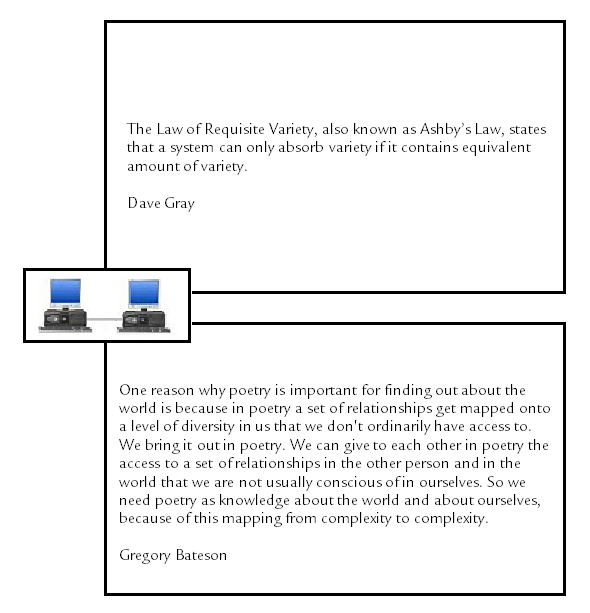
Mapping from complexity to complexity. Access to a set of relationships … that we are not usually conscious of in ourselves.  The depth and riches of imagination, of the arts and sciences, of the listening heart / mind, of the world around us, of the models we need to make to navigate that world successfully… of the wisdom our steersmen need, and all too often lack.

Zen‘s post Ruminating on Strategic thinking had me thinking a bit, and I guess I felt some of his bullet points,

  • Assessment of the relationships among the variables
  • Assessment of the relationship between the variables and their strategic environment
  • Assessment of current “trajectory” or trend lines of variables
  • Assessment of costs to effect a change in the position or nature of each variable
  • Assessment of the strengths and weaknesses of the variables as a functioning system

and particularly

  • Recognition of systemic “choke points”, “tipping points” and feedback loops.

are separable as components one might learn, but need to fuse into a single intuition if the result is to be fully system-responsive.

And I think the two comments above by Ashby and Bateson are in their own ways both “about” that — about the need for a gestalt understanding rather than a list of separate and disparate parts…

*

And of course, those two quotes can also be used to pitch for cybernetics, or for poetry, or both… much to my delight!

Ruminating on Strategic Thinking

Wednesday, December 21st, 2011

“Let the Wookiee win….”

Warning! Thinking out loud in progress…..

Strategy is often described as the alignment of “Ends-Ways-Means” and “planning” to achieve important goals and several other useful definitions related to matters of war, statecraft and business.  That great strategists have come in many forms, not just between fields but demonstrating tremendous variance within them – ex.  George  Marshall vs. Alexander the Great vs. Carl von Clausewitz – indicates that strategic thinking is a complex activity in terms of cognition.

What are some of the mental actions that compose “strategic thinking” or “making strategy”? A few ideas:

  • Recognition of important variables
  • Assessment of the nature of each variable
  • Assessment of the relative importance of each variable
  • Assessment of the relationships among the variables
  • Assessment of the relationship between the variables and their strategic environment
  • Assessment of current “trajectory” or trend lines of variables
  • Assessment of costs to effect a change in the position or nature of each variable
  • Assessment of the strengths and weaknesses of the variables as a functioning system
  • Recognition of systemic “choke points”, “tipping points” and feedback loops.

  • Probabilistic estimation
  • Logical reasoning
  • Introspection 
  • Extrapolation
  • Simplification
  • Metacognition
  • Horizontal Thinking
  • Insight
  • Imagination (esp. at “grand strategic” level)

  • Logistical estimation of costs
  • Normative evaluation of potential benefits
  • Understanding of temporal constraints
  • Recognition of opportunity costs
  • Recognition of boundary conditions
  • Recognition of physical constraints of strategic environment (terrain, weather, distance etc.)
  • Recognition of patterns in the history of the strategic environment

  • Net assessment of the maximum capabilities of a political community (first ours, then theirs)
  • Understanding of organizational structure of a political community
  • Recognition of stakeholders in the political community 
  • Understanding of decision making process of the political community
  • Understanding the power relationships of the decision making process of the political community
  • Understanding the distribution of resources within the political community
  • Recognition of the touchstone points of the cultural identity of the political community (positive and negative) and worldview
  • Assessment of morale of the political community and the community’s moral code
  • Assessment of psychology of individual adversary decision makers
  • Identification of points of comparative advantage
  • Recognition of how different bilateral outcomes/shifts will affect third parties
  • Assessment of relationship between the adversaries and between them and third parties

This list is not comprehensive. In fact, I have a question for the readership, particularly those with military service and/or a good grasp of military history:

Where do the interpersonal skills or “emotional intelligence” abilities that comprise the activity we term “leadership” fit into strategic thinking? Or is it a separate but complementary suite of talents? We often assume that great strategists are the great leaders, but we tend to forget all of the generals who were popular yet mediocre in the field and gloss over the human faults of those who won great glory.

I have some ideas but I would like to hear yours. Or any additional suggestions or comments you would care to make.

We spend far too much time on content, and not enough time on form

Tuesday, December 13th, 2011

[ by Charles Cameron — recursion as form — this one’s for analysts: poets should know it already ]

.

We spend far too much time on content, and not enough time on form.

We spend far too much time on the data, and not enough time on relationships. It is pattern that connects the dots with accuracy, not more dots – quality of insight, not quantity of information.

And pattern is underlying form.

Haiku is a form. The sonnet is a form, the sonata is a form. And just to juxtapose sonnet and sonata is to recognize the formal relationship between them.

1.

Recursion is the form that Doug Hofstadter explores in his book, Godel Escher Bach, and you’ll find it every time one mirror reflects another mirror (what color does a chameleon turn when placed on a mirror?), every time there’s a doll inside a doll inside a Matrioshka doll, often in the form of a paradox (“this sentence is meaningless”) – and when people take photos of themselves holding photos of themselves…

as in the pic of Noam Chomsky and Morris Halle and (in case your politics doesn’t agree so much with Chomsky) the one below them of Jacob Appelbaum and Donald Knuth in my “specs” image at the top of this post.

2.

Content can be powerful, but form really doubles up on the power. Here’s one way of thinking about it: form is what tightens information into meaning.

A couple of news reports in the last couple of days have caught my attention because of their form:

Charter of Open Source Org is Classified, CIA Says

Open Source Works, which is the CIA’s in-house open source analysis component, is devoted to intelligence analysis of unclassified, open source information. Oddly, however, the directive that established Open Source Works is classified, as is the charter of the organization. In fact, CIA says the very existence of any such records is a classified fact.

“The CIA can neither confirm nor deny the existence or nonexistence of records responsive to your request,” wrote Susan Viscuso, CIA Information and Privacy Coordinator, in a November 29 response to a Freedom of Information Act request from Jeffrey Richelson of the National Security Archive for the Open Source Works directive and charter.

“The fact of the existence or nonexistence of requested records is currently and properly classified and is intelligence sources and methods information that is protected from disclosure,” Dr. Viscuso wrote.

This is a surprising development since Open Source Works — by definition — does not engage in clandestine collection of intelligence. Rather, it performs analysis based on unclassified, open source materials.

That’s hilarious, it’s so misguided: I don’t know whether to laugh or barf (not a word I ever expected to use in my writings, but there you go).

3.

That’s sad, this one’s just plain tragic:

Protesters calling for religious tolerance attacked with stones, threatened with death

Police are investigating a violent attack on a ‘silent protest’ calling for religious tolerance, held at the Artificial Beach to mark Human Rights Day.

Witnesses said a group of men threw rocks at the 15-30 demonstrators, calling out threats and vowing to kill them.

One witness who took photos of the attacked said he was “threatened with death if these pictures were leaked. He said we should never been seen in the streets or we will be sorry.”

Killing your enemies for reasons of religion is one thing: killing those who work for peace between you and your religious enemies is no worse of the face of it – it’s religious killing, no more and no less, in both cases — but it drives the point home with considerable, poignant force.

Keep your eye out for recursion, it’s an interesting business. And respect form – it empowers content.

4.

You’ll find recursion right at the heart of Shakespeare: his plays were performed in a round theater (the “wooden O” of Henry V) called the Globe, whose motto was “totus mundus agit histrionem” – roughly, “the whole world enacts a play” – a notion which Shakespeare put into the mouth of the melancholy Jaques in As You Like It:

All the world’s a stage,
And all the men and women merely players.
They have their exits and their entrances,
And one man in his time plays many parts…

A martial version of this idea, indeed, can be found in the philosopher Plotinus, who wrote in his Enneads (3.ii.15):

Men directing their weapons against each other — under doom of death yet neatly lined up to fight as in the pyrrhic sword-dances of their sport — this is enough to tell us that all human intentions are but play, that death is nothing terrible, that to die in a war or in a fight is but to taste a little beforehand what old age has in store, to go away earlier and come back the sooner. So for misfortunes that may accompany life, the loss of property, for instance; the loser will see that there was a time when it was not his, that its possession is but a mock boon to the robbers, who will in their turn lose it to others, and even that to retain property is a greater loss than to forfeit it.

Murders, death in all its guises, the reduction and sacking of cities, all must be to us just such a spectacle as the changing scenes of a play; all is but the varied incident of a plot, costume on and off, acted grief and lament. For on earth, in all the succession of life, it is not the Soul within but the Shadow outside of the authentic man, that grieves and complains and acts out the plot on this world stage which men have dotted with stages of their own constructing.

5.

I thought it would be interesting to see if recursion had power, too, in the field of religion, and this passage from Ephesians (4.8) sprang to mind…

When he ascended up on high, he led captivity captive, and gave gifts unto men…

That’s a lovely recursion, “leading captivity captive”. But I think we can go deeper. John Donne‘s sonnet Death be not proud reaches to the very heart of the Christian message, it seems to me –it parallels the passage from Ephesians closely, while focusing in on the hope of resurrection with its stunning conclusion:

Death, thou shalt die.

Here’s the whole thing: profound content in impeccable form:

Death be not proud

Death be not proud, though some have called thee
Mighty and dreadfull, for, thou art not so,
For, those, whom thou think’st, thou dost overthrow,
Die not, poore death, nor yet canst thou kill me.
From rest and sleepe, which but thy pictures bee,
Much pleasure, then from thee, much more must flow,
And soonest our best men with thee doe goe,
Rest of their bones, and soules deliverie.
Thou art slave to Fate, Chance, kings, and desperate men,
And dost with poyson, warre, and sicknesse dwell,
And poppie, or charmes can make us sleepe as well,
And better then thy stroake; why swell’st thou then;
One short sleepe past, wee wake eternally,
And death shall be no more; death, thou shalt die.

6.

What do you think?
John Robb on the OODA Loop

Thursday, December 1st, 2011

John Robb at Global Guerrillas had a nice primer on John Boyd’s OODA Loop recently and he put on a twist that I thought was very useful:

HOW TO WIN ANY CONFLICT

….I’m Inside Your OODA Loop

How does all of this apply to conflict?  The simple answer is that conflict, in its most basic form, is a contest between decision making loops.  The side with the FASTER and BETTER decision making loop wins any conflict.  Why?  They adapt quicker.   Here’s some more detail:

A FASTER decision making loop means that you accomplish a successful OODA loop quicker than an opponent.  If you can do this, you are inside your opponent’s OODA loop.  This means that by the time your opponent responds to your last actions, you are already onto your next ones.  Get far enough ahead and the opponent’s decision making process will collapse and victory is assured.
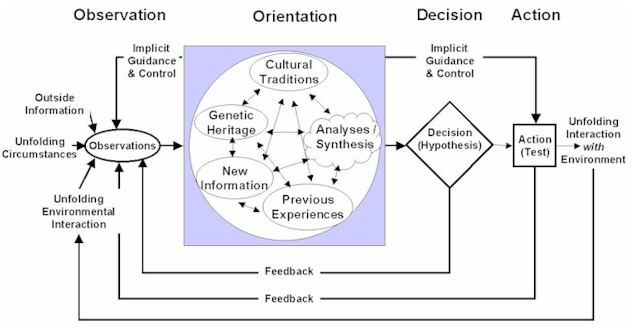

A BETTER decision making loop?  That’s question that can lead to endless debates and theory crafting.  My approach to improving a decision making loop?  Connectivity.  The more connected a loop is, the better the decision loop is.  Connectivity falls into three categories:

  1. Mental — improves decisions by connections to a superior mental model of the current situation.  A superior model/strategy is predictive of events. It can tell you what data is important and what isn’t.  Weak strategies/tactics fall apart upon first contact w/enemy.
  2. Physical   — improves observation through connections to better sources of data, cleaner w/less distortion  — improves action by making it possible to actually accomplish the desired decision in the real world
  3. Moral — better orientation due to connections to strong traditions, extensive experience, and collected wisdom.  Training can help here.

The opposite is true also.  Damage an opponents connectivity, and their decision making loops are less effective.

One of the difficulties with discussing OODA is that many people who either oppose the concept or do not know much about it, will explain the OODA Loop only as “getting inside your opponents OODA Loop” in terms of the capacity to “go faster” -i.e cycle through your own OODA Loop faster than your opponent, making more decisions, taking more actions, leaving them in the dust, disoreinted and going into a downward spiral to defeat. Usually, misrepresented like this:

Ok, well going “faster” is a small part of it, but not sequentially and there’s neurological limits on this that arrive pretty quickly in terms of thinking speed in any case. Robb’s use of “BETTER” helps capture more of the critical and subtle qualitative nature of the “Orientation” box:

What are some of the possible effects of a “virtuous cycle” of better decisions?

Position yourself with more options
Gain new perspectives (“Observation”, “Orientation”)
Position yourself with the greatest comparative advantage (best option)
Lock in a comparative advantage
Position yourself with the longest potential decision tree (no quick “dead ends” or “cul de sacs”)
Change the tempo of interaction in your favor
Change the rules of interaction in your favor
Prevent a conflict with additional potential oponents
Lower your costs or increase theirs
Assure minimum gains
Arrive first
Increase or decrease the distance between yourself and your opponent
Broaden or narrow the field of conflict
Gain time
Seize or maintain the initiative
Define or redefine “victory”
Foreclose a critical option or set of options to your opponent
Force your opponent to act on your terms (“Check”)
Lower the morale of your opponent

Confuse, mystify or mislead your opponent
Attract allies or supporters
Increase your resources or potential maximum gains
Repair, remediate or replace previous losses

John is correct that “connectivity” helps you gain many of these benefits. 

Remember:

 “Being on the winning side is a lot more fun!”

ADDENDUM (Some interesting commentary on OODA):

Adam Elkus

I’ve Got the OODA Blues

Joseph Fouche:

Libeling Boyd

How Not to be Like Boyd

Who’s Afraid of Genghis John?

TDAXP, PhD

Variations of the OODA Loop 1: Introduction
Variations of the OODA Loop 2: The Naive Boydian Loop
Variations of the OODA Loop 3: The Sophisticated Boydian Loop
Variations of the OODA Loop 4: Pseudo-Boydian Loops
Variations of the OODA Loop 5: Post-Boydian Loops
Variations of the OODA Loop 6: Bibliography

Book

Sunday, November 20th, 2011

Thinking in Time by Richard Neustadt and Ernest May

Picked up this classic work on metacognition, history and strategic decision making for the astronomical price of…..$ 4. Including shipping.

The diminuition of the teaching of history in elite universities after the 1960’s, when the old undergraduate canon was chucked in deference to demands by student and faculty radicals for an a la carte system (to replace the old core with politicized race-gender-crit rubbish), has contributed to the decline in American strategic thinking.


Switch to our mobile site
