zenpundit.com » metacognition

Archive for the ‘metacognition’ Category

2011, meet 1997 (and 1995, and 1943…)

Wednesday, May 25th, 2011

[ by Charles Cameron — creativity, IARPA, HipBone Games, h/t Hermann Hesse ]

.
Funny thing, that.

quo-iarpa.gif

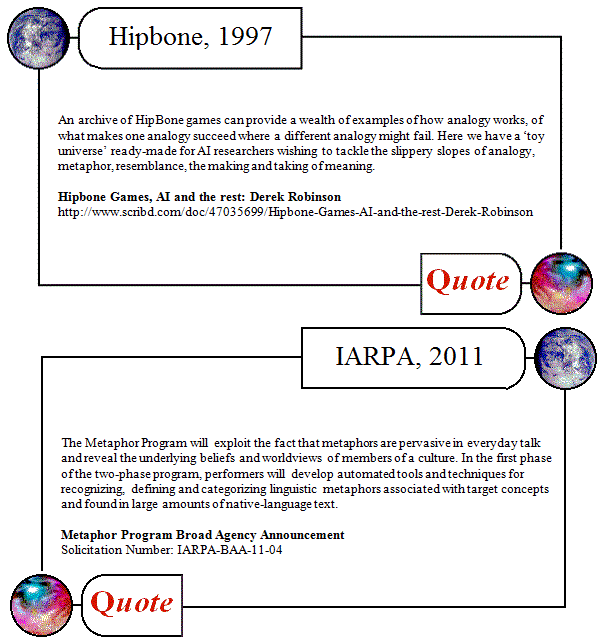
In 1997, Derek Robinson wrote a short piece about my HipBone Games, indicating what they were good for. Read it – then read the IARPA solicitation that just came out.

My approach is to lure people into discovering analogies, metaphors, parallels and oppositions by playing a game which elicits them as game moves — a live process, and one that cuts to the very heart of creativity — IARPA wants an automated version, which will be clunky by comparison. And as Derek points out in his piece — pointed out, that is to say, fourteen years ago, quoting an even earlier (1995) comment from Douglas Hofstadter:

If, instead of using the real world, one carefully creates a simpler, artificial world in which to study the high-level processes of perception, the problems become more tractable.

That’s what my games are — “a simpler, artificial world in which to study the high-level processes of perception” — specifically, “of analogy, metaphor, resemblance, the making and taking of meaning”.

I’ve been working on this stuff for at least fifteen years… inspired by a book Hermann Hesse published in 1943.

*

And oh yes, there’s a “future of search engines” hiding in there, too.

Creativity and the laughable

Monday, May 16th, 2011

[ by Charles Cameron — creativity, Taliban, Leonardo, pareidolia, Virgin Mary, Kwan-yin ]
*

.
Sharing, as I do with Zen, a keen interest in the creative process, I am used to the idea that an idea that seems trivial at first, the very expression of which risks making oneself a laughing-stock, may well carry the seed of success.

Whitehead is quoted as saying, “Every really new idea looks crazy at first.” Einstein, “If at first the idea is not absurd, then there is no hope for it.” Nils Bohr, “Your theory is crazy, but it’s not crazy enough to be true.” The idea is not even confined to physicists and mathematicians. Mark Twain observed, “The man with a new idea is a crank – until the idea succeeds.” And Winston Churchill, “No idea is so outlandish that it should not be considered with a searching but at the same time steady eye.”

I was therefore intrigued to read this account of the origins of the Taliban’s recent Kandahar prison break:

One of the surprising mujahideen squad in the city of Kandahar, who by his connections gained full knowledge of the inside and outside of the prison, pondered one day whether it could be possible to dig a tunnel from the inside of a house on the other side of the street to the prison as a means to releasing the prisoners. This fantasy and imagination seemed laughable at first even to its owner; he dared not share his opinion with others. But, after more time and continued thinking, he reached a conclusion. On one of these days, while he was riding a motorcycle with two of his comrades, he shared that view with them. They thought it impossible initially and deemed it a fruitless, dangerous attempt. Finally, they placed their trust on God and shared their opinion with the mujahideen high command in Kandahar. With guidelines from the command, the aforementioned four revealed [to] their trusted comrades their decision to implement this plan regardless of its risks and even if it looked impossible.

The sentence that really got my attention was this one:

This fantasy and imagination seemed laughable at first even to its owner; he dared not share his opinion with others.

*

Leonardo da Vinci once wrote of having “a new and speculative idea, which although it may seem trivial and almost laughable, is none the less of great value in quickening the spirit of the invention.”

His “trivial and almost laughable” idea?

It is this: that you should look at certain walls stained with damp or at stones of uneven colour. If you have to invent some setting you will be able to see in these the likeness of divine landscapes, adorned with mountains, ruins, rocks, woods, great plains, hills and valleys in great variety; and then again you will see there battles and strange figures in violent action, expressions of faces and clothes and an infinity of things which you will be able to reduce to their complete and proper forms. In such walls the same thing happens as in the sound of bells, in whose strokes you may find every word which you can imagine.

Essentially, Leonardo is suggesting that we use what’s effectively the Rorschach technique to induce pareidolia (I think that’s the state) and elicit mental contents – images triggered by the mind’s eagerness to sense meaning – thus imitating the universe itself in bringing something out of nothing, out of the potent void.

*

This is, however, the same psychological mechanism that brought us the sale of a grilled cheese sandwich for $28,000 on eBay – because it “looked like” the Virgin Mary

That’s not a note I’d like to end on, however — so I’ll just remind myself that we don’t “know” what the Virgin Mary looks like, and pass on to the rather charming story of a similar pareidolic image, this one possessing the almost miraculous property of looking simultaneously like the Blessed Virgin and the bodhisattva of compassion, Kuan-Yin:

Situated in the East Bay area, near the lovely city of San Francisco, the Purple Lotus School is witnessing yet another miracle. … In April 1996, when the great “Merit Wall” on campus had just been constructed, a mysterious face appeared on the wall immediately after the cement dried. … Buddhists who have witnessed this phenomenon believe this to be the face of the compassionate Bodhisattva Kuan-Yin. … Others have believed this image to be that of the Virgin Mary. Magia and Junia Chou, the daughters of the Purple Lotus Society’s Master Samantha Chou, attend a Catholic elementary school. Upon seeing the image, both called out earnestly and delightedly, “Look! It’s the Virgin Mary!” … With the essence of Enlightenment and universal wisdom in mind, perhaps one can argue that a distinction between the two is not important after all.

*

It’s laughable, I know — but I must confess I like the “meaning” I can draw from that…
Answering Ronfeldt’s Question About the Nature of Strategy

Wednesday, May 4th, 2011

RAND emeritus scholar and co-author of the classic Netwars and Networks, David Ronfeldt asked an astute question in reaction to my post proposing a grand strategy board:

I almost always see strategy defined as the art of relating ends and means.  It’s defined that way time after time, often but not always with a few extra criteria added here and there.  Usually something about plans or resources.  But I’ve long felt that I’d prefer to define strategy as the art of positioning.  That presumes a consideration of ends and means, but in my view, it’s not as abstract a definition, and gets to the core concern right away.  In looking around for who else may favor such a definition, the best and almost only leader I find is Michael Porter and his writings about corporate strategy.  He’s says explicitly that strategy is the art of positioning – apropos market positioning in particular.  maybe in some long-forgotten moment, that’s where I got the notion in the first place.  Meanwhile, i’ve been told that, of military strategists, Jomini emphasizes positioning the most.  This is not my area of expertise.  I’d like to know more:  is the “ends and means” view so accepted, so basic, so adaptable, that it’s not worth questioning?  What’s to be gained, and/or lost, by the “positioning” view?  Is there any strategy that isn’t about positioning? 

This is a great question, because it is a clarifying question about fundamentals.

I am not familiar with Micheal Porter’s work, but Chet Richards pointed out in his excellent Certain to Win that there are some significant differences in applying strategic thinking to business compared to using strategy in war. While war and the market both represent dynamic, competitive environments which require actors to adapt to survive, war is a destructive enterprise while business is ultimately transactional, cooperative and constructive, though you may have to overcome competition and conflict first. Conflict and competition on which the state and society place tight legal constraints to which buyers and sellers must conform.  Arguably, this explains the drift toward oligopolistic competition in regulated capiltalist economies: the constraints of rule of law which govern market actors would tend to give an even greater emphasis to “positioning” in peaceful economic competition than in warfare.

What about “positioning” and strategy generally?

Strategy is indeed defined by most experts as the alignment of Ends -Ways -Means. In my opinion, it is the most practical starting point for people of any level of strategic skill to consider what is to be done in the short or medium term within a known framework ( a theater, region, an alliance system, nation-state etc.). “Positioning” falls within this trinity under “ways” – for example, something as simple as seizing the high ground or as complicated as maneuver warfare theory is, in essence, an effort to acquire a comparative advantage over your opponent. Having comparative advantages are always good but they are usually transitory rather than being something that can be “locked in” permanently ( though man has tried – ex. the Great Wall of China, Constantinople on the Dardanelles, the age of fortresses in 16th-17th C. Europe, Mercantilist Policy, Massive Retaliation etc.). Normally, you have to keep moving, tactically adjusting your position in response to your opponent’s efforts to re-balance.

Positioning also exists outside the trinity of Ends-Ways-Means as the initial starting conditions that shape subsequent strategy. The phrase “Where you stand depends on where you sit” conveys the lesson that our perspectives, our premises, are deeply affected from where we begin. Geopolitical theory is rooted in this idea but positioning can be something other than physical location – politics and culture are positional because they are embeded with values and what we value to some extent determines what our Ends are going to be and how we perceive and define the problem for which we will employ a strategy to overcome.

The latter kind of positioning can be *very* problematic because ideological concerns inflame passions, distort our rational calculus of matching means to ends and generally introduce ever larger amounts of irrationality into strategic decision making at the expense of empirical observation. Boyd would call this a “mismatch” with reality from a corrupted OODA Loop and a textbook example would be the behavior of Imperial Japanese leaders in WWII. Launching an unwinnable war with the United States and prosecuting it almost to national annihilation was driven to a demonstrable extent by Japanese cultural norms related to honor, debt (on-giri), the “Imperial Will” and dysfunctional constitutional arrangements that made extricating Japan from a strategic cul-de-sac politically impossible. To a lesser extent, American prosecution of the war in Vietnam and the occupation of Iraq share similar irrationality derived from a priori ideological positioning.

A final observation:

When time horizons are very long and/or the problem is ill-defined and the framework boundaries vague or unknown or uncertainty high, the cognitive requirements for strategic thinking shift and it may not be possible to move beyond speculating as to Ends to the point where action should or even can be taken effectively. More information may be required. 0r greater means than exist. The problem may only be a hypothetical potentiality, rather than an actual problem. This point is one that is likely to be disputed as even being in the realm of strategy and could belong in that of theory or politics, depending on your perspective.

Many readers here are students of strategy or even professional strategists. In the interest of brevity, I’ve avoided getting into the specifics of schools of strategic thought or Clausewitz vs. Sun Tzu or Jomini, but I’d like to invite readers to weigh in on Dr. Ronfeldt’s question or my response as they wish.

TEMPO is Launched

Monday, May 2nd, 2011

 TEMPO by Dr. Venkatesh Rao

I mentioned TEMPO a few months back and I wanted to comgratulate Dr. Rao and the launch of his book and notify readers that Venkat will be doing a cross-country drive/book tour to promote TEMPO. Sort of a strategic cognition version of On The Road.

A review of TEMPO will appear here later this week.

More on Where Good Ideas Come From

Tuesday, April 19th, 2011

Dr. Von weighed in on Steven Johnson’s Where Good Ideas Come From with an extensive book review last December( I posted on Johnson here. On a related note, read Charles Cameron’s comment about the limitations of linear thinking here):

Where do New Ideas come from?

….But what exactly are innovation and creativity? The dictionary definition of innovation is ‘the introduction of new things or methods,’ while creativity is ‘the ability to create meaningful new ideas, forms or methods’ that are original and imaginative. So the key notion is the development of new ideas in whatever field one is working. A question naturally develops, which is where do new ideas come from? How do we begin preparing children now to be creative and innovative in the future? In the past, many would have first thought about the arts as being the training ground for creativity. Now, we realize that the development of the abilities and mindsets and skills necessary to be creative in every field of study is necessary.Steven Johnson’s new book, Where Good Ideas Come From: The Natural History of Innovation, provides the argument that there are seven common themes that have led to the vast majority of great ideas throughout history. He gives numerous examples of such ideas, ranging from Darwin’s development of the theory of evolution to the of the GPS system, from Google to the creation of the first mechanical computing devices centuries ago, and so on. It is an interesting read.Here is a summary of the seven themes that lead to good ideas. Keep in mind there is certainly some degree of overlap and relationships between the themes, but overall they can be thought of as distinct concepts.1. The Adjacent Possible: Even if you have an interest in some topic or problem, if there is not a good environment conducive to presenting the necessary pieces to solve the problem, good ideas will almost certainly not develop. You may be brilliant with some of the information (i.e. pieces of a puzzle) in your mind that is necessary to solve a problem, but if your surroundings are not able to provide the remaining pieces of information or experiences, you will endlessly search for them to no avail. If you are isolated from others who know something about your problem or issue, or if there is no means of gathering further information (which is becoming less of a problem with the advent of the Internet), or if your environment does not provide the physical infrastructure or supplies to finish building a new physical device, you will be unable to develop the Idea or solution to your problem.

2. Liquid Networks: Great ideas can develop when information is allowed to flow through a larger network. One possible network is a social network, or often and more specifically, a professional network. The focus of this is the ability to collaborate to solve problems. It turns out that there are almost no great ideas throughout history that have been developed in isolation or by an individual who did not need any help in the development of that great idea. One may think Newton or Einstein did their work in isolation, but this is not entirely true. Those two individuals come about as close as you can get to not needing a network to develop the laws of motion or relativity, but they relied on some level of feedback, reading others’ work, and ultimately talking and discussing issues with close colleagues and friends.
An interesting study was done that looked at how research groups reach the coveted ‘Eureka!’ moment, where a new discovery is made. It turns out that these rare moments of discovery or problem solving almost never happen in the lab! Instead, the ‘Aha!’ are yelled out at the conference table, where members of the group are throwing ideas around and sharing results of their latest work over the past week. The person who figures it out needs to have input they have not thought about from the larger group or network, before the grand idea is formed….

Read the rest here.


Switch to our mobile site
