zenpundit.com » intelligence

Archive for the ‘intelligence’ Category

The US Army War College National Security Seminar 2011

Sunday, June 12th, 2011

warcollege.jpg

As noted previously, I was fortunate to attend the National Security Seminar at the the US Army War College this year and wanted to relay my impressions while they were still fresh.

First, in terms of reception and cordiality, I have rarely experienced such an extensive and personal outreach as was demonstrated by the War College staff, faculty, administration and students. Every new member had a “sponsor” – a student, usually a colonel or Navy captain, who acted as a liason and personal guide from the time their plane touched down until the moment they returned to the airport. My sponsor, the former commander of the WolfhoundsColonel Richard “Flip” Wilson, whom I consider a friend, really extended himself on my behalf, making me feel welcome and a full member of Seminar Group 20. Most of the students have multiple tours of duty in Iraq and Afghanistan under their belt and many can report the same for the first Gulf War, Panama, Bosnia or Kosovo.

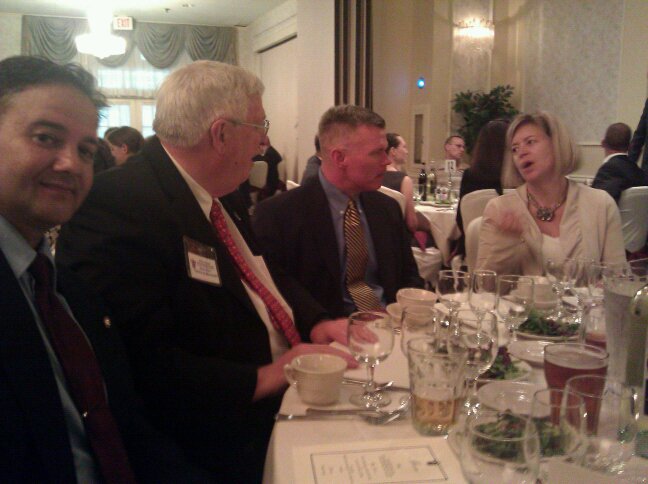
The War College, the Commandant and the Seminar Group all hosted receptions and dinners designed to get students and civilian new members to mix and further discuss issues raised in the seminar sessions or lectures. At these events I had the opportunity to meet and talk to the leadership of the Army War College including the Commandant Major General Gregg Martin, the Deputy Commandant for International Affairs, Ambassador Carol Van Voorst, the Executive Director of the Army Heritage Foundation, Mike Perry, the Director of SSI, Dr. Douglas Lovelace,  the Chief of Staff and numerous faculty and seminar members. The New Members such as myself were exceedingly well fed at these events as I suspect the Army was attempting to prove that it really does march on it’s stomach.
                                                                                                                                                                                                                                                                                                                

warparty.jpg

warparty2.jpg

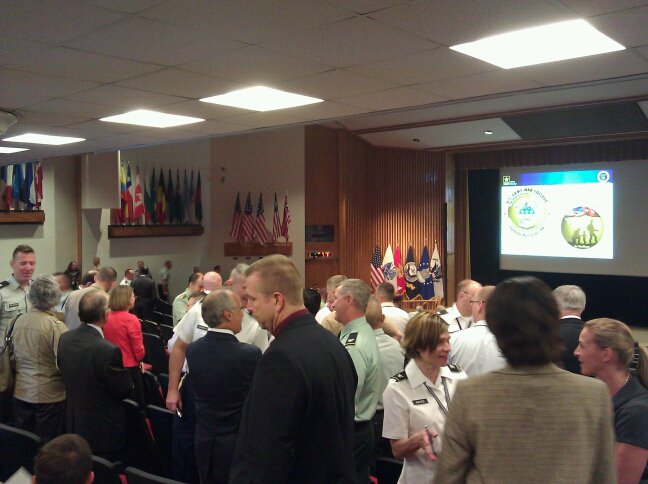
The serious business of the National Security Seminar was divided into two segments, the talks given by distinguished speakers to the entire class of 2011 and the New Members and the Seminar Group sessions of approximately twenty students, New Members, academics and foreign visitors. We received a brief on the war in Afghanistan from the ISAF Chief of Staff, who was standing in last minute for General Petraeus who was called to meet with senior adminstration officials; and a very interesting concluding talk by Foreign Affairs Editor Gideon Rose, author of How Wars End, which covered issues of strategy, grand strategy and the disconnect with policy.
warseminar.jpg

  The National Security Seminar is run strictly on a non-attribution basis, in order to encourage candor and frank exchange of views, which handicaps my ability to discuss specifics here. I can say that my views on Pakistan ( which I compared to “North Vietnam” ) riled more than a few people – Pakistan is the only country in the world given 2 exchange student slots at the Army War College at the request of the most senior leadership of the US Army – and several students and faculty members took the time, outside of seminar sessions, to make certain I heard countervailing POV regarding Pakistan’s value as an ally. Other topics included, but were not limited to:

Defense budget cuts and force structure
Narco-cartels in Mexico: Insurgency or No?
Civil-Military Relations
Repeal of DADT
AfPak War
al Qaida and GWOT/US Strategy
COIN
Critical thinking and Leadership
Logistics
Libya and NATO
AWC Strategy Curriculum/Program
What the US public expects from their military
China as a peer competitor
Effects of ten years of war on officer corps/military
Illegal combatants and international law
PTSD
Battle of Gettysburg and Grand Strategy
Cyberwar
Differences in Armed Services strategy, command climate, discipline, leadership
The Arab Spring
US Global leadership and Economics
Interagency Operational jointness

Most of the discussion took place in the seminar groups, with Q&A periods in the mass sessions with featured speakers. I came away deeply impressed with the seriousness and insights as practitioners that AWC students brought to the table. The AWC strategic studies program seeks to broaden students who are assumed to arrive with tactical expertise and prepare them for higher command that carries operational, strategic and even policy responsibilities (at least in terms of interpreting and executing within policy guidelines). Many students were articulating ideas associated with Thomas P.M. Barnett, the “mission order” and “commander’s intent” style of leadership or Clausewitzian strategic premises during debates and discussion.

The National Security Seminar Week was for me, an enlightening and exceptionally enjoyable experience, one I would highly recommend to readers who may have such opportunities in future years.

Patterns, Language, and Knowledge

Monday, June 6th, 2011

[by J. Scott Shipman]

John Boyd’s work led me to zenpundit a few years ago, and I am flattered and grateful to be small part of such an intellectually stimulating community.

One Boydian theme that has driven my reading is the “observe” node of his OODA (observe, orient, decide, act). While “orientation” gets most of the attention in Boydian circles, I have come to consider “observe” to be the foundation of knowledge, thus action.  “What” we see, or as my friend Dr. Terry Barnhart points out, what we “sense” directs orientations, decisions, and actions.

This short post is something of a preview (and an opportunity to try-out WordPress which does not like Safari—I’m using an old laptop that is slower than slow). I’d like to share four books that have influenced my thinking and I plan to review the first two of them here in the coming weeks.

patterns.jpg

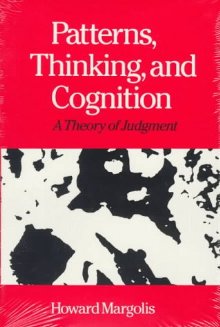
Patterns, Thinking, and Cognition, A Theory of Judgment, by Howard Margolis

Margolis’ thesis is “thinking and judgment…everything is reduced to pattern recognition.” Accordingly, he offers what he calls a P’ Cognition spiral, where the “spirals” represent a cognitive cycle and at the tops of the cycles represent a pattern recognition process. A review is in the works.

language.jpg

Language and Human Behavior, by Derek Bickerton Bickerton’s thesis is that “human cognition came out of language.” In this work, he defines language, explains the connection of language and evolution, and how language is integral to intelligence and consciousness. A review is in the works.

The final two books are  Personal Knowledge: Towards a Post-Critical Philosophy, and Meaning, by Michael Polanyi

“We know more than we can tell.” Michael Polanyi

There are several points of intersection between Polanyi’s work and that of Margolis and Bickerton, but what I found interesting were Polanyi’s treatment of what he refers to as two types of awareness; subsidiary and focal awareness. In Personal Knowledge, he offers an example of driving a nail, “I have a subsidiary awareness [also called from awareness in Meaning] of the feeling in the palm of my hand which is merged into my focal awareness of my driving the nail.” Subsidiary and focal awareness, according to Polanyi, are mutually exclusive where if one diverts one’s attention to the “feeling in the palm” one is likely to miss the nail. Musicians will recognize the distinction of “looking” at one’s hands will almost always divert from the music on the sheet.In Meaning, Polanyi goes further and assembles what he calls “three centers of tacit knowledge: first, the subsidiary particulars; second, the focal target; and third the knower who links the first to the second. We can place these three things in the three corners of a triangle. Or we can think of them as forming a triad, controlled by a person, the knower, who causes the subsidiaries to bear on the focus of his attention.”

Synthesis: I believe these ideas connect. For if Margolis is correct, then the “awareness” expressed by Polanyi would be apprehended using pattern recognition; recognition of patterns using Bickerton’s ideas with respect to language. Language is pattern-based, and we use language patterns in sense-making/creation of meaning.

More to come.

2011, meet 1997 (and 1995, and 1943…)

Wednesday, May 25th, 2011

[ by Charles Cameron — creativity, IARPA, HipBone Games, h/t Hermann Hesse ]

.
Funny thing, that.

quo-iarpa.gif

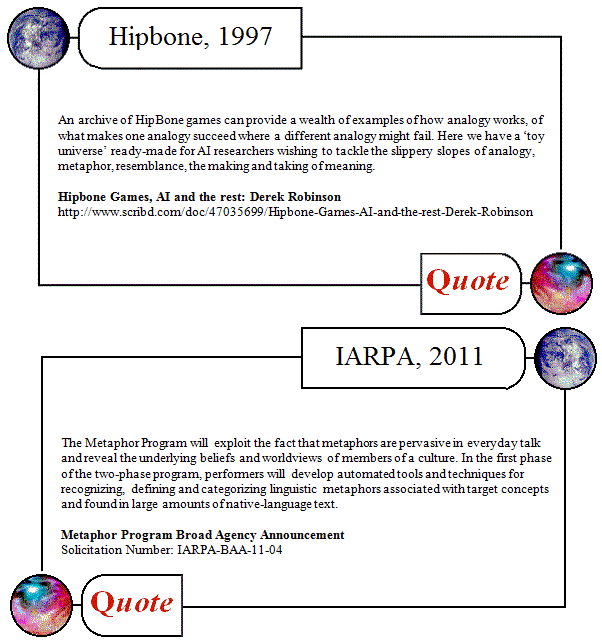
In 1997, Derek Robinson wrote a short piece about my HipBone Games, indicating what they were good for. Read it – then read the IARPA solicitation that just came out.

My approach is to lure people into discovering analogies, metaphors, parallels and oppositions by playing a game which elicits them as game moves — a live process, and one that cuts to the very heart of creativity — IARPA wants an automated version, which will be clunky by comparison. And as Derek points out in his piece — pointed out, that is to say, fourteen years ago, quoting an even earlier (1995) comment from Douglas Hofstadter:

If, instead of using the real world, one carefully creates a simpler, artificial world in which to study the high-level processes of perception, the problems become more tractable.

That’s what my games are — “a simpler, artificial world in which to study the high-level processes of perception” — specifically, “of analogy, metaphor, resemblance, the making and taking of meaning”.

I’ve been working on this stuff for at least fifteen years… inspired by a book Hermann Hesse published in 1943.

*

And oh yes, there’s a “future of search engines” hiding in there, too.

AQ Merch

Monday, May 23rd, 2011

[ by Charles Cameron — AQ tech savvy, impact of visuals ]
.
.
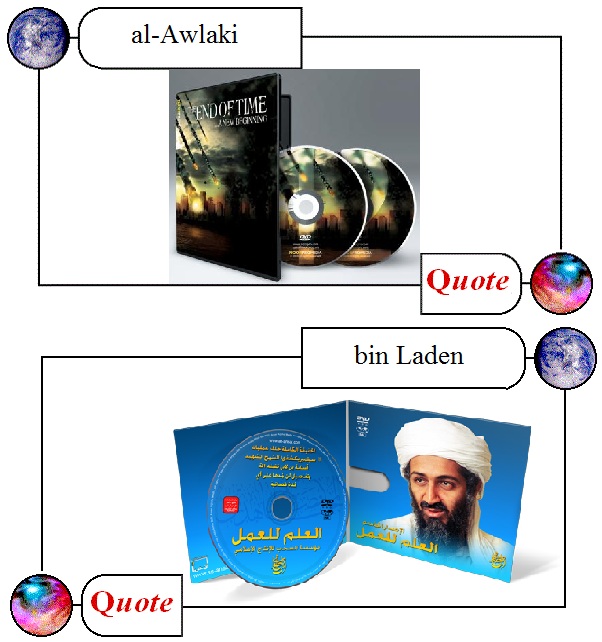
Jarret Brachman told us a while back:

Jihadi movement participants, he [al-Awlaki] argues, should also use computers, CD-ROMs, and DVDs to circulate large quantities of jihadi information—in the form of books, essays, brochures, photographs, and videos—in a highly compressed fashion.

I know that in theory, it doesn’t surprise me too much — but visuals like these bring it home to me in a way that reading words never will:

quo-aa-and-obl-merch.jpg

*

Merchandise — CDs and DVDs, the coin of the info-realm.

BTW, that Brachman article, High-Tech Terror: Al-Qaeda’s Use of New Technology, will be familiar to many who read here, but is worth reading if you don’t already know it.

Creativity and the laughable

Monday, May 16th, 2011

[ by Charles Cameron — creativity, Taliban, Leonardo, pareidolia, Virgin Mary, Kwan-yin ]
*

.
Sharing, as I do with Zen, a keen interest in the creative process, I am used to the idea that an idea that seems trivial at first, the very expression of which risks making oneself a laughing-stock, may well carry the seed of success.

Whitehead is quoted as saying, “Every really new idea looks crazy at first.” Einstein, “If at first the idea is not absurd, then there is no hope for it.” Nils Bohr, “Your theory is crazy, but it’s not crazy enough to be true.” The idea is not even confined to physicists and mathematicians. Mark Twain observed, “The man with a new idea is a crank – until the idea succeeds.” And Winston Churchill, “No idea is so outlandish that it should not be considered with a searching but at the same time steady eye.”

I was therefore intrigued to read this account of the origins of the Taliban’s recent Kandahar prison break:

One of the surprising mujahideen squad in the city of Kandahar, who by his connections gained full knowledge of the inside and outside of the prison, pondered one day whether it could be possible to dig a tunnel from the inside of a house on the other side of the street to the prison as a means to releasing the prisoners. This fantasy and imagination seemed laughable at first even to its owner; he dared not share his opinion with others. But, after more time and continued thinking, he reached a conclusion. On one of these days, while he was riding a motorcycle with two of his comrades, he shared that view with them. They thought it impossible initially and deemed it a fruitless, dangerous attempt. Finally, they placed their trust on God and shared their opinion with the mujahideen high command in Kandahar. With guidelines from the command, the aforementioned four revealed [to] their trusted comrades their decision to implement this plan regardless of its risks and even if it looked impossible.

The sentence that really got my attention was this one:

This fantasy and imagination seemed laughable at first even to its owner; he dared not share his opinion with others.

*

Leonardo da Vinci once wrote of having “a new and speculative idea, which although it may seem trivial and almost laughable, is none the less of great value in quickening the spirit of the invention.”

His “trivial and almost laughable” idea?

It is this: that you should look at certain walls stained with damp or at stones of uneven colour. If you have to invent some setting you will be able to see in these the likeness of divine landscapes, adorned with mountains, ruins, rocks, woods, great plains, hills and valleys in great variety; and then again you will see there battles and strange figures in violent action, expressions of faces and clothes and an infinity of things which you will be able to reduce to their complete and proper forms. In such walls the same thing happens as in the sound of bells, in whose strokes you may find every word which you can imagine.

Essentially, Leonardo is suggesting that we use what’s effectively the Rorschach technique to induce pareidolia (I think that’s the state) and elicit mental contents – images triggered by the mind’s eagerness to sense meaning – thus imitating the universe itself in bringing something out of nothing, out of the potent void.

*

This is, however, the same psychological mechanism that brought us the sale of a grilled cheese sandwich for $28,000 on eBay – because it “looked like” the Virgin Mary

That’s not a note I’d like to end on, however — so I’ll just remind myself that we don’t “know” what the Virgin Mary looks like, and pass on to the rather charming story of a similar pareidolic image, this one possessing the almost miraculous property of looking simultaneously like the Blessed Virgin and the bodhisattva of compassion, Kuan-Yin:

Situated in the East Bay area, near the lovely city of San Francisco, the Purple Lotus School is witnessing yet another miracle. … In April 1996, when the great “Merit Wall” on campus had just been constructed, a mysterious face appeared on the wall immediately after the cement dried. … Buddhists who have witnessed this phenomenon believe this to be the face of the compassionate Bodhisattva Kuan-Yin. … Others have believed this image to be that of the Virgin Mary. Magia and Junia Chou, the daughters of the Purple Lotus Society’s Master Samantha Chou, attend a Catholic elementary school. Upon seeing the image, both called out earnestly and delightedly, “Look! It’s the Virgin Mary!” … With the essence of Enlightenment and universal wisdom in mind, perhaps one can argue that a distinction between the two is not important after all.

*

It’s laughable, I know — but I must confess I like the “meaning” I can draw from that…


Switch to our mobile site