zenpundit.com » foreign language

Archive for the ‘foreign language’ Category

Great question!

Tuesday, May 21st, 2013

[ by Charles Cameron — from Paradise Regained: Overcoming Terrorism in Star Trek Into Darkness ]
.


.

Matt Ford, guest-blogging at Grand Blog Tarkin [includes spoilers] asks:

How many young Americans learned Arabic and Pashto or studied counterterrorism and international relations because nineteen men flew three planes into a building and one into the ground, killing thousands?

Great question!

And how many in the UK after 9/11? — and after 7/7?

**

Also worth reading [and also includes spoilers]:

Amy Davidson, Is “Star Trek into Darkness” a drone allegory?

Jottings 9: Boko / Beaucoup Haram

Monday, May 20th, 2013

[ by Charles Cameron — who just can’t resist a skilled bilingual pun, and is also curious these days about terrorist logos & branding ]
.

Hamas logo, left, and putative Boko Haram logo, right, compared


**

I found my delicious multilingual pun in a comment from April 2012 on an RFI post titled Boko Haram en renfort des islamistes armés dans le nord du Mali:

Ces voyous la je les appèlerai plutôt bokou haram! Lisez ça beaucoup haram. … Ce qu’ils font peut juste être qualifié de beaucoup haram.

**

BTW, does Boko Haram really use a Hamas logo with its own name clumsily cut’n’pasted across the top, as illustrated above and suggested here?

On getting it right, eh?

Thursday, April 25th, 2013

[ by Charles Cameron — with a little help from the Buddha, fake quotes, self-referential paradox, a pinch of salt, and two tbsps of anthropology ]
.

Over the last ten days we have seen a whole lot of speculation, misinformation, spin and gossip masquerading as analysis and journalism, and that was on my mind when I ran across an alleged Buddha-quote that told me to use my common sense — and since my common sense told me there probably wasn’t a phrase in Pali, the language of the earliest Buddhist texts, that would correspond too closely to the highly idiomatic English usage, common sense, I thought I should check it out with Fake Buddha Quotes, my go-to place for checking what the Buddha is supposed to have said:

I’m pretty sure the Buddha never said “Pretty sure I never said that” too, for much the same reason.

**

But what delights me most about all this is just how self-referential this all is: the Buddha allegedly warns us against trusting what we read even when it’s attributed to him, in what turns out to be a faux quote attributed to him, based on a real quote that reads (in one translation):

Any teaching should not be accepted as true for the following ten reasons: hearsay, tradition, rumor, accepted scriptures, surmise, axiom, logical reasoning, a feeling of affinity for the matter being pondered, the ability or attractiveness of the person offering the teaching, the fact that the teaching is offered by “my” teacher. Rather, the teaching should be accepted as true when one knows by direct experience that such is the case.

**

Fpr what it’s worth, the abbreviated version doesn’t mean the same as the original. From Koun Franz at Sweeping Zen:

his is a very different idea. The original says we need to verify through direct experience; the popular version says that we can stand back from the practice, at a distance, and use reason to determine its authenticity.

Or this, from Bodhipaksa, the Fake Buddha Quotes guy, :

The Buddha of course isn’t saying we should jettison reason and common sense. What he’s implying is that both those things can be misleading and what’s ultimately the arbiter of what’s true is experience. It’s when you “know for yourselves” that something is true through experience that you know it’s true.

**

Another comment on the same page led me to this first comment on cultures and languages —

which in turn reminded me of the second, a long-time favorite of mine from the time when I was some sort of Anthro professor in dreamy Oregon…

**

And, y’lnow, both those quotes in my second pair give you a visceral sense of what today’s SWJ article by Robert R. Greene Sands and Thomas J. Haines, Promoting Cross-Cultural Competence in Intelligence Professionals is very rightly on about, though it’s all phrased in a manner so abstract you might easily miss the point…

Mitigating cognitive, cultural and a host of tradecraft biases is essential for intelligence professionals to navigate through today’s culturally complex environments. Adopting the perspective of contemporary cultural groups, including nation-states, often defies understanding because the intelligence professional is challenged to both appreciate and consequently discern meaning of behavior that is predicated on vastly different beliefs and value systems. Fundamental to this dissonance is a markedly different cultural reality resulting from different histories, traditions and the stasis of culture. The professional’s western and deeply seated worldview impedes either the analysis itself, or is perjured by the cognitive restrictions imposed by the structured analytic strategies used.

The quote about the Wintu — it’s from Dorothy Lee, Linguistic Reflection of Wintu Thought, Chapter 9 in Dennis and Barbara Tedlock‘s Teachings from the American earth: Indian religion and philosophy — goes on to say:

The Wintu relationship with nature is one of intimacy and mutual courtesy. He kills a deer only when he needs it for his livelihood, and utilizes every part of it, hoofs and marrow and hide and sinew and flesh. Waste is abhorrent to him, not because he believes in the intrinsic virtue of thrift, but because the deer had died for him.

Now there‘s “a markedly different cultural reality” for you!

Empirical Studies of Conflict Site

Monday, January 21st, 2013

For those studying war, insurgency, irregulars or terrorism ESOC will be extremely useful – and depending on your area of research, possibly invaluable – as a resource.

Small Wars Journal had this to say about ESOC:

.…ESOC identifies, compiles, and analyzes micro-level conflict data and information on insurgency, civil war, and other sources of politically motivated violence worldwide. ESOC was established in 2008 by practitioners and scholars concerned by the significant barriers and upfront costs that challenge efforts to conduct careful sub-national research on conflict. The ESOC website is designed to help overcome these obstacles and to empower the quality of research needed to inform better policy and enhance security and good governance around the world.

The ESOC team includes about forty researchers (current and former) and is led by six members: Eli Berman, James D. Fearon, Joseph H. Felter, David Laitin, Jacob N. Shapiro, and Jeremy M. Weinstein.

The website is organized by countries and research themes. The six country pages are: Afghanistan, Colombia, Iraq, Pakistan, the Philippines, and Vietnam. The content is structured according to five themes: Demographic/Socioeconomic, Geography, Infrastructure, Public Opinion, and Violence. The website currently hosts about 45 ESOC data files, over 35 ESOC peer-reviewed publications (with replication data), and ten working papers. The ESOC team has also posted links to many external data repositories and external readings that have proven useful for analysis. The website will be regularly updated with new micro-level conflict data and contextual information, as it is compiled and submitted by ESOC researchers.

One caution: based on my source who was one of the folks gathering data for part of this project, as with all quantitative method research, there are hidden qualitative decisions in who did the counting, how and by what yardstick. If you are drawing conclusions about big picture trends in insurgency or irregular warfare across periods of time you are good to go. If your research is sharply confined to a specific and narrowly defined historical case study (say one campaign, a battle, one district – whatever), then drill down into ESOC’s data and methodology to the granular level before drawing a conclusion vice your sources and data outside ESOC.

Numbers by the numbers: four

Wednesday, July 18th, 2012

[ by Charles Cameron — importance of the ratio form (“this is to that as thus is to so”) as a bridge between domains and silos, creative leaps, the glass bead game, and finally, Chittick’s joke about camels, sex and translations from the Arabic ]
.
.

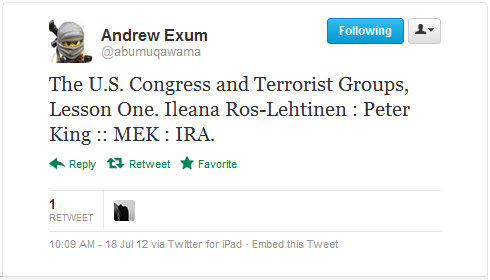
I retweeted this tweet of Andrew Exum‘s to my friend Paul Pilkington because I know he’s working on a project to find out what “this is to that” is to some other “this is to that” — across a wide swathe of human culture.

Note particularly that Exum is using this formal device to illuminate, to give insight, in an area of importance to analysts, strategic thinkers and decision makers.

I’m also retweeting Exum to Paul because I believe Paul’s simple experiment, based as it is on his reading of Hermann Hesse‘s Glass Bead Game, has the capacity to build an architecture of thought (a) crossing all disciplines and (b) spanning the trivial with the profound.

I’m doing something similar with Cath Styles in our Sembl games project — but this time I want to concentrate on Paul’s approach, and since there are four moving parts in an a is to be as c is to d configuration, I’m calling this post Numbers by the numbers: four — number three will just have to wait a while.

**

To get a sense of what Paul is up to, we can go to his Twitter Project page, which describes the fourth in a series of books he’s writing — and also follow him on Twitter, where he posts as Just Knecht.

Two of Paul’s recent tweets express his sense of the task pretty incisively:

The whole of language is the holding up of one unlike thing to compare, contrast and connect with another

Curating is a matter juxtaposition of work against work, artist against artist, place against place – A.Searle on Documenta 13, The Guardian

On his Twitter Project Page, he tells us:

Each tweet is an individual Glass Bead Game move, which is a comparison (metaphor, simile or analogy) across different areas, and may be either a statement or a question.

In question form, these are not unlike analogy questions from SAT tests with an additional dimension of general knowledge, cultural invention and intellectual playfulness. The basic challenge is to work out the relationship between two terms in one context, and apply it in another. Sometimes a tweet will extend an analogy further, which would be the beginning of forming a larger game from an individual move.

Some of the most interesting moves do not have right or wrong answers. Some have canonical or original answers, but they’re not necessarily right. In fact, very often I will post something I’ve picked up from elsewhere which I would love to see improved on, challenged, or at least better explained by others.

He then poses some of the sorts of questions that intrigue him:

Who is the J.H.Prynne of contemporary dance? Like Prynne in contemporary poetry they need to have been ‘out there’ right at the edge of theory and practice for some time, and also deeply steeped in tradition at the same time. Merce Cunningham? Suggestions welcome … And Heston Blumethal or Ferran Adrià might be the Prynne of cookery. But what about the Prynne of contemporary warfare?

What is the equivalent of sonata form in architecture? Goethe and Hegel both said ‘architecture is frozen music’ but neither really explained what they meant. If it is, then is there an architectural equivalent in Western architecture of the key structural form in Western art music? Suggestions welcome …

So, Zenpundit readers — who is the JH Prynne of contemporary warfare?

**

Not so long ago, in Numbers by the numbers: one, I posted a series of self-referential tweets that I’d collected over the last month or two — here I’d like to present some of Paul’s recent tweets:

Let’s start with one that’s a foreign policy insight, arguably as significant to day as it was when Vance first said it:

16 Jul @justknecht
“The Strait of Hormuz is the jugular vein of the West” (Cyrus Vance)

If these tweets can be timeless, they can also be timely:

4 Jul @justknecht
The Higgs boson is the quantum of the Higgs field, just as the photon is the quantum of the electromagnetic field

As they accumulate over time, they can build a conceptual “mesh” that engages an entire field — in this case, recent classical music — while linking it to a variety of other areas:

16 Jul @justknecht
“Boulez’ Derive 2 sounds like birthday cakes ought to” – Philip Clark, Gramophone

22 Jun @justknecht
Wagner was a beautiful sunset that was mistaken for a dawn – Claude Debussy, quoted by Geoffrey Norris in Gramophone

30 May @justknecht
Fauré’s Theme and Variations (no. 9) is like an evening star falling slowly from the sky – Bryce Morrison cites Alfred Cortot in Gramophone

11 May @justknecht
Kraftwerk is the Warhol of pop music – The New Yorker

There’s profundity here:

9 Jun @justknecht
“Space is to place as eternity is to time.” – Joseph Joubert

This could be, as Paul says, “the beginning of forming a larger game from an individual move” — that quote in itself could plausibly be the keystone of an architecture bridging science with religion…

There are historical parallels to consider:

31 May @justknecht
Robert Burton : Oxford :: Jeremy Prynne :: Cambridge

Catty remarks by Nobel laureates:

21 May @justknecht
“Thinking is to humans as swimming is to cats” (Nobel laureate Daniel Kahneman)

Near-tautologies:

21 May @justknecht
Macon Telegraph: Recipes are to food as blueprints are to buildings.

And, ooh, exotic forms of slander!

18 May @justknecht
“[Your daughter] has lovers as numerous as the striking of tablas on Palm Sunday” – Arabic satire by Abu Nawas, 756 – 813 AD

Once again, it’s form that generates insight, not content. Get used to form, play around with it, and content will leap out at you from the page, from the screen.

**

I’m no Arabist myself, but ah! that last quote reminds me irresistibly of the difficulties faced by translators from the Arabic, as recounted by William Chittick in The Self-disclosure of God: Principles of Ibn Al-‘Arabi’s Cosmology (SUNY Press, 1998, pp. xxxv-xxvi.)

An old joke among orientalists tells us that every Arabic word has four meanings: It means what it means, then it means the opposite of what it means, then it has something to do with sex, and finally it designates something to do with a camel …. The rational mind tends to push the meaning of a word away from experience to ‘what it means’ but the imaginal mind finds the self-disclosure of the Real in the sex and the camel … it is in the world’s concrete realities that God is found, not in its abstractions.

I’d been looking for an excuse to post that quote on Zenpundit — now I’ve found it!

Switch to our mobile site