zenpundit.com » strategist

Archive for the ‘strategist’ Category

Time for a Grand Strategy Board?

Monday, April 25th, 2011
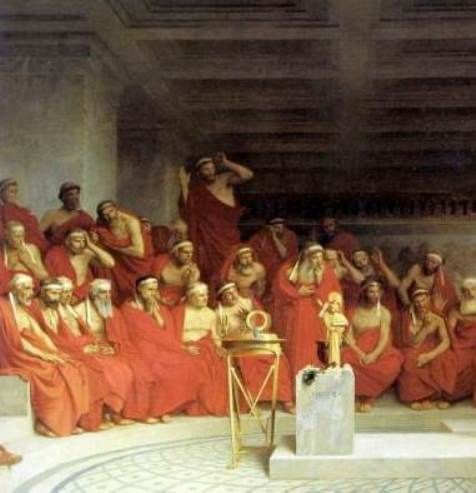
The Gerousia

“I have not lived so long, Spartans, without having had the experience of many wars, and I see among you of the same age as myself, who will not fall into the common misfortune of longing for war from inexperience or from a belief in it’s advantage and safety”

Archidamus, King of Sparta

One thing on which most commentators, academics and former officials seem to agree is that the United States government has a difficult time planning and executing strategy. Furthermore, that since 1991 we have been without a consensus as to America’s grand strategy, which would guide our crafting of policy and strategy. This failing bridges partisan divisions and departmental bureaucracies; there are many career officials, political appointees and even a few politicians, who can explain the nuances of the Afghan War, or the Libyan intervention, the depreciatory tailspin of the US Dollar or America’s Russia policy – but none who would venture to say how these relate to one another, still less to a common vision.

Sadly, they do not, in fact, relate to one another – at least not, as far as I can discern, intentionally.

Few American policies or even military operations (!) in one country can be said to have been conceived even within a coherent and logically consistent regional strategy and it is not just common, but normal, to have DIME agencies working at completely contradictory purposes in the same area of operations. The interagency process, to the extent that it exists, is fundamentally broken and incapable of interagency operational jointness; and the institutional coordinating mechanism for any “whole of government” effort, the National Security Council, has become too consumed with crisis management. A mismatched prioritization of resources which leaves little time for the kind of long range planning and strategic thinking that allows nations to seize the initiative instead of reacting to  events.

It would be a useful corrective for the better conception and execution of US policy, for the President and the Congress to create a special board for grand strategy that could give presidents and key officials frank assessments and confidential guidance to help weave their policy ideas into a durable and overarching national strategy. One that might last beyond a few days’ headlines in The New York Times.

The President of the United States, of course has a number of bodies that could, should but do not always provide strategic advice. There’s the Defense Policy Advisory Board, an Intelligence Advisory Board,  the National Intelligence Council, the State Department’s Policy Planning Staff, the Office of Net Assessment and not least, the NSC itself and the Joint Chiefs of Staff, whose Chairman, by act of Congress, is the military advisor to the President and Secretary of Defense. While strategic thinking does percolate from these entities, many have very specific mandates or, conversely, wide ranging briefs on matters other than strategy. Some operate many levels below the Oval Office, are filled with superannuated politicians or have personnel who, while intellectually brilliant, are excessively political and untrained in matters of strategy. The Joint Chiefs, the professionals of strategy, are highly cognizant of the Constitutional deference they are required to give to civilian officials and are very leery of overstepping their bounds into the more political realms of policy and grand strategy.

What  the President could use is a high level group just focused on getting strategy right – or making sure we have one at all.

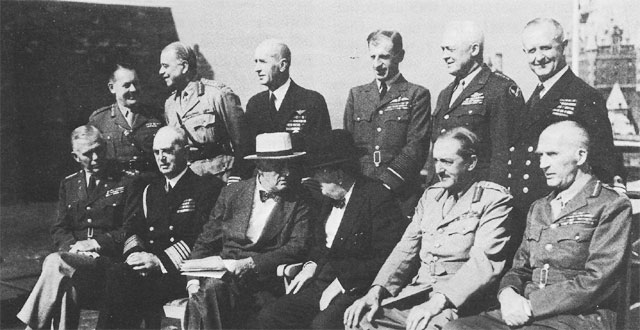
I’m envisioning a relatively small group composed of a core of pure strategists leavened with the most strategically oriented of our elder statesmen, flag officers, spooks and thinkers from cognate fields. A grand strategy board would be most active at the start of an administration and help in the crafting of the national strategy documents and return periodically when requested to give advice. Like the Spartan Gerousia, most of the members ( but not all) would be older and freer of the restraint of institutional imperatives and career ambitions. Like the Anglo-American joint chiefs and international conferences of WWII and the immediate postwar era, they would keep their eye on the panoramic view.
combined-chiefs.jpg

The Octagon Conference – FDR, Churchill and the Combined Chiefs of Staff

Here’s my grand strategy board in a hypothetical perfect world, unlike the one that prevails inside the beltway. I’m sure people will quibble with particular names or will suggest others. I freely admit, for example, that I do not have the best grasp of who our leading intellectual powerhouses are in the Navy, Air Force or the closed world of intelligence analysis and this impairs my ability to put together the list. Nevertheless, I’m trying anyway:

Let’s start with a group of acclaimed and eminent strategic thinkers who have demonstrated over a long tenure, their ability to consider matters of war, peace and statecraft as well as the nuances of strategic theory:

Thomas Schelling -Chairman
Andrew Marshall
Edward Luttwak
Colin Gray
Joseph Nye

Next, some senior statesmen:

Henry Kissinger
George Schultz
Zbigniew Brzezinski

Madeleine Albright

General officers and one colonel with a demonstrated talent for challenging conventional assumptions:

Lieutenant General Paul van Riper
General James Mattis 
General Jack Keane
Colonel John Warden

Two economists:

Alan Greenspan
Nouriel Roubini

Two scientists:

Freeman Dyson
E.O. Wilson

Mixed group of strategists, historians, practitioners and theorists:

David Kilcullen
John Robb
John Negroponte

Barry Posen
Antulio Echevarria

Chet Richards
Micheal Vlahos
Thomas P.M. Barnett
Stephen Biddle
Robert Conquest
Duane Clairridge
Jack Matlock
Martin van Creveld

Visionaries and Contrarians:

Nicholas Nassim Taleb
William Gibson
Ray Kurzweill
Andrew Bacevich

What are the problems with my grand strategy board (aside from having zero chance of coming into being)? 

For one, it is probably way too large. In my efforts to balance expertise in strategy with varied thinking it grew bigger than what is manageable in real life, if the group is to be productive.

Secondly, it is an exceedingly white, male and conservative leaning list – though to some extent that reflects the criteria of experience, the field of strategy itself and the nature of American politics.  Barbara Ehrenreich, for example, is definitely bright but her politics are fundamentally opposed to effectively maximizing American power in the world or the use of military force – thus making her of little use except as a voice of dissent.

Another limitation of this exercise is the idiosyncratic eclecticism of my approach – this was a blog post written over a few days in my spare time and not a methodical inquiry into who in American life would verifiably be the “best qualified” to help construct a grand strategy. There are “insiders” who command great respect within the national security, defense and intelligence communities who are unknown to the general public, or even this corner of the blogosphere, who would be enormously helpful to such a board. Finally, a grand strategy board would not be a panacea; it would be subject to all the inertial pressures that over time would reduce it’s ability to effect change, just as the Policy Planning Staff and the NSC have been “neutered” over decades by the forces of the status quo.

That said, the above group or one reasonably comparable to it could, for a time, markedly improve the construction of strategy , assuming American leaders are willing to enlist such advice, put aside short term political considerations and pursue long term strategic goals.

Whom would you nominate to a grand strategy board?

Grand Strategic Viewing:

Porter at Infinity Journal

Friday, April 8th, 2011

Infinity Journal has added a more “blog-like” or “column-like” section to cover events within a contemporaneous frame in addition to their peer-review articles which come out quarterly (or perhaps bimonthly) more contemporaneous peer reviewed articles, oriented toward current events, in addition to their quarterly publication of the journal . Dr. Patrick Porter of Offshore Balancer ( and King’s College) has the maiden post with a provocative piece:

Exclusive: Lost in Libya: The UK does not understand strategy

The limited war of 2011 would refuse to be quarantined. After all other options were exhausted, it could culminate in a land war against Tripoli. Distressingly, we would shoulder the burden of invading, pacifying and administering this country. Occupation would probably lead to resistance – and Libya propelled more foreign-born jihadi volunteers into Iraq than any other nation. A new front in the War on Terror would open up. Idealists now calling for humanitarian rescue would discover that all along they opposed Western imperial hubris….

Free registration required. 

Admittedly, I stole the excerpt above from SWJ Blog – the online format of IJ makes it difficult for bloggers to quote sections of articles by copying and pasting into blog posts. This probably cuts down on the velocity and extent of IJ articles circulating in the .mil/strategy/foreign policy online world (blogosphere, twitter, listservs). OTOH the editors may not care as it probably reduces the amount of inane vs. informed criticism as well 🙂

In any event. Dr. Porter’s article is worth reading.

More Books and Reviews to Come

Wednesday, March 30th, 2011

Going to try to catch up this week on the backlog of book reviews I need to do, particularly those books sent to me by publishers. I may have to break down and do a set of mini-reviews, so far behind I have gotten myself.

So, naturally, that was a suitable pretext to order more books 🙂

Here’s what arrived the other day….


STRATEGY: The Logic of War and Peace by Edward Luttwak

War Before Civilization by Lawrence H. Keeley

WAR: In Human Civilization by Azar Gat

The World of Yesterday by Stefan Zweig

Why the West Rules – For Now by Ian Morris

Luttwak’s book is a strategy classic and I recently enjoyed his Grand Strategy of the Byzantine Empire. I first heard of Stefan Zweig from Lexington Green but nearly everyone who has read The World of Yesterday that I have encountered has raved about it, so I am looking forward to that one. Why the West Rules- For Now is another rec from the Chicago Boyz crowd but I do not think that anyone has reviewed it there as of yet. Finally, I am pairing War Before Civilization with Azar Gat’s War in Human Civilization – have a sense that Gat’s ideas may be somewhat in tune with Martin van Creveld.

Have you read any of these?

OODA and “Strategy Making Process” for Business

Friday, March 25th, 2011

Handbook of Research on Strategy Process by Pietro  Mazzola and Franz W. Kellermans (Ed.)


Dr. Chet Richards has contributed to an important new theoretical book on strategic applications to business enterprises. For those newer readers, Chet is an authoritative source on strategy, particularly the theories of Colonel John Boyd and is the former proprietor of the late, great, strategy website DNI. I have learned a great deal over the years from Colonel Richards and heartily recommend his Certain to Win to anyone looking for the strategic edge.

For readers with a corporate credit card or departmental budget ( the book is *really* expensive) and a deep, academic or professional interest in strategic theory and thinking, this book is for you. I may require Inter-Library Loan. 🙂

As Chet describes it:

Deep stuff – very academic – but covers the waterfront of the research (i.e., as distinguished from the speculation) on the process of strategy.  As the co-editors describe it:

While strategy content focuses on the subject of the decision, strategy process focuses on actual decision making and its associated actions.  Strategy process research examines the process underpinning strategy formulation and implementation. … Although aimed primarily at the academic community, many of the contributions speak to a wider audience.

Expensive, but if you’re into this sort of thing, probably indispensable.

The Existence of the Operational Level of War, For and Against

Wednesday, March 16th, 2011

I was involved in a discussion elsewhere regarding the excellent and thought provoking article at SWJ by General Huba Wass de Czege on operation art, design and thinking:

Operational Art is Not a Level of War

Strongly recommend you read the article first. My remarks follow, slightly revised:

I have only read a few pieces by General Wass de Czege, those published at SWJ but the caliber of the general’s self-reflective, professional, thinking is something we should strive to emulate.

Here is what seems to be the crtical point in his article, after which I have a comment:

 “We doctrine writers of the 1980’s inserted operational art as a mid-level of war between tactics and strategy – making it the art of translating the governing strategy into the implementing tactics of the “tactical echelons.” And thus, making operational art the province of “campaigning” generals. Because of the way I was conditioned to think then, that strategy was the business of the upper echelons and tactics the business of the lower ones, I miss-translated an idea borrowed from Soviet doctrine about the mediation between strategy and tactics. I was then a product of indoctrination in the US Army’s War and Command and Staff Colleges. These institutions, and the business schools of the time, taught based on the industrial age organizational model of the head (where strategic decisions are made) and the rest of the body (where tactical decisions implement the strategy). I now believe that, without violating the historical meaning of the terms strategy and tactics, this is a much more useful and natural way to think of the relationship between tactics, strategy and operational art.

In fact, this allows one to close the conceptual gap between our bifurcated way of thinking about warfare between nation states and that between states and armed movements of any kind. It also helps do the same for the two tactical operating modes that have recently surfaced in new Army concepts – “combined arms maneuver” and “wide area security.”

Campaigning, another word for operational art, can occur at any scale, and in any milieu, as a close look at what our best company, battalion, and brigade commanders have been doing in Iraq and Afghanistan. “

I think maybe this should be qualified – re; operational art is not a “level”. It is a level of war and it is not at the same time.
 
The difference between the two I think is *how* we are employing the term: “Operational art” as a historical, taxonomic, description of how a military-political command structure has behaved/behaves as a warfighting institutional culture vs. methodologically how they *could* and *should* think about warfare and in turn behave at any “level”.
 
It is not surprising to me, thinking in terms of history, that Wass de Czege, where he wrote that he was in error, was drawing from Soviet examples. If we think about “operational art” as a “level of war” we are led to military powers where powerful ideological constraints systemically interfered with the “natural” clausewitzian connection between Policy and Strategy.
 
The USSR’s Red Army, from the early days of Commissar-Commander relationships in battle, through the Stalinist era to the more modern and restrained (i.e. non-murderous) controls of the Army’s Political Department and vetting security checks for promotion carried out jointly by the military, State Security and Party organs, created an atmosphere where deferral of political implications caused a) a segregation of an officer’s intellectual initiative to organizational and technical military questions and b) constructing military strategy and operational campaigns to at least nominally reflect Marxist-Leninist dogma and the Party line as a matter of necessity, and for a period, in an effort to try and avoid being physically liquidated.
 
Most of the Soviet Union’s most gifted military strategists and tacticians were unsuccessful in this regard and perished (ex. Svechin, Tukhachevskii, Blyukher). Arguably that left an institutional legacy in it’s wake that narrowed the conceptual framework with which Soviet Marshals and generals approached planning for war, including nuclear war.
 
Germany is another example, with the policy-strategy split favoring a professional military focus on operational art emerging as early as 1870 in tensions between Bismarck and Moltke over the war with France, growing worse during the Great War until during the Third Reich, a state of enforced paralysis occurs after 1942 on the Eastern Front. In theory, Hitler, who was his own war minister and commander-in-chief of the Army in addition to being the Supreme Commander, Fuhrer and Reich Chancellor, could (like Stalin) have resolved any contradictions or discordance between Policy and Strategy. Hitler deliberately chose not to do so and his paranoia led him to eventually limit even his field commander’s tactical flexibility (some generals, like Rommel, resisted this more effectively than others).
 
The US military, in my view, suffers a similar fixation. The reasons are very different – proper constitutional deference to civil authority coupled with a limited or absent capacity of most civilian political authorities to think in a complementary strategic fashion that would allow them to best guide their military commanders in jointly constructing a seamless bridge between policy-strategy-operational campaign. Another reason, though I do not want to go into it here, is a cultural reaction to the experience of the Vietnam War that became embedded in the officer corps during the shift to the AVF starting with the Nixon administration.
 
Tom Ricks had a very interesting post at Best Defense while back on the Hew Strachan article in which Ricks argued against the existence of an operational level of war, but as we are not discussing platonic forms, militaries are at whatever “level” of war for which their culture institutionally encourages officers to think about and plan. So in that sense, Wass de Czege is absolutely correct – they can and should be thinking across the whole range and not in “slots”. However, if they don’t do what he suggests and if they do predominantly focus on one “level” as most of their thinking and planning, be it tactics, operations, strategy. Then that level “exists”, it leaves a bureaucratic “trail”, grows a structure to execute it and will be put into practice during a war – at least initially until events force a change of practice from below (the field) or above ( political leaders).


Switch to our mobile site