zenpundit.com » arab world

Archive for the ‘arab world’ Category

Guest Post: Charles Cameron on Farrall and al-Masri

Tuesday, October 27th, 2009

By Charles Cameron

Something veeery interesting is breaking in the blogosphere: Leah Farrall is talking with Abu Walid al-Masri.

Leah Farrall blogs with verve and insight. She has been a “senior Counter Terrorism Intelligence Analyst with the Australian Federal
Police and the organization’s al Qaeda subject matter expert” who served as “senior Intelligence Analyst in the AFP’s Jakarta Regional
Cooperation Team (JRCT) in Indonesia and at the AFP’s Forward Operating Post in response to the second Bali bombings”. She’s now working on here PhD thesis on “Al Qaeda and militant salafist jihad”.

One of the leading figures in the interwoven tales of Al Qaida and the Taliban is Abu Walid al-Masri, who also blogs. According to his West Point CTC bio, Abu Walid fought for eleven years as a muj against the Soviets in Khost, Afghanistan, where he “gained a reputation as a skilled and pragmatic strategist and battlefield tactician”. He criticized bin Ladin’s 1991 decision to relocate AlQ to the Sudan, and was an early member of Mullah Omar’s circle. He also served as a reporter for Al-Jazeera, and (as the profile puts it) ended up wearing “several hats: Taliban propagandist, foreign correspondent, and al-Qa’ida trainer and strategist.” He strongly opposed 9/11.

In his early writings, he quoted Lenin, Mao, and Sun Tzu — and his writings have been extensive. Leah writes that in her view:

“….his work (12 books in all plus articles) was the most comprehensive and accurate of all memoirs or first hand accounts of al Qaeda and more broadly the history of Afghanistan since the Soviet invasion. I reached this conclusion after literally spending years and years cross checking his work with other accounts and all manner of sources, from both sides, for use in my thesis…”

And now for the drama:

As Leah notes with understandable excitement, Abu Walid has begun to respond to her blog posts with his own.

Readers of Zenpundit already know the power of multi-blogger conversations, and indeed it was one such conversation that gave rise to the Boyd Roundtable book that Zen himself edited.

This engagement between Leah and Abu Walid takes things a step further — two enemies, one an intel analyst and the other an insurgent strategist, are now holding a debate in public across the blogs.

That’s an interesting conversation to watch in its own right — and I trust Leah will bring Abu Walid’s side of it across into English. It is
also, it seems to me, an historic moment in the use of cyberspace.

*

Postscript:

Leah on Abu Walid responding to her blogging:

Text of Abu Walid’s response in Arabic — Leah notes she hopes to put up an English digest, if not a full translation, shortly:

It’s worth noting that there’s a somewhat similar conversation developing between some UK-based Sunni Salafist supporters of the Baluch action and western analyst-bloggers:

Again, it’s fascinating if you’re interested in web-based discourse, and with a nice Mahdist strand in there to please little old me.

I hope to pick up on that aspect with a post here shortly.

And then there’s blogger friend John Robb, who has recently been emailed by the Nigerian Henry Okah, whom Robb considers “hands down the most innovative and successful guerrilla entrepreneur in the world today”:

Guest Post: Iran or Afghanistan? The Black Flags of Khorasan…

Thursday, September 17th, 2009

Returning as a guest-blogger, Charles Cameron, who is the former Senior Analyst with The Arlington Institute and Principal Researcher with the Center for Millennial Studies at Boston University. The topic is an update on Cameron’s previous cautionary post on the potential implications of an emerging strand of Mahdism among radical Islamists.

( Ed. There will be an update later with two supporting images when I resolve a minor technical issue….)

Iran or Afghanistan? The Black Flags of Khorasan… 

By Charles Cameron.

 i

A couple of days ago I saw a video, posted on YouTube September 12, 2009, titled “The Army Of Imam Mahdi”. It carries the subtitle: “Soon the Army of Imam Mahdi will start its march from Afghanistan towards The Holy Land( Palestine ) and liberate it from the claws of Israel”. I have embedded it for your viewing convenience at the bottom of this post.

This video suggests that I should follow-up on my previous post, “Mahdism in the News” at , in which I noted that the personal representative of Ayatollah Khamenei, the Supreme Jurisprudent of (Shi’ite) Iran, had issued a call to neighboring and sympathetic nations to a joint mobilization in preparation for the return of the Mahdi.

That was a Shi’ite affair: but Sunni Muslims also await the Mahdi’s arrival, though not as the returning Shi’ite Twelfth Imam — and this video correspondingly offers us an appropriate parallel to Ali Saeedi’s call — but IMO should not be confused or conflated with it.

ii

I would like to make this much clear at the outset.

It is roughly as likely that the Ayatollah Khamenei would accept a Mahdi from among Al Qaida or the Taliban as it is that Pope Benedict would accept a Christ who staged his Second Coming in support of the fiercely anti-Catholic Rev. Ian Paisley of the Free Presbyterian Church of Ulster.

That’s not a scholarly comparison, by the way — more of a powerful hunch. But I think it needs to be said.

The Imam Mahdi of the Shi’ites is himself their Twelfth Imam, who was born in 869 CE and then “occulted” — hidden from mundane sight — centuries ago, returning among us in the fullness of time. He is Shi’a of the Shi’a, Muhammad ibn Hasan ibn ‘Ali, the last and greatest in the great Shi’ite lineage of the Twelve Imams.

iii

It was Joel Richardson’s blog at that first alerted me to this video (hat-tip, Joel). He writes:

This is the first time that I have seen solid proof that al-Qaeda and the Taliban is thoroughly guided by Islam’s demonic eschatology. For those who claim that Mahdism is only held by Shi’a, take note that it is a Sunni group that has created this thoroughly Mahdist video and not Shi’a. Al_Qaeda and the Taliban literally views themselves collectively as the Mahdi’s army carrying the Black Flags that will march to Jerusalem to “liberate” it from the Jews. This is a full blown Al-Qaeda / Mahdi Army recruitment video.

I think that’s a bit of an overstatement. I’d say more cautiously that this is evidence that al-Qaeda and the Taliban can be construed in light of Sunni Mahdist expectation, and may view themselves as the Mahdi’s army — and definitely shows that a Mahdist current is at work in some Sunni circles.

The sheikh who is quoted in the video is from Trinidad.

In a more far reaching post at , Joel also claims that the video was ” released under the al-Sahab label” — the al-Sahab logo appears on some of the footage, but the video itself is not from al-Sahab as far as I can determine — and his subtitle, which may have been provided for him by a WND editor, claims the video contains “footage confirming unity of apocalyptic Muslims”. Given Joel’s reference in the same post to the recent Iranian “mobilization” call on which my own earlier post was also based, I think it is important to emphasize:

(a) that while Sunni and Shi’ite Muslims may both be in expectation of the Mahdi, and may indeed both (sometimes) draw on ahadith about his army coming with black flags out of Khorasan, this does not mean that the two streams of Mahdism can be lumped together as a single movement, and

(b) that this video appears to be a production of sympathizers with the Taliban, rather than an Al-Q / al-Sahab production.

iv

The key passage in the video is a discourse attributed to Sufi Shayk Imran Nazar Hossein, who says:

The true messiah will destroy the false messiah. And when that happens then a Muslim army will liberate the Holy Land. The Prophet said, when you see the black flags coming from the direction of Khurasan, go and join that army. That army has already started its march. They know it, and that’s why they demonize as a terrorist anyone, anyone who supports that army. That army will liberate every single territory in a straight line until it reaches Jerusalem said Muhammad (as). At the heart of Khorasan is Afghanistan, and that’s why they have occupied Afghanistan. When that army liberates every territory on its way to Jerusalem, there will be in that army Imam al-Mahdi, and so the liberation from oppression in the Holy Land is not going to come about through any negotiations…

This would appear to be the Islamic scholar Imran Nazar Hosein (to use the spelling of his name used on the website dedicated to his work ), and the video clip that shows him was very likely taken some years back.

His biography can be found here. He appears to have had a distinguished career, including a period spent as Director of Islamic Studies for the Joint Committee of Muslim Organizations of Greater New York, and is the author of Jerusalem in the Qur’an – An Islamic View of the Destiny of Jerusalem.

v

The video includes clips of various mujahideen firing weapons and practicing martial arts, including one with shots of riders with a black flag…

and an image of the Dome of the Rock in Jerusalem (Baitul Maqdas), which appears to be their final goal.

vi

The hadith about the “black flags of Khorasan” mentioned here are, as I understand it, not strongly supported in the hadith literature, but they are available for quotation by those who wish to suggest that the Mahdist army will come from the general area now known as Afghanistan — or Iran, for that matter — a suggestion that gains interest as Afghanistan — or Iran — gains in geopolitical prominence…

Some quick indicators:

Sheikh Salman al-Oadah — once imprisoned for criticizing the Saudi regime and now one of its approved religious spokesmen — writes:

The hadith about the army with black banners coming out of Khorasan has two chains of transmission, but both are weak and cannot be authenticated. If a Muslim believes in this hadith, he believes in something false. Anyone who cares about his religion and belief should avoid heading towards falsehood.

Some people have used this hadith to support their claim that the Mahdi is from the family of al-Abbas and that the Mahdi is from of the Abbasid dynasty. There were Abbasid Caliphs who went by the name al-Mahdi.

The banners of the Abbasid State were black. It is not hard to see how this weak hadith might have been fabricated or at least tampered with to support the Abbasid cause.

That’s the negative view, to be set against significant Sunni jihadist currents that find the hadith useful.

As David Cook notes in his Contemporary Muslim Apocalyptic Literature, p. 173-74), Abdullah Azzam, bin Laden’s mentor, “popularized the position of Afghanistan as the messianic precursor to the future liberation of Palestine” in his book, From Kabul to Jerusalem. Cook also quotes an Egyptian apocalyptic author, Amin Jamal al-Din, as identifying the Taliban with the black flags and the Mahdi’s awaited campaign.

And while Ali-Saeedi, the spokesman for Khamenei, did not mention the Khorasan and black flag hadith in his call for a general mobilization in preparation for the Mahdi’s coming, Cook notes that the hadith in question have earlier been applied to the Iranian revolution of the 1980s under the Ayatollah Ruhollah Khomeini.

Timothy Furnish, in his book Holiest Wars: Islamic Manhdis, Their Jihads, and Osama bin Laden, discusses the Khorasan (“today eastern Iran and western Afghanistan”) and “black flags” hadith together with various Western theses as to their historicity, concluding that “the mass of hadiths” in general functions like a marketplace in which there is “a saying of the Prophet available off the shelf as a legitimizing agent for just about any position”.

Combine that with the apocalyptic habit of associating apocalyptic texts with events in today’s news, and you have a field ripe for what millennial historian Richard Landes calls “semeiotic arousal”.

vii

The video itself:

Apocalyptic Vision: Guest Post by Charles Cameron

Thursday, August 27th, 2009

I am pleased to have as a guest-blogger, Charles Cameron, who is the former Senior Analyst with The Arlington Institute and Principal Researcher with the Center for Millennial Studies at Boston University. He specializes in forensic theology, with a deep interest in millennial, eschatological and apocalyptic religious sects of all stripes.

MAHDISM IN THE NEWS

by Charles Cameron

I.

What’s this about the Mahdi and a call for Islamic mobilization?

Al-Arabiya carried what seems to me to be a significant article about the Mahdi, Islam’s end-times savior on August 17th. The report stated that the personal representative of the Supreme Leader was calling on Iran’s neighboring states “to mobilize their forces in preparation for the coming of the savior of Islam”.

Ayatollah Ali Khamenei’s spokesman, Ali Saeedi, said countries like Turkey, Iraq, Lebanon, Pakistan and Afghanistan should gather together all their forces in order to make drastic changes to prepare for the coming of al-Mahdi al-Montazar, Arabic for “the awaited guided one.”

“We still have a long way to go in order to achieve this. We have to train honest forces that can stop the obstacles that may hinder the coming of the Mahdi like the United States and Israel,” Saeedi said in statement posted by the Iranian Labor News Agency (ILNA).

Muslims must unite for Islam’s Savior: Iran, Al-Arabiya, Monday, 17 August 2009

That’s a call to arms, put out by a Shi’ite nation state, and addressed to Sunni and Shi’ite alike — and it drew almost no attention in the western press.We can safely disregard it, right? After all, Mahdism is a Shi’ite phenomenon, and whereas Iran has a conservative rearguard that expects the Mahdi’s soon-coming along with President Ahmadinejad, the Sunni world has no time for that kind of thing.

Except that bin Laden seems to share the apocalyptic expectation, if not the exclusively Shi’ite details — the view that the Mahdi has already been born once, into a Shi’ite family, and is presently in occultation prior to his soon return.

So I am not arguing that we should worry too much about Turkey, Iraq, Lebanon, Pakistan and Afghanistan all deciding to join forces with the Iranian Republican Guard any time soon. But I am arguing that we should be alert to Mahdism — and more generally, Messianism — as a contemporary driver.

II.

It so happens that Steve Coll was on the radio again this week, in a rebroadcast of a talk he gave in April, and here’s some of what he had to say on the subject of Osama bin Laden:

It’s a mistake to see him entirely as a political, or even to some extent mostly, as a political leader. He has a purchase on these grievances and he understands them and I’m sure he feels them — but he’s also a millenarian: he believes that he’s been called by God to wage a war that will only conclude at the end of time. He hasn’t built a political movement, he doesn’t offer any social services, he doesn’t build a hospital — he thinks he’s fighting until the end of time, that he’s carrying out a narrative that’s pre-ordained, and that his role is to awaken God’s followers to their righteous role so that they can pass to the next phase. And so there is this interaction of millenarian, apocalyptic thinking on the one hand — which justifies all violence — and this sort of terrestrial political critique on the other. And what happens when you read his statements in the west is that, well, everyone can understand the political critique, so that gets all the attention — and people’s eyes glaze over at the rest because it’s a little bit hard to digest. But when you read it in full it’s a very, very important aspect of why he’s doing what he’s doing and who he thinks he is.

Steve Coll, talking about his book The Bin Ladens for the World Affairs Council.

Should that surprise us?

Not if we noted Bin Laden’s quotation of the “Gharqad tree hadith” — which specifies the nature of the end times conflict:

Doomsday shall not come until Muslims fight Jews. A Jew would be hiding behind a tree or a stone. The tree or the stone would say, O Muslim, O subject of God, there is a Jew behind me come and kill him. The only exception is [Gharqad] tree is a tree that belongs to Jews.

and his comment:

Whoever claims that there is lasting peace with the Jews is a disbeliever of what the prophet, may the peace and blessings of God upon him, said. Our conflict with the enemies of Islam will continue until Doomsday.

No definite timeline is given, and bin Laden also remarks that his father waited forty years for the Mahdi — and indeed set aside $12 million to support him on his arrival — but the appeal is to end-times expectation,

FWIW, this isn’t the only time bin Laden has quoted the Gharqad tree hadith, and it is also quoted in the Charter of the Hamas — for more on the topic, see Anne Marie Oliver and Paul Steinberg, The Road to Martyrs’ Square, pp 19-21, and watch this chilling MEMRI video from of Sheikh Muhammad Al-Arifi, speaking on Al Aqsa TV, September 2008.

III.

Why is eschatological or apocalyptic rhetoric significant?

It is an accelerant. Simply put, it is a force-multiplier, acting on morale via the sphere of religion, by providing divine sanction for violence — zeal with a deadline.
.
Apocalyptic expectation is in part the expectation that “all the injustices of the old world will be put right” very soon, as Damian Thompson noted, and it creates “an especially potent form of charismatic authority, one that rubs off on ordinary believers as well as the prophet.” This extraordinary empowerment of the individual believer comes about because “foreknowledge about one of the most important subjects imaginable — the fate of the planet — creates a special, even intimate, bond between those who share it”:

In every case, the most striking feature of the millennial theodicy is the contrast between present misery and the glory to come: the latter justifies and makes tolerable the formed.

It may also justify and make tolerable the use of violence in the lead-up to apocalypse, as it clearly does in both the Shi’ite call to arms and the Sunni hadith quoted above. And furthermore, in all these cases the misery is the fruit of sin, whereas the glory is the glory of God.

The nature of millennial expectation is conditioned by culture, yet cross-cultural in its basic patterns, and transcendent in its authority. Thompson goes on to note that “the anticipation of violence does not constitute a cost of millenarianism, since the blood being shed will be that of the unsaved” — and Kerry Noble put the point quite succinctly in his retrospective account of a Christian millenarian movement he later left:

I was not looking forward to the coming war, but I was looking forward to the Kingdom of God that was to follow. That’s how many of us rationalized being soldiers of God. We wanted peace, but if purging had to precede peace, then let the purging begin.

Ahmadinejad or bin Laden might say much the same.

IV.

Who is awake to this pervasive strand of eschatological thinking, among the Shi’a, among the Sunni, and among ourselves?

I cannot speak for the intelligence community, except to say that a rational, secular analyst monitoring these matters is liable to note the “blips” of open source intel but miss the fire that underlies them. Or again, as Steve Coll put it,

people’s eyes glaze over at the rest because it’s a little bit hard to digest.

That’s not a feature — that’s a bug.

Some on the Christian right get it, because they live in the apocalyptic realm themselves. The two Joels, Rosenberg (author of Epicenter) and Richardson (author of The Islamic Antichrist), were among the few to blog Ali Saeedi’s comments, with Joel Rosenberg picking up on a piece on WND that quotes Joel Richardson, whose own blog,  Joel’s Trumpet, monitors Islamic apocalyptic closely from a Christian apocalyptic perspective.

But short of actual apocalyptic belief of one’s own — which will generally cause one to disparage if not dismiss the equivalent apocalypses of others — it takes an ear open to the whisperings of myth and dream, a mind open to the logic of music and poetry to understand such thinking, such imaginings.

Michael Vlahos of Johns Hopkins, the author of  Fighting Identity: Sacred War and World Change, certainly gets it, noting that 9/11 was the work of Holy Warriors “passionately steeped in ancient Muslim apocalyptic” — and that we responded “with out own brand of American apocalyptic”. Daniel Benjamin and Steven Simon, senior members of Clinton’s National Security Council get it — noting in their book, The Age of Sacred Terror, that “so much of what was heard from al-Qaeda after the attacks sounded to Americans like gibberish that many chords of the apocalypse were missed.”

Ali Allawi knows it, and dedicated his 2007 talk at the Jamestown Foundation to noting the “under the radar” existence and significance of Mahdist millennialism in Iraq.

But who else?

V.

When the overtly millennial year two thousand CE was approaching, Boston University hosted the Center or Millennial Studies, brainchild of Richard Landes of BU and Stephen O’Leary of USC, and for almost a decade scholars gathered for conferences to share the commonalities and differences between millennial movements from before the birth of Christ to the coming century and beyond.

When the roll-over to 2000 passed without major apocalyptic incident, the Center closed — but the millennial season was not over, it has only just begun.

Just this month I saw a “birther” — someone who believes President Obama was born in Kenya, and is thus not eligible to be president of the United States — tying that position in with Joel Richardson’s “middle eastern” antichrist: apocalyptic fervor once again enhancing a political stance. There will be more…

We will keep seeing millennial outpourings of zeal — and perhaps, though not always, violence — at least until 2012, when Mayan calendar enthusiasts (and apparently some readers of the jihadist online magazine, Jihad Recollections, issue 3) expect apocalyptic changes. And if the world staggers through to 2013 then at least to 2033, when many Christians will no doubt wish to celebrate the 2000th anniversary of the crucifixion and resurrection of their Savior. And should that not suffice for an ending of an age, at least till the turn of the next Islamic century in 1500 AH or 2076 CE and arrival of that century’s mujaddid or “reformer”. Or indeed the climactic battle between Islam (represented by the Mahdi) and Buddhism, predicted, curiously enough, in one of the Dalai Lama’s preferred texts — the Kalachakra or Wheel of Time Tantra — to take place in 2424 CE..

VI.

Perhaps we should take a hint from the Kalachakra, which in addition to positing an end times war, suggests that this is no more than a “a metaphor for the inner battle of deep blissful awareness … against unawareness and destructive behavior”. Gandhi said much the same about the battle of Kurukshetra in the Bhagavad Gita.

One might wish that all apocalyptic believers felt that way: they don’t.
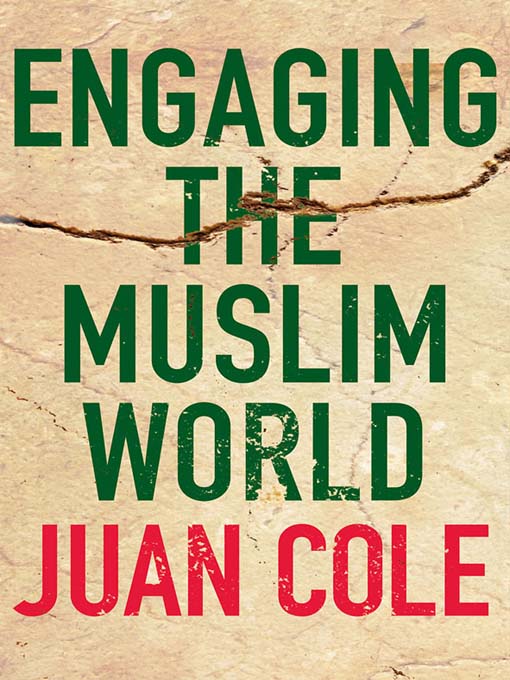
Book Review: Engaging the Muslim World by Juan Cole

Wednesday, July 8th, 2009

Engaging the Muslim World by Juan Cole

I recently finished reading Engaging the Muslim World by Juan Cole, the influential academic, well known liberal-left blogger of Informed Comment, past president of the Middle East Studies Association and occasional media talking head. Cole has written an intriguing book on contemporary foreign policy that is of special interest to those readers concerned with public diplomacy, the Muslim world, terrorism and the domestic politics of American foreign policy, particularly the war in Iraq. I will state straight off that there are arguments in this book presented by Cole that I profoundly disagree with, or, national security related assertions that I consider questionable; but in other instances, when Cole is concentrating on the nuances of the Arab-Muslim world’s political-cultural lens, he is an illuminating and insightful analyst from whom I have learned new things. 

Engaging the Muslim World is…well….engaging. I found Cole’s prose flowed smoothly, as if the author was talking to the reader across a table, and I had a hard time putting the book down, albeit I was frequently scribbling furiously in the margins. This is a polemical -policy book written by an academic for a lay audience and the reader’s reaction to Engaging the Muslim World will depend in part on their own worldview. Liberals will cheer more than they disagree with Cole, while conservatives and supporters of Israel are likely to reject many of the book’s normative assumptions long before they read the conclusions – but Cole also offers some prescriptive advice that center-right COIN and public diplomacy advocates will warmly embrace.

The book  is divided into six chapters. The first, “The Struggle for Islamic Oil:The Truth About Energy Independence” which deals with energy markets, the Cold War history of the Mideast, global warming, environmental policy, alternative fuel technologies and globalization, is a necessary effort to concisely account for the geoeconomic importance of Muslim oil producing states and the future of fossil fuel economies.  Cole argues – correctly, I suspect – that there will be no short or medium term substitutes for oil and gas until solar power technology is cost-efficient enough (and efficient in a physics sense) to compete with fossil fuels in the marketplace. Not being a scientist or an expert in energy market issues, I am poorly placed by professional background to evaluate Cole’s claims in these areas and will leave those to others.

That said, chapter one remains the odd man out. It smacks of having been  compacted by an editor out of two or more chapters and consequently has disparate issues jumbled together with insufficient explanation; as a whole, chapter one fits uncomfortably with the subsequent chapters which flow together naturally and thematically. On the other hand, the topic of oil can hardly be dispensed with either in a geopolitical discussion of the Mideast, so Cole was right to tackle it and the primary problem is really one of sequence, not subject matter.

Chapters two through six are the heart of Engaging the Muslim World, where Juan Cole articulates a theme of “Islam anxiety” permeating Western, particularly American, media and public opinion. Poorly informed about even the most basic information regarding the Muslim world, such as the differences between Shia and Sunnis, secular Baathist nationalists and Islamist radicals, quietists and the politically militant, Arabs and non-Arabs, Cole asserts that Westerners tend to lump Muslims of all shades of political belief, religiousity and nationality into a homogenous, vaguely mysterious but ever dangerous entity. Cole cites as one example, Egypt’s Sunni Muslim Brotherhood, which has foresworn violence and has members who sit in Egypt’s legislature, being lumped uncritically by American commentators with al Qaida and Hezbollah (which is a radical Shiite group).

A better way to understand violent Islamist extremists in relation to normal Muslims, in Cole’s view, would be to see them as analogous to our homegrown, violent, far-Right, white racist underground that produced Timothy McVeigh, who carried out the Oklahoma City bombing or as cult-like movements. While smaller in size than Islamist radicalism, the racist Right shares with violent Islamists the trappings of a fringe, ostracized, quasi-religious, political cult with a conspiratorial worldview that diverges sharply from the nation’s mainstream religious life. Violent Islamists often make themeslves as unpopular with their co-religioinists as do neo-Nazi extremists here, through actions that horrify society, such as the bloody massacre of Western tourists and Egyptian workers at  Luxor, Egypt.

Cole’s analogy with cults and racial extremists I think is a useful one. Radical Islamists are difficult to classify on a traditional political spectrum as their political behavior has definite similarities with those of the fascist and communist totalitarians of the 20th century, but will not fit smoothly with either, given Islamist religious extremism and the fanatical atheism or at least radically secular nature of the Bolsheviks and Nazis. The psychological overlap however is certain, something akin to the 19th century Anarchist-terrorists or what Eric Hoffer captured in his classic work, The True Believer.

On Israel and Iran, Cole bends over backwards, like a circus sideshow contortionist, to try and explain the lunacy (and Cole admits it is, at best, a crackpot worldview) of Ahmadinejad’s violently antisemitic statements about the Holocaust and Iran’s generally defiant behavior toward the international community while giving Israel no similar benefit of the doubt.  Cole argues that Ahmadinejad’s oft-stated “wipe Israel off of the map” is a deliberate mistranslation by the Western media. Ok, possibly so. I do not speak Farsi, so I’ll take Cole’s word here. If it is the case though, Ahmadinejad is well aware of how his repeated statement is being mistranslated by Reuters and AP, yet he keeps using it. Again and again. That is an ominous statement in itself.

This uneveness regarding Iran and Israel will no doubt enrage conservatives and delight progressives, but in fairness to Juan, I must say that despite his partiality toward Iran in his book, as a blogger he was very quick to denounce the obvious stealing of the recent election by Khameini-Ahmadinejad-IRGC and my perception is that Cole views the apocalyptic Mahdist tendency in Twelver Shiism that Ahmadinejad embraces as a kooky deviation from mainstream Shiism. That not just Ahmadinejad holds this belief dear, but also many influential figures in the Iranian security apparatus as well, is in my view, a cause for alarm.

Despite his politics, Cole concludes Engaging the Muslim World with a very pragmatic prescription for American public diplomacy for engaging Arabs and Muslims in a more effective manner than in the past eight or eighteen or eighty years. If I do not agree with every aspect, it is a good deal better than what the State Department and the rest of the USG is doing now:

Once I saw an Iraqi tribal leader interviewed on al-Jazeera. He said. “There is good and bad in America”. I was struck by how pragmatic and realistic his response was, and how different it was from so much of the fundamentalist vigilantee propaganda about the United States posted on radical internet bulletin boards. If Washington could reach out to all Muslims and bring them around to a more nuanced -and clear-view, in which America was not simply demonized, it would be a major accomplishment. The point is not that they should see the West through rose colored glasses, but that they should be willing to see the good and bad.

That would represent a step up by an order of magnitude.

Spread of 5GW Terminology

Friday, June 20th, 2008

My friend Bruce Kesler sent me a link to an article in David Horowitz’s Frontpagemag.com by Dr. Rachel Ehrenfeld  and Alyssa Lappen from the American Center for Democracy , Frontpagemag is a conservative site which mostly concentrates on purely political and cultural battles with the Far Left, that had a very interesting title:

The Fifth Generation Warfare

The article is actually an excerpt from an academic study prepared by the U.S. Naval War College, Armed Groups: Studies in National Security, Counterterrorism, and Counterinsurgency and the section used is focused on financing of Islamist terrorism and related activities. For example:

FINANCIAL JIHAD

Funding the jihad, i.e., financial jihad, or Al Jihad bi-al-Mal, is mandated by many verses in the Qur’an, such as chapter 61, verses 10.11: “you . . . should strive for the cause of Allah with your wealth and your lives,” and chapter 49, verse 15: “The [true] believers are only those who . . . strive with their wealth and their lives for the cause of Allah.” This has been reiterated throughout Islamic history and in recent times. “Financial Jihad [is] . . . more important . . . than self-sacrificing,” according to Saudi and Muslim Brotherhood (MB) spiritual leader Hamud bin Uqla al-Shuaibi.6

Qatar-based Muslim Brotherhood spiritual leader Yusuf al-Qaradawi, one of the most prominent Sunni scholars in the world today, reiterated the legal justification for “financial jihad [Al-Jihad bi-al-Mal]” in a lecture he gave on 4 May 2002 in the United Arab Emirates (UAE). According to him, “collecting money for the mujahideen (jihad fighters . . . ) was not a donation or a gift but a duty necessitated by the sacrifices they made for the Muslim nation.” 7

This is more or less in the vein of “Unrestricted Warfare” on the Chinese model but readers can read for themselves. What I find interesting is that the 4GW/5GW ideas and terminology that have been kicked around this corner of the blogosphere for the last four or five years are creeping in to mainstream use across the political spectrum as academics, journalists and politicos try to get a handle on the evolution of irregular warfare.

UPDATE:

A site called “Arabic Media Shack” emailed me today and pointed to this post by one of their bloggers “Grandmasta Splash” on perceptions of what is and what is not considered moderately conservative vs. extremist within the Muslim world. Later on, in an unrelated conversation, a source of great street cred gave Arabic Media Shack an unprompted personal endorsement. So, here they are.


Switch to our mobile site

