zenpundit.com » history

Archive for the ‘history’ Category

Silent reading, silent thinking, bifocal glasses

Thursday, July 26th, 2012

[ by Charles Cameron — two forms of creativity: far out and close in ]
.


.
Some of the most obvious things aren’t obvious at all, until you think of them. The things my friend Derek Robinson talks about as being in the beforeground. Too close to notice / right under our noses all along.
.
And I think that’s one of the principles of creative thinking — a lot of creative detailing takes place out on the bleeding edge, where someone pushes the limits of existing knowledge that little bit farther, and sometimes those insights can be revolutionary. But profound revelations also come from questioning the most basic assumptions — as Cambridge University Press blogged last year, celebrating the centenary of the Russell-Whitehead Principia Mathematica, vol II:

Principia attempted to ground mathematics in logic and the authors left no stone unturned in their attempt to create the ultimate definition of mathematics. For example, they were well into volume two before they had proved that one plus one equals two! They concluded their proofs with the laconic statement: “The above proposition is occasionally useful.”

BTW, that’s a point I also addressed in the context of my work on social entrepreneurship for the Skoll Foundation:

IMO, we need some funding sources that understand that the next significant breakthrough, too, will be all but invisible — and who therefore look specifically for projects that are categorized by their radical rethinking of the seemingly known and obvious.

**

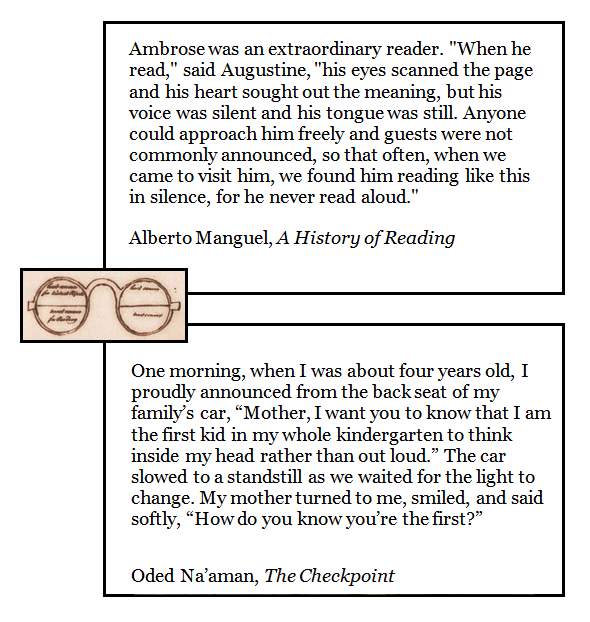
For anyone who’s curious, the bifocals pictured in the tiny “specs” section of my graphic above come from Ben Franklin‘s original letter proposing the idea of bifocal glasses, courtesy of the Library of Congress (link is to complete image).

The Odel Na’aman story, The Checkpoint: Terror, Power, and Cruelty is up at the Boston Review site. I haven’t read it yet, just tasted the first paragraph.

There are times when it helps to have bifocal (contrapuntal) vision…

Warlords Revisited

Monday, July 23rd, 2012

“The horror! The horror!

Charles Cameron sparked a discussion with his doublequotes post on two colonels, the late strategist John Boyd and the fictional monster,  Walter Kurtz from Francis Ford Coppola’s classic Vietnam War film homage to Joseph Conrad Apocalypse Now.  Kurtz is a disturbing figure, one who is recurrent in literature and history going back to Homer’s Iliad. A superlative warrior who excels above all others who nonetheless sheds all trace of civilization in his descent into barbarism. While the fall of a heroic individual can take many narrative forms, Kurtz is of a particular and dreaded kind of fallen man, the warlord.

Warlords are fascinating and repellent figures who seem to thrive best when the normal order of a society is breaking down, permitting the strong and ruthless to carve out their reputations in blood and infamy. As I have written previously:

Kent’s Imperative had a post up that would have been worthy of Coming Anarchy:

Enigmatic biographies of the damned 

“….Via the Economist this week, we learn of the death of an adversary whose kind has nearly been forgotten. Khun Sa was a warlord who amassed a private army and smuggling operation which dominated Asian heroin trafficking from remotest Burma over the course of nearly two decades. In the end, despite indictment in US courts, the politics of a failed state permitted him to retire as an investor and business figure, and to die peacefully in his own bed.

The stories of men such as these however shaped more than a region. They are the defining features of the flow of events in a world of dark globalization. Yet these are not the biographies that are taught in international relations academia, nor even in their counterpart intelligence studies classrooms. The psychology of such men, and the personal and organizational decision-making processes of the non-state groups which amassed power to rival a princeling of Renaissance Europe, are equally as worthy of study both for historical reasons as well as for the lessons they teach about the nature of empowered individuals.

….There are no shortage of warlords for such a study. Among the living we have Walid Jumblatt, the crafty chief of the Druze during the 1980’s civil war in Lebanon, the egomaniacal and democidal Charles Taylor of Liberia, Gulbuddin Hekmatyar the Islamist mujahedin commander and a large assortment of Somali, Colombian, Indonesian and El Salvadoran militiamen and paramilitaries. The history of the twentieth century alone offers up such colorful characters as “The Dogmeat General“, the ghoulishly brutal Ta Mok of the Khmer Rouge, “The Mad Baron” Ungern von SternbergCaptain Hermann Ehrhardt and Pancho Villa among many others.

What would such a historical/cross-cultural/psychological “warlord study” reveal ? Primarily the type of man that the German journalist Konrad Heiden termed “armed bohemians”. Men who are ill-suited to achieving success in an orderly society but are acutely sensitive to minute shifts that they can exploit during times of uncertainty, coupled with an amoral sociopathology to do so ruthlessly. Paranoid and vindictive, they also frequently possess a recklessness akin to bravery and a dramatic sentimentality that charms followers and naive observers alike. Some warlords can manifest a manic energy or regularly display great administrative talents while a minority are little better than half-mad gangsters getting by, for a time, on easy violence, low cunning and lady luck.

Every society, no matter how civilized or polite on the surface, harbors many such men within it. They are like ancient seeds waiting for the drought-breaking rains.

There are occasionally positive portrayals of warlords. Ahmed Shah Massoud, “the Lion of Panjshir” who fought tenaciously first against the Soviets, then later against the murderous Gulbuddin Hekmatyar’s army of thugs and the Taliban’s fanatics, providing a modicum of civilized governance to ordinary Afghans wherever his power ran, until his assassination by al Qaida. The cagey and mercurial Walid Jumblatt, made the transition from Druze warlord in the 1980’s to Lebanese politician and something of an elder statesman.

In literature, Xenophon was the de facto strategos of the retreating Greek mercenaries in The Anabasis of Cyrus, cut a noble example, but like Massoud, this is a rarity. In recent fiction, Stephen Pressfield created as an antagonist in The Profession, General James Salter, a totemic and caesarian figure who takes on the great powers with his PMC forces with impressive ruthlessness. In the popular fantasy series of George R.R. Martin that began with The Game of Thrones, the notable warlord is the outlandish, cruel and somewhat demented Vargo Hoat, who leads a freebooting company of misfit brigands “The Brave Companions“, whose nonstop atrocities and ludicrous pretensions lead all the other characters to call them “the Bloody Mummers“.

Given the world’s recent experiences with the Lord’s Resistance Army, General Butt Naked and the uprisings in Syria and Libya, I think Martin and Coppola have captured warlordism in it’s most frequent incarnation.

The Twilight War—a review

Monday, July 23rd, 2012

[by J. Scott Shipman]

The Twilight War, The Secret History of America’s Thirty-year Conflict with Iran, by David Crist

When President Obama made a heartfelt opening, a smug Iranian leadership viewed it as a ruse or the gesture of a weak leader. Iran spurned him. Obama fell back on sanctions and CENTCOM; Iran fell back into its comfortable bed of terrorism and warmongering. Soon it may no longer be twilight; the light is dimming, and night may well be approaching at long last. [emphasis added]

Thus concludes senior government historian David Crist’s The Twilight War, and be assured Crist’s language is not hyperbole. Crist masterfully details the tumult of U.S.-Iranian relations from the Carter administration to present day. Using recently released and unclassified archived data from principals directly involved in shaping and making American foreign policy, Crist provides the reader an up-front view of “how the sausage is made;” and, as with sausage, the view often isn’t pretty for either side. Crist’s access wasn’t limited to U.S. policy makers, as he conducted interviews with principles on the other side as well, for instance, he had secret meetings/interviews with pro-Iranian Lebanese officials in south Beirut. In all, Crist estimated he interviewed over “four hundred individuals in the United States and overseas.”

Crist begins his story with the Shah of Iran in the last days of his leadership, as popular sentiment was turning against both his regime, as well as his American enablers. He reveals the Carter administration’s fleeting notion of military intervention following the fall of the Shah, and includes details how the clerics reigned in professional Iranian military members, purging the “unreconstructed royalists.” From the start, the U.S. learned how difficult, if indeed impossible, relations were going to be with the new Iranian leadership. One State Department report summed up the situation:

It is clear that we are dealing with an outlook that differs fundamentally from our own, and a chaotic internal situation. Our character, our society are based on optimism—a long history of strength and success, the possibility of equality, the protection of institutions, enshrined in a constitution, the belief in our ability to control our own destiny. Iran, on the other hand has a long and painful history of foreign invasions, occupations, and domination. Their outlook is a function of this history and the solace most Iranians have found in Shi’a Islam. They place a premium on survival. They are manipulative, fatalistic, suspicious, and xenophobic.

While I am certain the writer of this report was not intending to be prophetic, as it turns out this paragraph captures the essence of our conflict. Each American president has thought himself equal to the challenge and each has thus far failed.

The Twilight War includes the birth of Hezbollah, accounts of the Marine barracks bombing in 1983 (from the men who were there), and the details of the Kuwaiti request for American protection of their tanker fleet from the Iranians. From this decision, the U.S. committed military force to protect Middle East oil—a difficult and at times, contentious decision. This decision resulted in continued sporadic confrontations between the U.S. and Iranian forces in the Persian Gulf.

Crist’s book is an illustration writ-large of a book previously reviewed here at Zenpundit.com; Derek Leebaert’s Magic and Mayhem, The Delusions of American Foreign Policy—as both “magic” and “mayhem” figure large in our on-going relationship with Iran. Most U.S. administrations when dealing with Iran came to rely on the “magic, ” and often divorced, or worse, ignored the realities.

At 572 pages, the fast paced narrative is a must read for anyone wanting insight into the origins and issues that remain in the ongoing U.S.-Iran conflict. The Twilight War is exhaustively sourced.  Crist says in the Notes his book was twenty-years in the making and it shows. Further, this book comes with excellent maps, so keeping up with the geography is made easier.

Tom Ricks said, “this is the foreign policy book of the year, perhaps many years,” and Ricks may be right. The Twilight War is an important and timely book on a vital topic, and comes with my strongest recommendation.

Postscript:

A copy of The Twilight War was provided to this reviewer by the publisher.

Venkat on Positioning vs. Melee Moves

Thursday, July 19th, 2012

Blogfriend, Dr. Venkat Rao had an intriguing post at Tempo (his other blog) on which I want to make a few, relatively disjointed, observations:

Positioning Moves versus Melee Moves 

My general philosophy of decision-making de-emphasizes the planning/execution distinction. But I am not an agility purist. Nobody is. You can think of the Agility Purist archetype as a useful abstraction. This mythical kind of decision-maker believes that a mind and personality that is sufficiently prepared for a particular domain (say programming or war or biochemistry) needs no preparation for specific situations or contingencies. This magical being can jump into any active situation in that particular domain and immediately start acting effectively.

At the other extreme you have an equally mythical Planning Purist archetype who has thought through every possible contingency all the way through the end and can basically hit “Start” and reach a successful outcome without further thinking. In fiction, this is best represented by jewelry heist capers based on long, involved and improbably robust sequences of moves, as in Ocean’s Eleven or The Italian Job. A few token things go wrong, but overall, these narratives play out like Rube Goldberg machines. 

What is interesting to me is that if we look at historical figures who epitomize a “purist archetype” they can represent disaster as easily as they can triumph. Take the planner archetype,  for example. Two figures in the annals of warfare who are “purists” in this regard would be Moltke the Elder and Robert Strange McNamara.

Because the Vietnam War was such a terrible debacle and because McNamara’s role in the war was so significant the resulting opprobrium heaped upon McNamara (deservedly, IMHO) makes it too easy to forget that he had a brilliant mind, that he was not just a reckless bumbler or a hack as Secretary of Defense. A famous anecdote of McNamara’s intelligence and his ability to quickly grasp enormous reams of data is in The Best and the Brightestby David Halberstam.  As Halberstam related, Secretary McNamara was once over a thousand slides into  being briefed about the war when he abruptly ordered the briefer to stop because the current slide conflicted with the information on something like “slide 23”. They stopped and checked. McNamara was indeed right.

It was McNamara who introduced systems analysis and PPBS to the Department of Defense, created the DIA and the Defense Logistics Agency. Yet despite his methodical and mathematical analytical gifts, his understanding of the human element was a curious lacuna that led to his carefully calculated attrition strategy and escalation. There was no way way, in Robert Strange McNamara’s metrics, to quantify Hanoi’s will to fight, and without such comprehension, attrition would be (to use a popular phrase anachronistically) a “stratergy of tactics”.

Field Marshal Graf von Moltke’s careeer as a war planner and chief of the Prussian general staff was a happier one as the victor in three of Prussia’s wars and a co-founder, with Bismarck, of the German Empire. A devoted student of Clausewitz, von Moltke was at home in the contradiction of exquisite planning and the improvisation that was part and parcel of coup d’oeil in the midst of battle. Unlike McNamara, von Moltke’s planning encompassed the human factors and serendipity. As Antulio J. Echevarria put it:

….Like Clausewitz, Moltke emphasized flexibility in military planning and execution. He eschewed dogmatic thinking, whether tactical or strategic, accepted chance and uncertainty as inseparable from the nature of war, and recognized the often decisive (but incalculable) role that moral factors played in victory. He originally viewed the destruction of the enemy’s main fighting force as the proper aim of war, but gradually became less convinced of its genuine decisiveness after the French resorted to partisan warfare in 1870-71.[10] “We want to believe,” he later told the Reichstag, “that neither the Thirty Years’ nor the Seven Years’ War will recur, but when millions of individuals are engaged in a bitter struggle for national existence, we cannot expect that the matter will be decided with a few victorious battles.”

….By the early 1880s, this free-form approach to war had further established itself as part of the German military tradition, accruing still more Moltkean ideas: simplicity is the essential ingredient of an order; war plans do not endure beyond the first engagement; friction, chance, and uncertainty are inescapable elements of war; and strategy serves policy best when it strives for the highest aim, complete tactical victory.[32] The fact that military writers often accused each other of Schematismus–rigid, prescriptive thinking–in Germany’s turn-of-the-century military debates indicates that Moltke’s ideas had become paradigmatic within the officer corps. Ironically, an inherent contradiction developed in the German view of war at this time–namely, that while war possessed no absolute rules, the destruction of the enemy’s forces had to remain its ultimate aim.

Second, Moltke’s open, inductive approach to war also helped legitimize a decentralized style of warfighting called (perhaps wrongly) Auftragstaktik. Much confusion reigns concerning this concept and its “dubious” historical validity.[34] Military writers on either side of the Atlantic have somewhat abused the term Auftragstaktik in an effort to legitimize their own preferred style of command. In fact, Auftragstaktik and the meaning behind it surfaced decisively, albeit sparingly, in the debate over tactics that raged for years between the Imperial Army’s traditionalists and reformists. In its origins, the concept probably owes more to that leading figure of the Prussian Restoration, Gerhard von Scharnhorst, than to Moltke. But Moltke clearly advocated the decentralization of military effort. He reasoned that war, a product of opposing wills subject to a host of frictions, gives rise to rapidly changing situations that quickly render a commander’s decisions obsolete. Hence, subordinates had to think and act according to the situation, even without or in defiance of orders. While Moltke did indeed promote such a style of command, he did not condone willful disobedience. In fact, the Prussian, and later the German, army maintained strict codes of discipline. 

Back to Venkat:

….In sail warfare, there is a clear distinciton between moves designed to put you in an advantageous position with respect to relatively predictable environmental conditions (primarily the wind direction of course) and moves that are used once an engagement starts.  The latter culminate in a melee: ships next to each other, boarding actions and hand-to-hand combat. It is messy, chaotic and the very definition of the “Fog of War” phenomenon (in the case of sail warfare, cannon fire and the action of fire ships could create a literal blinding smokescreen over everything).

You can think of positioning moves as rich moves based on fertile variablesthat are likely to put you in command of many situations (“own the high ground” is the most famous one). They are high-potential-energy commitments in the space of probable paths. You can also think of them as leverage moves. A crucial feature is that positioning moves involve much less time pressure than melee moves and can be set up well before they are needed. So positioning moves are early, rich moves.

Melee moves on the other hand are, well, the other kind.

I am no naval expert, but the sea like the sky, being free of human clutter and topographic variation, brutally clarifies for commanders and strategists like Mahan or Wohlstetter the relative spatial relationship between adversaries and the limitations of their comparative resources and capabilities in light of distance and time.

If Russia had been a sea, Hitler would have thought twice about Operation Barbarossa.

Numbers by the numbers: four

Wednesday, July 18th, 2012

[ by Charles Cameron — importance of the ratio form (“this is to that as thus is to so”) as a bridge between domains and silos, creative leaps, the glass bead game, and finally, Chittick’s joke about camels, sex and translations from the Arabic ]
.
.

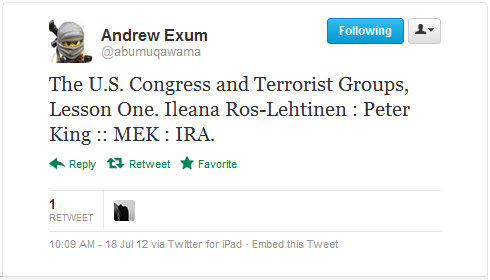
I retweeted this tweet of Andrew Exum‘s to my friend Paul Pilkington because I know he’s working on a project to find out what “this is to that” is to some other “this is to that” — across a wide swathe of human culture.

Note particularly that Exum is using this formal device to illuminate, to give insight, in an area of importance to analysts, strategic thinkers and decision makers.

I’m also retweeting Exum to Paul because I believe Paul’s simple experiment, based as it is on his reading of Hermann Hesse‘s Glass Bead Game, has the capacity to build an architecture of thought (a) crossing all disciplines and (b) spanning the trivial with the profound.

I’m doing something similar with Cath Styles in our Sembl games project — but this time I want to concentrate on Paul’s approach, and since there are four moving parts in an a is to be as c is to d configuration, I’m calling this post Numbers by the numbers: four — number three will just have to wait a while.

**

To get a sense of what Paul is up to, we can go to his Twitter Project page, which describes the fourth in a series of books he’s writing — and also follow him on Twitter, where he posts as Just Knecht.

Two of Paul’s recent tweets express his sense of the task pretty incisively:

The whole of language is the holding up of one unlike thing to compare, contrast and connect with another

Curating is a matter juxtaposition of work against work, artist against artist, place against place – A.Searle on Documenta 13, The Guardian

On his Twitter Project Page, he tells us:

Each tweet is an individual Glass Bead Game move, which is a comparison (metaphor, simile or analogy) across different areas, and may be either a statement or a question.

In question form, these are not unlike analogy questions from SAT tests with an additional dimension of general knowledge, cultural invention and intellectual playfulness. The basic challenge is to work out the relationship between two terms in one context, and apply it in another. Sometimes a tweet will extend an analogy further, which would be the beginning of forming a larger game from an individual move.

Some of the most interesting moves do not have right or wrong answers. Some have canonical or original answers, but they’re not necessarily right. In fact, very often I will post something I’ve picked up from elsewhere which I would love to see improved on, challenged, or at least better explained by others.

He then poses some of the sorts of questions that intrigue him:

Who is the J.H.Prynne of contemporary dance? Like Prynne in contemporary poetry they need to have been ‘out there’ right at the edge of theory and practice for some time, and also deeply steeped in tradition at the same time. Merce Cunningham? Suggestions welcome … And Heston Blumethal or Ferran Adrià might be the Prynne of cookery. But what about the Prynne of contemporary warfare?

What is the equivalent of sonata form in architecture? Goethe and Hegel both said ‘architecture is frozen music’ but neither really explained what they meant. If it is, then is there an architectural equivalent in Western architecture of the key structural form in Western art music? Suggestions welcome …

So, Zenpundit readers — who is the JH Prynne of contemporary warfare?

**

Not so long ago, in Numbers by the numbers: one, I posted a series of self-referential tweets that I’d collected over the last month or two — here I’d like to present some of Paul’s recent tweets:

Let’s start with one that’s a foreign policy insight, arguably as significant to day as it was when Vance first said it:

16 Jul @justknecht
“The Strait of Hormuz is the jugular vein of the West” (Cyrus Vance)

If these tweets can be timeless, they can also be timely:

4 Jul @justknecht
The Higgs boson is the quantum of the Higgs field, just as the photon is the quantum of the electromagnetic field

As they accumulate over time, they can build a conceptual “mesh” that engages an entire field — in this case, recent classical music — while linking it to a variety of other areas:

16 Jul @justknecht
“Boulez’ Derive 2 sounds like birthday cakes ought to” – Philip Clark, Gramophone

22 Jun @justknecht
Wagner was a beautiful sunset that was mistaken for a dawn – Claude Debussy, quoted by Geoffrey Norris in Gramophone

30 May @justknecht
Fauré’s Theme and Variations (no. 9) is like an evening star falling slowly from the sky – Bryce Morrison cites Alfred Cortot in Gramophone

11 May @justknecht
Kraftwerk is the Warhol of pop music – The New Yorker

There’s profundity here:

9 Jun @justknecht
“Space is to place as eternity is to time.” – Joseph Joubert

This could be, as Paul says, “the beginning of forming a larger game from an individual move” — that quote in itself could plausibly be the keystone of an architecture bridging science with religion…

There are historical parallels to consider:

31 May @justknecht
Robert Burton : Oxford :: Jeremy Prynne :: Cambridge

Catty remarks by Nobel laureates:

21 May @justknecht
“Thinking is to humans as swimming is to cats” (Nobel laureate Daniel Kahneman)

Near-tautologies:

21 May @justknecht
Macon Telegraph: Recipes are to food as blueprints are to buildings.

And, ooh, exotic forms of slander!

18 May @justknecht
“[Your daughter] has lovers as numerous as the striking of tablas on Palm Sunday” – Arabic satire by Abu Nawas, 756 – 813 AD

Once again, it’s form that generates insight, not content. Get used to form, play around with it, and content will leap out at you from the page, from the screen.

**

I’m no Arabist myself, but ah! that last quote reminds me irresistibly of the difficulties faced by translators from the Arabic, as recounted by William Chittick in The Self-disclosure of God: Principles of Ibn Al-‘Arabi’s Cosmology (SUNY Press, 1998, pp. xxxv-xxvi.)

An old joke among orientalists tells us that every Arabic word has four meanings: It means what it means, then it means the opposite of what it means, then it has something to do with sex, and finally it designates something to do with a camel …. The rational mind tends to push the meaning of a word away from experience to ‘what it means’ but the imaginal mind finds the self-disclosure of the Real in the sex and the camel … it is in the world’s concrete realities that God is found, not in its abstractions.

I’d been looking for an excuse to post that quote on Zenpundit — now I’ve found it!

Switch to our mobile site