zenpundit.com » history

Archive for the ‘history’ Category

On the “head of infidelity” and the tale of Abdul-Rahman ibn Awf

Monday, March 19th, 2012

[ by Charles Cameron — linking some late notes of OBL with his 1996 Declaration of War ]
.


photo credit: Maqam of Abdul-Rahman,
Nate Mathews, The Azanian Sea

I was reading David Ignatiusaccount of the forthcoming Abbottabad papers a couple of days ago, and was struck by a phrase bin Laden used in describing Obama:

Before his death, Osama bin Laden boldly commanded his network to organize special cells in Afghanistan and Pakistan to attack the aircraft of President Obama and Gen. David Petraeus.

“The reason for concentrating on them,” the al-Qaeda leader explained to his top lieutenant, “is that Obama is the head of infidelity and killing him automatically will make (Vice President Joe) Biden take over the presidency. … Biden is totally unprepared for that post, which will lead the U.S. into a crisis. As for Petraeus, he is the man of the hour … and killing him would alter the war’s path” in Afghanistan.

Obama is the head of infidelity — that had quite a ring to it.

And so, as I was rereading the text of bin Laden’s 1996 Declaration of War against the Americans Occupying the Land of the Two Holy Places this morning, I couldn’t help but notice his early use of the same phrase in that context:

And the story of Abdur-Rahman Ibn Awf about Ummayyah Ibn Khalaf shows the extent of Bilal’s (may Allah be pleased with him) persistence in killing the head of the Kufr: “the head of Kufr is Ummayyah Ibn Khalaf…. I shall live not if he survives” said Bilal.

Here’s the story of the Companion Abdul-Rahman ibn Awf as bin Laden recounts it, in the paragraph immediately preceding the one just quoted:

Abdul-Rahman Ibn Awf -may Allah be pleased with him- said: (I was at Badr where I noticed two youths one to my right and the other to my left. One of them asked me quietly (so not to be heard by the other) : O uncle point out Aba-Jahl to me. What do you want him for? , said Abdul Rahman. The boy answered: I have been informed that he- Aba-Jahl- abused the Messenger of Allah (), I swear by Allah, who have my soul in His hand, that if I see Aba-Jahl I’ll not let my shadow departs his shadow till one of us is dead. I was astonished, said Abdul Rahman; then the other youth said the same thing as the first one. Subsequently I saw Aba-Jahl among the people; I said to the boys do you see? this is the man you are asking me about. The two youths hit Aba-Jahl with their swords till he was dead. Allah is the greatest, Praise be to Him: Two youths of young age but with great perseverance, enthusiasm, courage and pride for the religion of Allah’s, each one of them asking about the most important act of killing that should be induced on the enemy. That is the killing of the pharaoh of this Ummah – Aba Jahl-, the leader of the unbelievers (Mushrikeen) at the battle of Badr. The role of Abdul Rahman Ibn Awf, may Allah be pleased with him, was to direct the two youths toward Aba-Jahl. That was the perseverance and the enthusiasm of the youths of that time and that was the perseverance and the enthusiasm of their fathers. It is this role that is now required from the people who have the expertise and knowledge in fighting the enemy. They should guide their brothers and sons in this matter; once that has been done, then our youths will repeat what their forefathers had said before: “I swear by Allah if I see him I’ll not let my shadow to departs from his shadow till one of us is dead”.

Bin Laden clearly saw himself, from the time of his Declaration through to the end in Abbottabad, as a modern-day Abdul-Rahman ibn Awf, directing the persevering and enthusiastic youth…

The Said Symphony: move 19

Sunday, March 18th, 2012

[ by Charles Cameron – extended analytic game on Israeli-Palestinian conflict — for those who wish to catch up, our game thus far consists of an intro to the game and game board, followed by moves 1-5, 6-9, then moves 10-11 which together constitute a meditation, moves 12, 13-15, 16-17, and most recently before this, move 18 with cadenza ]

Move 19: The view from above

Move content:

Discussing strategy, the very canny LTG (USMC, Ret’d.) Paul Van Riper had this to say:

What we tend to do is look toward the enemy. We’re only looking one way: from us to them. But the good commanders take two other views. They mentally move forward and look back to themselves. They look from the enemy back to the friendly, and they try to imagine how the enemy might attack them. The third is to get a bird’s-eye view, a top-down view, where you take the whole scene in. The amateur looks one way; the professional looks at least three different ways.

A bird’s-eye view, a hawk’s eye view, a top-down view, an overview, a view from 30,000 feet, a God’s eye view, a view from above, a zoom…

If move 18 and its cadenza gave us a view of the depth of vision or insight that is necessary for a full and rich understanding of the world we live in — its qualitative or spiritual scope, if you like — this next move, with its picnic and drone-sight, addresses its breadth in space and time — materially and quantitatively speaking.

The classic expression of the sheer material scope of the universe was put together by Charles and Ray Eames in their justly celebrated film, Powers of Ten, from which the lower of these two images is drawn:

Here are some other relevant scans of the scope of things, in terms of time and space:

The Scale of the Universe 2
A Brief History of The Universe
The Known Universe
A Time-Lapse Map of Every Nuclear Explosion Since 1945

These are impressive videos to be sure, but as an aside I’ll invite you to ask yourselves how well they compare with this zoom in words, a poem by the zennist, ecologist, essayist and poet Gary Snyder, from his book, Axe Handles: Poems:

Such breadth of vision, such craft.

*

If this “material scope of things” too has a cadenza, it would be that all of this is shot through with some primary oppositions, dappled as the poet Gerard Manley Hopkins would have it, with swift, slow; sweet, sour; adazzle, dim — as indicated in the drone-sight and picnic double image at the head of this move.

This dappling, this constant flux of opposites, takes many forms — day and night lead to the more abstract light and dark, which can then be interpreted morally as good and evil, to which we respond with repulsion and attraction as the case may be, building our worldviews from love or fear…

At different scales the opposites that matter most to us may have different names and shadings, but here I’d just like to draw attention to the dappling of our world with:

competition and cooperation
Darwin‘s natural selection and Kropotkin‘s mutual aid
duel and duet (ah! — a favorite phrasing of mine)
war and peace

Provocatively, we find this dappling in scriptures, too, wherein the ripples of such verses as “The LORD is a man of war: the LORD is his name” (Exodus 15.3) dropped like a stone into the pond of the human mind, meet with the ripples of other verses such as “God is love; and he that dwelleth in love dwelleth in God, and God in him” (I John 4.16).

There are times when we take such oppositions literally, perhaps too literally, and times when we begin to see oppositions as abstract and theoretical end-points to what is in fact a yin-yang process continually unfolding…

Which brings me by a commodius vicus of recirculation to this image of the great opposition between war and peace, its dappling, its unfolding:

Links claimed:

To the Lamb, move 18: this move presents the material scope of the universe in counterpoint to its visionary scope as laid out in move 18 with its cadenza.

To Revelation, move 17 — the word revelation means unveiling, as we have seen, and our sciences and technologies, with their spectra of telescopes, microscopes, cameras and zooms, are unveiling and revealing to us much about the physicality of the world we live in — much that was accounted for in other times and places through intuition, vision and poetry.

This scientific and technical revelation of material existence, for many of us moderns, has largely eclipsed the mode of visionary revelation of move 17 — yet it cannot eradicate it. Implicit in this move, then, is the sense that we carry with us both subjective and objective, inner and outer, qualitative and quantitative understandings — though the data that “sight” and “insight” provide us with may be different in kind, and resolving them may be something of a koan to us, the deep problem in consciousness as philosophers of science have named it — and that we can discount neither one if we are to have and maintain a rich sense of our situation.

Comment:

If the two previous moves have shown us the scope of the universe we co-inhabit, perhaps we should now make our own zoom in, much as James Joyce did when he had the schoolboy Stephen inscribe his name and address in his geography book as Stephen Dedalus, Class of Elements, Clongowes Wood College, Sallins, County Kildare, Ireland, Europe, The World, Universe – an address that Stephen then read both forwards and backwards, finding himself in one direction, and finding in the other that he had no means of knowing what might lie beyond the universe…

Imagine then, skipping rapidly from (unimaginable) cosmos via such things as the intriguingly named End of Greatness to galaxy or nebula…

…solar system and planet — whence we can slow down and zero gently in on the Middle (or as my friend Ralph Birnbaum would call it, the Muddle) East, Israel / Palestine, Jerusalem / Al Quds / the Temple Mount / Noble Sanctuary – and to such matters of contemplative vision and tribal passion as the first, second and projected third Temples, the al-Aqsa mosque.

Our increasing focus will bring us, then, to that the rock which Jews believe marks the place where Abraham bound his son Isaac (the Akedah), and which Muslims believe to be the place of ascent of the Prophet to the celestial realms (the Mi’raj) on his Night Journey (Qur’an, Al-Isra).

Here again myth and history collide, and both visionary and material considerations merge in the heart of the what my friend the Israeli journalist Gershom Gorenberg has justly called “the most contested piece of real estate on earth”.

The End and Ends

Tuesday, March 13th, 2012

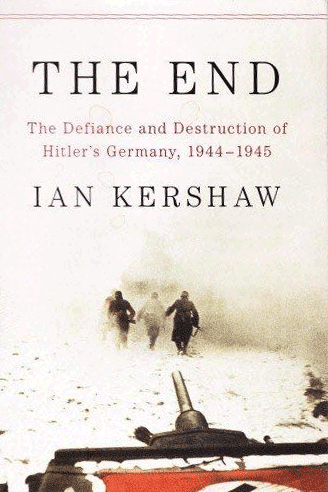
The End by Sir Ian Kershaw

I am currently reading The End, about the last year of the Third Reich and the Nazi death spiral toward Germany’s absolute destruction. It is a fascinating, mass suicidal, political dynamic that was mirrored to an even greater degree of fanaticism by Nazi Germany’s Axis partner, the Imperial Japanese. Facing the prospect of certain defeat, the Germans with very few exceptions, collectively refused every opportunity to shorten the agony or lighten the consequences of defeat and stubbornly followed their Fuhrer to the uttermost doom. It made no sense then and still does not now, seven decades later.

Adolf Hitler’s personal authority over the life and death of every soul in Germany did not end until his last breath. When surrounded by Soviet armies, trapped in his Fuhrerbunker in the ruin of Berlin, all it took for Hitler to depose his most powerful paladins, Hermann Goering and Heinrich Himmler was a word. They still commanded vast military and paramilitary security forces – Himmler had been put in charge of the Home Army as well as the SS, Gestapo and German police – but when Hitler withdrew his support and condemned them, their power crumbled. Goering, the glittering Nazi Reichsmarchal and second man in the state, was ignominiously arrested.

Even in Gotterdammerung, the Germans remained spellbound, like a man in a trance placing a noose around his own neck.

Currently, the chattering classes of the United States are uneasily working their way toward a possible war with Iran, or at least a confrontation with Teheran over their illegal nuclear weapons program (some people will object that, technically, we are not certain that Iran has a weapons program. This is true. It is also irrelevant to the diplomatic dynamic created by Iran’s nuclear activities which the regime uses to signal regularly to all observers that they could have one).  There is much debate over the rationality of Iran’s rulers and the likely consequences if Iran is permitted to become a nuclear weapons state. There is danger and risk in any potential course of action and predictions are being made, in my humble opinion, far too breezily.

In the run-up to war or negotiation, in dealing with the Iranians and making our strategic calculations, it might be useful to recall the behavior of the Germans.

A Wound That Does Not Cease to Bleed: The War in Vietnam

Wednesday, February 29th, 2012

Amigo of ZP blog, West Point military historian Colonel Gian Gentile, throws down the gauntlet in his review of Lewis Sorley’s new biography, Westmoreland: The General Who Lost Vietnam, in The National Interest:

The Better War That Never Was

DID GENERAL Westmoreland lose Vietnam? The answer is no. But he did lose the war over the memory of the Vietnam War. He lost it to military historian Lewis Sorley, among others. In his recent biography of William C. Westmoreland, Sorley posits what might be called “the better-war thesis”—that a better war leading to American victory was available to the United States if only the right general had been in charge. The problem, however, is that this so-called better war exists mostly in the minds of misguided historians and agenda-driven pundits.

In the battle over the memory of the Vietnam War, Sorley annihilates Westmoreland and leaves his character and reputation in smoldering ruins. Yet Sorley’s victory in the fight for the memory of Vietnam has not brought us a balanced historical biography of Westmoreland.  

 ….The better-war thesis argues that if only the U.S. Army had concentrated from the start on building up the South Vietnamese armed forces and winning the hearts and minds of the South Vietnamese people through limited applications of military force, we would have won the war. But the question remains: Precisely how could tactical adjustments early in the war have overpowered the political constraints placed on the army by the Johnson administration, which kept it from taking the fight to the North Vietnamese? Or the dysfunctional nature of the South Vietnamese government and military that precluded them from standing on their own? Or the declining popular support and political will in the United States as the war dragged on without a decent end in sight? Or, perhaps most importantly, how could tactical adjustments toward better methods of counterinsurgency have overpowered a communist enemy that fought the war totally while the United States fought it with limited means? In his Westmoreland biography, Sorley essentially ignores these questions.

Could the United States have prevailed in Vietnam? Yes, but it would have had to commit to staying there for generations, not a mere handful of years. The Vietnam War was an attempt at armed nation building for South Vietnam. Nations and their societies, however, are not built overnight, especially when they are violently contested by internal and external enemies. Thus, to prevail in Vietnam, the United States would have needed the collective will that it mustered to win World War II and would have had to be able to maintain it for generations. That kind of will—or staying power—was never a real possibility.

In war, political and societal will are calculations of strategy, and strategists in Vietnam should have discerned early on that the war was simply unwinnable based on what the American people were willing to pay. Once the war started and it became clear that to prevail meant staying for an unacceptable amount of time, American strategy should have moved to withdraw much earlier than it did. Ending wars fought under botched strategy and policy can be every bit as damaging as the wars themselves.

Well worth the read, not least for Gian’s model of how one historian carefully dismantles the thesis of another.

We are a mere three years from the fiftieth anniversary of Lyndon Johnson’s escalation of the Vietnam War, less than two years from the fiftieth anniversary of the assassination of John F. Kennedy that brought LBJ into power and a year from the fiftieth anniversary of the infamous coup d’etat against American client, President Ngo Dinh Diem, that JFK had approved. Finally,  fifty years ago, Kennedy drastically increased the American military advisory mission to South Vietnam to just under 10,000 men and signed off on clandestine operations against North Vietnam.

All those fiftieth anniversaries amount to a golden jubilee of rancor.

The bitterness sown by the lost war in Vietnam still burns in American politics like red hot coals. Less bright perhaps than the open flame of 1968, but if you scratch the surface, you will find with no less heat. The war spawned division and polarization that twisted our politics and poisoned public debate to this day, echoing now as farce as much as tragedy.

During the 1980’s, Vietnam historiography was virtually a cottage industry. It was the subject that ate the profession as a generation of academics who cut their academic teeth during the era of antiwar protest on campus acquired tenure, middle-aged paunches and lost hair while nursing their political grievances in their scholarship. I personally recall, as an  undergraduate, the war being referenced (usually along with vitriolic abuse of Ronald Reagan) in every humanities class, no matter how remote the course, with some professors being known for the quality of their off-topic rants.

While Westmoreland bears heavy responsibility for his part in a losing a war, even as theater commander in Saigon he was only an executor, not a maker, of strategy, much less national policy. Westmoreland did not lose Vietnam in a stunning battlefield capitulation, so Gentile is right to defend “Westy” from being scapegoated for the poor strategic reasoning hatched in the Oval Office. Where Westmoreland was at fault was in his inability to either intellectually comprehend the bigger strategic picture in which he found himself struggling (most likely) or if he did, to effectively articulate the strategic environment in Southeast Asia to a domineering President who was stubbornly determined to brook no contrary advice (possible). Had Westmoreland tried, he likely would have failed (Brute Krulak’s effort in this regard got him physically ejected from the Oval Office by the seat of his pants by Johnson himself. I am dubious that LBJ would have been any happier with contradiction of policy from Westmoreland).

Gentile, much like my professors of yore, is deeply interested in the congruence between events in his own time with those of the Vietnam era., in particular, the salience of counterinsurgency doctrine in the wars of Iraq and Afghanistan. There is, of course, some continuity between the Vietnam era and today present, a historical thread seized by the COINdinistas themselves in their veneration of Galula and slurping knife-blade portions of soup, but the continuity has limits. I suspect a Millennial generation vet of Kandahar or Fallujah, should they venture to become a historian, will frame and seek to explain their wars without much reference to the societal touchstone that is Vietnam.

Perhaps by then, for American society, Vietnam will have finally ceased to bleed.

New Book Review up at PRAGATI: George F. Kennan: an American Life

Thursday, February 16th, 2012


PRAGATI – the Indian National Interest Review has published my review of John Lewis Gaddis’ biography George F. Kennan: An American Life 

The creative art of strategy 

….Into the breach strides eminent diplomatic historian John Lewis Gaddis, offering a magisterial 784 page biography, a quarter- century in the making, George F. Kennan: An American Life. Gaddis, a noted historian of the Cold War and critic of revisionist interpretations of American foreign policy, has produced his magnum opus, distilling not only the essence of Kennan’s career, but the origins of his grand strategic worldview that were part and parcel the self-critical and lonely isolation that made Kennan such an acute observer of foreign societies and a myopic student of his own.

Gaddis, who is a co-founder of the elite Grand Strategy Program at Yale University, had such a long intellectual association with his subject, having been appointed Kennan’s biographer in 1982, that one wonders on theories of strategy at times where George Kennan ends and John Lewis Gaddis begins. Giving Kennan the supreme compliment among strategists, that he possessed in the years of the Long Telegram and the Policy Planning Staff, Clausewitz’s Coup d’oeil, Gaddis does not shy away from explaining Kennan’s human imperfections to the reader that made the diplomat a study in contradictions….

Read the rest here.


Switch to our mobile site