zenpundit.com » france

Archive for the ‘france’ Category

Enantiodromia: the French Revolution

Thursday, January 1st, 2015

[ by Charles Cameron — abstraction and pattern recognition as devices to evade one’s foibles, preferences, analytic assumptions ]
.

Robespierre facial reconstruction
Robespierre, forensic reconstruction

**

The itaicized portion of the quote below just happens to be a concise statement of the pattern known as enantiodromia [1, 2, 3] — and the puzzlement it represents to linear (as opposed to loopish) thinkers:

Since the collapse of Jacobin rule after Robespierre’s execution in Thermidor Year II, debate has raged over how an event that began with the promise of liberty and fraternity degenerated so rapidly into fifteen months of mass imprisonment and death.

**

The quote above is from The World Turned Upside Down, a review of Jonathan Israel‘s Revolutionary Ideas: An Intellectual History of the French Revolution from the Rights of Man to Robespierre by Hugh Gough in the Dublin Review of Books. Here’s the full para:

Anyone looking for a neat explanation of the French revolutionary terror faces the problem of choice. Since the collapse of Jacobin rule after Robespierre’s execution in Thermidor Year II, debate has raged over how an event that began with the promise of liberty and fraternity degenerated so rapidly into fifteen months of mass imprisonment and death. During 1793 and 1794 around three hundred thousand people were jailed, many of them dying from disease and neglect, a further seventeen thousand were guillotined or shot and a quarter of a million killed in civil wars, of which the Vendée was by far the most deadly. After Thermidor the revolution’s opponents argued that terror on such a scale was inherent in the entire revolutionary project from the outset, part of a “genetic code” of violence and intolerance deeply embedded in the revolutionary gene. The revolution’s supporters, on the other hand, defended terror as the product of difficult circumstances, a regrettable but necessary expedient to combat the threats posed to the republic by civil war and military invasion.

**

Dichotomy.

The two sides of the debate are separated by their political associations with the events in question. Take away the sentiment-engagers — bread vs cake, revolution, Bastille, Marseillaise, the guillotine, the tricoteuses, the American revolution, Marx, whatever — thus viewing the image as simply one of contending forces, preferring neither one to the other, and the paradox resolves itself into a simple self-biting circle: the oppressed press back until they are themselves the pressors.

Jung knew this archetypal pattern — but I suspect he is little known in the history silo, and has indeed been expelled from the silo of the psychologists.

Somewhere in back of the event is a pattern, and when sufficiently abstracted the pattern will illustrate with commendable impartiality the forces in play in the whole.

For the analyst, that impartiality, that wholistic perspective, is pure gold.

For myself, it was Reason enthroned in Notre Dame that truly set my teeth on edge.

**

Image source:

  • Robespierre’s likely appearance, a forensic reconstruction
  • **

    And a Happy New Year to us all!

    Serpent logics: the marathon

    Sunday, November 24th, 2013

    [ by Charles Cameron — oh, the sheer delightful drudgery of finding patterns everywhere ]
    .

    I’ll start this post, as I did the previous one to which this is a sort of appendix, with a (deeply strange, tell me about it) example of the…

    Matrioshka pattern:


    That’s a piece of jewelry made out of disembodied pieces of Barbies from the extraordinary designer’s mind of Margaux Lange, FWIW.

    **

    This post is the hard core follow up to my earlier piece today, Serpent logics: a ramble, and offers you the chance to laugh and groan your way through all the other “patterns” I’ve been collecting over the last few months. My hope is that repeated (over)exposure to these patterns will make the same patterns leap out at you when you encounter them in “real life”.

    Most of the examples you run across may prove humorous — but if you’re monitoring news feeds for serious matters, my hunch is that you’ll find some of them helpful in grasping “big pictures” or gestalts, noting analomalies and seeing parallels you might otherwise have missed.

    Have at it!

    **

    Here’s another Matrioshka, from the structural end of lit crit that my friend Wm. Benzon attacks with gusto over at New Savannah:

    **

    Enantiodromia:

    You’ll recall this is the pattern where something turns into its opposite… as described in this quote from the movie Prozac Nation:

    I dream about all the things I wish I’d said.
    The opposite of what came out of my mouth.
    I wish I’d said
    “Please forgive me. Please help me.
    I know I have no right to behave this way?”

    Here are a few examples…

    Ahmed Akkari Repents Violent Opposition to Danish Cartoons Lampooning Islam:

    After a Danish newspaper published cartoons satirizing the Muslim Prophet Muhammad, Ahmed Akkari spearheaded protests that ultimately cost the lives of 200 people. Now he says he’s sorry. Michael Moynihan on what changed Akkari’s mind.

    That’s impressive!

    That one’s run of the media mill…

    And this one’s from my delightful, delicious boss, Danielle LaPorte:

    **

    A friend sent me this:

    **

    Let’s just plough ahead…

    Nominalism:

    Nominalism is the category where the distinction between a word and what it represents gets blurry — a very significant distinction in some cases —

    How’s this for naming your donkey after your President?

    Consider this one, another instance of nominalism in action, from the French justice system:

    A mother who sent her three-year-old son Jihad to school wearing a sweater with the words “I am a bomb” on the front, along with his name and ‘Born on September 11th’ on the back, was handed a suspended jail sentence on Friday for “glorifying a crime”. A court of appeal in the city of Nimes, southern France, convicted Jihad’s mother Bouchra Bagour and his uncle Zeyad for “glorifying a crime” in relation to the terrorist attacks in the United States on September 11th 2001.

    The classic nominalist image — with which I’d compare and contrast the French three-year-old with the unfortunate name and tsee-shirt — is Magritte’s cdelebrated “Ceci n’est pas une pipe”:

    And here’s one final nominalist example:

    **

    The spiral:

    Here’s a potential downwards spiral, for those watching India:

    **

    Straight parallelism:

    This one’s from Jonathan Franzen:

    And meanwhile the overheating of the atmosphere, meanwhile the calamitous overuse of antibiotics by agribusiness, meanwhile the widespread tinkering with cell nucleii, which may well prove to be as disastrous as tinkering with atomic nucleii. And, yes, the thermonuclear warheads are still in their silos and subs.

    **

    Simple Opposition:

    **

    Some of these categories seem pretty fluid — or to put that another way, some of these examples might fit with equal ease into several doifferent categories. Here’s another oppositional class:

    Arms crossed:

    From Ezra Klein and Evan Solta blogging at WaPo’s Wonkbook: The Republican Party’s problem, in two sentences:

    It would be a disaster for the party to shut down the government over Obamacare. But it’s good for every individual Republican politician to support shutting down the government over Obamacare.

    A great “values” juxtaposition:

    And hey, nice phrasing:

    **

    Here’s an example of one of the central patterns of violence and justice:

    Tit for Tat:

    [ the account this tweet came from, which was a media outlet for Shabaab, has since been closed — hence the less than euqal graphical appearance of this particular tweet… ]

    **

    And here, without too much further ado, is a whole concatenation of…

    Serpents biting their tails:

    [ … and that last one of Nein‘s appears to have been withdrawn from circulation ]

    This one I love for its lesson on biblical pick-and-choose:

    This one is also a DoubleQuote:

    when closely followed by:

    And this one really bites:

    **

    To close the series out with more of a bang than a whimper, here’s Serpent bites Tail with apocalypse & gameplay for additional spice:

    Some poems, Madhu

    Saturday, September 28th, 2013

    [ by Charles Cameron — some of my own poems, some of my own theology, and a damn fine French police procedural on Netflix ]
    .

    Engrenages / Sprial, season 4 episode 9

    **

    Madhu, a wonderful friend of this blog, encouraged me some while back to post some of my poems here. I don’t do it often, and I hope you will at least tolerate it when I do.

    This one, for instance:

    The rolling dice
    .

    That there is a murder to be committed, this the god knows, that the car
    travelling through the woods contains victim and victor paired like dice strung
    on a rear-view mirror, this the god knows, but it is the tops of trees
    the god attends to, oblivious of the car which moves on its inerrant way
    between them, the topmost branches it she or he observes, the upper
    and as the car is first heard approaching, middle, and as it rolls into view
    in left field, lower branches, the car now drawing his attention, riddle
    of the two men still obscured by deflecting windows, roof doors tyres and

    the leaves, the fallen, as though the two men from their high estate had fallen
    to this, to the ground, among leaves which become mulch, the one sooner
    and the other later, man become mulch as the god had become man, a
    seasoning, of the ground, fall, a leavening of the earth, spring, in that primal
    and primordial turning of planets and years on which between tree top
    and mulch, between before and when with no after, two men’s dice are rolled.

    **

    As you know, I’m interested in the workings of the imagination, and find much of its power concentrated in the specific theologies and rituals of the world’s religions. My poems, accordingly, allow me to explore themes at the intersection of human behavior in all its light and shade, with the divine, in all its brilliant clarity, depth of heart, and, well, ineffableness, inscrutablemness, indescribability.

    Indescribable? The word the Athanasian Creed uses is Incomprehensible:

    As also there are not Three Uncreated, nor Three Incomprehensibles, but One Uncreated, and One Uncomprehensible.

    You see, for my purposes the word god refers precisely to a greater unknown that nevertheless permeates and can inspire us — and simply saying that indescribable is omnipresent, omniscient and omnipotent gives us very little understanding. Inspiration and revelation are, for me, poetic openings on what cannot in any definitional sense be known, but from which our lives can glean radiance, love, clarity, courage.

    **

    In my attempt to glean some of that harvest for myself, and to spread some of what I glean around in words, I have found myself writing a long, continuing series of poems that take their central motif from films. If god, or whatever name you might use to point to that Incomprehensible — that medium “in which we live and move and have our being” — if that is indeed conscious of all that is, I’m inclined to wonder how it (he, she, other, all or none of the above) perceives, in a way that makes sense to me.

    And the “seeing” that most extends my own outward perception of the world is the seeing done by cameras and brought to me by movies. So I give “god” in this series of poems all the zooms, overhead shots, close-ups, jump cuts, helicopter rides, narrative thrust, slomo, freezeframe and other tricks that film is capable of… to get a human glimpse of an omni-director who might even, like Hitchcock and Renoir, choose to make a cameo appearance in his (her its or other) own film.

    And what films do I use? The one’s I’m watching between fatigue and sleep, for late-night entertainment — usually thrillers, and on Netflix. The poem above and the two which follow were written this last week, triggered by an episode of Engrenages, a French policier [trailer here] which shows in the UK under the title Spiral, and which has been called “France’s answer to The Wire” in this Guardian write-up from an early season: Meet Spiral’s feminist anti-hero.

    I like it very much — but have to put it on pause from time to time, when a poem comes on through.

    **

    Okay, here are the other two poems from the set of three, drawn from my viewing of Engrenages, season 4 episode 9:

    Still rolling
    .

    The spade wasn’t used, wasn’t needed, wasn’t necessary, the dice rolled,
    no murder was committed, did the god know this, no, that the car
    traveling through these trees would roll back the two men out of the woods
    and into some new relation, clearer for being less fearful, though
    he wild with hope and he sweating with regret might yet change course
    as the god already knew or might know or might not if there be such
    a they it she or he know, passionate impassive or nonexistent, or might
    mightily decide — but the dice had rolled, the car parts the trees, departs

    the woods, burial and the eventual arising of young two leafed tree sprouts
    will continue though the car has left to right of view, and still, moved,
    the god sees, observes, reflects, and builds, in his own extended image,
    narratives of birth and eventful or eventless lives and meaningless or
    on some perhaps many occasions meaningful deaths, and — who knows,
    perhaps the god if any, rebirths after eventful nonevents, and thus onwards.

    and this one:

    Stopt
    .

    And then again the car, in the woods, its doors wide open like wings,
    surely the god would lift the car above treetops, clouds, into some other,
    some blue, some empyrean, yonder, where murder would no longer
    be needed, necessary, where no dice would roll but puffballs,
    tossed clouds. hither and yon without pattern or purpose, repeating
    yet that eternal pattern, that this car so still might forever roll,
    this breath so quiet might breathe, life under the trees and under these
    stars continue, continue, one death less than the god expected, the

    car wings watching to carry the spirit windward, deprived of the death,
    the murder uncommitted is no murder but if it be committed, even
    here late in the day in the woods, in this word, committed, then
    there is murder under the high trees a few paces from the sad car, the
    corpse carrier, the fortuneless car carriage, and a man who stood
    upright yet walked crooked perhaps is fallen, flat, dead and truly buried.

    **

    Caroline Proust as police captain Laure Berthaud, in Engrenages

    .

    Please feel free to comment on any or all of this: the ideas about a greater-than-human perception, poetry, cinema, Engrenages, these particular poems…

    Most intriguing game-theoretic comment of the year thus far

    Friday, September 20th, 2013

    [ by Charles Cameron — at the intersection of zero-sum and non-zero sum games ]
    .

    And the hands-down winner is — opening today’s Washington Post to the op-ed page — President Hassan Rouhani of Iran, who says:

    The world has changed. International politics is no longer a zero-sum game but a multi-dimensional arena where cooperation and competition often occur simultaneously. Gone is the age of blood feuds. World leaders are expected to lead in turning threats into opportunities.

    I think he’s right, though I’ll leave the question of whether he means it TBD — but if he does, that’s a.. that’s a.. that’s a Major Game Changer — and verra interesting in any case:

  • What’s the non-zero-sum strategy when there may be one or more zero-sum players in the game?
  • **

    For your further edification, here’s what a genuine game-changer, in both literal and metaphoric sense of the phrase, looks like:
    .


    .

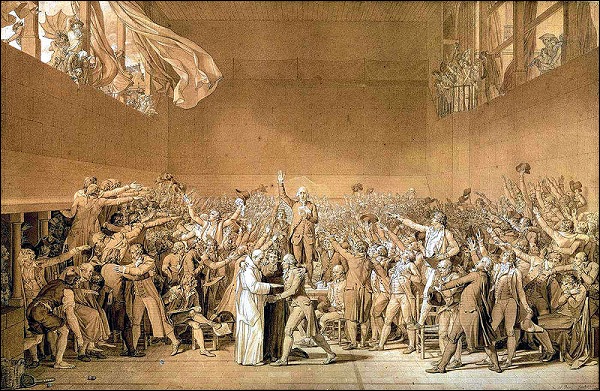
    The court is a tennis court, the game in play is revolutionary politics, the event is the Tennis Court Oath, where the members of the National Assembly gathered to swear “not to separate, and to reassemble wherever circumstances require, until the constitution of the kingdom is established” — the drawing is by Jacques-Louis David.

    A wildlife DoubleQuote in the Wild, hat-tip Dan Trombly

    Sunday, September 1st, 2013

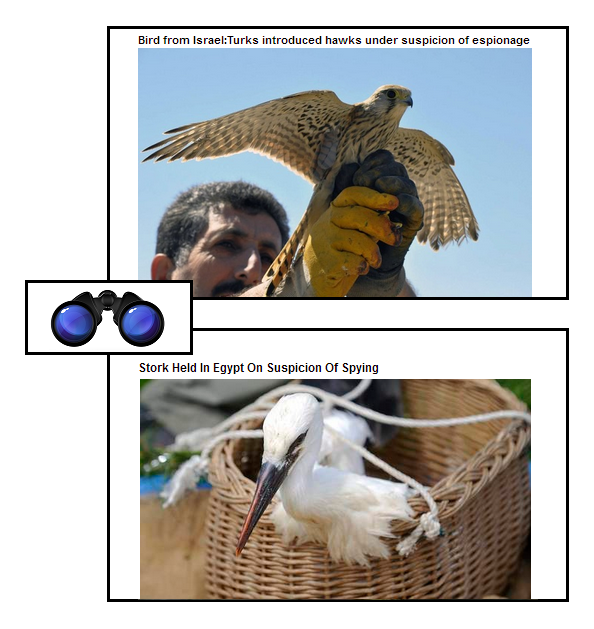
    [ by Charles Cameron — carrier pigeons, guilty, 1914, okay — dolphins, jury still out — but these storks and hawks, innocent I do believe ]
    .

    Sources:

  • Sky News, Stork Held In Egypt On Suspicion Of Spying, 31 August, 2013
  • National Turk, Turks introduced hawks under suspicion of espionage, 27 July, 2013
  • **

    I can claim no responsibility for this DoubleQuote, which I would never have “caught” without Dan Trombly‘s keen eye as manifest in his tweet today:

    For extra bite:

    The stork story concludes with this delicious tid-bit:

    In 2010, a series of shark attacks along Egypt’s Mediterranean coast were blamed on “GPS-controlled sharks” allegedly sent by Israeli security services into Sinai waters.

    Jumping the shark?


    Switch to our mobile site