zenpundit.com » Questions

Archive for the ‘Questions’ Category

Formats for civil online debate II — inspired by Hesse’s Bead Game

Tuesday, August 16th, 2011

[ by Charles Cameron — hypertext, rhetoric, glass bead games, civility ]

.

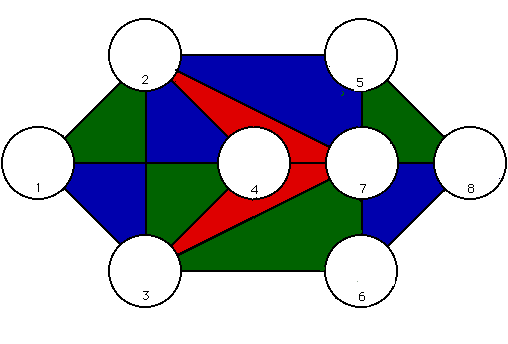
My second attempt at a format for online debate is, as I said, a variant on the “Dart Board” sometimes used for playing my HipBone Games (see, for instance, my solo game War is Sexy, says Dawn).

*

The idea here would be to format a blog post and series of 7 comments by a Querent (the one with the Question) who may also be the Umpire — both roles would be issue-neutral — a Proponent who would propose and support a thesis, and an Antagonist who would oppose it.And I should add, right at the outset, that this is a formal process for the named participants — as a white tie debate at the Oxford Union is a formal process — no matter how raucus the kibitzers may get, and accordingly requires a day or two between moves to allow for consideration, research and preparation.
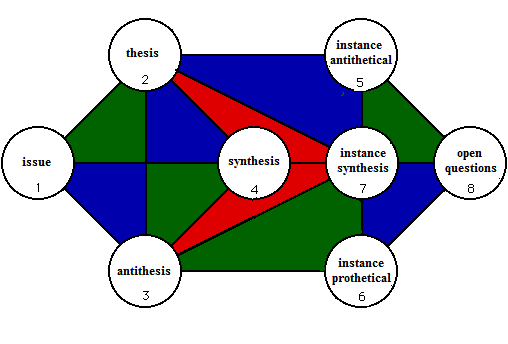
dartbdwhitedebatesetup.png

The Querent makes the first move in the first position on the board, giving it short move title (short enough to be typed on the board graphic in the space currently occupied by the word “issue‘) and a paragraph or so of move content setting forth concisely the issue to be discussed — ideally via an issue neutral anecdote or quote. After each move, the Querent (or a graphically inclined observer) would ideally update and post the game board after inserting the relevant move title.

[ Those who are not among the named participants may of course kibitz at any time… ]

The Proponent next carefully chooses a pithy quote or anecdote, gives it a move title (as above), and posts the move title, the chosen move content (the anecdote or quote selected), the link claimed (setting forth concisely the nature of his or her argument as it relates to the move content of the Querent‘s issue), and if she or he so chooses, a comment (the comments in a HipBone Game are intended for meta-conversations among the various players).

The Antagonist then similarly chooses an anecdote or quote, and posts move title, move content, links claimed — in this case, showing the links with both the issue as stated at position 1 in the Querent’s move, and the thesis as stated in position 2 in the Proponent’s move — and a comment if so desired.

Okay, that’s thesis and antithesis, the Umpire then posts a move title, some move content and links claimed to all three positions in play, with a comment if so desired, in the fourth position (labeled synthesis).

The rule is that whenever playing in a position which links via a board line to one or more previous moves, the links claimed must include explanations of how the move relates to those previous moves.

The Antagonist plays next in position 5 — playing move title, move content, links claimed, comment — providing an instance with which to dispute the thesis, and linking as per the rule just stated to the thesis proposed at position 2 — only!

Since position 5 is only connected to position 2 of those positions in play, no other links should be claimed.

Similarly, the protagonist then plays in position 6, a move which I’ve called the “prothetical” instance without a clue as to whether prothetical is a real word — tho’ I like it — linking only to the antithesis in position 2, which it seeks to refute.

Move 7 is by far the trickiest of the game, and is made by the Umpire, who now has to provide move content that synthesizes the game thus far, explaining links claimed to positions 2, 3, 4, 5 and 6 (ie to the original thesis, antithesis and synthesis, but moving the synthesis to encompass also the two instances)…

But the Umpire can take consolation in the fact that in the final move 8, the Querent gets to raise afresh those questions which remain — now that both sides have had their say, and the Umpire has attempted reconcile them.

*

Three quotes, the first one on debate:

Harmony among conflicting viewpoints, not the victory of one of them, should be the ultimate goal…

— from Bizell & Herzberg, The Rhetorical Tradition, as quoted here

The second moving from debate to dialog:

One way of helping to free these serious blocks in communication would be to carry out discussions in a spirit of free dialogue. Key features of such a dialogue is for each person to be able to hold several points of view, in a sort of active suspension, while treating the ideas of others with something of the care and attention that are given to his or her own. Each participant is not called on to accept or reject particular points of view; rather he or she should attempt to come to understanding of what they mean.

David Bohm, Science Order and Creativity, p 86

And the third, from Buddhist Madhyamika philosophy, moving into the contemplative realm where all answers are seen as the stepping off points for open questions:

I wanted to use one word in Tibetan that I’ve found very useful for myself… and this is the word zöpa.. this translates usually as patience or endurance or tolerance, but there’s this very subtle translation of zöpa, which is the ability to tolerate emptiness basically, which is another ways of saying the ability to tolerate that things don’t exist in one way, that things are so full and infinite and leave you so speechless, and so undefinably grand – and these are just descriptive words, but you have to use some words to communicate, I guess — the ability bear that, that fullness, like we’ve been talking about, not turning away, not turning away.

Elizabeth Mattis-Namgyel, in (if I recall) a Shambhala-sponsored retreat video

*

A blank Dart board, downloadable for your convenience:
dartbdwhitedebateblank.png

Formats for civil online debate I – inspired by the Talmud

Monday, August 15th, 2011

[ by Charles Cameron — hypertext, rhetoric, Talmud, civility ]

.

I have been thinking quite a bit recently about formats for online debate, and posted a comment on Jean Goodwin‘s blog yesterday, in which I commented on the Talmudic page (see R Eliezar Segal‘s excellent hypertext version for an explanation of how it works). It’s a topic that has interested me since before the turn of the millennium, and one I’ve discussed and prototyped a bit in some of Howard Rheingold‘s class forums.

Yesterday in my comment on JG’s blog, I said:

My guiding principle here is that devising suitable forms may well elevate the content poured into them…

I said this because, in my view, constraint facilitates excellence.

*

Part of the key here is captured very nicely in this quote from Jean Toomer:

In this multiple simultaneous world words only dole out one thing at a time.

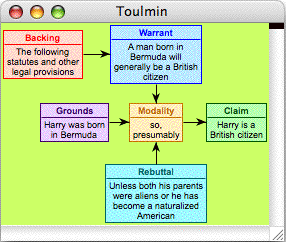
So we need polyphony, we need forms that capture many voices, many points of view, the perspectives of many stakeholders, simultaneously — not a linear progression from premise to conclusion.  And since we’re talking argumentation here, this simultaneity can be captured in a graphical form, as in this diagram based on Toulmin:

toulmin-example.gif

*

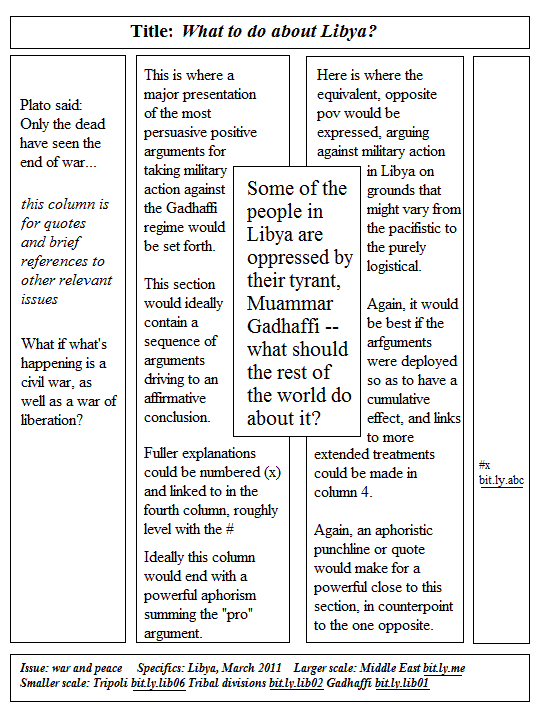
In that spirit, I thought I’d post a couple of my own experimental formats.  The first is based fairly closely on the Talmudic page — and I put it together in March of this year, so things in Libya have moved along a bit since then, though not quite enough as yet:

libyan-talmudsm.gif

My second format is a variant on the “Dart Board” sometimes used for playing my HipBone Games (see, for instance, my solo game War is Sexy, says Dawn).

I shall present it in a follow up post of its own.

*

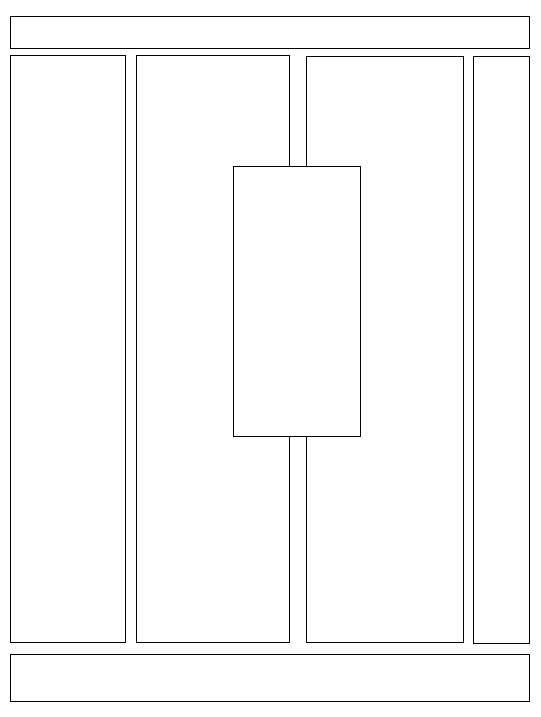
For your convenience, here’s a blank template for the kind of Talmudic debate-page I used above, available for download.  It can be filled with any graphical software that allows text and a choice of fonts & sizes.  I recommend using larger type for the main text, medium for the commentary, and small print for annotations and footnotes:

libyan-talmudsm-blank.png

Few at SWJ on “Less is Often More?”

Wednesday, June 22nd, 2011

Major Michael Few had a short theoretical post that sparked an important discussion at SWJ Blog and other social networking sites. He’s wrestling with the military-tactical effects of diminishing returns. Well worth your time to read through:

Less is Often More?

This is a post that I never would have written while practicing the art in Iraq. On the ground level, every commander wants more forces. In fact, one of the unstated prerequisites for command is that you must conduct at least one daily bitching session where you emphatically describe how much more effective you could be if you were given another platoon, company, battalion, etc…

– More forces equal more villages and more neighborhoods you can clear and occupy.
– More forces equal more visible power and control.
– More resources equal more money to bribe your enemies.

But, sometimes more is actually less:

– More forces mean that you can act unilaterally and just ignore the impotent host nation security forces.
– More forces mean that you can coerce and bully the corrupt political leaders.
– More resources mean that you may waste money building elaborate schools and medical clinics and digging canals rather than repairing the existing suitable structures.

Sometimes with more, we merely attack the symptoms creating short-term visible gains rather than attacking the root problems. Doctrinally, we would call this creating maneuver space on the human and physical terrain.

Read the rest here.

Systemic Curricular Choices Shape National Cognitive Traits

Thursday, March 10th, 2011

A brief point.

AFJ has a feature article by General Martin Dempsey on the need for the Army in it’s professional military education system to build future leaders who are critical thinkers:

Building Critical Thinkers

….The Army Leader Development Strategy identifies three critical leadership attributes for all Army leaders: character, presence and intellect. In addition to those three foundational attributes, we assert that strategic leaders must be inquisitive and open-minded. They must be able to think critically and be capable of developing creative solutions to complex problems. They must be historically minded; that is, they must be able to see and articulate issues in historical context. Possessed of a strong personal and professional ethic, strategic leaders must be able to navigate successfully in ethical “gray zones,” where absolutes may be elusive. Similarly, they must be comfortable with ambiguity and able to provide advice and make decisions with less, not more, information. While all leaders need these qualities, the complexity of problems will increase over the course of an officer’s career and require strategic leaders to develop greater sophistication of thought….

Read the rest here.

The nation is currently undergoing a debate about public education, of sorts. I say “of sorts” because the debate has largely been very dishonest on the part of proponents of certain kinds of “reforms” in which they hope to have a future financial interest, if radical changes can be legislatively imposed that will a) drastically lower labor costs and b) permit a “scalable” curriculum, to use the grammar of certain equity investor CEOs and lobbyists. The former does not concern this topic as much as the second, though the two will work in unison to create a profitable business model for a for-profit management company desiring to contract with local and state governments to run school systems.

“Scalability” builds upon Bush era NCLB legislation that emphasized standardized testing in basic math and reading skills, with punitive accountability measures for schools and districts failing to make “adequate yearly progress”. Due to the penalties and escalating standards, public schools have frequently narrowed their curriculums considerably, reducing instructional time for history, science, complex literature and the arts to put greater emphasis on basic skill drill instruction in just two subjects.

The net effect is that American public school students, roughly 88 % of all school children, spend a greater proportion of their day at concrete level cognitive activities than they did five or ten years ago and far less time on higher-level “critical thinking” like analysis or synthesis, making evaluative judgments, inquiry based learning or problem solving.

 “Scalability” means expanding on this dreary and unstimulating paradigm with digitally delivered, worksheet-like exercises to comprise the largest percentage of the instructional time for the largest number of children possible. It will be a low-cost, high-profit system of remedial education for would-be contractors, provided students are not able to “opt out”, except by leaving the public system entirely.

But only if their parents can afford it.

The US military relies upon the public schools to deliver the initial k-12 education of the overwhelming majority of their officer corps, to say nothing of the enlisted ranks. The soldiers, sailors, marines and airmen who went to Andover or similar private institutions before enlisting are very, very few. Today some public schools are excellent, some are failing and the rest are in-between. Most make an effort to challenge students of all ability levels, from those needing extra help to those in AP courses and gifted programs. There is systemic resiliency in a diversity of experiences.

What will be the effect on  the military leadership in the future if critical thought is methodically removed from public education by a nationally imposed, remedially oriented, uniform, “scalable” curriculum that is effectively free of science, history, literature and the arts? What kind of cognitive culture will we be creating primarily to financially benefit a small cadre of highly politically connected, billionaire-backed, would-be contractors?

Can inculcating critical thinking really be left entirely to universities and, in the case of the military, mid-career education?

What kind of thinkers will that system produce?

Better?

Or worse?

“What we think, we become” – Buddha

Question……

Thursday, February 24th, 2011

We have been hearing a great deal about the “leaderless” Libyan resistance to Gaddafi. To a lesser degree, we heard similar things about Egypt when protestors failed to coalesce behind Elbareidi as Egypt’s national savior, but it was muted, perhaps due to the prominence of Wael Ghonim, an influential figure to whom western reporters and audencies could relate. Ghonim, however, was not a “leader” in the same sense as say, Nehru, Walesa or Yeltsin.

Are these revolts really of a different political character or do their “leaders” in this panopticonic global environment just have the sense to stay the hell out of sight?


Switch to our mobile site