zenpundit.com » Charles Cameron

Archive for the ‘Charles Cameron’ Category

Coronavirus meets religion #3

Thursday, March 19th, 2020

[ by Charles Cameron — third in a series — mostly about locusts ]
.

Eye-grabbing but not helpful:

**

The image comes from Prophecy News Watch, where it heads up today’s article, Is Coronavirus Connected To Bible Prophecy?. The answer:

I believe what we are witnessing with COVID-19 is part of the birth pains Jesus talked about in the Olivet Discourse. In fact, I think it is a major birth pain; as is the locust plague that is ravaging Africa and the Mideast; as is the large number of social uprisings in countries around he world; as is the increase in earthquake activity; as were the record-breaking Australian wild fires; as is…you get the picture. Birth pains increase in frequency and intensity, and they only increase until the moment of delivery

**

Plague of locusts? From the Times of Israel, courtesy Richard Landes:

Notice the subtitle: the locusts will ” skip Holy Land”. In the story of the Biblical plagues, the locusts were the eighth out of ten plagues of increasing severity meted out by the Lord against Pharaoh and his Egypt. There was worse to come, but the locust plague itself would be worse than any other locus plague before or since. As Moses prophesies to Pharaoh:

Exodus 10. 3:Thus saith the Lord God of the Hebrews, How long wilt thou refuse to humble thyself before me? let my people go, that they may serve me.

4 Else, if thou refuse to let my people go, behold, to morrow will I bring the locusts into thy coast:

5 And they shall cover the face of the earth, that one cannot be able to see the earth: and they shall eat the residue of that which is escaped, which remaineth unto you from the hail, and shall eat every tree which groweth for you out of the field:

6 And they shall fill thy houses, and the houses of all thy servants, and the houses of all the Egyptians; which neither thy fathers, nor thy fathers’ fathers have seen, since the day that they were upon the earth unto this day.

It was the tenth and worst plague– the death of the firstborn — that afflicted the Egyptians and which “passed over” the Israelites — compare the eerie echo here of the plage that will “skip Holy Land”.

Worlds within the world: studio of Kiefer, mind of Vollmann

Monday, February 24th, 2020

[ by Charles Cameron — the worlds within this world are to be found in the workshops of Anselm Kiefer and William Vollmann ]
.

Artist one of two: Anselm Kiefer:

Kiefer devoted himself to investigating the interwoven patterns of German mythology and history and the way they contributed to the rise of Fascism. He confronted these issues by violating aesthetic taboos and resurrecting sublimated icons. For example, in his 1969 Occupations series, Kiefer photographed himself striking the “Sieg Heil” pose. Subsequent paintings—immense landscapes and architectural interiors, often encrusted with sand and straw—invoke Germany’s literary and political heritage. References abound to the Nibelungen and Wagner, Albert Speer’s architecture, and Adolf Hitler.

Interwoven patterns? The Nibelungen? Albert Speer?
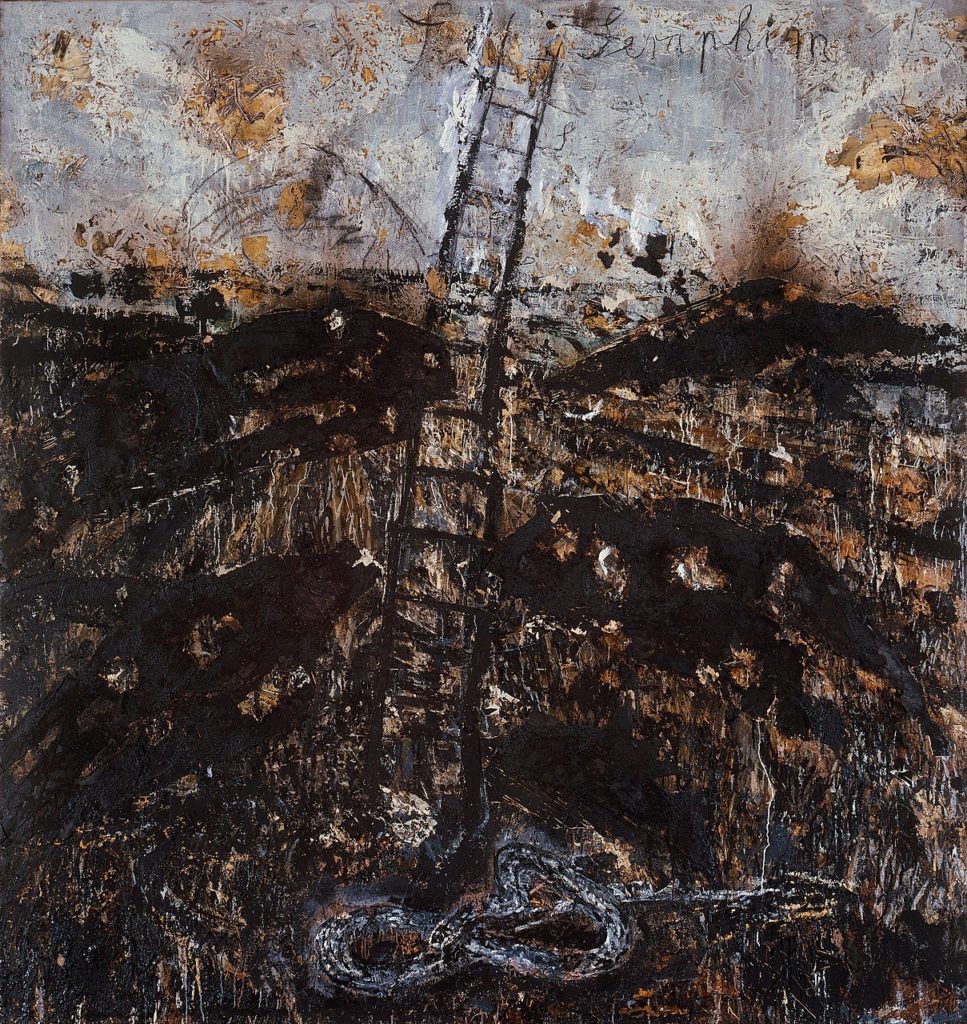
Seraphim? Jacob’s ladder, on which angels travel up and down? And in this time of nuclear and gas chamber holocausts, have they abandoned the ladder?

Seraphim is part of Kiefer’s Angel series, which treats the theme of spiritual salvation by fire, an ancient belief perverted by the Nazis in their quest for an exclusively Aryan nation.

Spiritual salvation by fire?

Okay, This fellow has the kind of dark mythological intensity that interests me. Let’s take a stroll through this man’s world — a deeper dive into his studio.

In we go:–

It was like a world inside the world. Huge metal slabs were leaning against the walls. Helter-skelter around them, on racks with wheels, stood large paintings of oceans and beaches, rivers and meadows, mountains and forests, some covered with corroded ravines of lead. Vitrines in every size were standing everywhere, filled with the strangest things: the roots of trees, rusty hammers, little clay pigs. Shelves that ran the length of the hall were stacked with balance scales, hooks, rifles, stoves, snakes, torpedoes, piles of bricks, heaps of dried flowers, even whole trees. There were more full-size fighter jets and a cage that was maybe 300 square feet that was filled with golden wheat and what appeared to be the cooling tower of a nuclear power plant with a bicycle dangling down the side.

Torpedoes! Whole fighter jets! Whole trees!

Kiefer‘s paintings, we learn, are overwhelming, dark and vast — Seraphim‘s a good example — enforcing silence before their enormous intensity. And then, suddenly — watercolors, “brimming with color — sparkling blues and brilliant reds” as bright as the moments of a life, and thus as intensely personal as the dark vast paintings had been impersonal and overbearing — as is, one is forced to admit, our century.

He’s an artist — exhibit number one.

**

Here’s exhibit number two: the mind of William Vollmann..

Deep dive number two:

Bill greeted me warmly and showed me around the art-making area of his bunker, where he has a power engraver—he was working on a suite of Norse block prints when I visited—and where he prints his Dolores photographs using an arcane 19th century method called gum bichromate, which takes up to 28 days to produce a single print. Then he led me to the walk-in.

What’s in here?

This is the meat locker, where Dolores’s parts are. When the electrician wired it up, he asked, “What do you use this for?” I said, “Oh, that’s just where I keep my victims.” There was a long silence….She’s got her dresses here and I have my bulletproof helmet and various stuff from my journalism in there

Lecter, Hannibal? “That’s just where I keep my victims”?

Vollmann, like Kiefer, is possessed of a world both dark and sparkling bright. The sheer extent of his variety, too, is impressive, overwhelming.

I have in my room at the Pine Creek Care Center only two smallish bookshelves, and in them one book of Vollmann‘s: Kissing the Mask: Beauty, Understatement and Femininity in Japanese Noh Theater. I mean, how not?
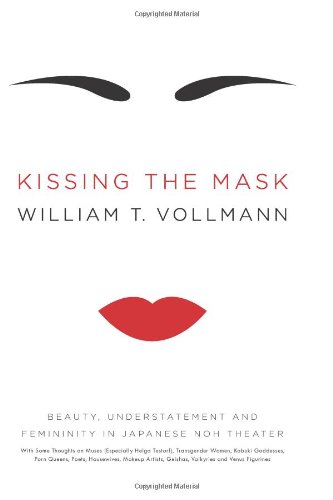
Kissing the Mask is so packed with beauty, understatement — erotics, Japan, Noh, Vollmann himself, Noh backstage, behind-the-scenes, photographs — ” a string ball of thoughts” — I’d like to say “torpedoes .. even whole trees” but Vollmann‘s world within the world is other than Kiefer’s, as though there were room for two worlds within our world — three perhaps — though I’ve yet to encounter the third — “with Some Thoughts on Muses (Especially Helga Testorf), Transgender Women, Kabuki Goddesses. porn queens, poets, housewives, makeup artists, geishas, valkyries, and Venus figurines” Vollmann addsall this in small print at the bottom of the book’s cover.

And Valkyries!

It takes my reading glasses and a Sherlock Holmes magnifying glass to read these days, and my copy of the abridged, one-volume Rising Up and Rising Down: Some Thoughts on Violence, Freedom and Urgent Means is in storage — a book fate which I both mourn and feel intense gratitude for.

When Vollmann turns to consider violence — “to establish a moral calculus to consider the causes, effects, and ethics of violence” as Wikipedia has it — he spends twenty and more years on the task.

The abridgment, Vollmann says, he made in half an hour, for the money. Truth to the work’s title is to be found in the $700, seven-volume original set, 3,500 copies. Even with dollar-store glasses and Holmes’ magnifying glass — enhanced with the option of bright light the better to read by — seven volumes is beyond me, as 700 pages of the condensed would be.

And there are yet other Vollmanns, with other worlds..

**

Oh but let Van Gogh have the last word, eh, Vollmann?
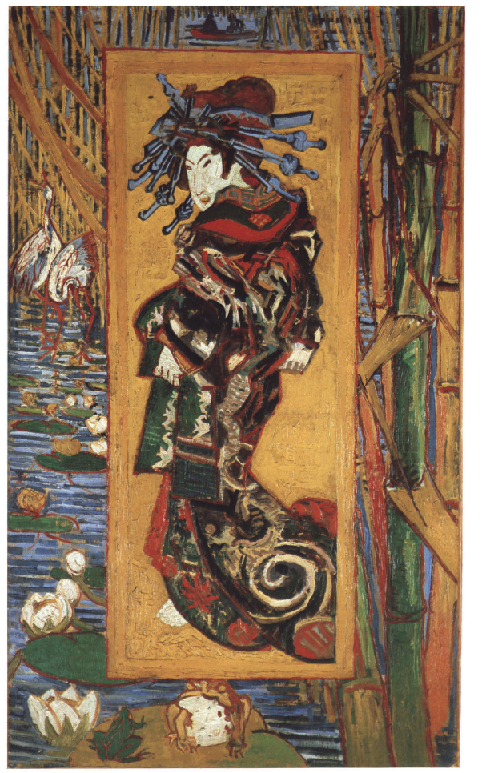
Vincent Van Gogh, Japonoiserie, The Courtesan

**

Sources

  • Guggenheim, Kiefer, Seraphim
  • NYT, Into the Black Forest With the Greatest Living Artist

  • 3 am, becoming dolores: william t. vollmann exposes his female alter ego
  • Wikipedia, William T. Vollmann

  • Metropolitan Publications, Van Gogh in Arles
  • Doing without, a new wave?

    Sunday, February 23rd, 2020

    [ by Charles Cameron — intuitive and counter-intuitive redefined, no politicians, no borders, no traffic lights ]]
    .

    Consider these two titles, both of which I ran across today:

    Sources:

  • The Nation, What Would an Open-Borders World Actually Look Like?
  • New Yorker, Politics Without Politicians
  • **

    Consider: doing without traffic lights:

    The original example is Drachten, a town in Holland of 50,000 people. It is home to exactly zero traffic lights. Even in areas of the town with a traffic volume of 22,000 cars per day, traffic lights have been replaced by roundabouts, extended cycle paths and improved pedestrian areas. The town saw accidents at one intersection fall from 36 over a four-year period to just two in the last two years since the lights were removed in 2006.

    The counter-intuitive finding is that streets without traffic signals mean that cars drive more slowly and carefully because the rules of the road are ambiguous—there’s no red, green or yellow to tell drivers precisely what to do.

    Counter-intuitive. eh? Highly intuitive, and counter to popular assumption, I’d say. Out of the box from one-two-three to zero.

    A very interesting title from 2014, & a title match, 1972

    Saturday, February 15th, 2020

    [ by Charles Cameron — a biker gang as alt-army, a chess board as Cold War battlefield — Night Wolves, and Fischer Spassky ]
    .

    I mentioned the Night Wolves bikers in my post It’s how we / they roll in May 2015, and there have been many reports of their activities elsewhere — but yesterday I was pointed to some videos I hadn’t seen before, and came across this intriguing title on an RT video from Sevastopol, 2014:

    Russia: Epic Night Wolves biker rally takes war in Ukraine to the stage

    Similar, is this Guardian headline from 2916:

    Putin’s Angels: the bikers battling for Russia in Ukraine

    **

    Think about it. Taking a war to the stage — with a couple of rock bands, a light show, plenty of fires, and the Night Wolves themselves making high bike jumps across the stage — may sound like little or nothing, but for the citizens of Sevastopol is’s either w pretty profound warning or a pretty powerful affirmation that the Crimea belongs to Mother Russia.

    That’s quite an audience! And read the caption:

    This city will come back
    Sevastopol will stay Russian

    **

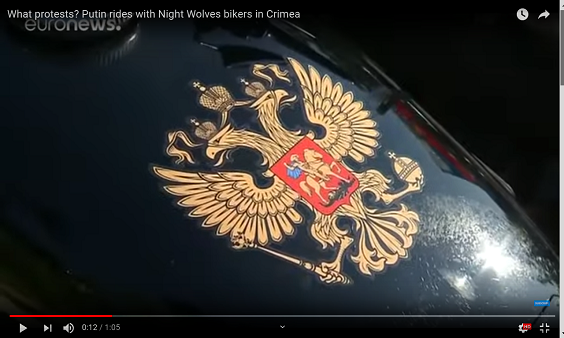
    Note — this is a very short video clip — that Putin rides with the Night Wolves — in Crimea:

    Note that Putin‘s bike has the Russian Imperial insignia of a double-headed eagle — on his gas tank!

    Note the crown at the very top, and St George slaying the dragon in the center panel.

    **

    If you have 35 minutes, watch this — it’s pretty damn impressive for a show put on by a biker gang:

    If you don’t have 35 minutes, just flick through it, catching a sense of the thing. But uit’s well worth watching in full, so perhaps you can find time to come back and watch it later.

    **

    The title of this post claims that “Epic Night Wolves biker rally takes war in Ukraine to the stage<" is A very interesting title". Any text which suggests that war can be considered a drama, a game, or a dream -- a subset of reality -- is of inherent interest: think of the impact of the black American athlete Jesse Owens crushing his German opponent to win four gold medals in Hitler's 1936 Summer Olympics!

    In this case we have the claim that war can be enacted in a rock and roll and light show. A comparison with warfare as chess may prove illuminating: consider the Telegraph article titled How Bobby Fischer and Boris Spassky became pawns — the title itself is extraordinary, making pawns of two great chess grand masters!

    Even before Fischer-Spassky, we are told:

    For the USSR, chess had always been a key weapon in the Cold War.

    And the match itself? For this, let’s turm to an Irish Times article:

    Cold War in Reykjavik as Fischer breaks Soviet defender Spassky

    Never before or after has a chess tournament, or perhaps any sporting event, taken on such non-sporting significance. This was not Spassky v Fischer. It was the USSR v US. [ .. ]

    The fate of a nation has rarely depended on the result of a sporting endeavour. But that was how the match-up between Fischer and Spassky was portrayed in the lead-up to Reykjavik in 1972.

    When he defeated Spassky, we are told, Fischer “was treated as a war hero.” Spassky resigned by telephone– and Fischer? Ever the eccentric —

    The audience (about 2,500) burst into rhythmic applause and rose. Fischer, still busying himself at the chessboard, again nodded, looked uncomfortable, glanced at the audience from the corner of his eyes and rushed off.

    Predictable, enormously surprising

    Friday, February 7th, 2020

    [ by Charles Cameron — read these in sequence and tremble — with a brief note on impeachment ]
    .

    Here:

  • New Yorker, Citing climate change, BlackRock will start moving away from fossil fuels
  • New Yorker, Will Big Business Finally reckon with the Climate Crisis?
  • World Economic Forum, The Global Risks Report 2020
  • BlackRock, A Fundamental Reshaping of Finance
  • Guardian, European Investment Bank to phase out fossil fuel financing
  • IEEFA, The terrible, horrible, no good, very bad year for oil and gas
  • **

    Climate scientists caught on first, then the military, and now financial risk analysts. Meanwile, Mitt Romney spoke his conscience to the Senate on impeachment. Things are shifting: if BlackRock and IEEFA were the jurors, with a dime of every dollar in the world at stake, President trump might not like their verdict.


    Switch to our mobile site