zenpundit.com » Afghanistan

Archive for the ‘Afghanistan’ Category

There Will Be Blood…..

Thursday, January 19th, 2012

All In: The Education of General David Petraeus by Paula Broadwell, with Vernon Loeb

The official biography of CIA Director General David Petraeus, by Harvard researcher Paula Broadwell, has long been anticipated in the .mil/COIN/NatSec/Foreign Policy communities and blogosphere.  I can hear pencils scrawling furiously away in the margins even as I type this post. 🙂

Broadwell,  herself a reserve Army officer, West Pointer, Harvard grad, doctoral student at King’s College War Studies Department , and by all accounts, an impressive up and coming individual,  had very extensive access to her subject – allegedly, far more than the official Army historian assigned to General Petraeus’ last command. Given the subject is General Petraeus, the precarious state of American policy in Afghanistan and 2012 as a circus of political excess, All In will be one of the few “must read” books this year.

And, I must commend Miss Mrs. Broadwell highly here, she will be donating 20 % of her net proceeds to help wounded veterans.

That said, in terms of reaction to this book, there will be blood.

Reviews of All In will afford the opportunity to tear the scabs off of the well-worn COINdinista/COINtra debate and rub salt in the exposed wounds – I for one am especially looking forward to reading future back to back reviews by Carl Prine and Thomas Ricks and Abu Muqawama vs. Colonel Gian Gentile. In the mainstream press, the opportunity for newspaper columnists to get in gratuitous potshots against figures like Presidents Bush and Obama, Dick Cheney, Don Rumsfeld, Robert Gates, Joe Biden, Hillary Clinton, Stan McChrystal and numerous others or grind partisan axes will be too tempting to resist, regardless of how relevant these remarks are to Broadwell’s biography of Petraeus. The looming specter of draconian cuts to defense budgets will also add to the rancor of the discussion of the book within the defense community.

Somewhere in that debate will be the book Broadwell actually wrote and within the book, perhaps, we will come to see David Petraeus. Or not.

Get your popcorn ready!

Right now, I am deep into reading the superb George Kennan biography by eminent diplomatic historian John Lewis Gaddis but All In is definitely next on my list.

And it will be reviewed.

Justice, Coercion, Legitimacy, State-Building and Afghanistan

Tuesday, January 17th, 2012

Discussion has been emerging in the foreign policy blogosphere of   late  regarding sovereignty and the other day, Afghanistan scholar Antonio Giustozzi opined on coercion, a necessary tool of a state seeking to wield a monopoly of force.

Theory is good and the discussion is an important one with implications for US foreign policy, but it helps when debate is informed by empirical examples from practitioners.  Quesopaper, a blog by  someone out in the field  in Afghanistan has been dormant for a while, but sprang alive again with a timely post:

Rule of Law, The Afghan Springer Show 

….Rule of Law is one of the key aspects to “fixing” Afghanistan. When the Taliban dominated the country, they controlled the “courts.” As Taliban influence waned, the US and partner nations have sought to create a more traditional court system. I can’t speak intelligently on why “WE” decided to create a more western form of law in Afghanistan, but I can say, it’s not the correct approach.

I work in a remote district. It’s over an hour to the main provincial (think state) government center. The difference between the two places is about as extreme as possible. The villages, even the district center (think country govt) lack ANY essential services. There are no plumbing systems, no electricity, no garbage service…nothing. Yet, the people here survive; and dare I say? Thrive.

Like most farming folks, the people here like to be left alone. The people appreciate the Govt–Government of the Islamic Republic of Afghanistan aka “GIRoA”–but they only want so much help. Rule of Law doesn’t fit into their needs.

So, how do rural locals settle disputes?

I just recently worked with a local governor as he negotiated the resolution of a 25 year dispute. Dispute doesn’t really describe what happened…feud is more appropriate. Each side had multiple murders, one family had 1300 fig trees destroyed. Decades of money in dispute. The feud was complicated enough that the Taliban failed to resolve the issue in nearly seven years of negotiations. Negotiations require buy-in from many parties…I could go on about this, but I doubt I can make it any clearer…

Land disputes are among the thorniest local civil society issues in Afghanistan, and one where the generally corrupt and inept Karzai regime draws a particularly poor comparison with the Taliban insurgency’s ability to provide “rough justice” where the richer, more influential party to the dispute does not automatically win through bribery. Land claims are blood issues in peasant-agrarian societies in general and all the worse in honor cultures that tolerate vendettas – that the brutal Taliban could not force a settlement in this case, or did not dare to try – speaks volumes.

….Finally, our district (county govt) governor is called upon to start the process of reconciliation. This BTW is MAJOR progress for the legitimacy of GIRoA. It means the people trust this man to handle this dispute. It might become national news (for Afghanistan) though you will never hear this story on any US network or .com site (except quesopaper.com). After weeks of massaging each side, pulling out their story, commitments (commitment to settle is vital in these things) and “evidence.”

An aside about evidence…in a society that is mostly verbal and illiterate, nearly anything written can become something that it is not…WTF are you talking about Pietro? What I mean is, give someone who can’t read a document. That paper is written in a foreign language, with foreign letters. Tell him its a deed to a piece of land…wait 35 years. Now, tell that man’s grandson that the land he’s been farming for 10 years; that his family has worked for generations, isn’t actually his.

Now he has nothing; he can’t provide for his family. Tell him, his paper is a receipt for a Persian rug, not a deed…explain that he owes the real land owner for the use of that property and revenues generated. Let me know how that goes…if you smell cordite it probably didn’t go to well.

For very poor people who live at the margins of subsistence, the stakes could not be higher, which can make rolling the dice on private violence attractive (this is also why land reform programs are only a short term stopgap in economic development and reform. Agrarian population almost always exceeds arable land and as the plots get smaller, they are less productive).  Dying on your feet with a weapon in hand looks a lot more honorable to a hard-pressed farmer than watching your children waste away from starvation as the other villagers gossip about your plight.

A state with legitimate authority can preempt or suppress such private violence, but is also expected to solve the problem.

….Back to our story…The governor calls in Sharia/Islamic law experts and elders from both tribes and other community elders. Mix that group into a bunch of small rooms and start shifting groups from room to room…hours of discussions (which looks like arguing to me). Don’t forget, this thing hasn’t been settled before, it’s serious business, and here serious business is settled with an AK. At anytime the whole ordeal can melt into violence.

Success is fleeting. I have a gun, no fooling…I’m armed….

Go to quesopaper to find out what happened next. 🙂

Part of the problem is, as quesopaper indicates, our Western framework. We began experimenting with rule of law to settle property claims and commons rights starting, oh, in 14th century England with land enclosures and we did not really finish for good until after Reconstruction in the very late 19th century. That’s 500 years for the “Rule of Law” as we understand it to become the standard for 100 % of the population, 100% of the time.

And along the way, there was blood. Rivers of it. From the Highlands of Scotland, to the piney woods upcountry of Appalachia to the Black Hills and the great Western Range Wars. The gavel of the judge had to be preceded by the soldier’s rifle, the settler’s six shooter, the rebel’s musket and knives used in the dead of night.

Are Afghans in far rural villages closer to a Manhattan attorney or an English tenant whose access to the pasture has been closed off by his noble lord against all custom and ancient right? What quesopaer is seeing is “state building” from scratch, from the bottom up. Slow, painful, difficult to be certain, but more likely to be durable than imported abstractions imposed from the top down.

We are leaving Afghanistan, it is clear. Any state that we leave behind that can resist the Taliban must be able to stand behind and enforce a rule of law as Afghans understand and accept it.


A poignant week or so in DoubleQuotes

Friday, December 30th, 2011

[ by Charles Cameron — fictitious peoples (Israelis, Palestinians), approved and disapproved scriptures (Hindu, Falun Gong), religious violence (Afghanistan, Nigeria, Bethlehem) ]
.

So, is there some sort of contest going on between Iranian and American ex-Speakers? Perhaps Elliott Abrams‘s response to Gingrich, quoted in the Washington Post piece, applies equally well to Haddad-Adel?

There was no Jordan or Syria or Iraq, either, so perhaps he would say they are all invented people as well and also have no right to statehood.

Next up…

And okay, what’s the point here? Is it that the Russians want to please both the Chinese and Indian governments — or that they don’t like new scriptures but are okay with old ones? Or is the problem that they haven’t decided yet on a “one size fits all” approach to unOrthodox religions?

Sigh. Next…

This is brutal — and apparently intercontinental.

You might think it’s obvious what the wrong answer is, and who’s doing the killing, in Nigeria. But these things can cut both ways:

Even here, it’s not clear who threw the bomb into the madrasa, although one could hazard a guess…

And even the site of the Nativity is infected. The Guardian’s account of events there this Christmas season is harsh in tone — but consider whose Nativity is supposedly being celebrated…

I’d say the Qur’an offers a better image of Christian monks than that experienced by those Palestinian riot police… who, in the event, although they themselves were also assailed with broom-sticks, declined to arrest anyone because, as Palestinian police lieutenant-colonel Khaled al-Tamimi put it:

Everything is all right and things have returned to normal. No one was arrested because all those involved were men of God.

Still, things could be worse. It was a squabble along similar lines in which nine several Orthodox monks were killed that triggered the Crimean War: details in Raymond Cohen, Conflict and Neglect: Between Ruin and Preservation at the Church of the Nativity — h/t Juan Cole, who also has video of this year’s brouhaha.

*

Et in terra pax hominibus bonae voluntatis.

Iconic: compare and contrast III

Saturday, December 24th, 2011

[ by Charles Cameron – Iraq war, beginning and ending, analytic power of similarity ]

.

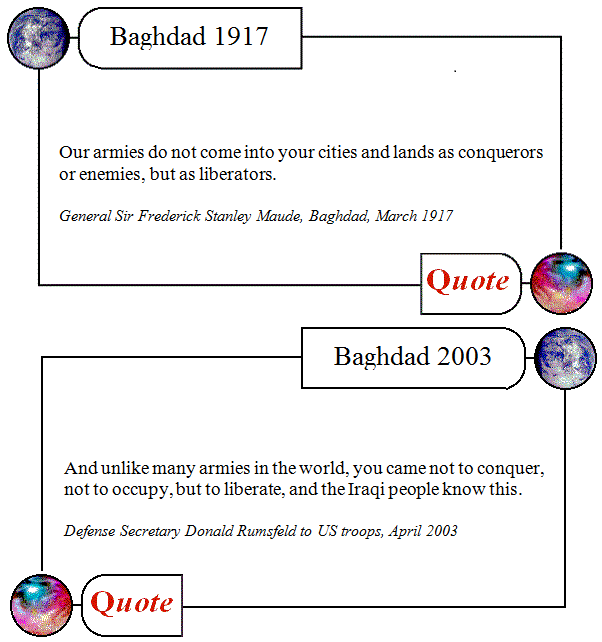
I’ve thanked Zen for his Iconic Compare and Contrast post already, but I’d like to run with his juxtaposition of images from the end of the Iraq war, and book-end it with an early DoubleQuote of mine from the beginning, thus:

That’s the beginning of the war, as I saw it “binocularly” — and here’s its ending, as Zen captured it:

Different though they are — one verbal, one visual — I think they go well together. I think they belong together.

But that’s essentially an aesthetic intuition.

*

And — apart from thanking Zen — that’s the thing I want to talk about.

The two quotes, eighty-six years apart, about an (anglophone) army in Baghdad coming there to liberate, not to conquer, are similar enough that they should give us pause for thought. They challenge us to think long and hard about the similarities between the two situations — and they challenge us to think no less hard and long about their differences.

Likewise, it’s the similarities between the two images Zen chose — of the Soviet withdrawal from Afghanistan and the US exit from Iraq — that give that juxtaposition its power.  And Zen has chosen very carefully:

Not only are there two lines of vehicles stretching back from the foreground away into the distance in each image, but the angle from which the two columns are seen is about the same — and there are even two “tracks” in each photo reinforcing the vanishing point — two tracks to the right of the vehicles in the Afghan photo, the edge of the road and a what looks like the shadow of an overhead cable in the photo from Iraq.

*

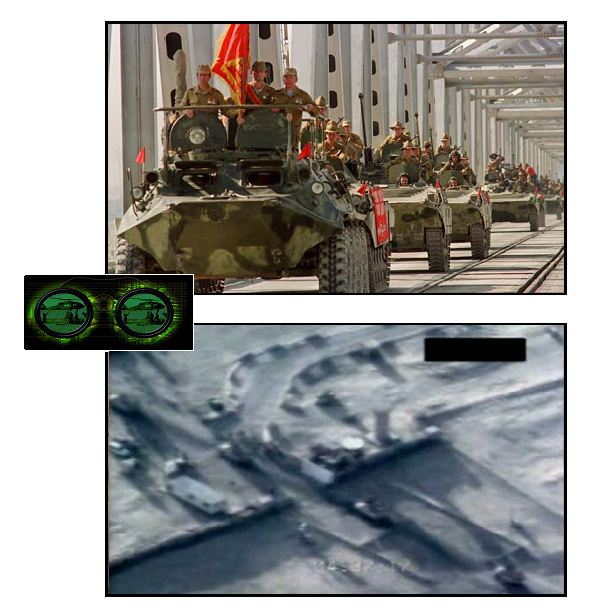
But let’s take this a bit further. The following juxtaposition is every bit as much a juxtaposition of the Soviet and American withdrawals as the pair of images Zen picked, but this time we have an aerial view of the US convoy — so the visual “rhyme” between the two images is no longer there — and even though the aerial shot is an intriguing one, what a difference that makes!

There’s nothing in that juxtaposition to make you go, yes!

On the level of what’s being referred to, the troop withdrawals from Afghanistan and Iraq,  this pair of images has the same properties as the two images that Zen selected.  But it doesn’t capture our attention in nearly the same way.

And the same would have been true if I’d picked a different sentence from Rumsfeld‘s speech to juxtapose with General Maude‘s “not as conquerors or enemies but as liberators” — such as, “You’ve unleashed events that will unquestionably shape the course of this country, the fate of the people, and very likely affect the future of this entire region.” I’d still be comparing and contrasting two speeches from the beginnings of two occupations of Baghdad.  But there’d be no oomph to the comparison.

*

Because — and this is what I am trying to get at, the basic principle of HipBone analysis and what distinguishes it from otherwise similar modes of brainstorming and mind-mapping — the recognition of pattern, of salient sameness, of close parallelism or opposition is the criterion for success or failure in a HipBone-style juxtaposition.

Zen’s graphic example has that closeness — even down to those two parallel tracks beside and to the right of the vehicles.  My two quotes from Maude and Rumsfeld have that.  And it’s that closeness of match that makes a juxtaposition powerful.

Analogy works this way, rhyme works this way, fugue works this way, graphic match (in cinematography) works this way — it’s basic to the arts, basic to rhetoric, and basic to the way our analogically-disposed minds think.

It is not a method for arriving at conclusions, it’s a method for posing questions. And it sits right at the juncture where analysis admits it is not a science but an art.

Zen’s Iconic Compare and Contrast: Nine Years

Saturday, December 24th, 2011

I would like to depart from my usual style and take a leaf out of Charles Cameron’s playbook – notably his last post. Consider this a “Part II”.

Here are my selections:

Friendship Bridge, Afghanistan – February 16, 1989

….Many troops wondered how the Iraqis, whom they had worked closely with and trained over the past year, would react when they awakened on Sunday to find that the remaining American troops on the base had left without saying anything.

“The Iraqis are going to wake up in the morning, and nobody will be there,” said a soldier who identified himself only as Specialist Joseph. He said he had emigrated to the United States from Iraq in 2009 and enlisted a year later, and refused to give his full name because he worried for his family’s safety…..

Tampa Highway, Iraq – December 18, 2011

War without a strategy is like driving without a map – and in both cases you may not like your destination.


Switch to our mobile site