zenpundit.com » britain

Archive for the ‘britain’ Category

Grand Strategy Board II, UK Edition

Tuesday, May 10th, 2011


Aaron Ellis at Egremont, the blog of the Tory Reform Group, has taken a liking to my previous post, Time for a Grand Strategy Board? and decided that the time might be right for Britain:

Should the UK institutionalise its Wise Men?

Ever since the end of the Cold War, this country has found it hard to think strategically. A parliamentary report last year stated, “We have simply fallen out of the habit”. It has also befallen the United States and both our foreign policies have suffered from similar problems. The ‘Big Picture’ is being obscured as policies such as humanitarian intervention and promotion of democracy take the place of grand strategy.

Governments have also found it hard to implement their chosen policies because of the lack of proper strategy – the sort that links ends, ways and means. This has been the case for military action, as we are witnessing in Libya.

The lack of any overarching ideas about our role and our interests has led to an incoherent foreign policy, as competing departments pursue contradictory policies even within the same country.

The problem is partly institutional. Jim Scopes, a former director of strategy at HM Revenue & Customs, has written that current reward and promotion mechanisms in the Civil Service “favour reactive (problem-solving) behaviour rather than proactive (strategic) approaches.” The Public Administration Committee has found that “the ability of the military and the Civil Service to identify those people who are able to operate and think at the strategic level is poor.” As I wrote last month, the makeup of government institutions is not the only factor in making strategies but it is an important one. The world is so unstable right now that it is essential for policymakers to understand the global environment if they are to form a sensible foreign policy – yet the structure of governments influences how they see the world.

If governments are filled with officials more comfortable with solving immediate problems then foreign policy will be reactive and short-termist. We need people to take the longer view…

Read the rest here.

There’s an interesting symmetry here, in the effort to improve the strategic capacity of respectively the United States and the United Kingdom, that derive from the differences in their Constitutional arrangements and national security cultures.

Britain has operated for centuries with an unwritten Constitution and Cabinet government. While these phrases are much more historically complex than meets the eye, the power relationships of Monarch, Houses of Parliament, electorate, peerage, bureaucracy and Party having evolved considerably over time, we can simplify things by stating that the cardinal virtue of the British system was flexibility, to adapt to circumstances. In a crisis, power could rapidly flow to the minister best suited to deal with the trouble at hand and the lack of institutional structures helped ensure that once the crisis had ebbed, concentrated power would just as rapidly dissipate.

The United States, by contrast, has a written Constitution and a Federal government, which while also undergoing historical evolution, is characterized by restraint. Friction is engineered into the American system to thwart or deter concentrations of power and circumscribe it’s exercise within defined parameters . Except in rare instances of overwhelming national consensus, new activities by the US government require the Congress to establish formal institutions that will then fall within the natural gridlock of checks and balances that is the American system.

Ironically, in remediating the lack of strategic vision on both sides of the Atlantic, a Grand Strategy Board would represent an institutionalization of strategy by the British, whose flexible system is in need of a long term, disciplined, focus and a strategic advisory lobby for the Americans, whose more rigid political system periodically requires blue ribbon commissions, panels, study groups and boards to break our habitual political deadlocks.
Porter at Infinity Journal

Friday, April 8th, 2011

Infinity Journal has added a more “blog-like” or “column-like” section to cover events within a contemporaneous frame in addition to their peer-review articles which come out quarterly (or perhaps bimonthly) more contemporaneous peer reviewed articles, oriented toward current events, in addition to their quarterly publication of the journal . Dr. Patrick Porter of Offshore Balancer ( and King’s College) has the maiden post with a provocative piece:

Exclusive: Lost in Libya: The UK does not understand strategy

The limited war of 2011 would refuse to be quarantined. After all other options were exhausted, it could culminate in a land war against Tripoli. Distressingly, we would shoulder the burden of invading, pacifying and administering this country. Occupation would probably lead to resistance – and Libya propelled more foreign-born jihadi volunteers into Iraq than any other nation. A new front in the War on Terror would open up. Idealists now calling for humanitarian rescue would discover that all along they opposed Western imperial hubris….

Free registration required. 

Admittedly, I stole the excerpt above from SWJ Blog – the online format of IJ makes it difficult for bloggers to quote sections of articles by copying and pasting into blog posts. This probably cuts down on the velocity and extent of IJ articles circulating in the .mil/strategy/foreign policy online world (blogosphere, twitter, listservs). OTOH the editors may not care as it probably reduces the amount of inane vs. informed criticism as well 🙂

In any event. Dr. Porter’s article is worth reading.

Honor killings

Monday, March 7th, 2011

[ by Charles Cameron — cross-posted from ChicagoBoyz ]

*

I had occasion today to give myself a quick refresher course on honor killings, one form of which is already present in the Torah as of Leviticus 21.9:

And the daughter of any priest, if she profane herself by playing the whore, she profaneth her father: she shall be burnt with fire.

and found myself once again noting that there is a substantial swathe of regions of the world where honor killings are found, and that where it is found (including in immigrant communities from those parts of the world) the practice is not confined to any one religious group.

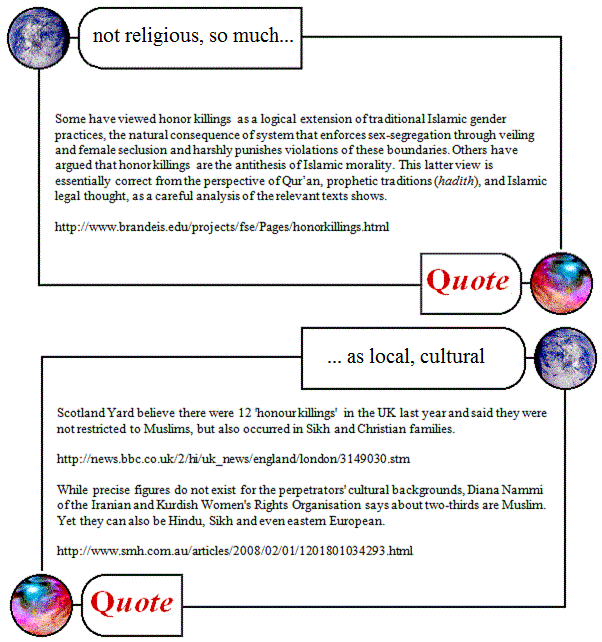
Hence this DoubleQuote:

I think it is appropriate to consider honor killing a form of religious violence when the claim is made by those who do the killing that they are acting in the name of their religion — but that it is also important to distinguish such acts committed in a cultural context in which they are practiced across religions from acts that are the exclusive province of one religious tradition.

There are examples of honor killings which are performed in the name of Islam, and/or advocated by Islamic scholars — and the same could no doubt be said of other religious traditions — but honor killing as a genre is fundamentally more cultural than religious.

Sources: Brandeis studyBBCSydney Morning Herald

The analytic point:

From my point of view as an analyst, it is important to note and compare both religious and cultural drivers — neither avoiding mention of the one out of “correctness” — nor overlooking the other for lack of comparative data.

Off-Base

Thursday, January 27th, 2011

Dr.David Ucko at the excellent Kings of War blog has his story and he is sticking to it:

The Weather Underground: a different approach to political violence

I recently watched The Weather Underground, a 2002 documentary on the eponymous radical organisation active within the United States during the 1970s. The film may be of interest to those studying radicalisation, insurgency and political violence, as it effectively explores the rise, evolution and demise of a revolutionary organisation. It also raises some semantic/ethical questions about ‘who is a terrorist’.

….The use of violence for political messaging may be viewed as ‘terrorism’, and this is typically how the Weather Underground is understood. But is this accurate? Terrorist groups deliberately target civilians to scare or terrorise wider populations into a certain political behaviour. The WUO refrained from such action: they used violence against buildings rather than people, to symbolise their discontent with specific policies and actions, but without killing those held responsible. It was ‘propaganda of the deed’, but without the bloodshed. Accordingly, none of WUO’s attacks resulted in casualties (the one exception has not been definitively linked to the group), and for this reason alone, it is difficult to call WUO a ‘terrorist’ organisation.

Uh, no it isn’t. As the commenters at KoW are busy trying to inform Ucko, this narrative does not fit the facts of the history of the Weathermen.

David, I suspect, is not trying to romanticize the Weathermen here so much as force-fit them into his theoretical model of terrorism, possibly influenced by a tactical turn that was undertaken by the IRA to drive up financial costs for the British government while minimizing the bad press that and damage to their public image that had been growing from earlier, bloody, IRA bombings.

Of Anwar al-Awlaki and Bold Christian Clothing

Monday, January 24th, 2011

[ by Charles Cameron ]

I am, admittedly, very interested in religion, and Christianity has been the mother-lode for me of the imagery, gestures and profound words that can move heart, soul, mind and imagination into a greater depth.

Advertising, on the other hand… well, let’s just say that the best of it plays on imagination, too, but it is generally more of an intrusion upon – via billboards on landscapes, via commercials in movies, or via irritating jingles and catch phrases that subvert my best attempts at quieting the mind – than an experience of the kind of depth that religion at its best can offer.

But if you are interested in religion, and click online in enough of the right places, advertising that has “religious” content will be targeted to you.

*

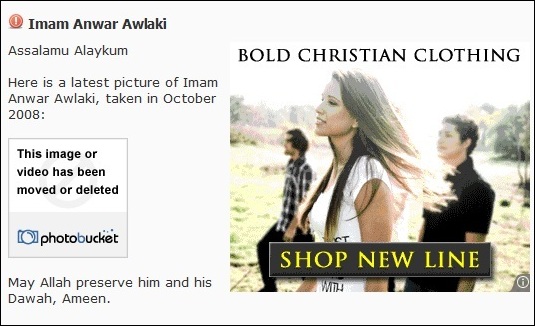
And so it is that I went online this morning to check out something about al-Awlaki on Islamic Awakening, an American jihadist forum, and found myself invited to consider, instead, wearing some “bold Christian clothing”.

This was while I was researching al-Awlaki, right? the Muslim jihadist preacher?

at:

a site with its own curious graphics…

And looking closer at that logo, isn’t that some sort of triumphalist armored vehicle I see?

*

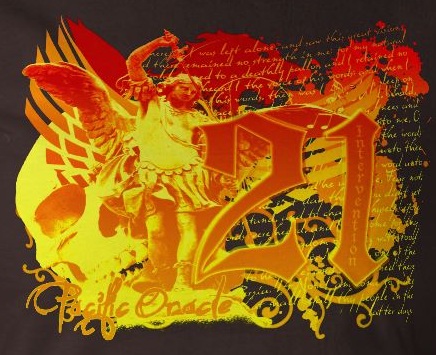
Well, never averse to a pretty girl, and noticing the one in the Bold Christian ad, I thought I’d taker a look at Bold Christian Clothing to find out what sort of fashion sense was popular among the younger Christian set just now, and found I could obtain t-shirts with such comforting images as these…

— this one’s symbolic of our relatively new century, I guess…

or this:

which I am praeternaturally fond of since my online moniker is hipbone, with its veiled reference to the Valley of the Dry Bones in that very same chapter 37 of Ezekiel…

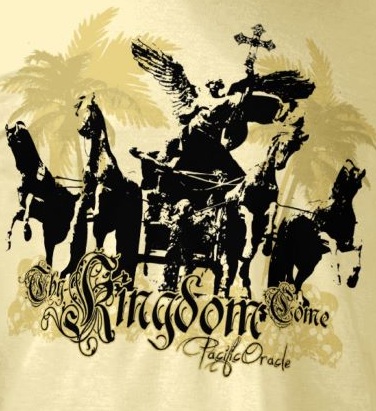
and then there’s this masterfully supremacist rendering of a part of the Lord’s Prayer:

which I must admit isn’t the image of Thy Kingdom Come that springs to mind when I personally hope and pray for heaven on earth.

What exactly is it, you may ask? According to the manufacturer, it’s

The Lord’s Prayer — “Thy Kingdom Come” with an Angel holding the cross, Horses, skulls under the horses, and palm trees (with Shield and Pacific Oracle cross logo added)

It’s also “the softest, smoothest shirt we sell” … “made from combed cotton for your added comfort” and gives “a flattering and stylish fit to virtually any body type”.

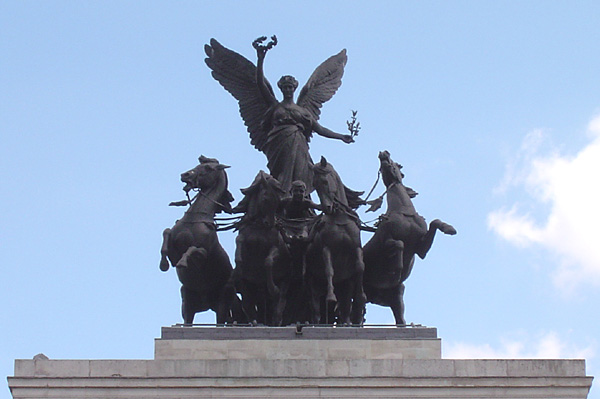
I on the other hand think it looks more like a photoshopped variant of the Quadringa statue in London that celebrates Wellington’s victory over Napoleon at Waterloo:

*

In light of all this, I do believe I’ll just wear white – although even that could be misinterpreted, I guess.


Switch to our mobile site