zenpundit.com » Strategy and War

Archive for the ‘Strategy and War’ Category

Elkus on Mad Dogs and Military History

Friday, May 10th, 2013

Adam Elkus has a lengthy and meaty post at Abu Muqawama, inspired by General Mattis, one that you should really read in full:

The Mattis Book Club

….But while gaining an understanding of the nature of war is useful, there are a lot of things it won’t do. This becomes most apparent in the section of the email where Mattis makes specific claims. Mattis repeatedly states that nothing is new under the sun, makes comparisons across big temporal zones (Alexander the Great in Persian Iraq vs. 2004 iraq), and advances specific analytical arguments about military theories. He does so on the basis of a sweeping generalization that 5,000 years of warfare tells us in aggregate that war has not changed. While this makes for a rousing line, it is also a fairly problematic statement. How do we really know that the nature of war has not changed in 5,000 years?

We should recognize that this is an isolated quote, and strive to not take out of context what was a heartfelt letter to a colleague in need of guidance. But the argument itself—as the cumulative product of a process of self-education in the nature of warfare, does merit some critical analysis. It is part of a humanistic conception of war that stresses the unity of military experience across the ages, and puts the fighting man’s will first. What Mattis dashed off in an email has been repeated by others in journal articles, blog posts, essays, and books. The military historian Brian McAllister Linn, in his seminal study of the Army’s cultures, dubbed it the “heroic” style of war. Linn constrasts this humanistic style this with technocratic Managers, defensive Guardians, and other military tribes with differing values and approaches.

So what do we know about 5,000 years of constant violence?

Often times the answer is that it depends. As my Fuller and Liddell-Hart examples illustrate, the quality of historical accounts is extremely uneven. Military history as a modern discipline only started with Hans Delbruck, a civilian who did some basic math and discovered that many of the most prominent chroniclers of pre-modern warfare were flat-out wrong about ancient history’s greatest battles and campaigns. Anthropologists still argue today about the nature of violence in the evolutionary state of nature and whether it can be mapped to violence in settled states. Second, it may be true that war is war in the Clausewitzian sense. But while it is technically true that Alexander’s Iraqi opponents and Sadrist mobs are both humans seeking to use force to impose their will, this in and of itself is not very useful. There are fairly prominent shifts in the character of politics, the international system, techology, wealth, and society that matter too.  

What constitutes politics is a very important point.

Take for example, the Romans. There was a definite shift between the Early-Middle Republican eras and the Late Republic in elite politics and the socioeconomic conditions upon which Roman assumptions about war and the organization and supply of Legions rested.  Growing inequality of wealth was making it harder for Plebian citizens to afford to muster for a campaign, the need for longserving “professional” Legates to maintain “institutional memory” of the “arts of war” of the Legions expanded even as the highly coveted opportunities for Patricians to command decreased. These trends clashed with what the Romans liked to  believe about themselves and the friction between advocates of reforms (often necessary and practical) and the upholders of  centuries of honored tradition made Roman politics increasingly bitter, dysfunctional and subsequently lethal. The early Romans would have been horrified by Marius and Sulla, to say nothing of Antony and Octavian.

In the end, the politics of the Romans, along with their battlefield experiences, changed how they organized and manned their Legions, why and how they fought the wars as they did and continued to shape Roman warfare as long as the empire lasted. Julius Caesar would have been as startled by Late Antiquity’s semi-barbarian “Roman” Magister Militiums as his own career would have dismayed Decius Mus.

Adam goes on to have some useful things to say about the need for combining historical and quantitative  social science  methodologies and the limitations of each. Delbruck’s overstated skepticism of the ancients aside, sometimes we moderns do not count any better in war or politics – or at times,  even worse

Syria is Not Rwanda

Monday, April 29th, 2013

Anne-Marie Slaughter had a short but bombastic WaPo op-ed on Syria and chemical weapons use that requires comment:

Obama should remember Rwanda as he weighs action in Syria 

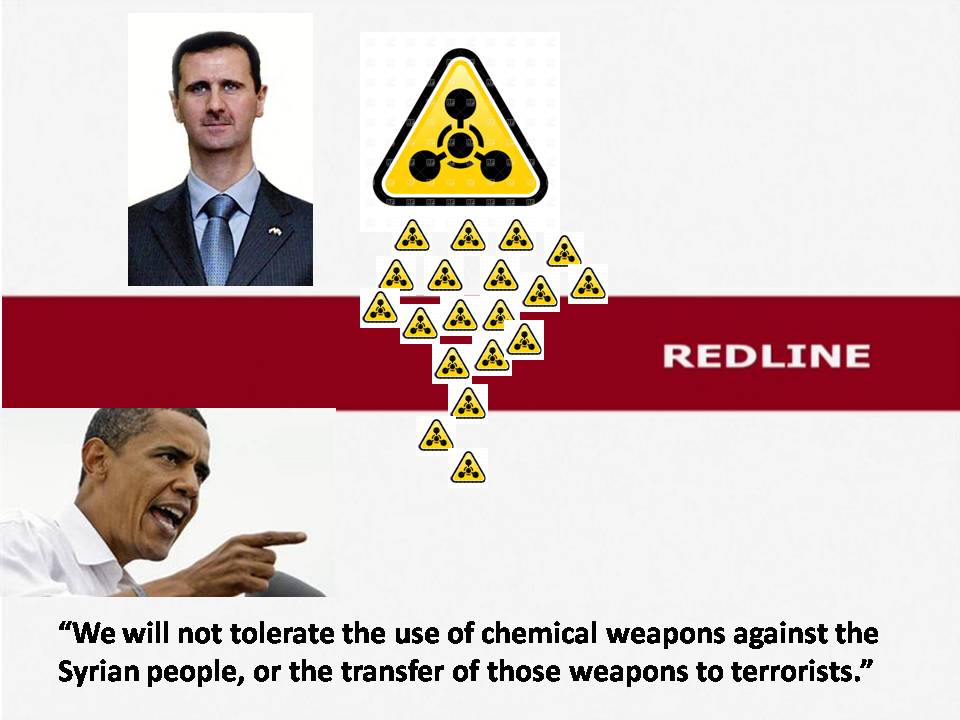
….The Clinton administration did not want to acknowledge that genocide was taking place in Rwanda because the United States would have been legally bound by the Genocide Convention of 1948 to intervene to stop the killing. The reason the Obama administration does not want to recognize that chemical weapons are being used in Syria is because Obama warned the Syrian regime clearly and sharply in August against using such weapons. “There would be enormous consequences if we start seeing movement on the chemical-weapons front or the use of chemical weapons,” he said. “That would change my calculations significantly.”

….But the White House must recognize that the game has already changed. U.S. credibility is on the line. For all the temptation to hide behind the decision to invade Iraq based on faulty intelligence about weapons of mass destruction, Obama must realize the tremendous damage he will do to the United States and to his legacy if he fails to act. He should understand the deep and lasting damage done when the gap between words and deeds becomes too great to ignore, when those who wield power are exposed as not saying what they mean or meaning what they say.

This is remarkably poorly reasoned advice from Dr. Slaughter that hopefully, President Obama will continue to ignore.
.
The President, on the basis of advice very much in the spirit of this op-ed, drew a public “red-line” about chemical weapons use for Bashar Assad, or some variation of that, on six occasions, personally and through intermediaries. On the narrow point, Slaughter is correct that this action was ill-considered, in that the President wisely does not seem to have much of an appetite for jumping into the Syrian conflict. Bluffing needlessly is not a good practice in foreign policy simply to pacify domestic critics, but it is something presidents do from time to time. Maybe the POTUS arguably needs better foreign policy advisers, but doubling down by following through with some kind (Slaughter fails to specify) military intervention in Syria is not supported in this op-ed by anything beyond mere rhetoric.
.
First, as bad as the Syrian civil war is in terms of casualties it does not remotely approximate the Rwandan Genocide in scale, moral clarity, military dynamics or characteristics of the major actors. This is a terrible analogy designed primarily to appeal to emotion in the uninformed. Syria is engaged in civil war, not genocide.
.
Secondly, the “credibility” argument has been lifted by Slaughter from it’s Cold War historical context where the United States capacity to provide a nuclear umbrella and effective deterrent for allied states was tied to the perception of our political will to assume the appropriate risks, which in turn would help avoid escalation of any given conflict to WWIII. This psychological-political variable of “credibility” soon migrated from the realm of direct US-Soviet nuclear confrontation in Europe to all manner of minor disputes (ex. –Quemoy and Matsu, civil unrest in the Dominican Republic) and proxy wars. It was often misapplied in these circumstances and “credibility” assumed a much greater exigency in the minds of American statesmen than it it did in our Soviet adversaries or even our allies, to the point where American statecraft at the highest level was paralyzed by groupthink in dealing with the war in Vietnam. By 1968, even the French thought we were mad.
.
Absent the superpower rivalry that kept the world near the brink of global thermonuclear war, “credibility” as understood by Johnson, Rusk, Nixon and Kissinger loses much of it’s impetus. If “credibility” is the only reason for significant US intervention in Syria it is being offered because there are no good, hardheaded, reasons based on interest that can pass a laugh test.
.
The historical examples President Obama should heed in contemplating American intervention in Syria is not Rwanda, but Lebanon and Iraq.

Only Amateurs Negotiate in Public

Friday, April 26th, 2013

There is much buzz right now about whether the cruel Syrian Baathist-Alawite regime of Bashar Assad, struggling to hold on to power in the midst of civil war against rebel Sunni forces, crossed   President Obama’s “red line” by using Sarin gas, a war crime. That is not really the important point for Americans. There are two things to consider here.

First, specifically how would intervening militarily in Syria’s awful civil war be in American national interest?

It is important to get a clear cut answer here because everyone arguing that Assad has “crossed a red line” that we will “not tolerate” is making a de facto argument for some kind of intervention on our part. Maybe if no one can define such an interest it is because there isn’t any and intervening will bring the US nothing but costs in blood and treasure without gaining anything of strategic value. I’m not against intervention per se but there really ought to be a coherent reason so we can rationally measure it against the potential costs which, from where I sit, look rather large.

Secondly, in important matters of state, you don’t negotiate in public with a potential adversary if you really hope to gain a concession from them and if you reach the point of issuing a public ultimatum, you don’t bluff.

The people who have advised President Obama to make these “red line” statements to Syria through the media instead of quietly through diplomatic channels are either professionally incompetent at statecraft or they were hoping to manipulate the President by getting him to back himself into a corner with tough rhetoric so that if Assad did not blink then Obama would have the choice of looking weak and foolish or of approving some kind of action against Syria. Either way, the President was poorly served by this advice. Maybe he needs some new foreign policy and national security advisers who actually know something more about the world than domestic politics and being lawyer-lobbyists.

As a result that the President never really had any intentions of, say, invading Syria this year, we are now being treated to nervously asserted, lawyerly parsing of what really counts as “red lines” and what technical level of Sarin gas particulates constitutes “use”. It is an embarrassing climb down for the administration but also for the United States that never needed to happen. Empty posturing is not a substitute for a policy. Saying “Do something!” is not a strategy.

This is no brief for Assad’s regime. He’s definitely a bad actor and runs a nasty and now democidal police state he inherited from his mass-murdering father, Hafez Assad. I’m open to hearing why the US should aid in a regime change because the outcome will be in our interests in some concrete and definable way. Oh, yeah, and it might help if the person making the pitch knew something about Syria and regional geopolitics, or was at least consulted about it.

Let’s think long and hard this time.

Octavian Manea interviews MIT’s Roger D. Peterson

Friday, April 19th, 2013

Another installment of Octavian Manea’s excellent COIN interview series at SWJ. This one focuses on social science and varieties of insurgency:

Breaking Down “Hearts and Minds”: The Power of Individual Causal Mechanisms in an Insurgency 

….OM: In your research you pointed out to a spectrum of conceivable individual roles in an insurgency. What is the methodology behind this typology?

RDP: This methodology comes from my 2001 book (Resistance and Rebellion: Lessons from Eastern Europe) which focused on Lithuanian resistance to Soviets in the 1940’s. Insurgency is a complex phenomenon, especially in how violent organization and networks are created and sustained, and the methodology of that book involved breaking down this complexity into component parts and then building back up into a coherent whole. At the base of this process is the way individuals position themselves relative to the dramatic and violent events of insurgency. Most people may wish to remain neutral and just take care of their families but events push significant numbers of individuals into roles of unarmed support of insurgents, or local armed position of a militia, membership in a mobile non-local organization, or equivalent positions in support of the government.  Furthermore, individuals may move back and forth along this spectrum of roles. If one is skeptical of broad and vague theories at a high level of aggregation, as I am, then you need to get down and observe dynamics at a basic level. Observing movement along this spectrum of roles is one way to do that. 

…..Is it FM 3-24 and the whole contemporary Western COIN discourse too narrow, too much focused on rational, cost/benefit models of decision-making? Is it too restrictive when making this inventory of driving motivations or causal mechanisms?

RDP: I think there is a tendency in the Western academic analysis to focus on rational theories. Those theories are straightforward.  But they also might be too straightforward, too simple.  In Iraq, the coalition did not plan on the emotion of resentment stemming from a status reversal affecting Sunni calculations in the beginning stages of the conflict. We did not understand the revenge norms that exist in some of the places. We did not fully understand the social norms that helped to produce the tribal militias in Anbar province.  We did not understand the psychological mechanisms underlying the Sunni view of the new world they were living in. 

The last part is a curious lacuna.

The incompetence of the planning for the occupation of Iraq has been amply recorded – the high level disdain of General Tommy Franks and Secretary Rumsfeld for what befell the day after victory, the keeping of professional Arabists at arms length in preference for Beltway contractors and college kids with AEI connections, the haplessness of Jay Garner and the political obtuseness of Paul Bremer ad so on. This is not what I mean about lacuna.

I mean something more fundamental, in terms of understanding human nature as the root of political behavior and therefore political violence. We are all familiar with the Clausewitzian trinity (or should be) but less attention is paid to the motivational factors that make men decide to stand, fight and die or stand aside. Thucydides also had a trinity that did not attempt to capture the nature of war but rather explain why wars happened and it seems to me to be of particular use for evaluating the decision in small wars to pick up a gun or not, to side with the government or join the rebellion:

“Surely, Lacedaemonians, neither by the patriotism that we displayed at that crisis, nor by the wisdom of our counsels, do we merit our extreme unpopularity with the Hellenes, not at least unpopularity for our empire. That empire we acquired by no violent means, but because you were unwilling to prosecute to its conclusion the war against the barbarian, and because the allies attached themselves to us and spontaneously asked us to assume the command. And the nature of the case first compelled us to advance our empire to its present height; fear being our principal motive, though honour and interest afterwards came in. And at last, when almost all hated us, when some had already revolted and had been subdued, when you had ceased to be the friends that you once were, and had become objects of suspicion and dislike, it appeared no longer safe to give up our empire; especially as all who left us would fall to you. And no one can quarrel with a people for making, in matters of tremendous risk, the best provision that it can for its interest. 

Fear, honor and interest are ever present in “calculation” both by men and by the political communities they compose and the factions that threaten to tear them apart. All the more so in a defeated and broken country divided by ethnicity and sect where all parties were uneasily eyeing the conqueror. No special knowledge of Arab culture should have been required to anticipate that Iraqi men, if made desperate by uncertainty and circumstance, might have at least seen it in their interest to achieve some measure of security with the gun and to enact policies of carrots and sticks a priori to discourage that, before the insurgency gained critical mass.

Awareness of the universality of the Thucydidean trinity would not have in itself guaranteed success in Iraq but knowing it is a rudimentary minimum of political competence upon which you can at least build.

New Book and New Monograph

Wednesday, April 10th, 2013

The Strategy Bridge by Colin S. Gray

I have been eager to read this book by the eminent Anglo-American strategist Colin Gray ever since Adam Elkus sang it’s praises and now I have a hardcover copy thanks entirely to an enterprising amigo. A description from Oxford Scholarship:

The Strategy Bridge: Theory for Practice is an original contribution to the general theory of strategy. While heavily indebted to the writings of Carl von Clausewitz, Sun Tzu, and the very few other classic authors, this book presents the theory, rather than merely comments on the theory, as developed by others. Bridge explains that the purpose of strategy is to connect purposefully politics and policy with the instruments they must use. The primary focus of attention is on military strategy, but this subject is well nested in discussion of grand strategy, for which military strategy is only one strand. Bridge presents the general theory of strategy comprehensively and explains the utility of this general theory for the particular strategies that strategists need to develop in order to meet their historically unique challenges. The book argues that strategy’s general theory provides essential education for practicing strategists at all times and in all circumstances. As general theory, Bridge is as relevant to understanding strategic behaviour in the Peloponnesian War as it is for the conflicts of the twenty?first century. The book proceeds from exposition of general strategic theory to address three basic issue areas that are not at all well explained in the extant literature, let alone understood, with a view to advancing better practice. Specifically, Bridge tackles the problems that harass and imperil strategic performance; it probes deeply into the hugely under?examined subject of just what it is that the strategist produces—strategic effect; and it ‘joins up the dots’ from theory through practice to consequences, by means of a close examination of command performance. Bridge takes a holistic view of strategy, and it is rigorously attentive to the significance of the contexts within which and for which strategies are developed and applied. The book regards the strategist as a hero, charged with the feasible, but awesomely difficult, task of converting the threat and use of force (for military strategy) into desired political consequences. He seeks some control over the rival or enemy via strategic effect, the product of his instrumental labours. In order to maximize his prospects for success, the practicing strategist requires all the educational assistance that strategic theory can provide.

I am unfortunately in the midst of a large project for work, but The Strategy Bridge is now at the very top of my bookpile and I will review it when I am finished.

And as long as we are on the subject of Professor Gray, he ventured into the murky domain of cyber war recently, publishing a monograph on the subject for The Strategic Studies Institute:

Making Strategic Sense of Cyber Power: Why the Sky is not Falling

Obviously, Dr. Gray is not in the “Cyber Pearl Harbor” camp:

The revolution in military affairs (RMA) theory of the 1990s (and the transformation theory that succeeded it) was always strategy- and politics-light. It is not exactly surprising thatthe next major intellectual challenge, that of cyber, similarly should attract analysis and assessment almost entirely naked of political and strategic meaning. Presumably, many people believed that “doing it” was more important than thinking about why one should be doing it. Anyone who seeks to think strategically is obliged to ask, “So what?” of his or her subject of current concern. But the cyber revolution did not arrive with three bangs, in a manner closely analogous to the atomic fact of the summer of 1945; instead it ambled, then galloped forward over a 25-year period, with most of us adapting to it in detail. When historians in the future seek to identify a classic book or two on cyber power written in the 1990s and 2000s, they will be hard pressed to locate even the shortest of short-listable items. There are three or four books that appear to have unusual merit, but they are not conceptually impressive. Certainly they are nowhere near deserving (oxymoronic) instant classic status. It is important that cyber should be understood as just another RMA, because it is possible to make helpful sense of it in that context. Above all else, perhaps, RMA identification enables us to place cyber where it belongs, in the grand narrative of strategic history….

Read the rest here.


Switch to our mobile site