zenpundit.com » Religion

Archive for the ‘Religion’ Category

Christianity, culture, compassion, camels — and their shadows too

Saturday, August 22nd, 2015

[ by Charles Cameron — by way of TS Eliot, Mario Vargas Llosa and others, and leading to a post on camels and their shadows ]
.
limits of compassion

**

In the year I was born, 1943, TS Eliot published a series of essays titled Notes Toward the Definition of Culture in the New English Weekly. Mario Vargas Llosa supposedly references Eliot’s essays in his own Notes on the Death of Culture: Essays on Spectacle and Society — which Joshua Cohen then distills into this paragraph:

Eliot defines culture as existing in, and through, three different spheres: that of the individual, the group or class, and the entire rest of society. Individuals’ sensibilities affiliate them with a group or class, which doesn’t have to be the one they’re born into. That group or class proceeds to exercise its idea of culture on society as a whole, with the elites — the educated and artists, in Eliot’s ideal arrangement — ­leveraging their access to the media and academia to influence the tastes of the average citizen, and of the next ­generation too. As for what forms the individual, it’s the family, and the family, in turn, is formed by the church: “It is in Christianity that our arts have developed,” Eliot writes; “it is in Christianity that the laws of Europe have — until recently — been rooted.”

I’m not sure of the bibliographic details here, but you’ll note the similarity of Eliot’s claim in quote marks above to certain claims made concerning America in recent years — and indeed, to others in Anders Breivik‘s Manifesto.

It’s the concept of culture as comprised of the sensibilities of individuals, groups and society that first and most interests me here, though — and the significance of family, and I’m hoping Michael Lotus will have something to say about that.

**

Here’s more from Eliot:

It is in Christianity that our arts have developed; it is in Christianity that the laws of Europe — until recently — have been rooted. It is against a background of Christianity that all of our thought has significance. An individual European may not believe that the Christian faith is true, and yet what he says, and makes, and does will all spring out of his heritage of Christian culture and depend upon that culture for its meaning .. I do not believe that culture of Europe could survive the complete disappearance of the Christian faith. And I am convinced of that, not merely because I am a Christian myself, but as a student of social biology. If Christianity goes, the whole culture goes.

**

Now take a cool sip of water to cleanse the palate..

**

This may nor may not seem to resonate with Eliot’s ideas:

Slovakia prefers its desperate refugees to be Christians, please

Slovakia would prefer to accept Christian refugees under a European plan to resettle people who have fled from wars and poverty in the Middle East, Asia and Africa, the Interior Ministry said on Thursday.

The Central European country will take 100 people from refugee camps in Turkey and 100 people from Italy, preferably Christians, a ministry spokesman said.

“We want to choose people who really want to start a new life in Slovakia. Slovakia as a Christian country can really help Christians from Syria to find new home in Slovakia,” spokesman Ivan Netik said.

“For most migrants we are only a transit country. In Slovakia we have really tiny community of Muslims. We even dont have mosques.”

If Muslim asylum-seekers chose Slovakia, they would not be discriminated against, he said. But Slovakia would not take in refugees who did not want to stay in the country but intended to move on.

“We do not discriminate against any religion, but it would be a false, insincere solidarity if we took people .. who dont want to live in Slovakia,” he said.

That. btw, is the most nuanced version of the Slovakian response to the refugees I’ve seen.

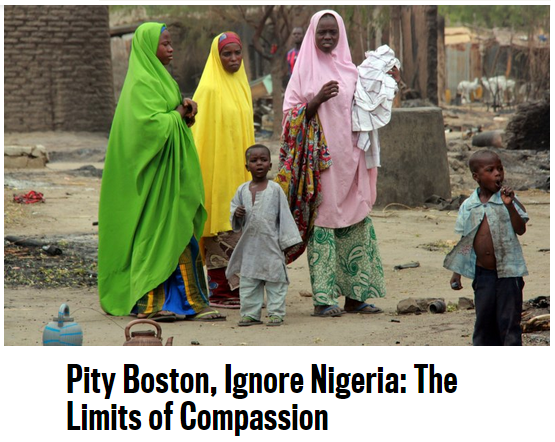
Comnpassion? A conceptual radius of compassion?

Are there, should there be, limits to compassion?

**

In an upcoming post on the shadows of camels, I’ll explain my overall intent in posting such items as this one — and it is not to suggest that Breivik is the same as Slovakia, or Eliot the same as Breivik, or Christianity across Europe equivalent to camels or the shadows of camels across the desert.. nor that compassion should or should not have a radius, conceptual or otherwise.
The Washington Post – can’t read, or can’t count?

Thursday, August 20th, 2015

[ by Charles Cameron — a grumpy grammatical plaint, plus Proclus for poet’s delight ]
.

You know me, maybe — I’m not a quant, if anything I’m a qualit, but even so..

CEOs at the top 50 U.S. charities, including Samaritan’s Purse, earn in the $350,000 to $450,000 range, which makes Graham’s $622,000 salary from his aid organization alone about 40 percent to 50 percent higher than average, according to a Forbes story. He receives the rest of his $258,000 compensation as CEO of the Billy Graham Evangelistic Association.

That’s straight out of the Washington Post, who got it whole cloth from Religion News Service.

**

OK, we know what the writer means to say, but.

If top US charity CEOs including Franklin Graham earn between $350,000 to $450,000, and Graham earns $622,000 as his CEO’s salary, then — bzztzz — top US chatioty CEOs earn in the $350,000 to $622,000 range, , not “in the $350,000 to $450,000 range” period.

Further, if Graham earns $622,000 from Samaritan’s Purse — which purse it seems I shall not be filling any time soon, and which might want to change its name to Sadducee’s Purse — the “rest of his $258,000 compensation” doesn’t make any sense at all — bzztzz. How can $622,000 plus an additional fee possibly sum to $258,000?

There is a language, English, and a numerical method, Arithmetic, and this paragraph is lacking in one, the other, or both.

**

Or is Franklin Graham paid in irrational numbers?

Proclus, as quoted by Danziger:

It is told that those who first brought out the irrationals from concealment into the open perished in shipwreck, to a man. For the unutterable and the formless must needs be concealed. And those who uncovered and touched this image of life were instantly destroyed and shall remain forever exposed to the play of the eternal waves.

Play of the eternal waves?

Perhaps Graham’s expefrience is not unlike that of George Boole, who wrote a sonnet on the Trinity, and of whom Margaret Masterman wrote:

Towards mathematical truth he had indeed a consciously religious attitude, which he sometimes expressed to himself by the phrase, ‘For ever, O Lord, Thy word is settled in heaven.’ Boole’s behaviour during his last illness was characteristic of the man… When his mind had been wandering in fever, he told his wife that the whole universe seemed to be spread before him like a great black ocean, where there was nothing to see and nothing to hear, except that at intervals a silver trumpet seemed to sound across the waters, ‘For ever, O Lord, Thy word is settled in heaven.’ And as he lay in bed on the borders of delirium, all the little sounds of the house, such as the creaking of doors, resolved themselves into a chant of these words, which expressed for him the excellence of mathematical truth.

**

Ah, but I drift.

Christ on a Cathedral, Buddha at the Printshop

Monday, August 17th, 2015

[ by Charles Cameron — art & tech interfacing with religion ]
.

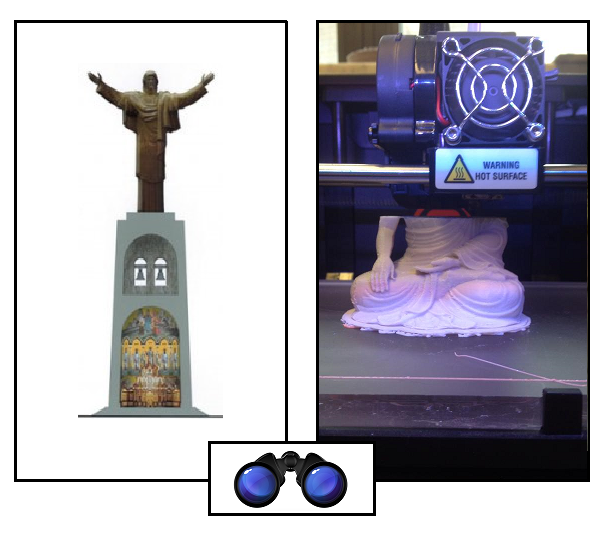
In today’s news, religious statuary:

SPEC statues christ buddha

**

To the left:

Vladivostok ‘to get tallest statue of Jesus Christ in the world’

In Vladivostok, the monument will be composed of two parts: the statue itself and the pedestal housing a cathedral in honour of Archangel Michael.

The monument stands 50 metres taller than the world famous ‘Christ the Redeemer’ in Rio de Janeiro, and two metres higher than ‘The Christ the King’ in Lisbon.

I guess that gives it pride (a deadly siubn, no?) of place.

To the right:

Japanese temples stop theft by replacing priceless statues with 3D-printed copies

The abbot of a Buddhist temple in Jiangjin City was concerned about the potential theft of a valuable statue of Amitabha Buddha. After learning about 3D-printing technology, he made a copy of the statue and gave the original to a local museum for safekeeping.

“There is no way to permanently guard the Buddha statue all of the time,” said the abbot. “Even though this 3D print is just a replica of the original statue, as long as it resides within our temple people can use it as a shrine nonetheless.”

The image of a 3-D Buddha printing is from the Art Program at Seton Hill University.

My latest for Lapido: renewing the power of holiness?

Wednesday, August 12th, 2015

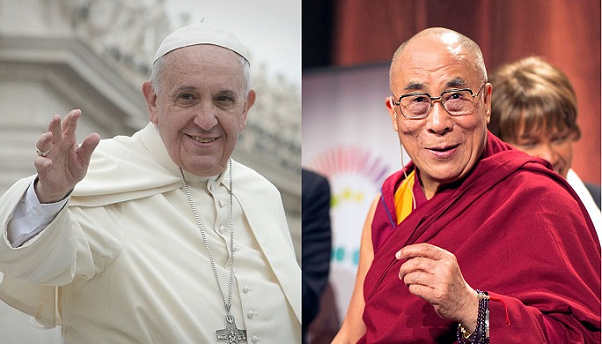
[ by Charles Cameron — The Dalai Lama and the Pope: two saints, sorta, astride a supposedly secular world ]
.

Pope Francis & Dalai Lama 602
HH Pope Francis, HH the Dalai Lama. Photos: Jeffrey Bruno, Christopher (CC BY SA 2.0)

My latest post for LapidoMedia is titled The Dalai Lama and the Pope: renewing the power of holiness. It begins:

TWO figures of undoubted moral stature now dominate world affairs. Each of them is a religious leader. Each is known by the title His Holiness, but seems to wear the title lightly.

For neither of them is virtue a lost ideal, neither is morality a private matter.

Each preaches compassion, consideration for the poor, spirituality above materialism, and the care of the natural world.

What do these two men have in common, that distinguishes their voices from those of other office holders and persons of power and influence?

Certainly, each has been featured in Rolling Stone, which indicates their popular appeal.

Each one’s office has a long pedigree, and each just might be the last of his kind. Perhaps there’s a clue there.

It concludes with:

First contemplation, then action: this is the secret uniting heart, mind and hand which gives these two figures their appeal and stature.

And the need to join together to combat climate change is one arena in which these two men are in strong agreement.

The Guardian reports from Glastonbury, ‘The Dalai Lama has endorsed the pope’s radical message on climate change and called on fellow religious leaders to “speak out about current affairs which affect the future of mankind.”’

The Pope writes, ‘The urgent challenge to protect our common home includes a concern to bring the whole human family together to seek a sustainable and integral development.”

Where will these two religious figures – moral icons of our age – lead our arrogantly secular world?

To raead the whole thing, visit the Lapidoedia site.

When one life sprouts inside another

Thursday, July 16th, 2015

[ by Charles Cameron — some ugly comparisons, you have been warned — but it is only the exaggerated ugliness that drives my point home ]
.

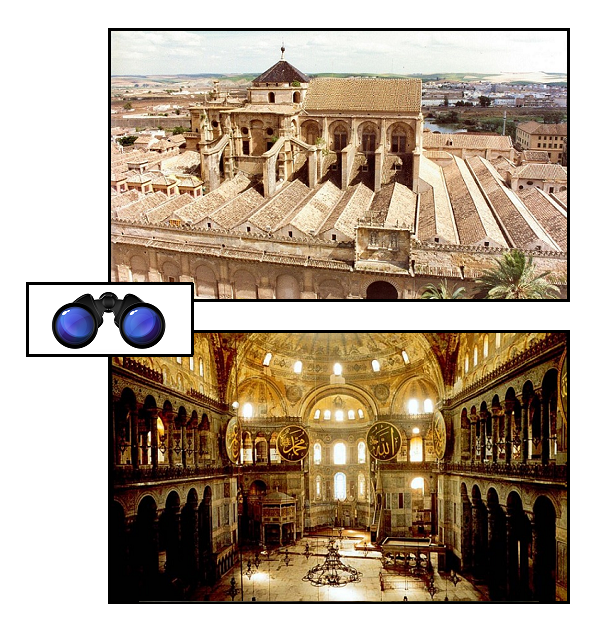
The first DoubleQuote of three I’m posting here shows two views of sacred sites taken over by conquering religions.

SPEC DQ cordoba istanbul

You may have seen this DoubleQuote before — the upper panel shows the Mezqita or Grand Mosque of Cordoba, an extraordinarily beautiful building in the middle of which Spanish Catholics grafted a baroque cathedral, an act of which King Carlos V of Spain said:

You have built here what you or anyone might have built anywhere else, but you have destroyed what was unique in the world

The lower panel shows the Hagia Sophia or Basilica of the Holy Spirit in Istanbul, which was turned into a mosque by Muslim conquerors, and subsequently made into a museum

**

The question this sort of transformation of sacred places — from one faith to another, often by conquest but also on occasion by commercial transfer or simple generosity — leaves me wondering what it must feel like for those who lose their place of worship, especially in case of conquest. And I should make it clear that my question applies as much to Jews unable to pray on Temple Mount as it does to Christians in Istanbul or Muslims in Cordoba.

By its visual nature, the Cordoban example sticks in my mind, however — the relatively new cathedral sprouting quiute visibly from the ancient mosque.

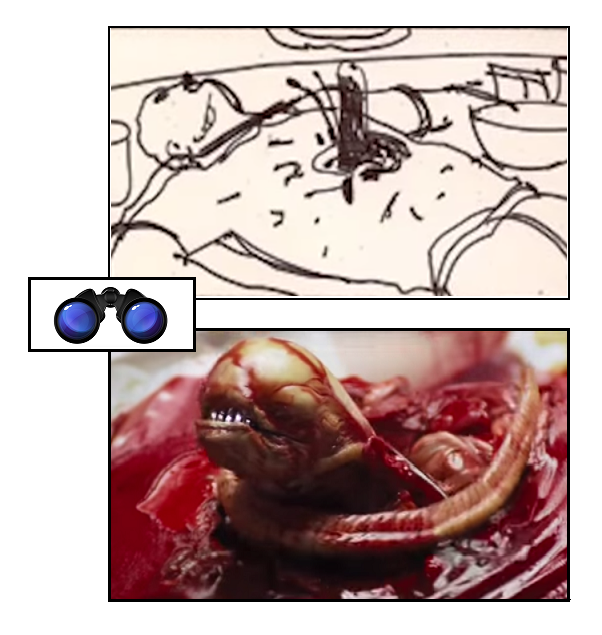
And so it is that my mind, habituated to seeking visual analogues, stumbled on the disgusting — if brilliant — birth of the alien in Ridley Scott‘s The Alien:

SPEC DQ alien chestbuster birth

I know: Giger‘s aliens in the movie — and even more so, in the now canonical “chestburster” scene — are hideous, as Ridley Scott himself said, “in the unique manner in which they convey both horror and beauty.”

**

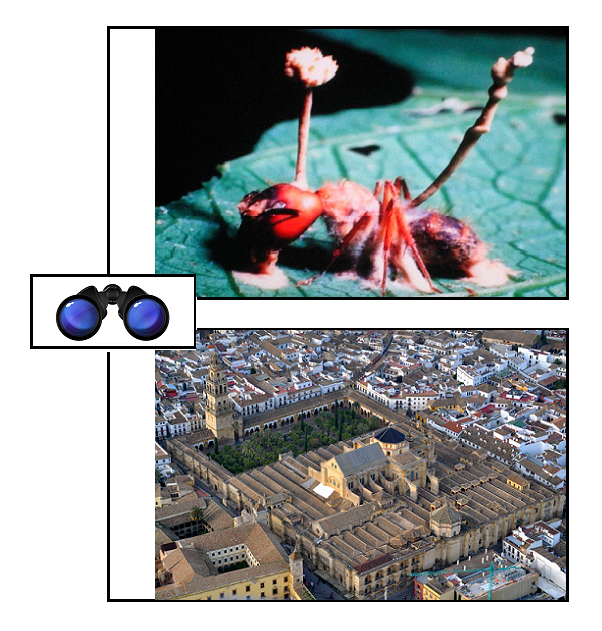
Granted, these comparisons from “fiction” (above) and “nature” (below) to what is now one of the world’s more interesting architectural oddities seem obscene — we are used to the church-in-a-mosque as a tourist attraction, and in its own way a minjor miracle —

SPEC Mezquita and Ant

— my interest here, hiowever, is in looking at it, not through Muslim eyes, but through the eyes of those Muslims for whom building a church inside what was not only a mosque but one of the most beautiful mosques in the world feels like a grievous insult.

For them, the cathedral in the Mezquita is a blasphemy — the insertion of a polluted form of worship in a place once dedicated to God’s own preferential service. And this is important not so that we can understand the ideation of those who wish to return the cathedal to a mosque and more generally Spain to al-Andalus, but so that we can comprehend the depth and intensity of the associated emotion.

The passion.

Which some Christians must surely also feel whewn they enter the museum of Hagia Sophia, once so proud a place of Christian worship and history — or some Jews with respect to the Temple Mount in Jerusalem, where the movement to permit Jewish worship, at present forbidden, is gaining momentum.

The passion behind (sacred) revanchism.


Switch to our mobile site