[ by Charles Cameron — graphical analysis, selling bibles to teenage boys, tge Mass in time of war ]
.
Following on from my post on the work of Al Farrow, and leading towards a series of posts on ritual and ceremonial, I’d like to show you two very different images at the overlap of war and religion.
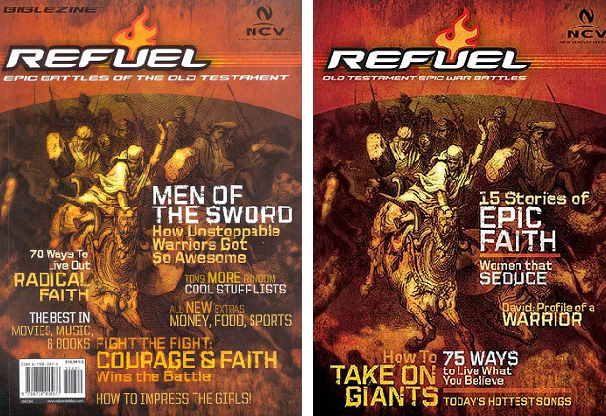
The first shows two different covers of the books of Joshua, Judges, Ruth, I & II Samuel, I & II Kings, Ezra and Nehemiah, as featured in a “biblezine” edition of the New Century Version of the Bible pitched at teenage testosterone.
Each of will have our own sense of whether that’s fun, stupid, Biblical, unBiblical, enticing, disgusting or simply uninteresting — but whatever your aesthetic and/or belief-based response, there’s a powerful lesson there in the choice of subtitles:
how unstoppable warriors got so awesome…
courage and faith wins the battle…
how to impress the girls!
how to take on giants!
women that seduce…
tons more random cool stuff lists…
I’m not a fan of this kind of thing myself, but I picked up a copy when I saw one at the thrift the other day — the one with Men of the Sword on the cover — and as someone who has done a fair amount of copy-editing in my day, was surprised to see “courage and faith wins the battle” (sic) had slipped past the editorial eyes at Nelson Books…
The New Testament in the same series is a bit better — the cover still features “dynamic stories of daring men” –but the, ahem, romantic element has been toned down a bit, with the catch phrase “class act: how to attract godly girls” replacing the Old Testament’s “how to impress the girls”.
* * *
Okay, I’m not as young as I once was, and maybe I’ve been mean enough at the expense of these people who want to market the Bible as though it was an invitation to warfare washed down with sex.
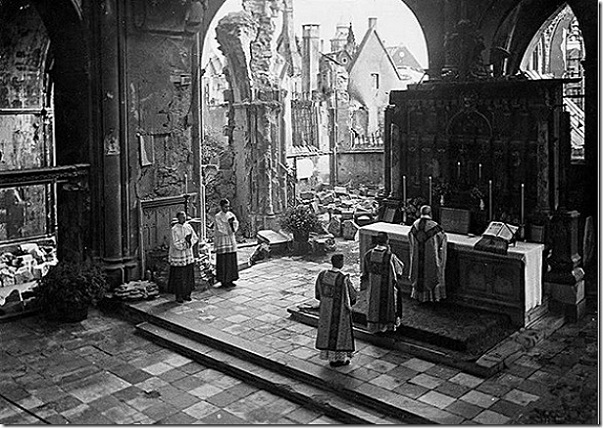
The other image I found recently comes a great deal closer to my own taste, and will serve as an excellent introduction to the idea of religious ceremonial as an oasis of peace in time of war:
Again, I suppose there may be some who will find the idea of religious ritual boring and irrelevant rather than beautiful — but it is its capacity to move us at a deep level — even (and perhaps particularly) when high tides of circumstance and emotion are breaking over us — that I wish to focus on and, to the extent that it is possible, explore and explain in some upcoming posts.
In my view, it was this kind of beauty, verging on the austere and the timeless, rather than the snazzy and faddish “impress the girls — draw in the kids” kind, that Pope Benedict XVI had in mind when he said:
Like the rest of Christian Revelation, the liturgy is inherently linked to beauty: it is veritatis splendor. The liturgy is a radiant expression of the paschal mystery, in which Christ draws us to himself and calls us to communion. As Saint Bonaventure would say, in Jesus we contemplate beauty and splendor at their source.
* * *
I am not a Catholic, though my sympathies run in that direction, and my examples of ceremonial will not be drawn only from Catholic or Christian sources — part of what i want to explore is the universal quality of ritual as a powerful source of motivation and inspiration, while another aspect has to do with the interweaving of military, religious and state symbols, but the point I would most like to make in each case is the profound impact that such symbols and rituals can have on the receptive heart.
I hope to touch on a wide range of ritual expressions, from the Requiem for a departed princely Habsburg to the Lakota sweat lodge, and from to the fire-walking ceremonial of the Mt Takei monks of Japan to the Spanish bull-fight, with a close look at the ritual surrounding coronation in my own British tradition.
For those who would like to peer deeper into these matters, I would suggest these four books:
Victor Turner, The Ritual Process Geoffrey Wainwright, Eucharist and Eschatology William Cavanaugh, Torture and Eucharist Josepha Zulaika, Basque Violence: Metaphor and sacrament
The first explains “how ritual works” from an anthropological point of view, the second deals with the purposeful interweaving, accomplished within ritual, of time with the timeless, the third with the way in which sacramental transcendence is the very antithesis of torture, and the fourth with the impact of a sacramental sensibility within terrorism.
Each one is a masterpiece of intelligence and profound feeling.
[ by Charles Cameron — art, religion, and violence ]
.
Al Farrow, the San Francisco-based artist, finds and shows us that violence which is one pole of religion — what I think of myself as the landmines in the garden, where the garden is pardis, pairidaeza, paradise, the opposite pole of religion — perhaps inseparable from the violence, perhaps separable — the pole of peace, eirene, salaam…
He show us this uncanny juxtaposition by building. meticulously, a cathedral out of guns and bullets:
His work leaves me impressed, but ill at ease, and for that I am grateful: he makes me think.
Take a close look at one of those flying buttresses… and compare it with its cousins at Notre Dame:
That detail really brings the power of Farrow’s work home to me.
*
William Blake suggested that it is the artist’s function to “cleanse the doors of perception” — to give us fresh eyes, to see the world anew for us.
Al Farrow does this: it is as though in his cathedral, Catholic and Protestant Ireland meet. Indeed, in an exhibit of his works — he has built mosques and synagogues of guns and bullets too — Christianity faces off against Islam, Judaism confronts its demons.
But there’s something more here, perhaps – the clash of war and peace, of hate and love — and how hatred can at times work with “love” as a protective shield…
I am perpetually surprised by the historical and continuing partnership of war and religion. The atrocities committed in acts of war absolutely violate every tenet of religion, yet rarely do religious institutions speak against the violations committed in the name of God. Historically, Popes have even offered eternal salvation to those who fought on their behalf (The crusades, etc.).
In my constructed reliquaries, I am playfully employing symbols of war, religion and death in a facade of architectural beauty and harmony. I have allowed my interests in art history, archeology and anthropology to influence the work. The sculptures are an ironic play on the medieval cult of the relic, tomb art, and the seductive nature of objects commissioned and historically employed by those seeking position of power.
There’s considerable further irony, therefore, in the way in which Farrow’s already ironic work can be juxtaposed with it’s utterly non-ironic equivalent – Saddam Hussein‘s concept of the Mother of All Battles Mosque:
*
Farrow’s work does not instruct us to be warriors, nor to be pacifists – it draws our attention to the blend of violence and peace of which our human dreams and lives are made. As Farrow says in this video clip from an exhibit of his work in Washington:
I use real bones, real bullets, real guns, because fake bones wouldn’t shake anybody up, nor would a fake gun. The purpose of my work is actually to get people to think about that complex relationship between war and religion – or any violence and religion. And a lot of violence is committed and has been through history in the name of religion, and that’s an ongoing thing, in any part of the world you look.
And yes, I think it’s fair to say Farrow’s juxtapositions of religion and violence clearly lean us towards peace. War does the same, no?
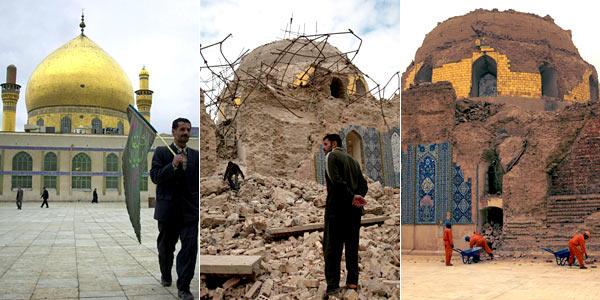
War, after all, destroys places of worship, along with many and varied other places – munitions dumps and churches, mosques and homes:
But just as religion has its landmines, so too it offers us its gardens – and just as a mosque or church or temple may be a rallying point offering a divine sanction to violence, so too it may be a focus for peace and reconciliation.
Out of the ashes of destruction: creation, renewal, rebuilding…
For more on Al Farrow’s work, visit the Catharine Clark Gallery page. And feel uneasy by all means, meditate — the koan I am sitting with this month is “Stop the War” — and ponder…
We’re delighted here at Zenpundit to present a cross-post from our blog-friend Pundita— of whom it has been said that “What Julia Child did for French cooking, Pundita is doing for foreign policy discussion. She’s opened a haute pursuit to ordinary people.”
Pundita quotes Mark in this post, and also raises some interesting issues with regard to America and monarchism — and as I have been prepping a series of posts on “the impact of ritual and ceremonial in church, military and state,” we all agreed it would be good to bring this post across to ZP in the hope of stirring some discussion — and see how things develop from there.
Pundita’s epigraph for this post is as follows:
Alan Rickman‘s Sheriff of Nottingham to a scribe: “Wait a minute. Robin Hood steals money from my pocket, forcing me to hurt the public, and they love him for it? That’s it then. Cancel the kitchen scraps for lepers and orphans, no more merciful beheadings, and call off Christmas.”
The title of this post refers to the punch line in a series of TV commercials in the USA for Sears Optical eyeglasses. The ads feature amusing skits of people in serious need of a pair of glasses, such as the woman who mistakes a police patrol car for a taxicab. But helped along by bravura performances from Tara L. Clark as a blind-as-a-bat cat owner and Squirty as a wild racoon who can’t believe his luck, one of the skits is so funny it’s gone viral on the internet:
Oh look it’s a democracy! Come snuggle with the United States!
There is nothing funny, however, about American officials who are so blind to what the United States stands for they snuggle with governments that march to a very different drumbeat than their own. Yet the officials are supported in their blindness by an equally blind populace. So in this post I’m going to break a taboo and wrestle with topics that are only whispered about in this country: monarchism and America’s involvement with it. To set the stage I’ll start with quotes from two recent news reports:
Stephen Harper is working to recast the Canadian identity, undoing 40 years of a Liberal narrative and instead creating a new patriotism viewed through a conservative lens.Restoring the “royal” prefix to the navy and air force this week is just part of the Prime Minister’s attempt at “creating a new frame” for Canada and Canadians. …
A photograph taken last Friday of Gary F. Locke, the new United States ambassador to China, buying coffee with his 6-year-old daughter and carrying a black backpack at a Starbucks in the Seattle airport, has gone viral on the Chinese Internet. The seemingly banal scene has bewildered and disarmed Chinese because they are used to seeing their own officials indulge in privileged lives often propped up by graft and bribery and lavish expense accounts.
[…]
The first impression from the Starbucks episode has been bolstered by another photograph that shows Mr. Locke, his wife, Mona, and their three children carrying their own luggage after landing at Beijing Capital International Airport.Chinese who saw them then spread the word that the family had gotten into an anonymous minivan because a formal sedan that had been sent to pick them up was too small.
“To most Chinese people, the scene was so unusual it almost defied belief,” Chen Weihua, an editor at China Daily, an official English-language newspaper, wrote in an article Wednesday.
Cheng Li, a scholar at the Brookings Institution who studies Chinese elite politics, said in an e-mail: “Ambassador Locke’s photo contrasts sharply with the image of the Chinese officials who often live in a secret, insulated, very privileged fashion.
Often I’ve heard it asked why Britain’s political Right doesn’t seem much less socialist than the country’s Left. I’d say the answer is that the United Kingdom’s welfare state has as much to do with Marxism as bread and circus did under the Roman emperors. I’d also say the same answer would apply to the welfare state in the Kingdom of Norway and the Kingdom of Sweden and a number of other countries that are constitutional monarchies.
Yet my fellow Americans have such difficulty seeing monarchism that they confuse it with something else. The same blindness can afflict Americans who insist that China is not much different from the United States. In his 2008 article for the May/June issue of Good magazine (Ten Reasons Why China Matters To You), Thomas P.M. Barnett, an American security analyst, wrote that “China’s transformation echoes much of America’s past. … right now, China is somewhere in the historical vicinity of ‘rising America’ circa 1880.”
In my retort (The National Petition Bureau will see you now, Dr Barnett), I pointed out that Chinese make the pilgrimage to a bureau that’s a CCP placemarker for an emperor’s go-fers. I added in exasperation, “Ah yes, I remember as if just yesterday the tens of millions of American peasants in the 1880s who pilgrimaged to the nation’s capital every year to seek redress from the emperor.”
Dr Barnett turned out to have a sense of humor or at least a fair-minded attitude about receiving criticism because he linked my post at his blog. Yet that did little to allay my concern that Washington’s foreign policy establishment was blind as a bat to the fact that modern China is an imperial society with a frownie face of Communist Party dictatorship painted on it, and that modern Britain and a good number of other NATO-member countries are basically monarchist societies with a smiley face of democracy plastered on them.
One could even make an argument that modern Mexico’s most entrenched problems are rooted not in the rule of the Spanish but in indigenous imperial civilizations that predated Spain by thousands of years.
In fact, the more one starts looking around the world for societies that are not holdovers from the days of kings the more one appreciates that the United States of America has very few natural allies; i.e., countries that represent a real break with monarchism and the class systems that uphold it.
Norwegians might bristle at their society being described as monarchist. They would point out that their noble class has no political power anymore and that Norway today is an egalitarian society. However, it is an egalitarianism so rigidly enforced that the Norwegian mass murderer Anders Behring Breivik believed after he set off a bomb in Oslo that he would be caught and killed by the police before he reached Utoya island.
His faith in the omniscience of Norway’s government was dashed but the point is that the country’s egalitarian “open society” is maintained by the second largest deployment of public-space CCTV cameras outside the United Kingdom. And Norway’s generous public welfare system means that from cradle to grave Norwegians are easily monitored by the state, which helps the government make sure Norway stays an open, egalitarian society.
Yet Americans insist on describing such states as Leftist! Karl Marx would roll in his grave if he saw what passes today for many Leftist governments.
These same Americans decry their government’s close alliance with absolute monarchies such as the Kingdom of Saudi Arabia. They do so without realizing that there is a long history of the United States being closely allied with monarchies; that many of these are no longer “absolute” but “constitutional” with parliamentary forms of government and voting rights makes them no less monarchist.
Americans were also miffed at what they considered snobbishness when they heard the Swedish Chairman of BP, Carl-Henric Svanberg, expressing concern for the victims of the Gulf oil spill by referring to them as “the small people.”
Translation malfunction, explained his apologists. There was no malfunction; English is Svanberg’s second language. And he wasn’t being snobbish, he was being Swedish. Noblesse oblige and all that; one must always look after the basic needs of the small people so they don’t revolt.
None of the above is meant as a criticism of the countries I’ve mentioned or their people, and one would be hard-pressed to find nicer peoples than the majority of Swedes or Norwegians — and Canadians for that matter, who also live under a constitutional monarchy. I see no harm in people upholding traditions that provide them with a sense of order and give them continuity with their past, which is why I cheered on the royal pomp associated with the marriage of William and Kate. If it helped Britons get clearer on their values I was all for that.
The harm comes when Americans are so unclear on their own values, their own past and traditions, they can’t engage closely with the rest of the world without becoming terribly confused. One consequence is that the more the U.S. government has tried to mesh with the “international community,” the lower America’s standing in the world has fallen.
Americans can’t turn the situation around without first acknowledging that the international community is in large measure of bunch of royalists. Arriving at this realization doesn’t mean Americans should eschew friendly relations with people in such societies or that official Washington should spurn engaging with the governments on issues of mutual interest. It does mean that Americans are asking for ever greater trouble by lumping “democratic” monarchies” with American democracy.
Over at ZenPundit, Mark Safranski has again expressed concern about what he calls an emerging American oligarchy, an elite that’s manipulating the rest of the American populace to accept its rule. Meanwhile, Fareed Zakaria is seriously proposing that America replace its president with a prime minister and Congress with a parliament — with an upper house, I suppose, to be stuffed with Mark’s oligarchs, duly elected of course, so that Americans will stop the troublesome habit of vehemently disagreeing with one another.
Now just see how one thing leads to another. First you’re snuggling with liberal monarchies, then authoritarian ones, then one day you’re asking, ‘Why is there no USA anymore? Why is there only the international community?’
Ambassador Charles Hill’s Grand Strategies, Literature, Statecraft, and World Order was the best book I read in 2010, so I had high expectations for this volume and was not disappointed. Ambassador Hill provides a 35,000-foot view of the relationships between the West and Islam in history focusing on the subtitle of his earlier work in the form of “world order.”
Unsurprisingly, as in Grand Strategies Hill goes back to the roots of modern order in the Treaty of Westphalia (1648). He provides a brief review of the world ushered in by the men who negotiated, and quotes another historian who said, “men who were laboring, each in his own way, for the termination of a terrible war. They had no idea of progress. The word “innovation” was anathema to them. The last thing on their minds was the creation of a new system of sovereign states…” Here we are 363 years later and “from the seeds sown at Westphalia” the system they set in place is has grown, but has been under siege many times from many fronts.
Westphalia was distinctive because it was “procedural, not substantive” and required a minimum number of procedures/practices to which to adhere and allowed disparate parties with different, “even mutually antagonistic, substantive doctrines and objectives” to work together. Hill points out four distinctions:
Religious arguments were not allowed in diplomacy.
The State was the fundamental entity.
Interstate/international norms and laws were encouraged, absent “divine sources” but based on mutually beneficial/positive agreements.
Use of professional military and diplomats with “its own set of protcols.” [Personal note: In another life, I was an arms control inspector enforcing the START I and INF Treaties—protocol was very serious and the true measure of the actual treaty language. There was also a strong and consistent application of reciprocity that made each party think before stretching protocol—this happened to my teams more than once.]
For Hill a central mission of the United States is the defense of the Westphalian world order. In less than 165 pages and six chapters, he outlines the origins of modern Western order and correspondingly covers Islamic order. From the beginning to the end Hill provides ample evidence of challenges to Westphalia, often from indigenous Western sources, but focusing mostly on our trials with Islam.
Hill sets the sources from whence the Western and Islamic world orders arose, where the West was grounded in Christianity, and the Islamic in the Caliphate. For two religions claiming Abrahamic roots, their worldviews were, and in many instances remain diametrically opposed. Central was the question of duality or unity. For the West, the State and religion were two complementary systems/powers—following the teaching of Christ ““Render unto Caesar the things which are Caesar’s, and unto God the things that are God’s” (St Matthew’s Gospel 22:21) For Islam there was no distinction, and the very thought was hateful to Islamists. Islam’s “unswerving devotion to monotheism” continues to this day among those groups and states using terror to upend existing world order.
I am sympathetic to Hill’s ideas; however recognize with globalization and the internet tweaks may be required. And I’ll take this segue to introduce an idea for consideration.
Westphalia’s removal of religion made trade possible among former religious enemies. Unambiguous rules for contracts and dispute resolution evolved. What if we could bridge the gap between Western jurisprudence and tribal, or non-Western legal systems? What if, instead of insisting our way or the highway we design a solution that would allow both sides to keep their respective legal processes and procedures, thereby opening untapped markets?
At least one person has already considered these alternatives. Michael Van Notten (1933-2002) was a practicing lawyer in the Netherlands and married into a Somali tribe. Van Notten used his legal training and insights gained as a member of his new family to design a method of contracting where tribal law and Western jurisprudence could peacefully and prosperously coexist. Van Notten recorded his ideas in a book called The Law of Somalis, A Stable Foundation for Economic Development in the Horn of Africa. I’ll not review this book, but wanted offer this as a teaser alternative.
After reviewing the history of the West and Islam, Hill identifies seven Clausewitzian centers of gravity for both: legal, military, the State, women, democracy, nuclear weapons, and values. Hill makes the distinction between the use of diplomacy by Islam and the Islamist (the fundamental variety). No surprises, to the Islamist a secular State is an “apostasy,” as is international law (Sharia being the single source), democracy and the rights of women.
Hill concludes, “Islamic civilization entered the international system under duress,” which he believes has contributed to the current situation of failing states and lagging economies that establish conditions where radicalized Islam can flourish. The radicalized elements reject the secular Westphalian world order, however Hill points out that some in Islam insist that sharia imposed by the state “cannot be the true law of Islam. It is not possible to apply sharia through the state; it can only be applied through acceptance by human beings (An-Na’im).” Another alternative is the Medina polity established by the Prophet (“later called the Pact—kitab—of Medina) “guaranteeing each tribe the right to follow its own religion and customs, imposing on all citizens rules designed to keep the overall peace, establishing a legal process by which the tribes settled purely internal matters themselves and ceded to Muhammad the authority to settle intertribal disputes…Although this document has been called the first written constitution, it was really more of a multiparty treaty” (Ansary).
Hill convincingly demonstrates that more often than not, rulers have co-opted Islam as a way to dominate the people (Iran comes to mind.). He quotes Professor L. Carl Brown of Princeton, “nothing exclusively “Islamic” about this Muslim attitude towards politics, any more than the politics of feudalism or of imperial Russia was distinctly “Christian.” It is the political legacy of Muslims, not the theology of Islam…”
For the Islamist, secularism is the booger man, but secularism in the Westphalian order has its own set of problems. Hill writes, “A new phenomena arose: wars motivated by religious convictions were replaced by wars driven by ideologies—surrogates for religion—each aimed to oppose, undermine, destroy and replace the Westphalian system. The greatest of these was international communism, the latest is international Islamism.”
In many respects, Trials is as good as Grand Strategies. Ambassador Hill is to be commended for his insight, courage, and conviction—this little book packs a big, enlightening punch. Strongest recommendation.
References you may find of interest (links to quoted authors above are links to the respective reference):
It is very difficult, if not impossible, to provide the contextual knowledge we need to understand and defeat our enemy if we rely solely upon anthropologists and social scientists…. Today our multi-disciplinary analysis of the enemy and his doctrine just as much requires — if not more so — the expertise of the regional historian and theologian, the specialist who knows when and how Sunni Islam split from Shia Islam and what the difference is between the Meccan and Medinan verses of the Koran. We should ask ourselves honestly, how many national security practitioners know the answers to these questions, or at least have somewhere to turn to within government to provide them such essential expertise.
I do appreciate that this was written by Dr Gorka for an audience that needs to keep up to speed on many, many topics. What dismays me here isn’t the idea that “national security practitioners” should know these things — they should indeed, and should certainly also know specialists who know a great deal more — but that the bar is set so low, “a specialist” being, for that audience, someone “who knows when and how Sunni Islam split from Shia Islam and what the difference is between the Meccan and Medinan verses of the Koran”.
Let’s back up a bit. Here’s a report on the Senate hearing on the appointment of GEN. Dempsey as Chief of Staff of the U.S. Army.
Gen. Martin Dempsey, tapped by the White House to be the next top military officer, acknowledged Tuesday that he and other senior officers failed to grasp the power dynamics among Islamic-based groups in Iraq.
After the U.S. military toppled the Saddam Hussein-led regime there in 2003, a powder keg erupted that was driven, in large part, by centuries-old power struggles and distrust among Iraq’s various Islamic sects.
It took American civilian and military leaders years to adapt and understand these dynamics, which experts say played a major role in both the length and violent nature of the Iraq war.
Driving the lack of understanding was a tendency of the military to “take five minutes to understand” an issue while immediately spending the next “55 minutes trying to solve it,” Dempsey said during his confirmation hearing before the Senate Armed Services Committee.
Those “five minutes to understand” might get you the basic difference between the Meccan and Medinan suras — but a specialist knows a little more than that, as one can gather from comments Dr Timothy Furnish posted just the other day on his MahdiWatch blog, commenting on Dempsey’s remarks:
One might reasonably wonder whether the US military and intelligence community (not to mention the State Department) truly does, finally, realize the importance of sectarian differences in the Islamic world. For example, the Syrian case pitting the pseudo-Shi`i Alawi rulers against the country’s Sunni majority only recently came to Washington’s attention; neither Libya’s history of Sanusiyah Sufi jihad against occupation, nor Mua`amar al-Qadhafi’s heretical Islamic teachings and rule, has been fully considered or acknowledged by the American government; and there are still commanders deploying to and from Afghanistan who seem blissfully ignorant of the fact that that country is 19% Shi`i (and that a substantial subset of that is not Twelver but Sevener, or Isma’ili, Shi`i).
But that’s one paragraph from a single blog post, and Furnish has written a book — has written, as they say, “the book” on Mahdism. And that’s just one book, you don’t suppose Furnish’s knowledge is limited to what he managed to compress into a few hundred pages, do you?
Furnish is a specialist — that’s why I read and correspond with him. I’m a generalist with, I hope, some decent insights into what to watch for and who to read for background — but Furnish is a specialist.
And the solution isn’t to add “specialist” to a checklist, find one on LinkedIn and check it off — the solution is widespread, ongoing conversation among specialists, with the help of generalists, across all silos and disciplinary boundaries, of the sort we try to promote here from time to time… until there are enough people, with enough parts of the puzzle, that we don’t get blindsided by our ignorances.
Ignorances, plural. Knowledges, plural.
*
This just in… Dr Furnish’s second book — The Caliphate: Threat or Opportunity? — is now available for pre-order. I hope to review it at some point here on ZP.
Zenpundit is a blog dedicated to exploring the intersections of foreign policy, history, military theory, national security,strategic thinking, futurism, cognition and a number of other esoteric pursuits.