zenpundit.com » social science

Archive for the ‘social science’ Category

A Recommended Blog for Metacognition

Sunday, January 30th, 2011

A while back, I added Ribbonfarm to the blogroll, which is written by Dr. Venkat Rao, a corporate scientist typeafter John Hagel featured in his twitterstream an old but amusing post by Rao analyzing sociopathology in corporate life via characters from The Office. Clever. I thought I would blogroll him and check in periodically.

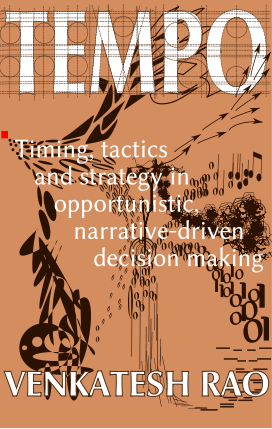
Later, I noticed that Rao makes frequent references to Clausewitz in his posts and that he is writing Tempo, a book on decision making that will be of great personal and professional interest to many readers here. At this juncture, I’m intrigued.
Then last week, Rao featured a lengthy post on metacognition where he made some excellent points. Here’s a few of them, but as I can only put up a small selection, you should go read the full post:

Boundary Condition Thinking:

 ….To build mathematical models, you start by observing and brain-dumping everything you know about the problem, including key unknowns, onto paper.  This brain-dump is basically an unstructured take on what’s going on. There’s a big word for it: phenomenology. When I do a phenomenology-dumping brainstorm, I use a mix of qualitative notes, quotes, questions, little pictures, mind maps, fragments of equations, fragments of pseudo-code, made-up graphs, and so forth.

You then sort out three types of model building blocks in the phenomenology: dynamics, constraints and boundary conditions (technically all three are varieties of constraints, but never mind that).

Dynamics refers to how things change, and the laws govern those changes. Dynamics are front and center in mathematical thought. Insights come relatively easily when you are thinking about dynamics, and sudden changes in dynamics are usually very visible.  Dynamics is about things like the swinging behavior of pendulums.

Constraints are a little harder. It takes some practice and technical peripheral vision to learn to work elegantly with constraints. When constraints are created, destroyed, loosened or tightened, the changes are usually harder to notice, and the effects are often delayed or obscured. If I were to suddenly pinch the middle of the string of a swinging string-and-weight pendulum, it would start oscillating faster. But if you are paying attention only to the swinging dynamics, you may not notice that the actual noteworthy event is the introduction of a new constraint. You might start thinking, “there must be a new force that is pushing things along faster” and go hunting for that mysterious force.

This is a trivial example, but in more complex cases, you can waste a lot of time thinking unproductively about dynamics (even building whole separate dynamic models) when you should just be watching for changes in the pattern of constraints.

….Historians are a great example. The best historians tend to have an intuitive grasp of this approach to building models using these three building blocks.  Here is how you can sort these three kinds of pieces out in your own thinking. It involves asking a set of questions when you begin to think about a complicated problem.

  1. What are the patterns of change here? What happens when I do various things? What’s the simplest explanation here? (dynamics)
  2. What can I not change, where are the limits? What can break if things get extreme? (constraints)
  3. What are the raw numbers and facts that I need to actually do some detective work to get at, and cannot simply infer from what I already know? (boundary conditions).

Besides historians, trend analysts and fashionistas also seem to think this way. Notice something? Most of the action is in the third question. That’s why historians spend so much time organizing their facts and numbers.

Nice. There’s a multitude of places here to jump off and generate further epistemic analysis, and I am sure that some of the admirers of Boyd, Polanyi, Wohlstetter, Feynman, Kahn and Clausewitz in the ZP readership might do so in the comments. Or my co-blogger Charles might weigh in from the imaginative/mythic/visual domain. We’ll see.

Regardless, I think if you are following blogs like Metamodern, Thomas P.M. Barnett,  Open the Future, Global Guerrillas, John Hagel’s Edge Perspectives, Eide Neurolearning Blog or liked the old Kent’s Imperative (suddenly live again after being dormant for 2 years), you’ll want to consider adding Ribbonfarm to your RSS feed or blogroll.

ADDENDUM:

Ed at Project White Horse, another fine site for your blogroll, is also blogging on boundary conditions:

Stall, Spin, Crash, Burn and Die – Boundary Conditions for 2011

….You can’t fix things without some understanding, real understanding of the problem – nor can there be real leadership without actionable understanding. That’s where establishing boundary conditions as a vehicle to frame the problem – and therefore garner greater insight – become important.

Drilling for oil at a depth of 5000ft and in open ocean – Deepwater Horizon – should have been/should be seen as a “crisis” in waiting no matter the historical track record. Proper understanding would have meant that the National decision making level immediately recognized the high potential for the initial crisis migrating into a severely complex catastrophe after the explosion and acted, not waiting to see if BP’s response plans would work. Activities in “Blue Water”/open ocean are not a linear extrapolation from “inshore,” nor is 5000 ft a linear extrapolation from 200ft or 500ft. depths.  BP’s plans might have been up to the problem, but the shear nature of the environment, if scrutinized in context of “unconventional” as described below, should have been a trigger to initiate intermediate action.  Rather, the declaration of an Event of National Significance was 30+ days in coming??? A significant point, I believe, is the problem generated by not recognizing the nature or even acknowledging the existence of a different kind of  problem, one potentially very complex or stochastic in nature – an “unconventional crisis.”

Off-Base

Thursday, January 27th, 2011

Dr.David Ucko at the excellent Kings of War blog has his story and he is sticking to it:

The Weather Underground: a different approach to political violence

I recently watched The Weather Underground, a 2002 documentary on the eponymous radical organisation active within the United States during the 1970s. The film may be of interest to those studying radicalisation, insurgency and political violence, as it effectively explores the rise, evolution and demise of a revolutionary organisation. It also raises some semantic/ethical questions about ‘who is a terrorist’.

….The use of violence for political messaging may be viewed as ‘terrorism’, and this is typically how the Weather Underground is understood. But is this accurate? Terrorist groups deliberately target civilians to scare or terrorise wider populations into a certain political behaviour. The WUO refrained from such action: they used violence against buildings rather than people, to symbolise their discontent with specific policies and actions, but without killing those held responsible. It was ‘propaganda of the deed’, but without the bloodshed. Accordingly, none of WUO’s attacks resulted in casualties (the one exception has not been definitively linked to the group), and for this reason alone, it is difficult to call WUO a ‘terrorist’ organisation.

Uh, no it isn’t. As the commenters at KoW are busy trying to inform Ucko, this narrative does not fit the facts of the history of the Weathermen.

David, I suspect, is not trying to romanticize the Weathermen here so much as force-fit them into his theoretical model of terrorism, possibly influenced by a tactical turn that was undertaken by the IRA to drive up financial costs for the British government while minimizing the bad press that and damage to their public image that had been growing from earlier, bloody, IRA bombings.

Narcos Over the Border

Friday, January 21st, 2011

Narcos Over the Border: Gangs, Cartels and Mercenaries by Dr. Robert J. Bunker (Ed.)

Just received a review copy courtesy of Dr. Bunker and James Driscoll of Taylor & Francis – could not have arrived at a better time given several research projects in which I am engaged.

The 237 page, heavily footnoted, book is organized into three sections: Organization and Technology Use by the narcos networks, Silver or Lead on their carrot and stick infiltration/intimidation of civil society and the state apparatus, and Response Strategies for the opponents of the cartels. Bunker’s co-authors Matt Begert, Pamela Bunker, Lisa Campbell, Paul Kan, Alberto Melis, Luz Nagle, John Sullivan, Graham Turbiville, Jr., Phil Wiliams and Sarah Womer bring an array of critical perspectives to the table from academia, law enforcement, intelligence, defense and security fields as researchers and practitioners.

Looks good – will get a full review here at a later date, but a work that will definitely of interest to those readers focusing on national security, COIN, 4GW, irregular or Hybrid war, terrorism, transnational organized crime and black globalization.

Quantum COIN

Tuesday, January 18th, 2011


With quantum mechanics being used as a metaphor.

The New Physics: Key to Strengthening COIN by  A. Lawrence Chickering

….At the present time, most of what is being done for COIN is driven by old physics concepts, while many things we ought to be doing are understandable more in terms of the new physics.

One can see the difference between these two concepts in terms of the distinction between helping and empowering.3 The importance of this distinction is implicit in the widely quoted statement that T.E. Lawrence made in 1917 about the importance of empowering people and giving them ownership by letting them do things. -Do not try to do too much with your own hands,? Lawrence wrote.4 -Better the Arabs do it tolerably than that you do it perfectly. . . .?5 Helping is a powerful example of simple, Newtonian causation; it produces -concrete, measurable results,? which are the central concern of most philanthropy and donor programs. Unfortunately, the concrete results it produces are far weaker than the outcomes that result from empowerment and ownership.

Helping? is Newtonian and objective. You build a well, and the -measurable result? is a well. -Empowering? and -ownership? are post-Newtonian and subjective. You cannot -see? empowerment or ownership. These concepts have power when they are felt by people. Following Lawrence‘s statement, empowering and ownership are the key in COIN.

Empowering people, encouraging them to do things for themselves, shows the importance of non-local causation and results based only on probabilities. When a local community becomes empowered, there is no certainty what it will do. They will do things people care about-things they value. If you work in 100 communities, you cannot say what each village will do, but you can predict that some percentage will build wells, and some other percentage will build schools-and so on.

You know that empowering will not produce the -concrete, measurable results? you can get if the -helper? does the work, but when the helper does the work, there will be no community ownership and no sense of responsibility for security or maintenance of the -improvement?. With empowerment and ownership, people will protect a well or school and will maintain it. That explains why the well built by -an Arab? (Lawrence‘s phrase) is worth so much more than one built by -us? (the helpers).

The author has a solid point about top-down, outsider-controlled, hierarchically-organized aid activities cultivating an attitude of dependency, passivity or fatalism in populations that COIN forces are attempting to win over.

If we see symptoms of “welfare dependency” and disengagement from civil society in American neighborhoods with minimal levels of employment, high levels of violent crime and atomized social structures, as partly the product of intervention by social workers, police, state court systems and Federal programs, how much more so is this the case with third-country COIN? With bad people running around with RPG’s and AK-47’s? What would you, the impoverished and unarmed farmer of the village do? Stick out your neck? Or keep your head down?

Untangling two words

Monday, January 17th, 2011

[ by Charles Cameron ]

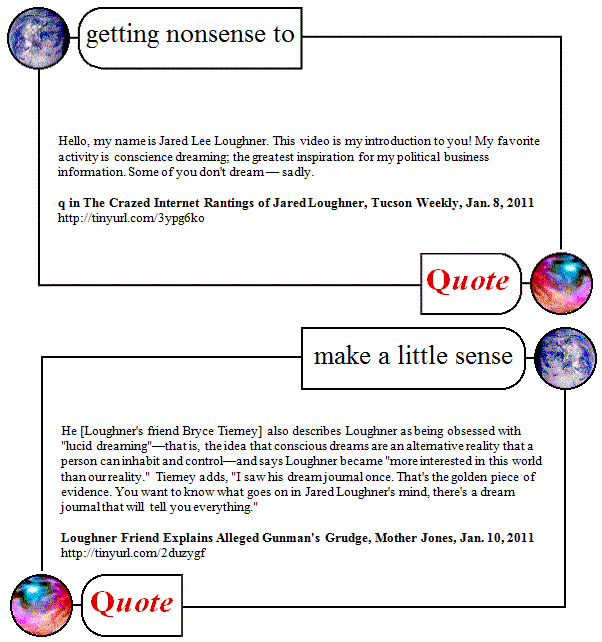
I’d like to take one small data-point and bring it into sharp focus with what lit critics would call a close reading of a two-word phrase from one of Loughner’s videos.

Maybe it’s because in French conscience means both what we’d call conscience and consciousness in English, when I read the weirdly stilted prose of Jared Loughner with its curious insistence on syllogism, the phrase “conscience dreaming” suggested “conscious dreaming” to me — and I wondered whether Loughner wasn’t perhaps thinking of the activity called “lucid dreaming” in which one knows while dreaming that one is dreaming, and begins to “direct” the dream in much the same way in which a film-maker directs a film.

The first quote in this DoubleQuote is from one of Loughner’s videos — the second, which confirms my hypothesis, quotes a friend of his.

I am not suggesting that “lucid dreaming” is responsible for Loughner’s actions — I’m not sure that anything or anyone is, including Loughner himself.

My point is that here as elsewhere, figuring out what the allusions in an unfamiliar rhetoric mean is an important step in understanding the mental processes that produce it.

Lucid dreaming is one clue in the tangled mess that was Loughner’s state of mind that day…


Switch to our mobile site