zenpundit.com » social science

Archive for the ‘social science’ Category

Book Review: Engaging the Muslim World by Juan Cole

Wednesday, July 8th, 2009
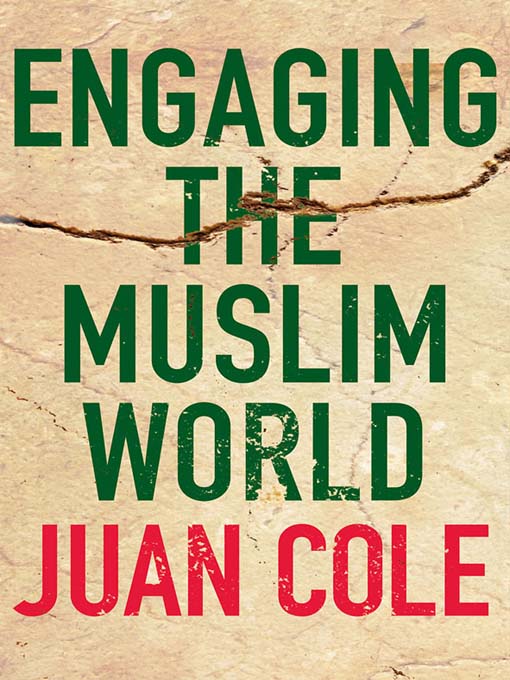
Engaging the Muslim World by Juan Cole

I recently finished reading Engaging the Muslim World by Juan Cole, the influential academic, well known liberal-left blogger of Informed Comment, past president of the Middle East Studies Association and occasional media talking head. Cole has written an intriguing book on contemporary foreign policy that is of special interest to those readers concerned with public diplomacy, the Muslim world, terrorism and the domestic politics of American foreign policy, particularly the war in Iraq. I will state straight off that there are arguments in this book presented by Cole that I profoundly disagree with, or, national security related assertions that I consider questionable; but in other instances, when Cole is concentrating on the nuances of the Arab-Muslim world’s political-cultural lens, he is an illuminating and insightful analyst from whom I have learned new things. 

Engaging the Muslim World is…well….engaging. I found Cole’s prose flowed smoothly, as if the author was talking to the reader across a table, and I had a hard time putting the book down, albeit I was frequently scribbling furiously in the margins. This is a polemical -policy book written by an academic for a lay audience and the reader’s reaction to Engaging the Muslim World will depend in part on their own worldview. Liberals will cheer more than they disagree with Cole, while conservatives and supporters of Israel are likely to reject many of the book’s normative assumptions long before they read the conclusions – but Cole also offers some prescriptive advice that center-right COIN and public diplomacy advocates will warmly embrace.

The book  is divided into six chapters. The first, “The Struggle for Islamic Oil:The Truth About Energy Independence” which deals with energy markets, the Cold War history of the Mideast, global warming, environmental policy, alternative fuel technologies and globalization, is a necessary effort to concisely account for the geoeconomic importance of Muslim oil producing states and the future of fossil fuel economies.  Cole argues – correctly, I suspect – that there will be no short or medium term substitutes for oil and gas until solar power technology is cost-efficient enough (and efficient in a physics sense) to compete with fossil fuels in the marketplace. Not being a scientist or an expert in energy market issues, I am poorly placed by professional background to evaluate Cole’s claims in these areas and will leave those to others.

That said, chapter one remains the odd man out. It smacks of having been  compacted by an editor out of two or more chapters and consequently has disparate issues jumbled together with insufficient explanation; as a whole, chapter one fits uncomfortably with the subsequent chapters which flow together naturally and thematically. On the other hand, the topic of oil can hardly be dispensed with either in a geopolitical discussion of the Mideast, so Cole was right to tackle it and the primary problem is really one of sequence, not subject matter.

Chapters two through six are the heart of Engaging the Muslim World, where Juan Cole articulates a theme of “Islam anxiety” permeating Western, particularly American, media and public opinion. Poorly informed about even the most basic information regarding the Muslim world, such as the differences between Shia and Sunnis, secular Baathist nationalists and Islamist radicals, quietists and the politically militant, Arabs and non-Arabs, Cole asserts that Westerners tend to lump Muslims of all shades of political belief, religiousity and nationality into a homogenous, vaguely mysterious but ever dangerous entity. Cole cites as one example, Egypt’s Sunni Muslim Brotherhood, which has foresworn violence and has members who sit in Egypt’s legislature, being lumped uncritically by American commentators with al Qaida and Hezbollah (which is a radical Shiite group).

A better way to understand violent Islamist extremists in relation to normal Muslims, in Cole’s view, would be to see them as analogous to our homegrown, violent, far-Right, white racist underground that produced Timothy McVeigh, who carried out the Oklahoma City bombing or as cult-like movements. While smaller in size than Islamist radicalism, the racist Right shares with violent Islamists the trappings of a fringe, ostracized, quasi-religious, political cult with a conspiratorial worldview that diverges sharply from the nation’s mainstream religious life. Violent Islamists often make themeslves as unpopular with their co-religioinists as do neo-Nazi extremists here, through actions that horrify society, such as the bloody massacre of Western tourists and Egyptian workers at  Luxor, Egypt.

Cole’s analogy with cults and racial extremists I think is a useful one. Radical Islamists are difficult to classify on a traditional political spectrum as their political behavior has definite similarities with those of the fascist and communist totalitarians of the 20th century, but will not fit smoothly with either, given Islamist religious extremism and the fanatical atheism or at least radically secular nature of the Bolsheviks and Nazis. The psychological overlap however is certain, something akin to the 19th century Anarchist-terrorists or what Eric Hoffer captured in his classic work, The True Believer.

On Israel and Iran, Cole bends over backwards, like a circus sideshow contortionist, to try and explain the lunacy (and Cole admits it is, at best, a crackpot worldview) of Ahmadinejad’s violently antisemitic statements about the Holocaust and Iran’s generally defiant behavior toward the international community while giving Israel no similar benefit of the doubt.  Cole argues that Ahmadinejad’s oft-stated “wipe Israel off of the map” is a deliberate mistranslation by the Western media. Ok, possibly so. I do not speak Farsi, so I’ll take Cole’s word here. If it is the case though, Ahmadinejad is well aware of how his repeated statement is being mistranslated by Reuters and AP, yet he keeps using it. Again and again. That is an ominous statement in itself.

This uneveness regarding Iran and Israel will no doubt enrage conservatives and delight progressives, but in fairness to Juan, I must say that despite his partiality toward Iran in his book, as a blogger he was very quick to denounce the obvious stealing of the recent election by Khameini-Ahmadinejad-IRGC and my perception is that Cole views the apocalyptic Mahdist tendency in Twelver Shiism that Ahmadinejad embraces as a kooky deviation from mainstream Shiism. That not just Ahmadinejad holds this belief dear, but also many influential figures in the Iranian security apparatus as well, is in my view, a cause for alarm.

Despite his politics, Cole concludes Engaging the Muslim World with a very pragmatic prescription for American public diplomacy for engaging Arabs and Muslims in a more effective manner than in the past eight or eighteen or eighty years. If I do not agree with every aspect, it is a good deal better than what the State Department and the rest of the USG is doing now:

Once I saw an Iraqi tribal leader interviewed on al-Jazeera. He said. “There is good and bad in America”. I was struck by how pragmatic and realistic his response was, and how different it was from so much of the fundamentalist vigilantee propaganda about the United States posted on radical internet bulletin boards. If Washington could reach out to all Muslims and bring them around to a more nuanced -and clear-view, in which America was not simply demonized, it would be a major accomplishment. The point is not that they should see the West through rose colored glasses, but that they should be willing to see the good and bad.

That would represent a step up by an order of magnitude.

“Political Commissars in Camouflage”

Thursday, July 2nd, 2009

Dr. Tony Corn opens fire at the SWJ with a 33 page broadside against ….well….many targets… of the Defense Department/ military academia/civilian political status quo. I can’t say that I agree with every point in this brutal, turbocharged jeremiad, but some of Corn’s targets deserve the abuse he heaps on them, and he nails a few of my pet peeves, including the chronic neglect of strategy and grand strategy by the American elite (civilian appointees even more than flag officers, in my view).

You will agree and disagree with Corn as he has a high density of concepts and references here, often expressed in polemical terms. He also throws in a gratuitous dose of anti-Clausewitzianism to add salt to the wounds of some readers, if the political angle is not providing sufficient friction 🙂 :

From War Managers to Soldier Diplomats: The Coming Revolution in Civil Military Relations

….There was of course a price to be paid for the failure to distinguish between political partisanship and political literacy. The risk was to end up with an officer corps focused exclusively on tactical and operational matters, and so lacking in political literacy as to be unable to relate military means to political ends, i.e. to think strategically. It did not seem to matter much at the time for two reasons. In the nuclear age, strategic thinking was seen as being too important to be left to the military, and was therefore quickly taken over by civilians. In addition, those same civilians (including Huntington) tacitly shared the conviction famously expressed by Bernard Brodie in 1946: “Thus far the chief purpose of our military establishment has been to win wars. From now on its chief purpose must be to avert them. It can have no other useful purpose.” And indeed, if the main raison d’etre of the military is not to win, but to avert, war, why take the risk of having officers develop an “unhealthy” interest in politics by emphasizing the strategic level of war?

Read the whole thing here.

ADDENDUM:

My take, four years ago, on the emerging class of “soldier-statesmen” (I try to be so far ahead of each curve that it brings me no recognition whatsoever. LOL!)

Pressfield’s Reified Tribalism

Thursday, June 11th, 2009

Good Lord, I hardly know where to begin.

Late last night, I was pinged by Fabius Maximus who had just written a post about historical novelist Stephen Pressfield, author of Gates of Fire, The Virtues of War and The Afghan Campaign. I do not read enough fiction, so while I had heard of Pressfield because his books are very popular among milbloggers, I did not know anything about the man specifically. I was intrigued by FM’s post, here is an excerpt which will serve to introduce the subject at hand:

Advice about our long war – “It’s the tribes, stupid”

Today’s post examines advice to us from historian Steven Pressfield:

“The real enemy in Afghanistan isn’t Islamism or jihadism. It’s tribalism. … Can we Westerners impose ‘citizen values’ on a tribal society?”  (from his website)

Some people say our real enemy in Afghanistan is their religion.  Pressfield says our enemy is their form of society.  Both sides agree that they cannot be left alone, since they are “the enemy”.  This debate goes to the heart of our Long War, as both sides usually ignore the question of why we fight – and exactly how these people threaten us.

…. However, we can all look at his essay in the broader context of American grand strategy.  Please consider this astounding statement:

“What struck me most powerfully is that that war is a dead ringer for the ones we’re fighting today. … the clash of East and West is at bottom not about religion. It’s about two different ways of being in the world. Those ways haven’t changed in 2300 years. They are polar antagonists, incompatible and irreconcilable.

Economist and businesspeople discuss the Competitive Advantage of Nations (as in Michael Porter‘s 1990 book of that title).  Social scientists and geopolitical experts discuss Samuel P. Huntington’s Clash of Civilizations theory.  But Pressfield goes beyond these.  In effect he calls for a long war.  War between “polar antagonists, incompatible and irreconcilable” – perhaps running until one side is exterminated or conquered. 

Using Alexander’s invasion of Afghanistan as a paradigm raises as many questions than it answers.  What were Alexander’s reasons for invading Afghanistan?  Nothing rational, little more than love of war, power, and loot.  Do we have such aggressive motives?  Or do we fight legally under the international laws we both promulgated and signed, which means acting only in defense? 

Answering that requires a clear statement of the threat the tribes of Afghanistan pose to us.  Victory is impossible without a clear understanding of the threat and our goals. How can the tribes be enemies without a strong understanding of this?

Read the rest of Fabius Maximus’ post here. FM has a rich number of related links, most of which I will not duplicate here for sake of brevity.

Pressfield has been thinking about his concept for some time, having penned an op-ed piece for Dr. Chet Richards at DNI back in 2006 entitled “It’s the Tribes, Stupid” which I encourage you to read. Today, there is an impressively slick vblogging, presentation by Pressfield on a site of the same name “It’s the Tribes, Stupid”.  Pay close attention: this is what a bloggging series looks like with a budget and Hollywood production values. Agree or disagree with Mr. Pressfield’s argument ( and I shall do both) he is demonstrating “how” to use the online medium professionally in order to propagate a meme ( he just needs help maximizing the virality, but the components are “good to go” for anyone who cares to pick up the torch). It is first rate work, take a look for yourself at Pressfield’s intro piece:

Pressfield has three vposts up and two more for release in the pipeline on his site.

Joshua Foust of Registan.net has already taken issue on a host of Afghanistan context specific and non-specific ways while RAND emeritus David Ronfeldt has offered supportive comments at Pressfield’s blog. For my part, I think what Pressfield is doing here is well-intentioned, helpful to a degree, likely to be successful in spreading as a meme and ultimately off-target in a harmful way for the same reasons that his meme can effectively propagate in our information age. In short, what Pressfield is saying is useful tactically but could mislead us strategically, but boy, he sure says it well!

I say it is useful tactically in that most 18-21 year olds in military service are not cultural anthropologists and speaking from nearly 20 years experience in teaching, young Americans are breathtakingly egocentric in their worldview, even when they adopt a pose of critical antagonism toward their own country, it tends to be blindly self-referential. Walking a mile in another’s shoes is not something they do naturally and unprompted. That other people have radically different conceptions of “normal” is often a mind blowing epiphany for them when it sinks in, usually in their late 20’s, if at all.

In that Pressfield conveys the generalized and simplified basics of a generic “tribal mindset” in sound bites digestible to the average twenty year old from a dying Mill town or small Deep South rural county  is a feature, not a bug. We can’t send all the recruits straight from boot camp to do a few years at Oxford or Yale before they deploy to Khost or Anbar – we need “good enough” for a starting point, not perfection. Pressfield gets an “honor culture” and “primary loyalty identity” across effectively and that could, possibly, save some lives. Let’s keep that point in mind.

Secondly, Pressfield’s point that tribal mentality is significantly different from that of a Western citizen is fundamentally correct. Different political economies and social hierarchies rest on different value systems and alternate psychologies. Col. Pat Lang wrote that most tribesmen could “escape to be cab drivers” if they chose to do; tribesmen prefer tribal life and believe it to be superior to a “civilized” society that is bereft of honor, even if it is materially richer. We are unlikely to convince them otherwise and they will resent us for trying.

What Pressfield gets horribly wrong is the discounting of the religious radicalism aspect as being superceded by atavistic, superempowered, Ur-tribalism. Umm, no and not at all. The neo-fundamentalist Salafi and Deobandi Islamist radicals are, as Josh correctly argued, pan-Islamist militants who are deeply hostile to tribal customs and authorities they view as “jahiliyyah”, un-Islamic or even blasphemous apostasy. As far as our current operations go, this reaction was on display after the Soviet invasion of Afghanistan where Afghan Mujahedeen commanders tried their best to keep the Arab volunteers, Wahabbi extremists for the most part, from angering tribesmen by desecrating village shrines and graves of Sufi “saints” or revered, local, holy men. In reality, the conflict between Tribe and Religion goes back for centuries and periodically erupts in violence in one era and cohabitates peacefully in others.

Tribesmen and Islamist radicals are not natural allies unless we put them in that position and most of their countrymen are comfortable having multiple identities without choosing between them or abstaining from the elements of Westernization that they admire or enjoy. Viewing tribalism as “the enemy” makes the same mistake as viewing all Islam as the enemy. Frankly, we have enough enemies right now without multiplying them excessively and we can find many allies among tribesmen, if we approach them in the right fashion – something I suspect that Mr. Pressfield hopes that his videos will encourage American troops to do. I get the impression, from watching the videos, that Pressfield is employing many of the writer’s imaginative’s gifts there – simplifying, romanticizing, artfully mythologizing not by droning on but with clear, powerful, phrases that capture attention and have an impact. I am now tempted, after listening to Pressfield speak, to buy some of his books. 

With such skills though, he needs to take greater care to get his narrative right.

Qualitative vs. Quantitative

Saturday, May 23rd, 2009


Drew Conway of Zero Intelligence Agents asks a great question of all social science and humanities folk in the readership: 

Nye and Drezner on Quantitative Scholarship

As a student in a department that covets rational choice and high-tech quantitative methods, I can assure you none of my training was dedicated to learning the classics of political science philosophy. On the other hand, what is stressed here-and in many other “quant departments”-is the importance of research design. This training requires a deep appreciation of qualitative work. If we are producing relevant work, we must ask ourselves: “How does this model/analysis apply to reality? What is the story I am telling with this model/analysis?”

Whether you are a producer, consumer or tourist of political science research you probably have an opinion on this debate, and I’d like to hear it.

Drew asks an important question. “Research Design” is inherently an act of qualitative and normative judgments. If the researcher is lacking a consciously constructed and identifiable intellectual framework or lens, they will still have one by default, except it is likely to be composed of contradictory hodgepodge of unconsciously acquired biases, hiding under a presumption of objectivity. That’s not an optimum perspective from which to select objects to measure and yardsticks with which to measure them.

The comment I left at Drew’s site was:

Quantitative analysis is sharpening the focus of the telescope or microscope. Qualitative analysis is knowing what’s worth looking at.

Being trained as a historian, I’m a qual dude but quant tools can tell me when I’m on target or by how much I may be off. Or if I am full of crap. On the other hand, quant scholars can be like drunks looking for their car keys under a streetlamp because that is where the light is. Quants need data and not every significant variable is the one that is easiest to isolate and measure. Or measure beyond mere correlation. Or at all.

Quant-Qual can never be either/or any more than we should try walking on one leg.

We need more consilience and less compartmentalization in intellectual life.

Recommended…Reads.

Sunday, December 21st, 2008

              boydbook.jpg       

 Need a last minute gift idea for….yourself?  Some highly recommended books that I’ve perused in the past year or so:
Great Powers: America and the World After Bush by Thomas P.M. Barnett 

Having read an advanced copy, this is easily Tom’s best work, surpassing his bestselling The Pentagon’s New Map in sweep and historical depth. A book with a provocative analysis that is definitely going to challenge the comfortable assumptions of the defense and foreign policy establishments and enrage not a few partisans. I will have a full review in mid-January after I see the “final edit” version.

Caesar: Life of a Colossus by Adrian Goldsworthy

Goldsworthy, a British military historian, gives Julius Caesar the same comprehensive and magisterial treatment that Alan Schom rendered with his landmark biography of Napoleon (Napoleon Bonaparte, incidentally, was an admirer of Hannibal, not Caesar) A biography and work of military history that is a page turner.

The Wages of Destruction: The Making and Breaking of the Nazi Economy by Adam Tooze

Dan from Madison at Chicago Boyz has reviewed Wages of Destruction, which led me to pick up a copy recently and start reading. Like Niall Ferguson, Tooze puts economic history into a dramatic explanatory context. If you have doubts, pick up a copy and flip to the chapter entitled “The Grand Strategy of Racial War” and read. You’ll walk out of the store with it.

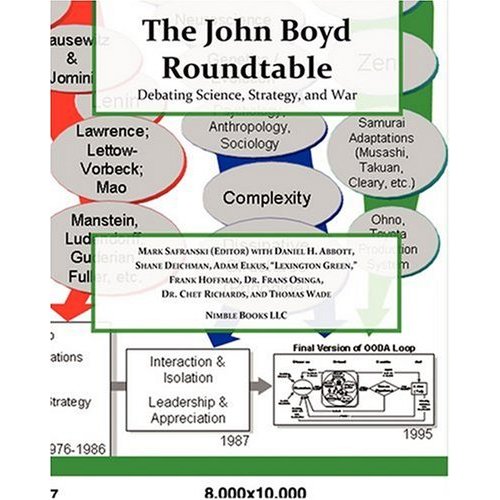
The John Boyd Roundtable: Debating Science, Strategy, and War by Mark Safranski, Daniel Abbott, Chet Richards, Shane Deichman, Thomas Wade, Frans Osinga, Adam Elkus and Frank Hoffman. Foreword by Thomas P.M. Barnett

A refinement and extension of the online roundtable at Chicago Boyz dedicated to reviewing Science, Strategy and War by Col. Frans Osinga (see below) and debating the ideas of the late strategic theorist Colonel John Boyd. Great for both the “Boyd expert” and those wanting a quick primer before tackling Osinga’s monumental work of strategic studies and intellectual history [ Full Disclosure: for newer readers who may not be aware, I was the editor and I’m shamelessly self-promoting here  🙂 ] 

Science, Strategy and War: The Strategic Theory of John Boyd (Strategy and History)  by Frans Osinga

Dr.Osinga has delivered a meticulously researched tome that William Lind called “the book Boyd would have written” that explains Colonel John Boyd as “the first postmodern strategist”. Osinga walks the reader through Boyd’s intellectual journey into fields as far removed from classical military studies as cybernetics, knowledge theory and the work of mathematician Kurt Godel and explains how Boyd distilled a strategic worldview on the nature of conflict and competition.


The Culture of War by Martin van Creveld

Eminent and controversial Dutch-Israeli military historian Martin van Creveld expands upon his body of work that is often described as “prophetic” these days in order to argue the intrinsic cultural value of war.

The Black Swan: The Impact of the Highly Improbable by Nassim Nicholas Taleb

This was the “must read” book of the blogosphere in 2007- 2008, widely cited (though perhaps first by John Robb) for the Black Swan concept itself. Taleb is an idiosyncratic, wide-ranging, writer interested in counterintuitive perspectives and is deeply skeptical of the validity of existing epistemological methodologies. Parts of the book will be of interest only to those with advanced backgrounds in probabalistic analysis and mathematics but there is much else that is intriguing and entertaining along the way while Taleb explains the characteristics of Extremistan and Mediocristan. A friend who moves among quite a few “thought leaders” described Taleb to me as “arrogant” but with something of value to say. Agreed.

On War (Oxford World’s Classics) by Carl von Clausewitz

Pick up a copy and join us during the Clausewitz Roundtable in January!!

Annihilation from Within: The Ultimate Threat to Nations by Fred C. Ikle

Ikle, a senior Defense Department official in the Reagan administration tackles apocalyptic threat scenarios including the one coming from our own best efforts to avoid them. A gloomy but thought-provoking read.

The Cold War: A New History by John Lewis Gaddis

Gaddis intended to write a book for the college undergraduate or layman that concisely explains the Cold War and the “why ?” of the victory of the West and generally does a superb job of it.  The undercurrent or background that may not be obvious to the layman is that Gaddis is sticking a thumb in the collective eye of the revisionist diplomatic historians of the New Left – notably Walter LaFeber, Lloyd Gardner, Gabriel Kolko and Robert Buzzanco and others descending at least vaguely from the school of thought founded by William Appleman Williams.

Stalin: The Court of the Red Tsar by Simon Sebag Montefiore

A brilliant example of Soviet studies scholarship. I’ve read innumerable books on Stalin and the USSR and I still learned things from  Montefiore. Highly recommended.

The Third Reich in Power, 1933-1939 by Richard J. Evans

The second book in his trilogy on the history of Nazism, Evans looks at the Nazi state and party apparatus and German society during the years of peace. Evans, along with Michael Burleigh, Ian Kershaw and Adam Tooze are revising our understanding of the Third Reich and illuminating that as evil as Hitler’s regime was in fact, it ultimately was intended to be several orders of magnitude worse had Germany won the Second World War.

Nixon and Kissinger: Partners in Power by Robert Dallek

A deeply partisan work of history, Dallek makes little effort to be fair (especially in the first half of the text) to either Richard Nixon or Henry Kissinger, both whom he characterizes as mentally and emotionally unstable, if highly intelligent, personalities and makes an argument that Nixon’s mental state during the Watergate crisis required his removal from office under the 25th amendment. It’s difficult to imagine Dallek treating Bill Clinton or LBJ in similar fashion, regardless of their personal behavior or abuses of power because seldom does Nixon ever get the benefit of the doubt ( in comparison Richard Reeves’ devastating profile, Nixon: Alone in the White House is a work of hagiography).

Why read Nixon and Kissinger then ? Because Dallek, despite his biases, has done an outstanding job in presenting new sources and evidence and his delving into the China Opening and Nixon and Kissinger’s very complicated personal relationship, remains a first-rate work of scholarship. Therefore, I say “Read it” ( just do not let it be the only book you read on Richard Nixon).

That’s it!


Switch to our mobile site