[ by Charles Cameron — commemoration of al-Hallaj, sufi and martyr, the nature of circumambulation, matrioshka, modeling and mandalas ]
.
According to a report by Fahad Faruquiin today’s Huff Post, Mansur al-Hallaj was martyred on this day, March 26, 922 CE.
His offence is often said to have been that he declared “An al-Haqq” — I am the Truth — although many sufis would say that his egoic nafs had been erased in fana, and that it was al-Haqq that spoke through him, not a claim that he made of himself.
So today would be the day to leave a marker here on Zenpundit, saying that I hope to return in the not too distant with a post that ties al-Hallaj as described in Faruqui’s post with the circumambulation of Banaras, the circumambulation of an avatar of Vishnu Shiva and Parvati by Ganesh, and the modeling of what I sometimes refer to as “pocket universes”…
*
The particular aspect of Faruqui’s post that caught my attention was this:
Hallaj was not sentenced to death for uttering “ana’l-haqq.” After his arrest, he was accused of various things, but, according to Professor Ernst, he was pinned down after his prosecutors discovered a document in the handwriting of Hallaj that recommended that those who were unable to afford Hajj pilgrimage could construct a model of Kaaba at home and perform circumambulation (tawaf) and give alms to poor and feed some orphans and they would have completed the Hajj.
“At that point one of the judges turned to Hallaj and said in Arabic ‘damuka halal,’ that is, your blood may legally be shed. In other words, now we have you,” said Professor Ernst, a specialist in Islamic Studies. “But then Hallaj said that I found this in the writings of Hasan al-Basri, so that was a kind of technicality, but he was given no opportunity to explain or repent.”
[ by Charles Cameron — against either / or thinking — a graphic reminder? ]
.
Islam is “a mosaic, not a monolith”.
Vartan Gregorian, president of the Carnegie Corporation, offered us a 177-page exposition of that theme in a book of that title published by the Brookings Institution (2003), expanding on an earlier and shorter essay of the same title. Of the book-length version, he writes:
Presenting such a wide-angle view in a relatively small space requires the free use of generalizations, summaries, and categorizations that must leave out many nuances of history.
1.
There’s no doubt that some currents within Islam preach a continuing war against “Crusaders and Zionists” — and make no mistake about it, this is a religious movement, claiming its sanction in scripture and its path as submission to the will of God, as indicated by David Martin Jones and MLR Smith in Whose Hearts and Whose Minds? The Curious Case of Global Counter-Insurgency [see Zen’s comments here]:
The process of radicalisation is obviously a complex one. Certainly, the passage to the act of terrorism cannot be reduced solely to religion. Nevertheless, it is somewhat naive, if not perverse, to dismiss it completely. The bombings of the Madrid and London transport systems in March 2004 and July 2005 respectively, and even the 9/11 assaults, are, whatever else, Islamist acts in a Western setting. The view that religion is at best a secondary motive defies the evidence. All the groups that have undertaken high-profile terrorist acts dating from 9/11 and stretching from Bali to Madrid, London and Mumbai have acted in the name of a militant understanding of Islam. Such a pattern of worldwide attacks, exhibiting a profound devotion to a politically religious cause intimates, if nothing else, a religious dimension to jihadism. In fact, to reduce jihadism to individual social pathology attempts to explain away political religion as a social fact. Rather worryingly, it assumes that when a highly motivated jihadist claims to undertake an operation to advance a doctrine, he does not really mean it.
This might seem so obvious as to require no comment — yet Jones and Smith follow this paragraph with a question:
we need to resolve this paradox: why do counterinsurgency theorists exhibit this reluctance to confront the ideological or politically religious dimension of modern insurgency?
— and there are no doubt other segments of the media, intelligence and policy communities of which the same question might be asked.
One aspect of the answer, I believe, lies in the general tendency of post-enlightenment thinkers to “push religion into the background of their story” (Richard Landes‘ words, which I quoted here in a different context a week ago).
2.
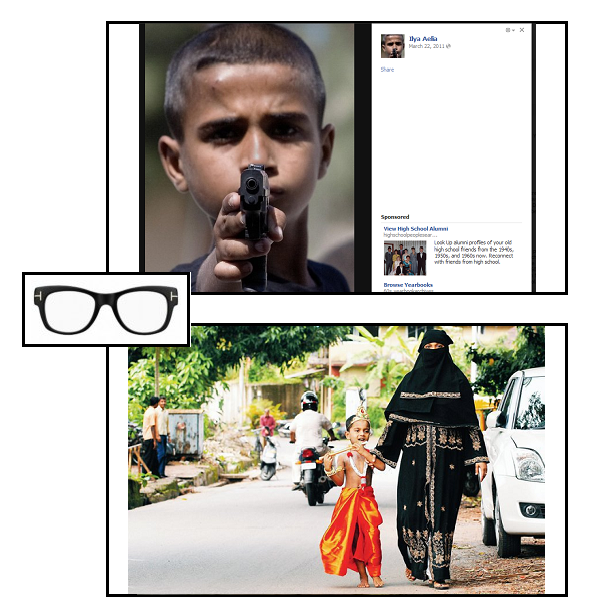
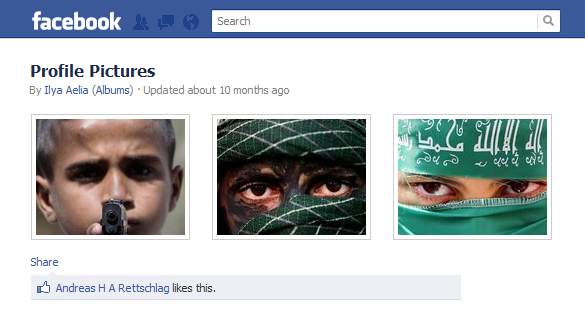
The young man pointing a gun at the viewer on a Facebook page (h/t Internet Hagganah) is the avatar of a net-salafi in Germany whose sequence of avatars looks like this:
Quintan Wiktorowicz defines a salafi thus:
The term “salafi” is used to denote those who follow the example of the companions (salaf) of the Prophet Mohammed. Salafis believe that because the companions learned about Islam directly from the Prophet, they commanded a pure understanding of the faith.
As he notes in another article:
The Salafi movement (often referred to as the Wahhabis)1 represents a diverse community. All Salafis share a puritanical approach to the religion intended to eschew religious innovation by strictly replicating the model of the Prophet Muhammad. Yet the community is broad enough to include such diverse figures as Osama bin Laden and the Mufti of Saudi Arabia. Individuals and groups within the community reflect varied positions on such important topics as jihad, apostasy, and the priorities of activism. In many cases, scholars claiming the Salafi mantel formulate antipodal juristic positions, leading one to question whether they can even be considered part of the same religious tradition.
The avatar-salafi depicted above sums up his own existence and “aim in life” by pointing a gun at you.
3.
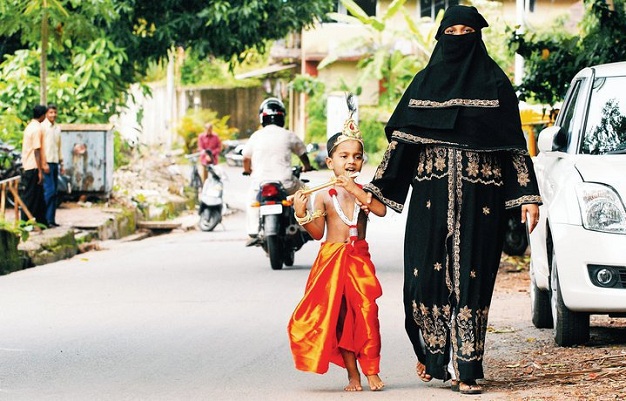
Not so the lady leading a child by the hand in the lower of the two images, from a photo taken in India.
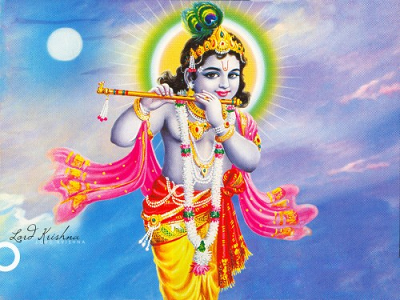
She offers us, in fact, a vividly contrasting picture of Islam to that of the salafi. She, a woman who is clearly observant of the demure dress code given in Qur’an 33.59 and wearing a niqab, is leading by the hand a joyful child arrayed in the finery of Krishna — beloved flute-playing avatar of Vishnu (avatar in its original sense) among her Hindu neighbors.
You might consider the pair of them together as monotheism hand-in-hand with polytheism. But then again, you might see them as peace and delight together, walking hand-in-hand.
You might see them as expressive of the Quranic proclamation (49.13 ):
O people, We have created you from a male and a female and made you into races and tribes so that you may know each other. Surely the most honored of you in the sight of God is the one who is the most righteous of you.
4.
To bring this back to contemporary politics, we may have our views about Islamist politics, and in the context of the changing scene across the Arab world it is worth pondering this recent quote from Rachid Ghannouchi, founder of the Ennahda Party in Tunisia, indicating another significant aspect of the contemporary evolution of Islamist thought:
Freedom is a fundamental principle in Islam, religion can not be forced on believers … Religion is not meant to give us guidance in all areas of industrial management, agricultural innovation, and governance, those subjects require human reason. Religion, however, gives us a code of values and principles.
Islam is not merely diverse, it is self-renewing.
5.
In light of all this, we need a far richer awareness of the mosaic that is Islam that our tendency towards black and white, war or peace, either / or thinking easily allows.
Consider these Quranic verses (35.27-28):
See you not that Allah sends down rain from the sky? With it We then bring out produce of various colors. And in the mountains are tracts white and red, of various shades of color, and black intense in hue. And so amongst men and crawling creatures and cattle, are they of various colors.
Again, the delight in diversity!
Now take another, closer look at those two folks from India:
….Into the breach strides eminent diplomatic historian John Lewis Gaddis, offering a magisterial 784 page biography, a quarter- century in the making, George F. Kennan: An American Life. Gaddis, a noted historian of the Cold War and critic of revisionist interpretations of American foreign policy, has produced his magnum opus, distilling not only the essence of Kennan’s career, but the origins of his grand strategic worldview that were part and parcel the self-critical and lonely isolation that made Kennan such an acute observer of foreign societies and a myopic student of his own.
Gaddis, who is a co-founder of the elite Grand Strategy Program at Yale University, had such a long intellectual association with his subject, having been appointed Kennan’s biographer in 1982, that one wonders on theories of strategy at times where George Kennan ends and John Lewis Gaddis begins. Giving Kennan the supreme compliment among strategists, that he possessed in the years of the Long Telegram and the Policy Planning Staff, Clausewitz’s Coup d’oeil, Gaddis does not shy away from explaining Kennan’s human imperfections to the reader that made the diplomat a study in contradictions….
[ by Charles Cameron — fictitious peoples (Israelis, Palestinians), approved and disapproved scriptures (Hindu, Falun Gong), religious violence (Afghanistan, Nigeria, Bethlehem) ]
.
So, is there some sort of contest going on between Iranian and American ex-Speakers? Perhaps Elliott Abrams‘s response to Gingrich, quoted in the Washington Post piece, applies equally well to Haddad-Adel?
There was no Jordan or Syria or Iraq, either, so perhaps he would say they are all invented people as well and also have no right to statehood.
Next up…
And okay, what’s the point here? Is it that the Russians want to please both the Chinese and Indian governments — or that they don’t like new scriptures but are okay with old ones? Or is the problem that they haven’t decided yet on a “one size fits all” approach to unOrthodox religions?
Sigh. Next…
This is brutal — and apparently intercontinental.
You might think it’s obvious what the wrong answer is, and who’s doing the killing, in Nigeria. But these things can cut both ways:
Even here, it’s not clear who threw the bomb into the madrasa, although one could hazard a guess…
And even the site of the Nativity is infected. The Guardian’s account of events there this Christmas season is harsh in tone — but consider whose Nativity is supposedly being celebrated…
I’d say the Qur’an offers a better image of Christian monks than that experienced by those Palestinian riot police… who, in the event, although they themselves were also assailed with broom-sticks, declined to arrest anyone because, as Palestinian police lieutenant-colonel Khaled al-Tamimi put it:
Everything is all right and things have returned to normal. No one was arrested because all those involved were men of God.
[ by Charles Cameron – Ghazwah-e-Hind, the other prong of Khorasan jihad, YouTube propaganda, Zaid Hamid, his warnings to the West (leave well alone!) and to the Hindus (convert!) ]
.
1.
The Hadith:
The major sweep of the victorious army with black banners will be from Khorasan to Jerusalem, as described in various earlier posts here — but there are ahadith that deal with the conquest of India (and China, but that’s another story, see David Cook, Studies in Muslim Apocalyptic, pp 170 ff) that are currently enjoying a vogue in Pakistan…
Here is one version of the hadith, as quoted by the Shaikh of the Naqshbandi Owaisiah Sufis, Muhammad Akram Awan, to whom I shall return in a future post, in a speech he gave in Pakistan in November 2008:
From Abu Hurairah (rau), he said: (saws)
The Messenger (saws) of Allah promised us Ghazwah-tal Hind. Now, if I encounter it, I shall invest my wealth and life in it. Then, if I am killed I will be among the most chosen Shuhada (martyrs) and if I live, I would be Abu Hurairah ‘the freed’ (from Hell Fire).
2.
The plan:
So how does that translate into contemporary geopolitics?
Syed Saleem Shahzad (Inside Al-Qaeda and the Taliban: Beyond Bin Laden and 9/11, pp 206-215) offers a brief overview of the Indian Jihad / Ghazwa-e-Hind in its current incarnation, with the involvement of the Pakistani ISI and AQ’s (presumed late) Ilyas Kashmiri, bringing us fast forward to the present day:
This was the ISI plan drawn up 30 years ago with Harkat-ul-Jihad-iIslami, Jamaat-e-Islami, Muslim Brotherhood connections, Islamic seminaries, and Sufi networks of constructing a theater of war from Central Asia to Bangladesh to defeat the Soviet Union in Afghanistan, and simultaneously to acquire the right of self-determination for Kashmiris in India. Thirty years later, Al-Qaeda simply refurbished the plan after sketching out its ideological boundaries, to prepare the greater theaters of war of Khurasan and Ghazwa-e-Hind for victory, before its armies, holding the black flag aloft, entered in the Middle East for the final battle against the Western world.
From my POV, the ghazwa is one of the topics Stephen Tankel might profitably have addressed as theological matter relevant to the LeT and the Mumbai attack…
Here’s the close of Shahzad’s book, to make the apocalyptic thrust in all this quite clear:
However, the saga of Al-Qaeda’s One Thousand and One Nights tales continues with new strategies and new characters. For Al-Qaeda these are just measures to keep the West running from pillar to post until it exhausts itself and Al-Qaeda can announce victory in Afghanistan. Al-Qaeda next aims to occupy the promised land of ancient Khurasan, with its boundaries stretching all the way from Central Asia to Khyber Paktoonwa through Afghanistan, and then expand the theater of war to India.
The promised messiah, the Mahdi, will then rise in the Middle East and Al-Qaeda will mobilize its forces from Ancient Khurasan for the liberation of Palestine, where a final victory will guarantee the revival of a Global Muslim Caliphate.
3.
The video:
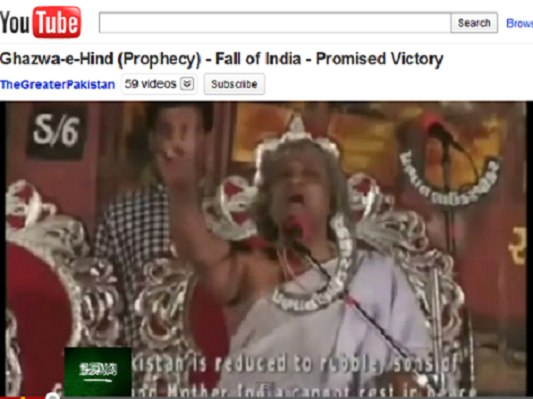
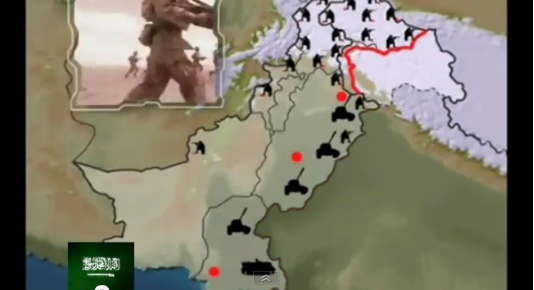
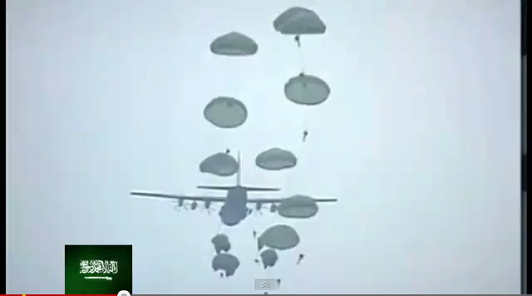
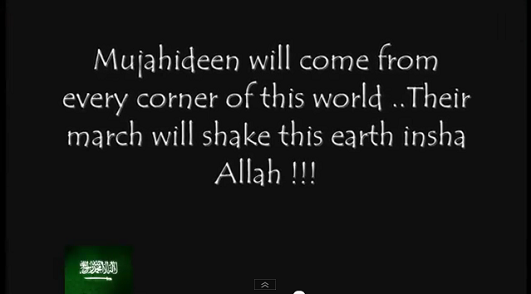
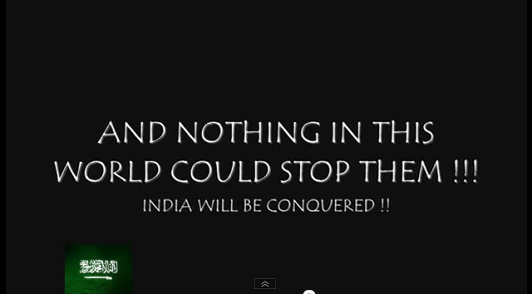
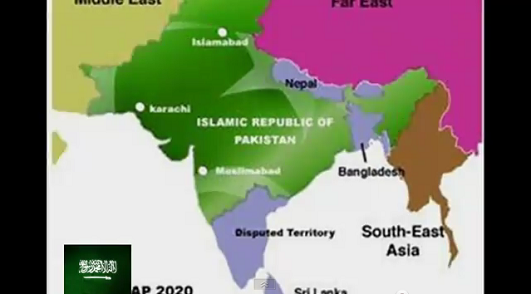
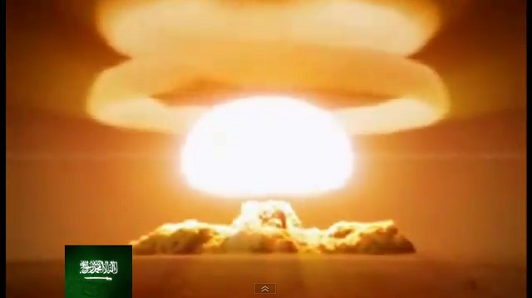
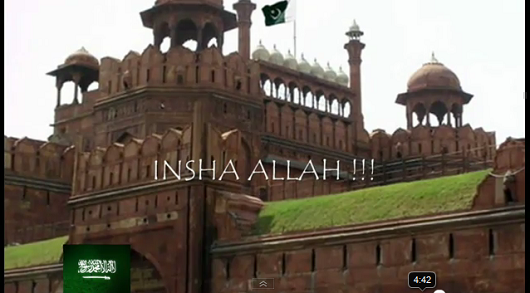
With that as background, I’d like to illustrate the emotional drive of the ghazwa idea, with screen shots from a video posted to YouTube in February of this year, titled Ghazwa-e-Hind (Prophecy) – Fall of India – Promised Victory. This section will take up quite a bit of screen space, but you can pretty much scroll on down and get the general idea, pausing where something seems a tad different or more interesting:
The video features stirring music throughout, presumably taken from Molossus (From “Batman Begins”) [2005] by Hans Zimmer & James Newton Howard — which we are invited to purchase on iTunes or AmazonMP3…
It opens with a rally, at which an Indian speaker is castigating Pakistan —
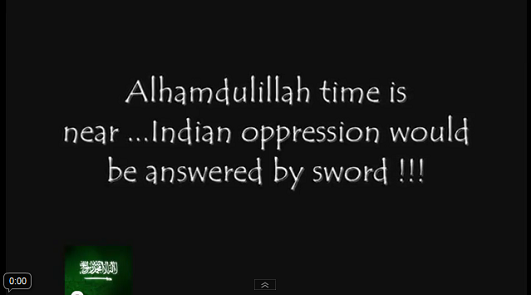
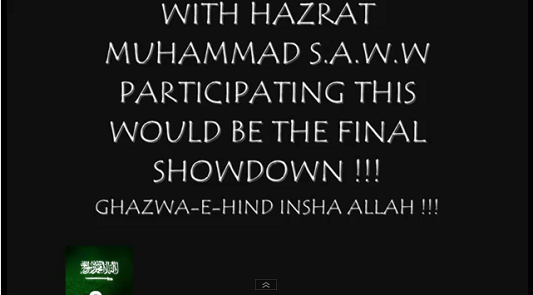
next up: two frames that give a textual expression of the hope involved —
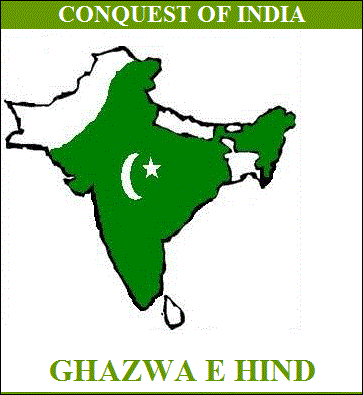
then, what we might call a “starting” map —
various evidences of military might —
another couple of text frames —
some arguably more intense weaponry —
and no less intense special forces —
then the hoped-for “close of play” map, book-ending the “opening” map above —
the ultimate threat —
and the flag of Pakistan flying over the Red Fort in Delhi —
4.
The warning:
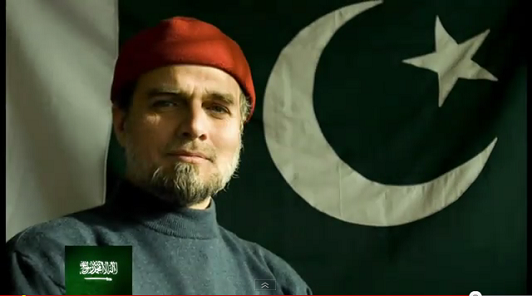
I have one final screen shot in the series, and it features Syed Zaid Hamid —
the man who has been most actively stirring up public sentiment in Pakistan for the Ghazwa-e-Hind.
I will close with two of Hamid’s speeches, posted on YouTube, each of them containing a warning. The first is in English, geopolitical in tone, and contains a warning to the US, Israel and India, that they should not attack Pakistan.
The second is addressed to the Hindus:
Such an invitation to convert is mandatory “when you meet your enemies’ before waging jihad, as stated in the hadith in Sahih Muslim, Book 19, 4294:
Invite them to (accept) Islam; if they respond to you, accept it from them and desist from fighting against them.
The first thing that we are calling you to is Islam.
(a) The religion of the Unification of God; of freedom from associating partners with Him, and rejection of this; of complete love of Him, the Exalted; of complete submission to His Laws; and of the discarding of all the opinions, orders, theories and religions which contradict with the religion He sent down to His Prophet Muhammad (peace be upon him). Islam is the religion of all the prophets, and makes no distinction between them – peace be upon them all.
5.
The outline:
That’s the basic outline.
I hope to dig in deeper and provide more subtlety in future posts, but this topic is still pretty new to me — I first ran across it, somewhat tangentially, in the United States of Islam video which I began to discuss in October 2010, and which I may return to shortly.
I also wish to invite comment from others who have been looking into the Ghazwa for longer than I have.
Zenpundit is a blog dedicated to exploring the intersections of foreign policy, history, military theory, national security,strategic thinking, futurism, cognition and a number of other esoteric pursuits.