zenpundit.com » Perception

Archive for the ‘Perception’ Category

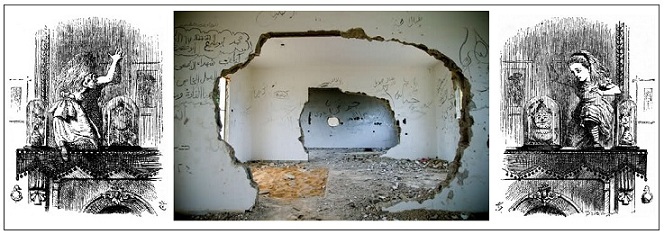
Alice’s Wonderland Battlespace

Tuesday, August 23rd, 2011

[ by Charles Cameron — terrain, IDF, inverse geometry, Necker cube, apocalyptic signs ]

.
wonderland-battlespace.jpg

I’ve just read one of those astounding paragraphs that leaves the mind reeling. Some of you will no doubt already be aware of the work of Israeli architect Eyal Weizman, but for me, his paper Lethal Territory is new ground:

The maneuver conducted by units of the Israeli Defense Forces (IDF) in Nablus in April 2002 was described by its commander, Brigadier General Aviv Kokhavi, as inverse geometry, the reorganization of the urban syntax by means of a series of microtactical actions. During the battle, soldiers moved within the city across hundred-meter-long “overground-tunnels” carved through a dense and contiguous urban fabric. Although several thousand soldiers and several hundred Palestinian guerrilla fighters were maneuvering simultaneously in the city, they were so “saturated” within its fabric that very few would have been visible from an aerial perspective at any given moment. Furthermore, soldiers used none of the streets, roads, alleys, or courtyards that constitute the syntax of the city, and none of the external doors, internal stairwells, and windows that constitute the order of buildings, but rather moved horizontally through party walls, and vertically through holes blasted in ceilings and floors. This form of movement, described by the military as “infestation”, sought to redefine inside as outside, and domestic interiors as thoroughfares. Rather than submit to the authority of conventional spatial boundaries and logic, movement became constitutive of space. The three-dimensional progression through walls, ceilings, and floors across the urban balk reinterpreted, short-circuited, and recomposed both architectural and urban syntax. The IDF’s strategy of “walking through walls” involved a conception of the city as not just the site, but the very medium of warfare — a flexible, almost liquid medium that is forever contingent and in flux.

Where do I begin?

* * *

1. For sheer creativity, this reversal of our normal understanding of space is both audacious and brilliant.

2. In terms of the way the humans living in that space experience the tactic, it must have been – must be – extraordinary – shock and awe on the scale of the individual family and its dwelling. Weizman quotes a Palestinian woman’s response:

Imagine it – you’re sitting in your living room, which you know so well; this is the room where the family watches television together after the evening meal. .. And, suddenly, that wall disappears with a deafening roar, the room fills with dust and debris, and through the wall pours one soldier after the other, screaming orders. You have no idea if they’re after you, if they’ve come to take over your home, or if your house just lies on their route to somewhere else. The children are screaming, panicking. . Is it possible to even begin to imagine the horror experienced by a five-year-old child as four, six, eight, twelve soldiers, their faces painted black, submachine guns pointed everywhere, antennas protruding from their backpacks, making them look like giant alien bugs, blast their way through that wall?

3. It has a past, there’s nothing entirely new under the sun:

Similarly, the strategy of walking through walls, as Israeli architect Sharon Rotbard reminds us, is reinvented for every urban battle in response to local conditions. It was first described in Marshal Thomas Bugeaud’s 1849 draft of La Guerre des Rues et des Maisons, in the context of anti-insurgency tactics used in the class-based urban battles of 19th-century Paris. Instead of storming the barricades from the front, Bugeaud recommended entering the barricaded block at a different location and “mouse-holing” along “over-ground tunnels” that cut across party walls, then taking the barricade by surprise from the flank. On the other side of the barricades and a decade later, Louis-August Blanqui wrote this microtactical maneuver into his Instructions pour une prise d’armes.

* * *

4. Quite apart from the notion of “inverse geometry” there’s a thread here that concerns mapping and deserves investigation. First, there’s this quote in Weizman’s essay from Walter Benjamin:

I have long, indeed for years, played with the idea of setting out the sphere of life — bios — graphically on a map. First I envisaged an ordinary map, but now I would incline to a general staff’s map of a city center, if such a thing existed. Doubtless it does not, because of the ignorance of the theatre of future wars.

Then, in a paper on forming a “coherent mental map of the Israeli-Palestinian conflict”, Weizman writes

A new understanding of territory had to be developed to govern the West Bank. The Occupied Territories were no longer seen as a two-dimensional surface, but as a large three-dimensional volume, layered with strategic, religious and political strata.

Later in the same piece, we can find Weizman’s description of a “politics of verticality” along with its vivid quote from Benveniste:

New and intricate frontiers were invented, like the temporary borders later drawn up in the Oslo Interim Accord, under which the Palestinian Authority was given control over isolated territorial ‘islands’, but Israel retained control over the airspace above them and the sub-terrain beneath.

This process might be described as the ‘politics of verticality’. It began as a set of ideas, policies, projects and regulations proposed by Israeli state-technocrats, generals, archaeologists, planners and road engineers since the occupation of the West Bank, severing the territory into different, discontinuous layers.

The writer Meron Benvenisti described the process as crashing “three-dimensional space into six dimensions – three Jewish and three Arab”. Former US president Bill Clinton sincerely believed in a vertical solution to the problem of partitioning the Temple Mount. Settlement Masterplanners like Matityahu Drobless aimed to generate control from high points.

* * *

Upside down, inside out, and topsy-turvy? Apart from Alice, of course — what does this remind me of?

Why, religion, naturally.

Take the Gospel of Thomas, logion 22 (Barnstone & Meyer, p. 51):

Yeshua said to them,
When you make the two into one,
and when you make the inner like the outer
and the outer like the inner
and the upper like the lower,
and when you make male and female into a single one,
so that the male will not be male nor female be female,
when you make eyes in place of an eye,
a hand in place of a hand,
a foot in place of a foot,
an image in place of an image,
then you will enter the kingdom.

Similar sayings are found in the poetry of Kabir, the great Indian mystic-poet, and described thus by Linda Hess (The Bijak of Kabir, p.135):

A particularly intriguing category of Kabir’s poems is the type known as ulatbamsi, poems in “upside down language”. They intrigue because they are absurd, paradoxical, crazy, impenetrable, and yet they purport to be meaningful.

In Japan, they might be given the name of koan — Hess quotes (p. 145) an early Mahayana sutra describing the world as “like a desert mirage, a celestial city, a mirror-reflection, a stone made from water hardened by a whirlwind”.
.

Here is one of the signs of the end times quote in Islamic sources:

After the night of three nights, the following morning the sun will rise in the west. People’s repentance will not be accepted after this incident.

* * *

And so perhaps the saying with which Eihei Dogen described Master Dogo‘s friend in his Shinji Shobogenzo best encapsulates both the state of mind that a sudden reality-reversal accomplishes in those who are not prepared for it — and paradoxically, the state of mind in which it can be accepted as part of the natural order of things:

He does not have a roof above his head, nor any ground under him.

Historical footnotes to game theory

Sunday, August 21st, 2011

[ by Charles Cameron — philosophy, psychology, history, game theory, dilemma, commons cooperation, analogy, 9/11 ]

.

I have an interest in game theory that is much like my interest in music: I can’t play, but I can whistle. And so it is that I’ve substituted curiosity about the history of the thing, and whatever analogical patterns I can discern there, for any actual ability at the thing itself.

Somewhere in my analogy-collector’s mind, then, I have these two quotes, cut from the living tissue of their writer’s thoughts, and prepped fpor contemplation. I find them, in retrospect, quite remarkable.

Jean-Jacques Rousseau, in On the Inequality among Mankind, wrote:

Such was the manner in which men might have insensibly acquired some gross idea of their mutual engagements and the advantage of fulfilling them, but this only as far as their present and sensible interest required; for as to foresight they were utter strangers to it, and far from troubling their heads about a distant futurity, they scarce thought of the day following. Was a deer to be taken? Every one saw that to succeed he must faithfully stand to his post; but suppose a hare to have slipped by within reach of any one of them, it is not to be doubted but he pursued it without scruple, and when he had seized his prey never reproached himself with having made his companions miss theirs.

And David Hume, in A Treatise of Human Nature:

Your corn is ripe today; mine will be so tomorrow. ‘Tis profitable for us both that I shou’d labour with you today, and that you shou’d aid me tomorrow. I have no kindness for you, and know that you have as little for me. I will not, therefore, take any pains on your account; and should I labour with you on my account, I know I shou’d be disappointed, and that I shou’d in vain depend upon your gratitude. Here then I leave you to labour alone: You treat me in the same manner. The seasons change; and both of us lose our harvests for want of mutual confidence and security.

*

Those two, I believe, are fairly well known – I was delighted the other day to run across a third sample for my collection. William James, in The Will to Believe, writes:

Wherever a desired result is achieved by the co-operation of many independent persons, its existence as a fact is a pure consequence of the precursive faith in one another of those immediately concerned. A government, an army, a commercial system, a ship, a college, an athletic team, all exist on this condition, without which not only is nothing achieved, but nothing is even attempted. A whole train of passengers (individually brave enough) will be looted by a few highwaymen, simply because the latter can count on one another, while each passenger fears that if he makes a movement of resistance, he will be shot before any one else backs him up. If we believed that the whole car-full would rise at once with us, we should each severally rise, and train-robbing would never even be attempted.

*

The first two quotes are of interest as showing the forms that an idea which will later be mathematized can take.  They are, if you like, precursors of game theoretic constructs, although neither Hume nor Rousseau appears to be mentioned in von Neumann and Morgenstern‘s Theory of Games and Economic Behavior.

The third, I think, is even more interesting..  Consider the eerie and heroic “fulfillment” of that third paragraph if read “as prophecy” – in this account from the 9/11 Commission Report of the events on United Flight 93:

During at least five of the passengers’ phone calls, information was shared about the attacks that had occurred earlier that morning at the World Trade Center. Five calls described the intent of passengers and surviving crew members to revolt against the hijackers. According to one call, they voted on whether to rush the terrorists in an attempt to retake the plane. They decided, and acted. At 9:57, the passenger assault began. Several passengers had terminated phone calls with loved ones in order to join the revolt. One of the callers ended her message as follows:

“Everyone’s running up to first class. I’ve got to go. Bye.” The cockpit voice recorder captured the sounds of the passenger assault muffled by the intervening cockpit door.

Yesterday’s highwayman is today’s hijacker, yesterday’s train is today’s plane…

*

If there’s anything to be learned here, it’s not a novel way of protecting trains or aircraft from passengers of malicious intent —

It’s that there’s a subtle thread running from something akin to instinct that’s also close to unspoken common sense, surfacing for a moment in the writings of thoughtful individuals, leading on occasion to the formulation of exact mathematical principles — but also (i) available, (ii) in the human repertoire, (iii) to be acted upon, (iv) cooperatively, (v) as required, (vi) via the medium of human common interest, (vii) which provides the resultant trust.

Which may in turn offer some reason for hope — for a humanity in various forms of communal distress…

The Debate over the Influence and Extent of “Realism”

Tuesday, August 16th, 2011

 Kudos to Dan Trombly of Fear, Honor and Interest. Why?

First, for drawing attention to the debate between Dan Drezner and Anne-Marie Slaughter over, hmm, “Real-world Realism” in American foreign policy:

Dan DreznerMeet the new foreign policy frontier…. same as the old foreign policy frontier

….Well, this is… this is… I’m sorry, I got lost among the ridiculously tall strawmen populating these paragraphs.   I’ll go out on a limb and posit that not even Henry Kissinger thinks of the world the way Slaughter describes it.  Just a quick glance at, say, Hillary Clinton’s recent speech in Hong Kong suggests that actual great power foreign policies bear no resemblance whatsoever to that description of “traditional foreign policy.” 

Slaughter knows this very well, given that she was Clinton’s first director of policy planning.  She also knows this because much of her writing in international relations is about the ways in which traditional governments are becoming more networked and adaptive to emergent foreign policy concerns.  

Rebuttal time…..

Anne-Marie SlaughterThe Debate Is On! A Response to Dan Drezner

….I’ll take that bet. I think it’s exactly how Henry Kissinger still thinks of the world. Indeed, he has just published a book on China — of course, because from the traditional realist perspective China is by far the most important foreign policy issue in the 20th century, as it is the only possible military and economic competitor to the United States. Hence, as realists/traditionalists never tire of repeating, the U.S.-China relationship is the most important global relationship of the 21st century: what matters most is ensuring that as both nations pursue their power-based interests they do not collide catastrophically. Never mind that an avian flu virus that is both fatal and aerosol-borne arising anywhere in Asia could do far more damage to global security and the economy than China ever could — just see the forthcoming movie Contagion.

The second reason for giving Mr. Trombly props is that his excellent post in response to the above was a lot more interesting and substantive than their pleasantly jocular and Friedmanesque exchange:

Old School realism and the problem of society

….Waltz cares about states because states, in the time periods he examines, are the primary bearers of power. Power, not the state, is likely the more long-standing differentiation between the liberal/idealist and realist schools of international affairs. Realists generally care more about who has power, and particularly coercive power, because in the realist view, it is the power to control – not to collaborate, connect, or convince – which is the final arbiter and source of other forms of  socio-political-economic behavior.

For most of the history of thinkers identified with realism, the state did not exist, nor did the conception of the state as a unitary actor. Thucydides, long identified as one of the fathers of Western realism, was not a Waltzian structural realist in the slightest. As most early realists did, he cited the origins of political behavior in irrational and rational drives, which originate in the hearts and minds of men. There were no states in Thucydides’s day, but city-states, empires, and various other forms of political organization which did not survive to the present day. Thus one had to be quite conscious not just of particular parties and factions, but even individuals, who, in a polis such as Athens could completely upturn the designs of the Athenian state. In his description of the varying governments and systems of organization at play, Thuycdides actually shows a keen awareness of how regime types and the social composition can influence international politics, but only insofar as it involves the exercise of power. The exchange of goods, culture, and ideas matters far less to him. Slaughter does offhand mention that an Avian flu could kill far more than a war and be more likely. Interestingly enough, the plague of Athens does play an important role in Thucydides’s history

….This pessimism about the dangers of those lacking political virtue, or restraint of their passions, from acquiring power colors, in one way or another, much of the subsequent 2,500 years of realist thought. Ultimately, the interactions and aims of the various interest groups that Slaughter describes, and Drezner dismissed, are not necessarily prescriptively ignored but the subjects of active disdain, fear, and scorn

Much to like in this fairly lengthy post, which  I recommend you read in full.

Now for my two cents.

First, as a factual matter, it would not be hard to establish that Dr. Slaughter is correct and Dr. Drezner is not that Henry Kissinger does think like that. He most certainly did while he was in power, as is amply recorded in the National Archives, Kissinger’s memoirs and secondary works by historians and biographers who made Kissinger their subject. To all appearances, Brent Scowcroft, Kissinger’s protege thinks the same way, as did Kissinger’s master, Richard Nixon, whose private remarks regarding the unimportance of ephemeral actors to geopolitics were brutal. The UN, for example, Nixon dismissed as a place for “just gassing around” and Nixon was happy to use the UN (and George Bush the Elder) as unwitting props in his China Opening.

Policy makers do not think like IR academics do, even when they are IR academics like Dr. Slaughter or Dr. Kissinger. They don’t have the time or luxury of remove from events. The cool, detached, analytical, Harvard intellectual who wrote Nuclear Weapons and Foreign Policy became the emotive, egoistic, domineering, slightly hysterical, bureaucratic operator and diplomatic tactician as National Security Adviser. I suspect a six days a week, sixteen hour days of crisis management culture as Policy Planning Director at State likewise tempered Slaughter’s time for theorizing speculations.

That said, there is some room present for Dr. Drezner’s skepticism and Mr. Trombly’s “active disdain, fear and scorn”of non-state actors (which I think is a spot on gestalt of the Metternich-worshipping Henry the K).

The state as an organization of coercion and defense is unrivaled in human history by any other political form except the tribe. The state is fine-tuned to be a beast of prey and open challeges to the state, in all it’s panolpy of might, without a long preparatory period of eroding it’s legitimacy and attriting it’s will to power, seldom turn out well unless the challenger is another state. Non-state actors who challenge state authority tend to survive and thrive initially only by being elusive, deceptive, adaptive, faster and by inflicting moral defeats until they accumulate enough armed power to co-opt, thwart, deter or topple the state by force. This requires the challenger engaging the state in such a way that it habitually reacts with excessive restraint punctuated by poorly directed outbursts of morally discrediting excessive violence ( see Boyd’s OODA Loop)

When non-state actor challengers gain sufficient political momentum and break into a full-fledged armed insurgency, a dangerous tipping point has been reached because insurgencies are generally very difficult, expensive and bloody to put down, often representing a much larger pool of passive political discontent. The advantage begins to turn to the challenger because the mere existence of the insurgency is itself an indictment of the state’s competence, authority and legitimacy. Some states never manage to regain the initiative, slipping into state failure and co-existing with the insurgency for decades or being ignominously defeated.

We live in an era of state decline, or at least an era of erosion of the state’s willingness to use force in self-defense with the unconstrained savagery of a William Tecumseh Sherman or a Curtis LeMay. While overall, the zeitgeist favors the non-state actor, challenging the state a much harder trick when it is ruled by a charismatic sociopath, an authoritarian lunatic or when the machinery of security is organized on the basis of extreme and homicidal paranoia. Very little political “room” exists in such circumstances for non-state actors of any size to emerge because the state has used terror to atomize society and dissolve natural bonds of social trust; dissidents, if they are to be effective, often must rely upon external support and patronage.

This is not to say that the power Dr. Slaughter commends, to “collaborate and connect” is unimportant. Far from it, as it represents a very formidible long term threat to the omnipotence of states by permitting a highly networked and wealthy global civil society to self-organize to check their power. At the inception though, “collaboration and connection” is very fragile and vulnerable to state interdiction. Representing oneself as a political challenge to the state before power is acquired to any significant degree is unwise; if empowering civil society in tyrannies through “collaboration and connection” is the goal of the USG, it ought to be done under the radar with plausible pretexts and without an obvious affiliation to American sponsorship.

That would only be…..realistic.

Formats for civil online debate I – inspired by the Talmud

Monday, August 15th, 2011

[ by Charles Cameron — hypertext, rhetoric, Talmud, civility ]

.

I have been thinking quite a bit recently about formats for online debate, and posted a comment on Jean Goodwin‘s blog yesterday, in which I commented on the Talmudic page (see R Eliezar Segal‘s excellent hypertext version for an explanation of how it works). It’s a topic that has interested me since before the turn of the millennium, and one I’ve discussed and prototyped a bit in some of Howard Rheingold‘s class forums.

Yesterday in my comment on JG’s blog, I said:

My guiding principle here is that devising suitable forms may well elevate the content poured into them…

I said this because, in my view, constraint facilitates excellence.

*

Part of the key here is captured very nicely in this quote from Jean Toomer:

In this multiple simultaneous world words only dole out one thing at a time.

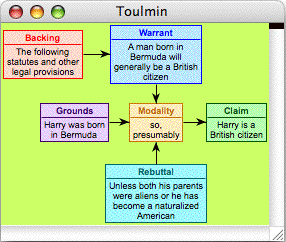
So we need polyphony, we need forms that capture many voices, many points of view, the perspectives of many stakeholders, simultaneously — not a linear progression from premise to conclusion.  And since we’re talking argumentation here, this simultaneity can be captured in a graphical form, as in this diagram based on Toulmin:

toulmin-example.gif

*

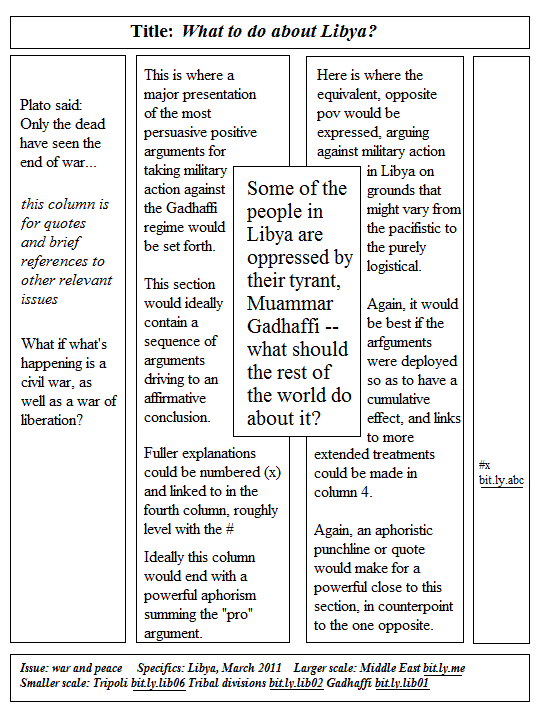
In that spirit, I thought I’d post a couple of my own experimental formats.  The first is based fairly closely on the Talmudic page — and I put it together in March of this year, so things in Libya have moved along a bit since then, though not quite enough as yet:

libyan-talmudsm.gif

My second format is a variant on the “Dart Board” sometimes used for playing my HipBone Games (see, for instance, my solo game War is Sexy, says Dawn).

I shall present it in a follow up post of its own.

*

For your convenience, here’s a blank template for the kind of Talmudic debate-page I used above, available for download.  It can be filled with any graphical software that allows text and a choice of fonts & sizes.  I recommend using larger type for the main text, medium for the commentary, and small print for annotations and footnotes:

libyan-talmudsm-blank.png

One thing leads to an unexpected other

Saturday, August 13th, 2011

[ by Charles Cameron — complex situations, unexpected consequences, analysts’ need for semi-random knowledges ]
.

azelin-tweet.gif

Suppose you’re a Japanese journalist given a news report to write about a tourist who may have contracted an obscure disease on a visit to Zaire. The job seems straightforward enough, you expect your Japanese readers to be sympathetic to the plight of your Japanese tourist subject, you don’t exactly expect your readers to include one Shoko Asahara, guru of Aum Shinrikyo…

But he’s there in the penumbra, reading… as this report from the Center for Counterproliferation Research of the NDU testifies:

In 1992, Aum sent a team of 40 people to Zaire to acquire Ebola. Led by Asahara himself, the team included doctors and nurses. During an outbreak of Ebola in Zaire, a Japanese tourist visiting that country may have contracted the hemorrhagic fever. This report, which received considerable publicity in Japan, apparently inspired Asahara to mount the expedition to Zaire in October 1992. Ostensibly, this trip was intended as a humanitarian mission, called the “African Salvation Tour.” It is not known if Aum actually obtained Ebola cultures. A Japanese magazine quoted a former member of the group, “We were cultivating Ebola, but it needed to be studied more. It can’t be used practically yet.”

One things leads to an unexpected other.

*

Here’s a positive example, one that I heard on the radio yesterday, and nothing to do with terrorism — except perhaps at the cellular level:

You know, the Scottish surgeon George Beatson was walking through the highlands in England, and he heard some shepherds saying, oh, you know, when we remove the ovaries of cows and goats, the pattern — or the breasts of these animals changes; the pattern of milk production changes.

So, Beatson began to wonder, well, what is the — this was a time when no one knew about estrogen. So, Beatson began to wonder, what is the connection between ovaries and breasts? And he said, well, if ovaries are connected to breasts, then maybe they’re connected to breast cancer.

And he took out the ovaries of three or four women with breast cancer and had these spontaneous, had these, not spontaneous, but amazing remissions. And it was — this is the basis for tamoxifen, the drug that actually blocks estrogen, and thereby affects breast cancer.

I mean, who would have thought that walking through and talking to a shepherd in Scotland would affect a billion-dollar drug, which is very, very powerful against breast cancer today?

One thing leads to an unexpected other.  Listen.

*

Back to terror — and what jihadists notice, think about and discuss:

They follow the news.

If the stock-market takes a dive, the folks on the forums know about it — and crow about it.  Because, as bin Laden said, AQ’s policy is one of “bleeding America to the point of bankruptcy, Allah willing, and nothing is too great for Allah.” Inspire magazine calls it “the strategy of a thousand cuts” and claims the “aim is to bleed the enemy to death”.  Daveed Gartenstein-Ross‘ book, Bin Laden’s Legacy, is abundantly clear on that point.

So yes, they follow the news.  So they know about the riots in the UK.

There was an interesting short flurry of tweets on Twitter a couple of days ago, when Will McCants, who monitors such things and runs the Jihadica blog, noted: “Lots of pictures of #londonriots being posted to Ansar jihadi forum” and followed up by quoting a couple of forum comments: “God is burning the ground beneath the feet of the Crusaders” and “We are witnessing this aggressor nation quaking inside and out….collapsing and suffering defeat by the permission of God”.

Jason Burke of the Guardian picked up on McCants’ post and noted, “so now Islamic militants exploiting #londonriots” – and Aaron Zelin of Jihadology chimed in with the tweet I quoted at the top of this post.

The conversation continued for a bit, but it’s Aaron’s comment that I want to focus on, because it makes explicit the kind of seamless weave of knowledge that I’ve been thinking about lately — which makes cross-disciplinary awareness both so necessary and so feasible at this time.  Let’s call it Zelin’s law:

every event and issue will be exploited by every group and ideology on the net.

Here’s my corollary: one thing leads to an unexpected other.

*

So what?

So we need a supersaturated solution of knowledges where decisions are made.

So our analysts need to be speckled specialists — experts with a sufficiently wide and random assortment of additional odd knowledges to be able to frame and reframe and reframe, to shake off any group frame and suggest half a dozen plausible alternatives, to doubt each one of them in turn, to turn to the right people who are themselves specialists in those other framings, to ask, to listen, to hear…

So we also need a supersaturated solution of ignorances — admitted, and inquiring.

*

Here’s Herbert E Meyer on the non-bureaucratic qualities of first-rate analysts:

In normal circumstances people like this would never be willing to take government jobs. Moreover, any agency that hired them would soon be driven nuts by their energy, their drive, their seemingly off-the-wall ideas, their sometimes bizarre work habits, even their tempers.

Sometimes bizarre, eh?  “Embrace the maverick,” Deputy Director for Intelligence Jami Miscik advised.

And by extension, embrace the unexpected — learn to expect it.

Is there a literature of the unexpected? Read it! And I don’t just mean read Nicholas Nassim Taleb‘s Black Swan — I mean, keep tabs on the undertows, read the opposition, read the factional fights within the opposition, read the underclass and upperclass, the radical and the pacific and the merely eccentric and the totally off the wall.  Know that some people believe there is a reptile in Queen Elizabeth II‘s head — and I don’t mean people who hold some variant on Paul MacLean‘s triune brain theory!  Read the ancients as well as the moderns.

Note especially the places where two fields or perspectives or framings overlap — they’re the places where experts can most easily see that each others’ approaches have value.  Cultivate binocular vision — and I mean, vision.

And do all this with a fair amount of randomness, with curiosity.

I happen to study religion, for instance, and splatter myself with other things — epidemiology, for instance, and complexity, and lit crit, and medieval music and plenty more besides — just enough to give a vaguely Jackson Pollock look to my interest in religion.

And Aum Shinrikyo’s attempt to gather samples of the Ebola virus isn’t an epidemiology story, isn’t a new religious movements story — it’s at the intersection, it’s both.

*

How many fields of knowledge can you gossip in for a minute or three? That’s a question with profound implications in terms of networked interactions and collective understanding.

How many languages can you frame your questions in?


Switch to our mobile site

