zenpundit.com » Perception

Archive for the ‘Perception’ Category

Carl Prine’s Rebuttal to “Be honest: Who actually read FM 3-24?”

Wednesday, July 13th, 2011

My amigo and SWJ News co-columinst Crispin Burke recently put forth a very interesting and provocative jeremiad “Be honest: Who actually read FM 3-24?” and one of his targets, journalist and Iraq war veteran Carl Prine, has been duly provoked, Prine has responded in great detail yesterday at Line of Departure:

Starbuck is wrong

Starbuck is wrong.

And in his drive to keep getting it wrong, he’s trying to rewrite FM 3-24, the military’s chief doctrinal publication on counterinsurgency.

But that just makes him more wrong.

He’s wrong about me.  He’s wrong about what I believe.  He’s wrong about the literature that informs FM 3-24.  He’s wrong about what the manual says and he’s wrong about what it left out.  He’s wrong about historiography.  He’s wrong about how a caste of top officers and diplomats came to understand “strategy” in the wake of the occupation of Iraq.

Let’s help get him right.  Or, at least, less wrong.  He’s a good man.  We need to turn him and ensure he quits taking shots at me I don’t deserve!

….The problem to anyone who studies Malaya, however, is that since the publication of the memoirs of exiled communist leader Chin Peng a dozen years ago, we now know that the civic, military and political policies under the British “hearts and minds” approach didn’t defeat the revolution.

Instead, the revolt was irreparably broken by brutal operations against the guerrillas, then a most coercive “screwing down the people” phase that dispossessed or killed thousands of Chinese, followed by draconian “population control” measures that, as Peng put it, starved the guerrillas in the bush because they snapped their rat lines and cut off their rice.

The “hearts and minds” initiatives designed to bring medical care, education, social welfare and other aid to the resettled Chinese and woo them to the colonial government’s side from 1952 – 1954 didn’t crack the back of the insurgency, a point now pretty much beyond dispute.

Why?  Because the previous “hearts and minds” claptrap as the cause of pacification in Malaya was contradicted by the Malayan Chinese, most especially those guerrillas who took up arms against the British regime!

You know, the people targeted by a population-centric counterinsurgency.  The people most counter-insurgents in their pop-centric fantasies almost never discuss except as abstractions, the human yarn wefted and warped by their long needles of war.

One finds “Hearts and Minds” prominently mentioned 11 times in Dr John Nagl’s valentine to Templer and colonial Malaya, Eating Soup with a Knife; to Nagl it’s the stuff of police services and economic development and whatnot with the psychology of the people being the center of gravity those reforms are meant to snatch.

And Nagl would like the best burglar of hearts and minds to be a learning, nimble and evolving military-political institution such as the U.S. Army.  It’s no small wonder, then, that Nagl became a dominant voice in FM 3-24 and that many of this thoughts in Eating Soup came to dominate the manual, too.

Or, as the introduction to FM 3-24 echoes soupily, “by focusing on efforts to secure the safety and support of the local populace, and through a concerted effort to truly function as learning organizations, the Army and Marine Corps can defeat their insurgent enemies.”

This is mere euphemism and wasn’t worth the ink that it cost taxpayers to print it.  But it sets the stage for the rest of FM 3-24, which follows a hearts and minds template that Starbuck doesn’t apparently realize is borrowed from mid-century….

Ouch. Note to self: if I ever decide to square off against Carl, I will make sure to do my homework. Read the rest here.

First, I would point out to readers here for whom some of this in both essays is inside baseball, that the tone is less harsh and the substantive distance between Burke and Prine less great in  the comments sections of both blogs than it first appears in reading their posts. It is a healthy, no-holds barred exchange and not a flame war.

Secondly, it is an important exchange, tying together COIN disputes over theory, historiography, empirical evidence, operational and tactical “lessons learned”, strategy, policy (Clausewitzian sense), politics (colloquial sense) and personalities that have raged for five years across military journals, think tanks, the media, the bureaucracy and the blogosphere. In some ways, these essays can serve as a summative of the debate. I say “some ways”, because what is the most important element or effect of America’s romance with COIN will differ markedly depending on whom has the floor. My own beef is not with doing COIN, it is with not doing strategy.

As Crispin and Carl’s vignette about General Creighton Abrams demonstrated, American historians are still having savagely bitter arguments about the war in Vietnam. For that matter, everyone who lived through the era did and still does. It is a wound that never seems to heal and has crippled our politics to this day, even as the veterans of Vietnam now turn to gray.

The 21st century COIN wars have not ripped American society apart down to the soul the way Vietnam did. As with the Korean War, the soldiers and marines in Afghanistan and Iraq fought bravely, at times desperately, to a general and mild approbation back home that sometimes looked a lot like indifference. Even the anti-war protestors mostly made a point of stating they were not against the troops, the venemous public malice of the 1960’s New Left radicals in the 2000’s was a property only of the lunatic fringe.

But COIN itself will be a historical argument without end.

The Said Symphony: Meditation / moves 10 and 11

Sunday, June 26th, 2011

[ by Charles Cameron – extended analytic game on Israeli-Palestinian conflict — continuing ]

Meditation part 1 / Move 10

.

What to say? There are two sides to the game, darkness and light, and the light encompasses the darkness, and the darkness threatens the light.

I promised a meditation on the state of the game, and it comes in the form of two moves: Move 10: Piano Lesson, by Haim Watzman, addresses the light, and my sense that the game is as much a gift to me as a gift from me to you, while Move 11: Auschwitz and Theodor Adorno raises the darkest question of all, whether art can still function in situations as terrible as those where humans hate to the fullest extent of their powers.
____________________________________________________________________________________________

Move 10: Piano Lesson, by Haim Watzman

move-010.gif

Move content:

The content of this move is Haim Watzman‘s story Piano Lesson which comes from his Necessary Stories series, on the South Jerusalem blog he shares with my friend and colleague Gershom Gorenberg. It concerns young Felix Mendelssohn, the grandson of the rabbinic scholar Moses Mendelssohn, composer – and the man who revived Bach‘s St Matthew Passion after it had lapsed into obscurity for a century or so.

Links claimed:

With Wagner, in complete refutation of the latter’s opinions about Judaism and musicianship – Watzman’s story opens with the words:

I am impressed. You play like a Jew, Felix. What I mean by that is that you have Johann Sebastian Bach in your heart as well as in your fingertips…

contains this more detailed assertion:

This piece you have played so beautifully for me this morning, the Partita No. 5 in G Major, can only be played properly, in our falscherleuchtung age, this time of false enlightenment, by a person of Jewish sensibility. Please do not interrupt me. At your age you are to listen to your elders first. After you listen you may disagree, you may do whatever you want. But first you must listen.

Sebastian Bach was a devout Lutheran, true, but he wrote Jewish music. I do not say this simply to embellish the repute of my ancestral people. The nation Israel needs no trills. I say this after long years of study and performance of Bach’s music, during which I have come to know this remarkable man. Better, I hazard to say, than his own sons did.

What is Jewish about the music? To see that, you have to know music. Which, of course you know. You also have to know what Judaism is. Which, thanks to my niece, you do not. This is scandalous. The grandson of the great Moses Mendelssohn knows nothing of his own people’s special relationship with God.

and closes with:

Remind me to show you the “St. Matthew Passion.” It is such wonderfully Jewish music!

Comment:

I read this story a day or two after completing moves 8 (Wagner) and 9 (Golgotha) and posting the game thus far to Zenpundit, and was astonished and delighted to find that a mind and heart in Jerusalem – friend of a friend – was touching on the same territory: the relationship of music, especially that of Bach, and Judaism.

But not only does Watzman deftly refute Wagner’s position on Judaism and music as presented in move 8, he also specifically discusses the contrapuntal aspect in both music and religious understanding, and the power of dissonance at times to work towards resolution.

This he accomplishes through a discussion of the two “laws” of Judaism, and the complexities of their musical relationship with one another:

I kept working on the piece and the morning prior to the performance I had my epiphany. Here, let me play it for you.

So where is the stress? Yes, here. And here too. At the end of the melodic line. And at the end of the harmonic progression. Which do not coincide.

You see, the underlying harmonics here are the Torah, the Written Law. And the melody playing above it is the Oral Law. The melody would be hollow, meaningless without the underlying harmony, and the underlying harmony would be incomplete and useless without the melody above it.

The simple-minded might think that the two laws should coincide. What good is a God if his message is not clear?

Yet it is the lack of clarity, the occasional dissonance, the unsynchronized phrases that move us forward, that propel us toward the final resolution. And that final tonic itself sends us off into new melodic and harmonic firmaments, from which we again return to our G major chord. One idea begins before the previous idea has been completed. As when you interrupt your Great Aunt Sara.

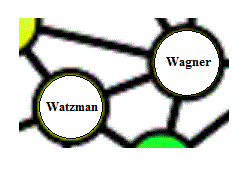
There is thus an uncanny melodic line here, running from Said through Bach, Gould, Wagner, to Watzman.

said-watzman.gif

Whatever I am doing here – and it feels at times quite lonely, I am not sure how many people will find this game an easy work to follow – in reading Watzman’s tale of Felix Mendelssohn I felt again my kinship with what has been termed the “invisible cloud of witnesses”…

Indeed, my sense of the gracious synchronicity involved in my stumbling across this particular story of Watzman’s at this particular time can only deepen as Watzman concludes his story – and I my move – with this rendition of the Bach Partita No. 5 in G major BWV 829, played by one Glenn Gould

____________________________________________________________________________________________

Meditation part 2 / Move 11

If the first part of this meditation relates to the game <as a whole, and to the fabric of grace of which, it seems, the universe as a whole is woven, this second part addresses the sense — as bitterly merciless to those who suffer it as grace is merciful to those who receive it — that the fabric of grace is itself picked at and torn by humans, in danger at any point (and perhaps in this moment more than most) of unravelling.

In my personal perspective, I should no more ignore the threat than ignore the grace — for love extends itself in compassion to the one, even as it extends in gratitude to the other.

____________________________________________________________________________________________

Move 11: Auschwitz and Theodor Adorno

move-011.gif

Move content:
Theodor Adorno famously said: “To write a poem after Auschwitz is barbaric.”

*

Think of this move as a sort of metaphysical black hole, an anti-game.

To expand on this idea a little: Adorno was a musical advisor to Thomas Mann while Mann was writing his novel Doctor Faustus — a copy of which he inscribed to his friend Hermann Hesse with the words “To Hermann Hesse, this glass bead game with black beads, from his friend Thomas Mann, Pacific Palisades, January 15, 1948” – featuring a composer named Adrian Leverkuhn, whose intention in his final work was to retract — cancel, annul — Beethoven‘s Ninth Symphony, and in particular its Ode to Joy with his own oratorio, The Lamentation of Doctor Faustus.

 “I find,” he said, “that it is not to be.”
“What, Adrian, is not to be?”
“The good and the noble, what we call the human, although it is good, and noble. What human beings have fought for and stormed citadels, what the ecstatics exultantly announced — that is not to be. It will be taken back. I will take it back.”
“I don’t quite understand, dear man. What will you take back?”
“The Ninth Symphony,” he replied.

Herbert Marcuse — another modernist philosopher of the left — is quite clear on the power of this Faustian attempt, which he approves as liberating us from “illusion” and indeed “making us see the things which we do not see or are not allowed to see, speak and hear a language which we do not hear and do not speak and are not allowed to hear and to speak”:

The present situation of art is, in my view, perhaps most clearly expressed in Thomas Mann’s demand that one must revoke the Ninth Symphony. One must revoke the Ninth Symphony not only because it is wrong and false (we cannot and should not sing an ode to joy, not even as promise), but also because it is there and is true in its own right. It stands in our universe as the justification of that ‘illusion’ which is no longer justifiable.

Links claimed:

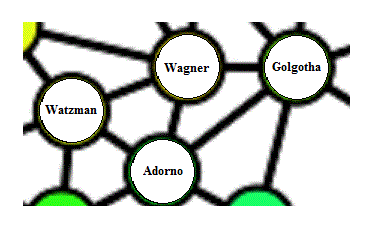
To Wagner, because the mythology of blood and race which he promulgated so stirred one Adolf Hitler that the latter carried out the Shoah, in face of which Adorno finds poetry – hence Orpheus and the muses — speechless.

To Golgotha, because Christ is banished and beaten from the city, Jerusalem, whose name is The Abode of Peace — because there is no more despairing cry than his cry at Golgotha: “My God, My God, why hast Thou forsaken Me?” — because the Descent of Mercy in human form is then brutally executed as a common criminal – because the very veil that protects the holy of holies in the JerusalemTemple is then torn asunder, as his body is broken – because all this marks the darkest moment in the Christian narrative – and because such desolation, felt by the Marys gathered at the foot of the cross, is nowhere so closely mapped in the history of the arts as by the silence of poetry and the arts before atrocity.

And to Watzman, because despite the Shoah — the Golgotha of my civilization and Hesse’s and Bach’s — and despite Adorno, there is poetry in his voice — an Israeli voice, speaking after Auschwitz, in an Israeli State, in Jerusalem.

Comment:

As I was setting out the ground-rules for this game, my friend Lexington Green made what I’d like to call “the essential objection”. He wrote:

Pals send their teenagers to be suicide bombers. That is beyond dissonant. There is no symphony where one group of musicians is committed to a relentless campaign of murder and terror. Said was using this as one more way of playing make-believe, and claiming moral equivalence. In other words, it was a sophisticated move in an elaborate scheme to help disarm his opponents so his fellow Palestinians could kill them.

There is another point of view, which sees the Israelis enforcing a mutant form of apartheid with attendant horrors on an occupied population – indeed, I have Israeli friends who hold some version of this view — but Lex’s point is crucial:

There is no symphony where one group of musicians is committed to a relentless campaign of murder and terror.

This cuts to the heart of the work, as it cuts to the heart of our world. It is, in essence, the issue of theodicy, and which Lex’s permission I am addressing it in this meditation, within the work itself …

My linking of the cry of Golgotha –“My God, My God, why hast Thou forsaken Me?” – with the cry of Adorno – “To write a poem after Auschwitz is barbaric” – is my presentation of the most godforsaken of despair of which we are humanly capable, and I present it within that opposite extremity of human possibility represented by Bach’s motto which I invoked earlier, Soli Deo Gloria.

It is precisely in the context of free will that both possibilities arise, and theodicy becomes an issue. Here, then, is the relationship of darkness to light as described by St John in the Prologue to his gospel:

the light shines in the dark, darkness does not blot it out.

I can say no fairer than that.

____________________________________________________________________________________________

Conclusion:

Oliver Sacks in Musicophilia tells the story of a Manhattan psychiatrist who lived immediately opposite the Twin Towers, and whose otherwise rich interior musical life went blank for months after he witnessed the 9-11 attacks:

My internal life was dominated by a dense and silent pall, as if an entire mode of existence were in an airless vacuum. Music, even the usual internal listening of especially beloved works, had been muted…

“Music”, the psychiatrist said, “finally returned as a part of life for and in me” after an absence of several months. The first music to return was Bach‘s Goldberg Variations.

Again, I must admit it was by no skill of mine but some grace of god or muse that I stumbled on Sacks’ book today, while searching my cramped and overflowing shelves for something else entirely.

There are, it seems true, periods of silence in the arts, while we absorb horrors of our human doing.

There is also a return from those horrors to the arts — even Marcuse admits this — and as forgiveness, mercy and compassion alike claim, to that great possibility, “a happy issue out of all our afflictions”.

Or so the mystics tell the realists — and time grinds all to dust.

[ next ]

Sacred Things

Thursday, June 23rd, 2011

[ post  by William Benzon cross-posted from his New Savanna blog with Intro by Charles Cameron — nature, arts, the sacred ]

.

Intro

.

This strange category, the sacred, strikes me as important because it intensifies.

It gives rise to beauty, terror, repulsion, love.  It empowers whatever vision, ideology, mission, crusade, jihad, movement, or tendency it touches.  And our society has in some ways lost touch with it so completely that we think it is found in the outward forms of piety, and miss its secular manifestations, its manifestation in religions other than our own, and most significantly and disastrously the groundswell of feeling it gives rise to in unexpected places.

It is a haven for many in an unlovely or uncertain world, a dwelling-place for saints, idealists, artists and — who knows? — perhaps the mad. And it catches us up when we least expect it — when the lights go down low in a cinema or at the opera, the curtain parts, and we enter another world whose rules are not our own.

We need to understand this.

.

In my post on Sacred space and the imagination, I tried to give a feel for the sacred without focusing on places of official worship, where it may be so expected as to be missed elsewhere, and I headed that post “no mil/intel stuff” because “this blog is dedicated to exploring the intersections of foreign policy, history, military theory, national security,strategic thinking, futurism, cognition and a number of other esoteric pursuits” — and my post clearly fell under the “other esoteric pursuits” part of the rubric.

But pattern pervades all, and the arts are prime sources for an understanding, a grasp, an accurate intuition of patterns in general. So we are not so far from strategy after all…

William Benzon responded to that post of mine, which he’d cross-posted on his own blog, with a post of his own, which I am cross-posting here. By way of introducing Benzon himself, then —

Benzon is a scientist (he led the information systems group at NASA in 1981, developing strategic recommendations about NASA-wide computer use and acquisition, and in conjunction with David G. Hays, published a series of articles in the Journal of Social and Evolutionary Systems covering the development of cognition in the brain from primitive vertebrates through primates and in human culture from the preliterate world through the development of computing) with wide cross-disciplinary interests (he’s played concerts with the likes of Dizzy Gillespie and B.B. King), either the first or one of the very first independent scholars invited by the National Humanities Center to lead off a topic of his choice on their blog, the author of a brilliant book on music and the brain, Beethoven’s Anvil: Music In Mind And Culture, and my friend.

Here, then, is his response to my post. Take it away, Bill…
.

Sacred Things

.

IMGP0005rd

… that still roaring dell, of which I told;
The roaring dell, o’erwooded, narrow, deep,
And only speckled by the mid-day sun;
Where its slim trunk the ash from rock to rock
Flings arching like a bridge;–that branchless ash,
Unsunn’d and damp, whose few poor yellow leaves
Ne’er tremble in the gale, yet tremble still,
Fann’d by the water-fall! and there my friends
Behold the dark green file of long lank weeds,
That all at once (a most fantastic sight!)
Still nod and drip beneath the dripping edge
Of the blue clay-stone.

— Coleridge, This Lime-Tree Bower My Prison

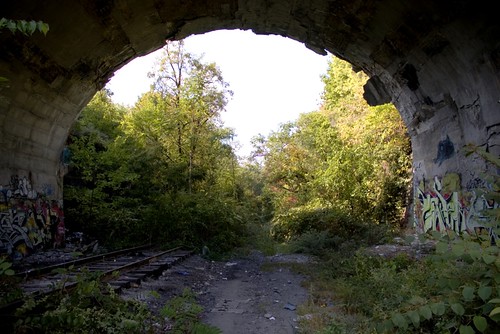
This post began, I suppose, when, upon reading Charles Cameron’s post, Sacred space and the imagination, the “graffiti!” light went off in my brain. Not just any graffiti light, but this one:

westward ho.jpg

Well, not that exact one, but it was a photograph of that same arch, a different photograph. This one shows the graffiti a little more clearly, but it’s not the same graffiti, as graffiti often changes over time, in some places more rapidly than others.

If you look back over Cameron’s images, you’ll see that it’s of a piece with them. And I’ve got dozens of photos of that arch: different times of the day, different seasons, different years, different graffiti, different angles. And that’s not all.

Graffiti and the sacred is a natural, one that hadn’t quite hit me full-on until I’d read Cameron’s post. You see, my first post about graffiti (the images, alas, are gone) was about this piece, which I called the Shrine of the Triceratops:

dino_train_872

It’s not that I believe, mind you, that there’s a triceratops cult in Jersey City and that this is where they meet. Nothing like that. Rather, that that image seemed to embody of the spirit of the place, the Japanese word is kami. (That triceratops is now gone. First, eroded by the weather, then other writers went over it.)

I could go on and on about graffiti, but I won’t, because this post isn’t just about graffiti. But I’ll leave you with one last graffiti thought. Graffiti is often likened to cave art. Well, cave art, some of it, perhaps all of it, is sacred art. Not mere pictures, but spirits bodied forth on walls.

*

And then there’s my current film project, Apocalypse Now. And that is deeply intertwined with the sacred. Not that it presents itself as a sacred story, nothing so straight-forward, but that it deals with ultimate things in a secular way.

Ultimate things in a secular way! – now there’s a fine kettle of fish for you. Just what does that mean? I suppose, for example, that that physicist’s dream, the grand unified theory, is a secular run on ultimate things. But is that secular the same secular as is appropriate to Appocalypse Now? I think not. Are we then confronted with the varieties of secular experience, mingling next to the varieties of religious experience? And where’s the boundary?

But, no, the film doesn’t present itself as religious in the way that Tree of Life presents itself as religious. But the caribao sacrifice at the end, that’s a real sacred ritual, not an enactment. Coppola shot the real thing, not that you’d know that from watching the film, though you could see that the caribao was really hacked to death. And the final third of the film takes place in a liminal no man’s land. It’s sacred territory, for some (nontrivial) meaning of sacred.

Anyhow, it looks like I’m going to argue that Apocalypse Now is an ontological text. That it is about the moral structure of the world rather than conveying this or that moral (or immoral) action. It’s about how things are through the ends of time, not about how this or that person gets from here to there.

*

And that certainly seems to be what’s going on in Malick’s very different The Tree of Life. We have the trials of the O’Brian family, daddy’s something of a dick, though a music-loving dick, mommy’s kind but a flake, and one kid dies – whether by suicide or not, that’s not clear from the film itself (I’ve seen it only once — shouldn’t have to see it more than once on such a plot point). But god’s creation is magnificent. As if that had anything to do with the O’Brian’s afflictions. Well, it does. It doesn’t.

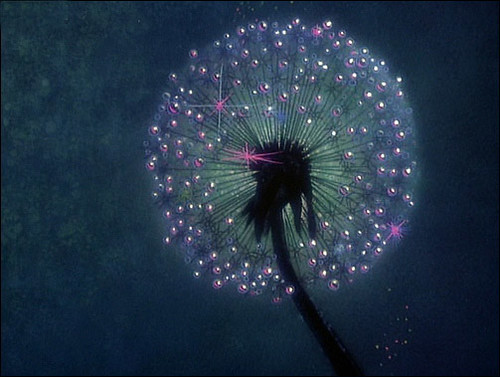
In any event, it seems that this film, that as a film must unfold in time, minute by minute by (often tedious) minute, blasts time to smithereens. It opens with a verse from Job and then a flickering shimmering light that’s supposed to be, I guess, a Supreme Something Or Other in the Universe, but isn’t this dew-flecked dandelion more elegant?

dandilion

And then, I think, some story in the more or less present. Yes, that’s it, she gets the telegram. The news is not good, not good at all. Things fall apart. A plane. At the airport. And somewhere in there not too far into the film we get this sequence in which the world and all the life in it gets created, ending with some dinosaur killing some other dinosaur. Live action and CGI special fx. Wonderful imagery. Wonderful.

And slices of that imagery get cut into the rest of the film as life goes on, backwards and forwards. It’s as though the world didn’t get created by once, but always and ever, created and recreated, recreating.

*

And behind it all there’s Uncle Walt. Uncle Walt’s the first one who gave us a vision of the creation of the world, a cinematic vision that is, one we can see with our own eyes and hear with our own ears. All in less than half an hour. And it’s got dinosaurs!

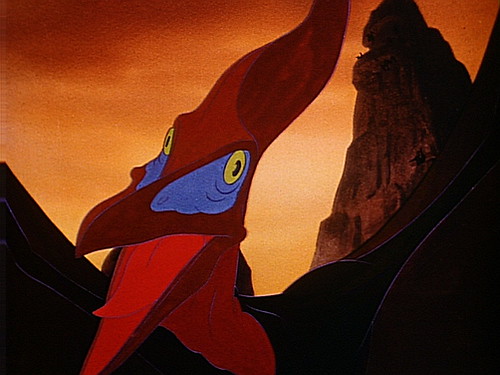
I’m talking, of course, of “The Rite of Spring” episode in Disney’s Fantasia. He got the science wrong, even then they knew that the T. Rex and the Stegosaurus never co-existed, but he showed us the whole solar system, and seismic activity, and crashing dashing oceans, then life originating in the ocean, coming on land. And dinosaurs!

pterodactyl.jpg

Disney’s the one who had the genius to visualize THE WHOLE THING. We who’ve grown up in the shadow of Disney now take it for granted that such things are seeable, but Disney was there first. If Disney hadn’t done it, Malick would have had to figure it out from scratch. As it is, Disney’s imagery has so permeated the culture than one can do (and see) a film like Tree of Life without once thinking of Fantasia.

In fact, the cultural coding against cartoons is so deep that I hesitate ever so little to put Fantasia in the same paragraph with Tree of Life. How could these films possibly have anything in common much less be the same thing: entertainment. Yikes! I mean, Tree of Life is so freakin’ serious. And Fantasia is so, well, gorgeous, and rather annoyingly cutesy at times.

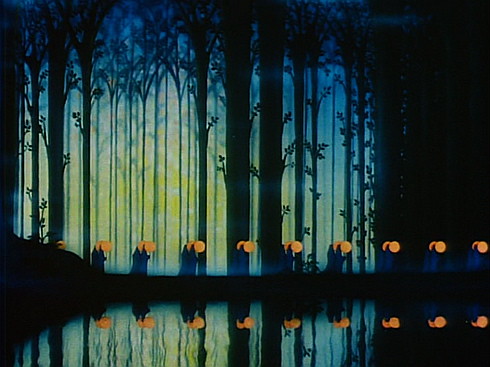
And it ends in a forest glade:

ave maria

The music is a rather fruity arrangement of Schubert’s Ave Maria. The motion: slow, stately, rigorous, restrained, austere.

— Bill Benzon.

Sacred space and the imagination

Sunday, June 19th, 2011

[ by Charles Cameron — no mil/intel stuff — the sacred, architecture, nature, books, imagination ]

.

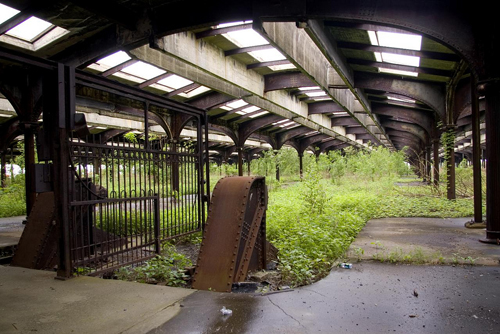
This post began with a photo my friend William Benzon took of an abandoned passenger terminal in Liberty State Park:

abandoned_passenger_terminal_libery_state_park.jpg

*

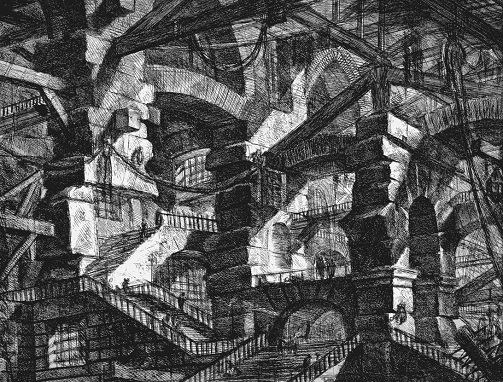
Without the greenery, I don’t think I’d feel this was “special” in quite the same way.  I might see it as prison-like, akin to those magnificent Piranesi prints in his Carceri series:

piranesi_carcere_xiv.jpg

… vast, haunted — the anti-cathedral.

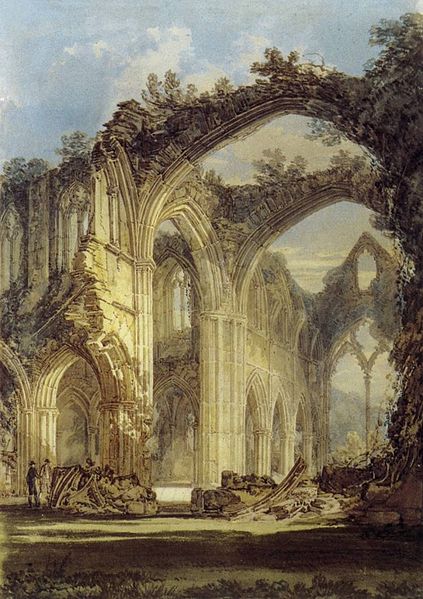
Yet the grasses and small trees are there in Benzon’s photo, green and vibrant — and in their presence, the prison becomes a cathedral… not unlike the great ruined abbeys of England, Tintern, Calder, Whitby, Walsingham, Fountains.

Here’s Tintern Abbey by JMW Turner, for a sense of how ruins were viewed in his day:

423px-turner_tintern1.jpg

Somehow, in the workings of the human mind and heart, nature’s grasses can keep a ruined space sacred…

*

But what of books?

bookstore-interior-design-in-the-former-dominican-church-by-merkxgirod-1.jpg

The effect is austere by comparison, but the hush of the library slips into the high-vaulted silence of the cloister, and when I saw Bill Benzon’s photo above, this photo of a bookstore in Holland was the first analogy to cross my mind…

The Selexyz Dominicanen bookshop is housed in an old church in the centre of Maastricht. A beautiful listed building, this former Dominican church was transformed into a bookstore by architects Merkx+Girod, resulting in an extraordinary combination of bookselling complex and church interior, preserving the unique landmark setting. It was praised by British newspaper The Guardian as ‘possibly the world’s finest bookshop’. Earlier, Selexyz Dominicanen had already received the prestigious Lensvelt Architecture Interior Award 2007 for the décor of the store.

Of course, not everyone thinks a bookstore is sacred, and a lot might depend on what books you browsed, or caught your neighbor browsing. Here’s one negative report:

When your church community gets bored of reaching out with the love of Christ and doesn’t like to meet together anymore, don’t cry over it! Build a bookstore and coffee shop out of your unwanted worship space. The chancel is great for a cappuccino… And the worship space would house a nice collection of bargain-priced books, and kitten calendars:

So next time you despair that the church has lost its way, relax and sooth your aching conscience with a steaming latte – you can even sit at the crucifix table and plug into the WiFi. There are so many uses for old churches, why bother with renewal in the Church at all?

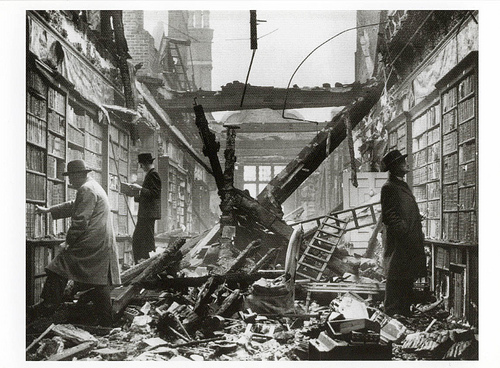
Even a ruined bookstore can have something of a sacred quality, though, as this London library photo clearly shows:

london-library-bomb-damage.jpg

Surely, that’s the last word in books — what more could one ask for?

*

Still — look.  There’s some sort of disaster, atrophy, ruin or sea-change in each of these images.  What happens when an architect — as skilled as the folks from who designed that bookstore — builds a chapel in the forest?

With all the contemporary emphasis on modern sustainable architecture, sometimes we seem to forget that environmentally friendly architecture has existed for a long time. Built in 1980, Thorncrown Chapel was created with the idea of highlighting the natural setting, which was, and still is, an attractive natural setting for tourists in the area. The owner of the site, Jim Reed, hired well known architect, Frank Lloyd Wright alumni E. Fay Jones to design and build the site which used native timber to match the setting around it, and the result was a fantastic expression of architecture that was awarded the “Twenty-Five year award” by the American Institute of Architects.

It is as lovely by winter light:

snow_fs1.jpg

as it is by light of spring and summer:

thorncrown-chapel.jpg

and yet I’d say there is something not ascetic but arid there: it has tried a great deal, but not died a little.

*

Nothing there is any which way ruined.  And it is out of ruins that our hopes grow these days, as grass at times breaks through tarmac.

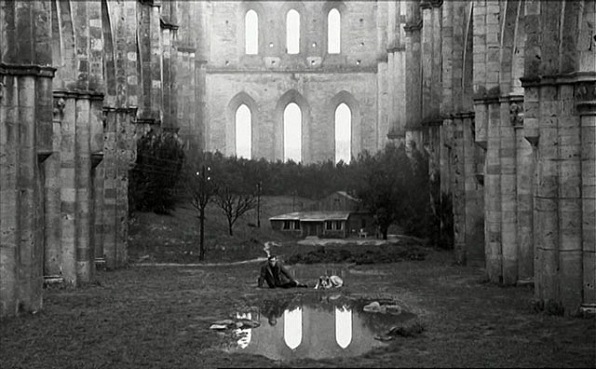
Tarkovsky’s great film Nostalghia closes with a breathtaking shot…

nostalghia11.jpg

a sacred space in pure, delivered, imagination — a single shot which to my mind, having seen the film and left the movie theater speechless, must be accounted the greatest single work of surrealism yet…

in which the protagonist, a Russian exiled in Italy, sees finally the lonely Italian abbey that has come to symbolize his loss of hearth and home, all loss, all absence — with his home nestled inside it, the little pond, himself, his dog…

The Said Symphony: moves 6-9

Saturday, June 18th, 2011

[ by Charles Cameron – extended analytic game on Israeli-Palestinian conflict — continuing ]

Move 6: Glenn Gould
move-006.gif

Move content:

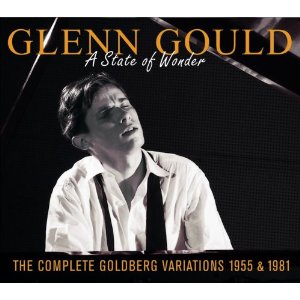
51pewuz2vyl__sl500_aa300_.jpg

Glenn Gould was a great pianist whose two recordings of Bach‘s Goldeberg Variations alone would prove both the brilliance of his skill, which could draw forth the individual lines in Bach’s counterpoint in a way no earlier pianist had the technique to pull off, and the depth of his musical understanding.
glenn-gould-solitude-trilogy.jpg

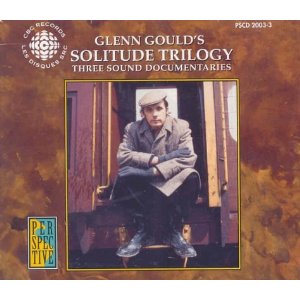
Late in life, Gould began “composing” radio works for the Canadian Broadcasting Corporation — he calls them “contrapuntal radio” — which revealed his interest in listening not just to Bach and other music but to life in general with an ear for counterpoint:

Gould set himself up to hear the world in a new way. In diners he ate his lunch alone, eaves dropping closely on the voices around him. He learned to hear conversation as music, the lilting lines, the rhythms everywhere up, down, and around, what Bach does to our sense of talk. There are two part inventions in words, themes and variations in the quarrels of couples and the tales told by friends. Gould met the world on his own terms, and he was fascinated by this way of listening to human voices as if they were a musical interplay, not participating in a conversation but taking it all in, as an audience.

It is that manner of listening which I am attempting in this game…

Links claimed:

To Bach, because Gould is Bach’s great interpreter, taking his interpretation of Bach’s counterpoint not just into the deep riches of Bach’s music for keyboards, but also out into the depth and riches of the world…

Comment:

I see this move as concluding the first, quiet introductory section of the game, setting forth the mode of understanding in which it is played, and honoring those those work has preceded, comforted and confirmed my own.

We shall return to this theme of counterpoint no doubt — the whole work falls under the aegis of Bach, as all of Bach’s work falls under his familiar motto: Soli Deo Gloria.
____________________________________________________________________________________________

Move 7: Daniel Barenboim

move-007.gif

Move content:

Daniel Barenboim is another celebrated musician, a brilliant Argentinian-Israeli pianist and conductor, in whose biography we read:

In the early 1990s, a chance meeting between Mr. Barenboim and the late Palestinian-born writer and Columbia University professor Edward Said in a London hotel lobby led to an intensive friendship that has had both political and musical repercussions. These two men, who should have been poles apart politically, discovered in that first meeting, which lasted for hours, that they had similar visions of Israeli/Palestinian possible future cooperation. They decided to continue their dialogue and to collaborate on musical events to further their shared vision of peaceful co-existence in the Middle East. This led to Mr. Barenboim’s first concert on the West Bank, a piano recital at the Palestinian Birzeit University in February 1999, and to a workshop for young musicians from the Middle East that took place in Weimar, Germany, in August 1999.

The West-Eastern Divan Workshop took two years to organize and involved talented young musicians between the ages of 14 and 25 from Egypt, Syria, Lebanon, Jordan, Tunisia and Israel. The idea was that they would come together to make music on neutral ground with the guidance of some of the world’s best musicians. … There were some tense moments among the young players at first but, coached by members of the Berlin Philharmonic, the Chicago Symphony and the Staatskapelle Berlin, and following master classes with the cellist Yo-Yo Ma and nightly cultural discussions with Mr. Said and Mr. Barenboim, the young musicians worked and played in increasing harmony.

From the orchestra’s current news page:

In 2005, the orchestra realized the impossible: a concert with Israelis, Palestinians, and other Arab musicians in the Palestinian territory of Ramallah.

Links claimed:

To Edward Said: because they were friends, because the West-Eastern Divan is a a human analog to Said’s view of a symphonic understanding of the Israeli-Palestinian conflict, and because he stands as an Israeli Jew in counterpoint to Said, the Palestinian.  Indeed, it is Barenboim, not Said, who is quoted here:

Drawing on the fundamentality of counterpoint in music, Barenboim describes how ‘in the act of challenging each other, the two voices fit together’ and that ‘music is always contrapuntal, in the philosophical sense of the word’ – indeed, ‘joy and sorrow can exist simultaneously in music’. He further argues that ‘acceptance of the freedom and individuality of the other is one of music’s most important lessons’. And this is the philosophy that underpins the phenomenon of the Divan orchestra: ‘You can’t make peace with an orchestra’, but one can ‘create the conditions for understanding’ and ‘awaken the curiosity of each individual to listen to the narrative of the other’.

To Bach, because as he writes:

I was reared on Bach. My father was virtually my only teacher, and he attached great importance to my growing up with Bach’s keyboard music. He considered it to be very important, not only for its musical and pianistic aspects, but also for everything else that is played on the piano. For him polyphonic music-making was simply one of the most important issues concerning everything relating to piano-playing. … The music can only be of interest if the different strands of the polyphonic texture are played so distinctly that they can all be heard and create a three-dimensional effect – just as in painting, where something is moved into the foreground and something else into the background, making one appear closer to the viewer than the other, although the painting is flat and one-dimensional.

And to Glenn Gould because —
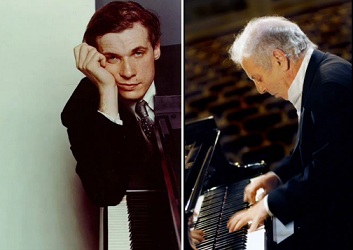
gould-barenboim.jpg

well, you may consider it a duel or a duet (a decision which shadows all differences, no?) but the two men are both celebrated for their renditions of the Bach Goldberg Variations, which are compared in excerpts back to back here on YouTube for our delight.

Comment:

I have only a couple of things to note here — the name West-Eastern Divan hearkens back to Goethe‘s poetry, and thus to the western world’s discovery of the sufic poetry of Hafez and Rumi — we find here a brief allusion to Yo-Yo Ma — and in the friendship of Said and Barenboim we see personified both the Israeli-Palestinian conflict and its transcending — in which a potential duel becomes a realized duet..

[ My thanks to Howard Rheingold for a pointer ]

____________________________________________________________________________________________

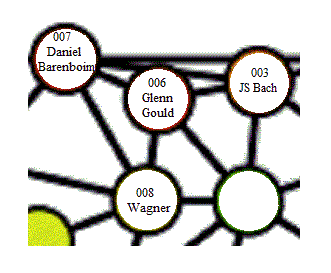
Move 8: Richard Wagner and antisemitism
move-008.gif

Move content:

barenboim-ring.jpg

With Richard Wagner, the ugly shadow of antisemitism falls across our play:

The idea of racial decline, and of German mentality being inherently superior, is integral to everything Wagner stood for. He saw himself as a redeemer, a notion his wife Cosima and her acolytes adopted as their creed. He gave the Aryan saviour-hero a dominant role in his operas. Siegfried is the incarnation of the sun-hero who would set Germany back on the true path – an idea that had existed in German mythology since the Middle Ages. Parsifal has characteristics of an Aryan Jesus.

European high culture had long had a disdain for the Jews, the merchants, the lenders — in Wagner’s writings, in his essay Judaism in Music and arguably in his operas too, he argues for the purity of the German race and the inability of the Jew, talented though he may be, to do more than ape that culture:

Our whole European art and civihisation, however, have remained to the Jew a foreign tongue; for, just as he has taken no part in the evolution of the one, so has he taken none in that of the other; but at most the homeless wight has been a cold, nay more, a hostile looker-on. In this Speech, this Art, the Jew can only afterspeak and after-patch — not truly make a poem of his words, an artwork of his doings.

It is a shadow that will touch, a virus that will infect Hitler — who will visit the Wagner family long after the Master’s death, attend and protect the Master’s playhouse in Bayreuth, cause the Master’s music to be played at the Nuremberg Rallies — and in so doing, teach European high culture itself that it is not immune to genocidal fantasies nor their execution in fact — enthrall and revolt and disgust and be deafeated — thus leading to the foundation in 1948 of the State of Israel, the Yom Ha’atzmaut of the Israelis, the Yawm an-Nakbah of the Palestinians…

Consider this press report, from which I have already quoted above:

Until the final scene, the Hamburg State Opera’s November 2002 production of Die Meistersinger von Nurnberg had proceeded without comment. Everyone was primed to applaud the hymn to “holy German art” that brings Richard Wagner’s four-hour pageant to a climax. Then came the bombshell. Midway through Hans Sachs’s monologue about honouring German masters over “foreign vanities”, the music came to an abrupt halt. Suddenly one of the mastersingers started speaking: “Have you actually thought about what you are singing?” he asked.

The virulence of antisemitism, and the shadow side of our common humanity, are not to be excluded from our game.

Links claimed:

To Daniel Barenboim, because he, a Jew and a musician, had the temerity to conduct the Berlin Staatskapelle orchestra in the Overture to Wagner’s Tristan und Isolde, in Jerusalem, in July 2001.

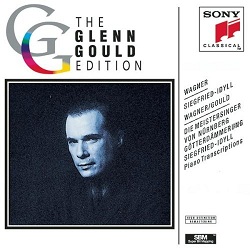
And to Glenn Gould, because…
gould-wagner.jpg

his piano transcription and performance of the Prelude to Die Meistersinger is a revelation: you might like to purchase it.

Comments:

I will confine myself to saying that Wagner’s concept of the gesamtkunstwerk or “work of total art” with its combination of poetry, drama, dance, song and even architecture is, in its own way, a precursor to many modern cross-disciplinary endeavors — the experimental works of Scriabin, whose “unrealized magnum opus Mysterium was to have been a grand week-long performance including music, scent, dance, and light in the foothills of the Himalayas” (Wikipedia), the Orphic poetry-in-film of Jean Cocteau, the crossover between poetry and the visual arts in Guillaume Apollinaire‘s Calligrammes — and not least, in Hermann Hesse‘s great Glasperlenspiel

____________________________________________________________________________________________

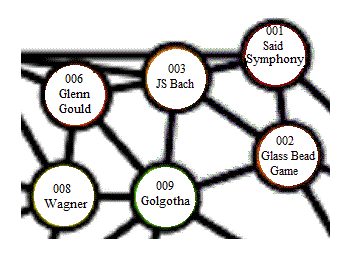
Move 9: Golgotha
move-09.gif

Move content:

Specifically, Golgotha refers to the small hill outside the Jerusalem city walls where Christ was crucified — our word “Calvary” is derived from the name:

And when they were come unto a place called Golgotha, that is to say, a place of a skull, They gave him vinegar to drink mingled with gall: and when he had tasted thereof, he would not drink. And they crucified him, and parted his garments, casting lots: that it might be fulfilled which was spoken by the prophet, They parted my garments among them, and upon my vesture did they cast lots. And sitting down they watched him there…

Matthew 27: 33-36
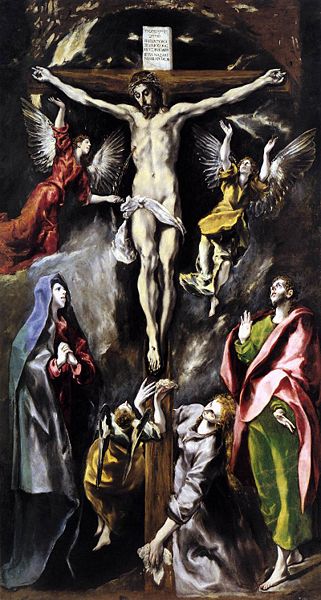
321px-crucifixion_prado.jpg
El Greco, The Crucifixion, The Prado, Madrid

Figuratively, Golgotha is the nadir, the lowest point — as in this powerful observation by the soldier-poet Capt. Wilfred Owen, describing the carnage of trench warfare in World War I in a letter to Osbert Sitwell, dated 4 July 1918.

For 14 hours yesterday, I was at work-teaching Christ to lift his cross by the numbers, and how to adjust his crown; and not to imagine he thirst until after the last halt. I attended his Supper to see that there were no complaints; and inspected his feet that they should be worthy of the nails. I see to it that he is dumb, and stands mute before his accusers. With a piece of silver I buy him every day, and with maps I make him familiar with the topography of Golgotha.


Links claimed:

To Wagner, in a manner that continues the motif of his antisemitism: Rudolf Steiner, founder of the Waldorf schools and anthroposophist, gave a lecture on the mythic underpinnings of Wagner’s Parsifal in 1906, which he said:

How was it that Wagner was able to find the right mood for his Parsifal? It is most important for us to recognize that Wagner was able to do this because he knew that what happened on Golgotha had especially to do with the blood, he knew that we had to see there not only the death of the Saviour but we had to see what took place there with the blood, how the blood was purified on Golgotha and became something quite different from ordinary blood. Wagner has spoken of the connection of the Saviour’s blood with the whole of mankind. In his book “Paganism and Christianity” we read these words: “Having found that the capacity for conscious suffering is a capacity peculiar to the blood of the so-called white race, we must now go on to recognize in the blood of the Saviour the very epitome, as it were, of voluntary conscious suffering that pours itself out as divine compassion for the whole human race.”

To Glenn Gould — introducing a contemporary instance of the nadir of human consciousness — because Hannibal Lecter, the insane psychiatrist of Thomas Harris‘ novel The Silence of the Lambs, has a copy he made from memory (“Memory, Officer Starling, is what I have for a view”) of Duccio‘s painting Golgotha after the Deposition on the walls of his cell, and listens to the Bach Goldberg Variations on his tape recorder — Glenn Gould is specified as the performer.

To the Glass Bead Game, because Hermann Hesse in what can only be an autobiographical passage in Demian writes:

The teacher had spoken of Golgotha. The Biblical account of the suffering and death of the savior had made the deepest impression upon me from my earliest childhood. Often as a small boy I had, after my father had read the story of the passion on Good Friday, lived in this painfully beautiful, pale, ghostly and still powerfully living world of Gethsemane and on Golgotha. I had experienced it listening to Bach’s St. Matthew Passion, it had flooded me with the somber, powerful tones of this mysterious world, with its mystical drama. Even today I find in this music, and in Actus Tragicus the essence of all that is poetical and of all artistic expression.

and there is no less surely an echo of that in a comment made by Joseph Knecht — the Magister Ludi of Hesse’s novel —

Nowadays, for example, we do not think much of the theology and the ecclesiastical culture of the eighteenth century, or the philosophy of the Enlightenment; but we consider the cantatas, passions, and preludes of Bach the ultimate quintessence of Christian culture.

For Hesse at least, and Knecht himself by implication, the Golgotha of Bach’s St Matthew Passion is “the essence … of all artistic expression”.

And to Bach, finally, for those sections (58-9 in Part II of the Passion) which deal with Golgotha and the crucifixion:

58a. Rezitativ (Evangelist): “Und da sie an die Stätte kamen”
58b. Chor: “Der du den Tempel Gottes zerbrichst”
58c. Rezitativ (Evangelist): “Desgleichen auch die Hohenpriester”
58d. Chor: “Andern hat er geholfen”
58e. Rezitativ (Evangelist):”Desgleichen schmäheten ihn auch die Mörder”
59. Rezitativ: “Ach Golgatha”

all of which can be heard in John Eliot Gardiner‘s performance here on YouTube, although I’d highly recommend Gardiner’s Bach: Sacred Vocal Works: the Christmas Oratorio, St. Matthew Passion, St. John Passion and Mass in B Minor as a boxed set — a stunning treasure.

Comment:

Hesse recommends the practice of meditation between moves in the Glass Bead Game, and rather than comment on this move briefly here, I shall next write a more extended meditation on the game thus far, and on this move in particular.

Here we approach the very walls of Jerusalem.
____________________________________________________________________________________________

Switch to our mobile site